

Key takeaways
- Five sliding compound miter saws compared on the fence facts their listings actually state, plus capacity, bevel and miter ranges and motor figures.
Shopping for a sliding compound miter saw with a sliding fence starts with a vocabulary problem: almost no brand names the feature the same way. One title says Large Sliding Fences outright, one maker’s copy talks about tall sliding fences, and others describe the fence only through the crown capacity it enables. The honest way to compare is on the fence and capacity facts each listing actually states, which is how the five saws below were graded.


All five are sliding compound saws with dual-bevel or bevel capability as listed, spanning 12-inch workshop machines and one 10-inch model. Every figure comes from the product names and specifications on the Amazon listings, including the places where a listing’s own summaries disagree with its description.
Quick Picks
As an Amazon Associate we earn from qualifying purchases.
| Product | Best for | Key spec from title |
|---|---|---|
| DEWALT DWS780 12-Inch Double Bevel Sliding Compound Miter Saw | Trim carpenters and serious renovators who cut wide stock and tall crown and want the fence behaviour stated in the listing itself. | Back fence cuts 2×16 at 90 degrees, sliding fence to 5-1/8 in |
| DEWALT DWS779 12-Inch Double Bevel Sliding Compound Miter Saw | Buyers who want the same tall-fence crown behaviour as the flagship but can live with a lower crosscut ceiling. | Tall sliding fences, 2×14 capacity at 90 degrees |
| Metabo HPT C12RSH2 12-Inch Sliding Compound Miter Saw | Small workshops where the saw lives against a wall and the sliding fence is a requirement, not a translation exercise. | Title states Large Sliding Fences, compact slide system |
| Makita LS1219L 12-Inch Dual-Bevel Sliding Compound Miter Saw with Laser | Workshops short on depth behind the saw, where the rail design matters more than published fence language. | 2-steel-rail sliding system, flush-to-wall footprint |
| SKIL MS6305-00 10-Inch Dual Bevel Sliding Compound Miter Saw | DIY renovators and flooring work whose stock stays within a 2×12 crosscut and who want the smaller, lighter format. | 10-inch blade, 4,800 rpm, cuts 2×12 at 90 degrees |
How to Choose
Read the fence claim in each brand’s own language
Sliding fence is a shopper’s phrase, not a catalogue term. One title here states Large Sliding Fences word for word; DEWALT’s copy describes a large or tall sliding fence through the crown it supports; Makita’s listing talks about rails and footprint instead. The practical test is what the fence lets you do: support tall crown vertically, back up wide stock, and stay square. Rank the listings by the fence behaviour they actually describe, and treat a listing with no fence wording as an unknown, not as a yes.
Capacity figures disagree inside single listings
One saw in this set carries two different crosscut claims in different summaries of the same listing, and the description’s figures are the ones used here. That pattern is common in power-tool listings, where comparison tables and deal copy lag behind description updates. When two numbers conflict, prefer the full description, note the conflict, and measure your widest real board against the lower figure if the difference would matter in your work. A saw that misses by half an inch misses completely.
Rear clearance decides where the saw can live
Sliding rails traditionally need a long run of empty space behind the saw, which small workshops do not have. Two listings here attack that directly: a compact slide system with zero rear clearance, and a two-steel-rail design with a reduced footprint for flush-to-wall operation. If your bench sits against a wall, those stated designs are worth more than a small capacity edge. Measure the depth you actually have, rail travel included, before falling for a headline crosscut number.
Blade size sets the ceiling on everything
The 12-inch saws state vertical capacities around 6-3/4 inches and crosscuts up to 2×16; the 10-inch saw states 2×12. Blade diameter is not a detail: it caps the tallest baseboard you can cut standing up, the widest board you can crosscut, and the crown you can nest. List your three biggest recurring cuts, then buy the smallest saw whose stated capacities clear all three with room to spare. Anything bigger is weight and money carried for cuts you never make.
The 5 Best Options
DEWALT DWS780 12-Inch Double Bevel Sliding Compound Miter Saw
The DWS780 is the capacity benchmark of this set. Its listing description states an exclusive back fence design that cuts up to 2×16 at 90 degrees and 2×12 at 45, with capacities of 6-3/4 inches vertical, 7-1/2 inches nested crown and 13-7/8 inches horizontal. The fence fact is explicit in the listing bullets: a large sliding fence that raises fence height to 5-1/8 inches for cutting crown molding up to 7-1/2 inches vertically. A 15-amp motor spins at 3,800 rpm, with miter range of 60 degrees right and 50 left and dual bevel to 49 degrees.
Specs
- Blade: 12 inches; motor 15 amp, 3,800 rpm per listing
- Capacity: 2×16 at 90 degrees and 2×12 at 45 per listing description
- Fence: large sliding fence raises height to 5-1/8 in per listing bullets
- Crown: up to 7-1/2 in nested; 6-3/4 in vertical capacity
- Horizontal capacity: 13-7/8 in per listing description
- Miter: 60 degrees right, 50 degrees left; dual bevel 0 to 49 degrees
Best for: Trim carpenters and serious renovators who cut wide stock and tall crown and want the fence behaviour stated in the listing itself.
Watch out for: A deal summary of this same listing quotes 2×14 at 90 and 2×10 at 45; the listing description’s 2×16 and 2×12 figures govern, and the entry above uses those.
DEWALT DWS779 12-Inch Double Bevel Sliding Compound Miter Saw
The DWS779 is the DWS780’s close sibling, and its listing states the fence story in the same terms: tall sliding fences that support crown molding up to 7-1/2 inches nested against the fence. Its stated capacities are a step down from the 780: 2×14 at 90 degrees and 2×10 at 45, from the same 15-amp, 3,800 rpm platform with a 12-inch blade. Bevel runs 49 degrees left and right and miter 60 degrees right and 50 left. For most trim work the practical difference between the two DEWALTs is the crosscut ceiling, not the fence.
Specs
- Blade: 12 inches; motor 15 amp, 3,800 rpm per listing
- Capacity: 2×14 at 90 degrees and 2×10 at 45 per listing
- Fence: tall sliding fences per listing-derived copy
- Crown: up to 7-1/2 in nested against the fence
- Bevel: 49 degrees left and right; miter 60 degrees right, 50 degrees left
Best for: Buyers who want the same tall-fence crown behaviour as the flagship but can live with a lower crosscut ceiling.
Watch out for: The fence wording for this model comes from listing-derived copy rather than the description block used for the DWS780, so read the live page’s fence sentences before treating them as identical.
Metabo HPT C12RSH2 12-Inch Sliding Compound Miter Saw

The C12RSH2 is the only saw here whose Amazon title itself contains the words Large Sliding Fences, which makes it the most literal answer to the keyword. Its compact slide system is the other headline: the rails are arranged so the saw needs zero rear clearance and can sit against a workshop wall. The listing states a 12-inch blade on a 15-amp motor, a cross cut of 4-1/8 by 12-1/4 inches at zero degrees, and a five-year warranty in the title. At 59.5 lb it is a bench saw that can still be moved by one person.
Specs
- Blade: 12 inches; motor 15 amp per listing title
- Fence: Large Sliding Fences stated in the Amazon title itself
- Slide system: compact slide, zero rear clearance per listing
- Capacity: cross cut 4-1/8 x 12-1/4 in at 0 degrees
- Warranty: 5 years per listing title
- Weight: 59.5 lb per manufacturer sheet
Best for: Small workshops where the saw lives against a wall and the sliding fence is a requirement, not a translation exercise.
Watch out for: Two codes circulate for this model in listing records; the code printed here is the one supported by the dp URL and model records, and the live page should be checked against it.
Makita LS1219L 12-Inch Dual-Bevel Sliding Compound Miter Saw with Laser

The LS1219L takes the space problem from the rail side: its listing states a unique two-steel-rail sliding system with a reduced footprint, designed for operation flush against a wall. It is a 12-inch dual-bevel sliding compound saw on a 15-amp motor, with a laser for cut-line visibility. Where this listing is quieter than the DEWALTs is the fence: no fence-specific wording beyond the rail system was captured from it, so this pick is argued on its slide design and footprint, and the entry does not dress that up as fence evidence.
Specs
- Blade: 12 inches; dual-bevel sliding compound design
- Motor: 15 amp per listing
- Slide system: unique 2-steel-rail system per listing
- Footprint: reduced, for operation flush against a wall
- Guide: laser included per listing title
Best for: Workshops short on depth behind the saw, where the rail design matters more than published fence language.
Watch out for: No sliding-fence wording was captured from this listing, so if the fence is your deciding feature, read the live page’s fence description before choosing it over the DEWALT or Metabo picks.
SKIL MS6305-00 10-Inch Dual Bevel Sliding Compound Miter Saw
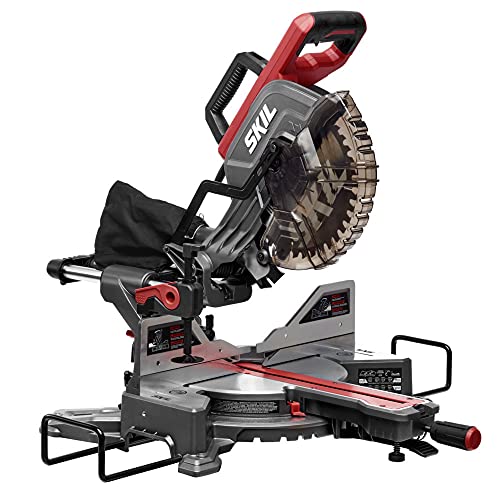
The SKIL is the smaller-format entry: a 10-inch dual bevel sliding compound saw where the rest of the set runs 12-inch blades. Its listing states a 15-amp motor at 4,800 rpm, the highest speed figure here, and a crosscut of 2×12 at 90 degrees from listing-derived comparison copy. For trim, flooring and furniture stock that never approaches the big saws’ ceilings, the smaller blade and footprint are a rational trade. What it gives up is the tall-stock and wide-board headroom the 12-inch machines state.
Specs
- Blade: 10 inches (not 12) per listing
- Motor: 15 amp, 4,800 rpm per listing
- Capacity: cuts 2×12 at 90 degrees per listing-derived copy
- Bevel: dual bevel design per listing title
Best for: DIY renovators and flooring work whose stock stays within a 2×12 crosscut and who want the smaller, lighter format.
Watch out for: The 10-inch blade caps depth and width below every other pick here; check your tallest baseboard and widest board against the stated capacity before choosing it.
Which One Fits Your Situation
A trim carpenter cutting tall crown every week
Take the DEWALT DWS780: its listing states the sliding fence height and the 7-1/2 inch nested crown capacity in plain figures, the strongest fence evidence here. Its bevel and miter ranges cover the compound angles crown work demands, and the capacity figures come from the listing description itself.
A small workshop with the bench against a wall
Take the Metabo HPT C12RSH2: zero rear clearance from its compact slide system, and the only title that states Large Sliding Fences outright. It is also the pick whose fence claim needs no translation, since the words sit in the title the maker wrote.
A renovator whose widest stock is flooring and 2×12 boards
Take the SKIL MS6305-00: its stated 2×12 crosscut covers that work in a smaller 10-inch format, without paying for capacity that goes unused. That keeps the purchase honest: you are paying for width you will use weekly, not for a ceiling touched once a year.
A buyer who values rail smoothness and footprint over fence copy
Take the Makita LS1219L for its two-steel-rail system and flush-to-wall design, after reading its live fence description as its entry advises. Read the fence sentences on its live page first, since that is the one specification its captured listing leaves open.
Common Mistakes
- Searching listings for the exact phrase sliding fence and concluding a saw lacks one, when the maker describes the same hardware through crown capacity or fence height.
- Trusting a comparison table or deal summary over the listing description when the two disagree on crosscut capacity, instead of using the description’s figures.
- Forgetting the rail travel behind the saw, then discovering the bench cannot sit where planned because the slide needs a foot of empty space.
- Buying a 10-inch saw for 12-inch work, or a 12-inch saw that never cuts anything wider than flooring, by skipping the capacity arithmetic entirely.
- Skipping the Bosch GCM12SD’s situation: its listing is a known quantity, but a captured no-featured-offers signal kept it out of this set until a live offer is confirmed.
Frequently Asked Questions
Why is the Bosch GCM12SD not in the main list?
Its listing states an axial-glide system and quick-release fences that slide for added support, which fits the keyword well. However, a captured pass over its Amazon page showed no featured offers available, so it is held out until a live offer is confirmed on the page itself.
Which saw states its sliding fence most explicitly?
The Metabo HPT C12RSH2, whose Amazon title contains the words Large Sliding Fences. The DEWALT DWS780 follows closely: its listing bullets state a large sliding fence raising fence height to 5-1/8 inches for tall crown work. The DEWALT DWS780 follows closely: its listing bullets state a large sliding fence raising fence height to 5-1/8 inches for tall crown work, with the nested crown capacity stated beside it.
What crosscut capacity should a general workshop saw have?
Enough for your widest recurring board with margin. The listings here state from 2×12 on the 10-inch SKIL to 2×16 at 90 degrees in the DWS780’s description. Most trim and framing stock sits well inside the middle of that range.
Does a sliding saw need space behind it?
Traditionally yes, for rail travel. Two listings here are designed around the problem: the Metabo states zero rear clearance from its compact slide system, and the Makita states a reduced footprint for flush-to-wall operation. Standard-rail saws still need the depth measured before placement.
More from Amazon
Programs that pair well with the guide above. Offers and eligibility are set by Amazon and may change.
Set up recurring deliveries of everyday items on eligible products. Terms and savings are set by Amazon.
Explore Subscribe & SaveCollect the home and kitchen items you want in one registry that guests can shop from.
Create a wedding registryFree shipping on eligible items, Prime Video and more. Eligible new members can start with a free trial.
Start a Prime free trialAudiobooks and podcasts to listen to on the go. Eligible new members can start with a free trial.
Try Audible freeAs an Amazon Associate we earn from qualifying purchases.






Write Your Review
No reviews yet. Be the first to share your experience!