

Key takeaways
- Looking for the best plastic free coffee makers? Compare six glass and stainless steel options, what each still contains, and how to choose.
The SimplyGoodCoffee Plastic-Free Brewer is the strongest answer for anyone who wants a drip machine with as little plastic as possible along the water path: the manufacturer describes a stainless steel boiler and flow path, a borosilicate glass reservoir and carafe, and silicone seals. A plastic-free coffee maker is one where the parts that touch hot water and brewed coffee are glass, stainless steel, or ceramic instead of molded plastic. Almost no countertop machine is plastic-free everywhere, so this guide ranks six options by how much plastic they keep away from the brew and tells you where each one still falls short.
Quick List
- SimplyGoodCoffee THE BREWER – best for the shortest plastic-contact path in an 8-cup drip machine
- Presto 02811 percolator – best for a plain, all-stainless brew path with minimal fuss
- Ninja Fresh Brew CE251 – best for a familiar programmable drip routine, with the most plastic of the group
- FUNLAVIE 12-Cup Percolator – best for a glass-and-stainless percolator with a delay timer
- aarke Drip Coffee Maker – best for certified brew quality with a glass carafe and metal body
- WILLOW 8-Cup Pour Over Brewer – best for a reusable metal filter and hot or iced brewing
Which One Is Right for You?
| If you… | Choose |
|---|---|
| want the least plastic touching hot water and are willing to pay for it | SimplyGoodCoffee THE BREWER |
| like a stovetop-style stainless percolator brew and want simple controls | Presto 02811 |
| care about SCA-certified brewing temperature and time, plus a metal body | aarke Drip Coffee Maker |
| want a 12-cup percolator with a glass carafe and a 24-hour delay | FUNLAVIE 12-Cup Percolator |
| want to drop paper filters and sometimes brew over ice | WILLOW 8-Cup Pour Over Brewer |
| need a programmable 12-cup machine and accept a mostly plastic housing | Ninja Fresh Brew CE251 |
If plastic avoidance is the main goal, start at the top of the list and move down only when budget, capacity, or brew style forces you to. If you just want a glass carafe and a reusable filter, the lower picks are reasonable compromises, as long as you understand what they are not.
All 6 Picks in Detail
1. SimplyGoodCoffee THE BREWER – Best for the Shortest Plastic-Contact Path
As an Amazon Associate we earn from qualifying purchases at no extra cost to you.

This 8-cup drip brewer is built around one idea: keep the water path to glass and metal. According to the maker’s product page, the boiler and flow path are stainless steel, the reservoir and carafe are borosilicate glass, the seals are medical-grade silicone, and the filter basket is stainless steel that takes number 4 cone filters. It is the only machine in this group whose maker markets it as plastic-free, and it earns the top slot because the claim is specific rather than vague.
It suits households that brew a pot or two a day and want a machine that looks like a countertop appliance rather than a piece of scientific equipment. The listing title calls it a plastic-free pour-over style drip brewer, and the maker states a brew temperature range of 195 to 205 degrees Fahrenheit.
- Capacity: 8 cups, about 40 oz per the maker
- Boiler and flow path: stainless steel
- Reservoir and carafe: borosilicate glass
- Seals: medical-grade silicone
- Rated power: about 1540 W per the maker
- Removable parts: listed as dishwasher safe by the maker
Pros:
- Most complete glass-and-stainless water path of the six
- Brew temperature range matches the commonly cited 195 to 205 degree window
- Easy-to-clean removable parts
Cons:
- Independent reviewers have noted that silicone lines and some exterior parts mean it is “low plastic” rather than literally plastic-free
- Smaller 8-cup capacity than the 12-cup machines here
- Sits at the premium end of the category, and the brand sells several versions, so confirm which one the listing shows
Compared with the aarke, it goes further on materials, while the aarke leans harder on certified brewing performance and a more compact footprint.
2. Presto 02811 Stainless Steel 12-Cup Percolator – Best for a Plain Stainless Brew Path

The Presto 02811 is the old-school answer. It is an electric percolator with a stainless steel body, stainless filter basket, and stainless perk tube, so hot water moves through metal rather than through a plastic reservoir and tubing. The model is listed for 2 to 12 cups and about 800 W on a standard 120 V outlet, with a detachable cord and a signal light that tells you when the pot is ready.
It suits campers-at-heart, small offices, and anyone who prefers a bold, hot, percolated cup and does not care about programmable features. It is also the simplest design in the group, which means there is little to go wrong.
- Capacity: 2 to 12 cups per the listing
- Body, basket and perk tube: stainless steel
- Power: 120 V, about 800 W
- Pace: roughly one cup per minute, per retailer descriptions
- Extras: detachable cord, easy-pour spout, stay-cool handle
- Filter: reusable basket; paper disc or wrap filters are commonly recommended
Pros:
- All-metal brew path in a very simple machine
- No glass to break and no tank to scrub
- Detachable cord makes storage easy
Cons:
- Percolation recirculates hot water through the grounds, which can taste harsh with fine or dark-roasted coffee
- Handle, knob, and cord insulation are typically polymer; confirm on the listing
- Retailer listings disagree on keep-warm behavior and dishwasher safety, so check the manual before relying on either
Next to the FUNLAVIE percolator, it trades a timer and glass carafe for a fully stainless body and a simpler job.
3. Ninja Fresh Brew CE251 – Best for Familiar Programmable Drip (With Caveats)
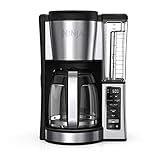
The Ninja CE251 is the least plastic-free machine here and belongs in this guide mainly as a reference point. It is a 12-cup programmable drip brewer with a glass carafe and a stainless steel finish, but reviews and retailer materials lists describe a largely plastic housing and a plastic water reservoir. It is included because many shoppers searching for a “plastic free” machine end up here, and it is better to know what you are getting.
It suits people who want a conventional, programmable drip routine and would use the glass carafe and reusable filter to reduce plastic exposure at the margins. Anyone whose priority is a metal-and-glass brew path should start higher in the list.
- Capacity: 12 cups; reservoir listed at 60 oz in some sources and 70 oz in the current title, so confirm the figure
- Carafe: glass
- Filter: reusable permanent filter
- Programming: 24-hour delay brew and a small-batch function for 1 to 4 cups
- Warming plate: adjustable, up to about 4 hours per reviews
- Power: about 1100 W at 120 V
Pros:
- Familiar controls and a delay timer
- Glass carafe and reusable filter
- Small-batch mode for one to four cups
Cons:
- Plastic housing and a plastic-leaning water path
- Reservoir capacity is inconsistent across listings
- Not the right pick if plastic avoidance is the goal
It offers more convenience than the Presto but far less material purity than the SimplyGoodCoffee brewer.
4. FUNLAVIE 12-Cup Electric Percolator – Best Glass-and-Stainless Percolator With a Timer

The FUNLAVIE combines a percolator brewing method with a few conveniences the Presto skips. The listing describes a 12-cup unit with a borosilicate glass carafe of about 1.7 liters, three brew strength settings (mild, regular, and bold), a 24-hour delay brew function, and a keep-warm mode quoted at about 131 degrees Fahrenheit for up to 8 hours. It is marketed with a BPA-free design that reduces plastic contact with the coffee.
It suits households that like percolated coffee but want a timer so the pot is ready on waking. The words “reduces” and “BPA-free” matter: this is a lower-plastic design, not a plastic-free one, so inspect the listing images for the lid, handle, and base materials.
- Capacity: 12 cups; carafe about 1.7 L per the Canadian listing
- Materials: borosilicate glass and stainless steel per listing
- Brew strength: mild, regular, bold
- Delay timer: up to 24 hours (a countdown delay, not clock-time programming)
- Keep warm: about 131 degrees F, up to 8 hours per the listing
- Model number: OMT-PC1058 per the listing; confirm on the product page
Pros:
- Timer and strength options that stainless percolators rarely offer
- Glass carafe lets you see the brew progress
- Large 12-cup capacity
Cons:
- Plastic is reduced, not eliminated
- Newer model with a thin track record; confirm warranty terms on the listing
- Glass is breakable in a way the Presto’s steel is not
Pick it over the Presto if a timer and glass carafe matter more than an all-steel body.
5. aarke Drip Coffee Maker – Best for Certified Brewing With a Metal Body

The aarke is a design-led drip brewer with a polished stainless steel body, a 42 oz glass carafe, and an automatic drip-stop. The listing says it is SCA certified, which refers to meeting the Specialty Coffee Association’s standards for brewing temperature and time, and that it brews a full pot in under six minutes. Reported brew temperatures run from about 197 to 205 degrees Fahrenheit, and an optional bloom mode pre-soaks the grounds for roughly 30 seconds.
It suits people who want better extraction than a bargain drip machine and a countertop piece they are happy to leave out. It is not plastic-free: reviewers and the listing indicate some internal parts and the carafe lid stirrer contain plastic, along with silicone.
- Capacity: 42 oz glass carafe; the “10 cup” label is based on a small 4.2 oz cup
- Body: stainless steel with die-cast aluminum, per reviews
- Power: about 1500 W at 120 V
- Hot plate: included
- Bloom mode: optional, about 30 seconds
- Dimensions: roughly 6.7 by 12.6 by 14.5 inches per listing information
Pros:
- SCA-certified brewing parameters, per the listing
- Metal exterior, glass carafe, and a compact footprint
- Drip-stop lets you pour mid-brew
Cons:
- Some internal and lid parts contain plastic
- Cup labels are conservative, so 42 oz is the number to plan around
- Hot plate keeps coffee warm but can slowly cook a half-full carafe
It brews better than the Ninja and the WILLOW, but it does not keep plastic out of the machine as thoroughly as the SimplyGoodCoffee brewer.
6. WILLOW 8-Cup Pour Over Coffee Maker – Best for Reusable Filters and Iced Coffee
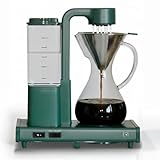
The WILLOW is an automatic drip brewer that styles itself as a pour-over machine. Its listing highlights a glass carafe, a reusable metal filter, hot and iced brew modes, auto shut-off, and a body made from 99 percent recycled materials. Capacity is stated as 8 cups or 42 oz, though a listing for a different color variant says 10 cups, so confirm which version you are looking at.
It suits people who want to stop buying paper filters and who sometimes brew over ice. The recycled-materials claim is about sustainability, not about avoiding plastic, and a recycled body is still very likely to be plastic. Treat it as a glass-carafe, metal-filter machine rather than a plastic-free one.
- Capacity: 8 cups (42 oz) per the title
- Carafe: glass
- Filter: reusable metal, with paper as an option per reviews
- Modes: hot and iced brew
- Safety: auto shut-off
- Footprint: about 7.25 by 12.44 by 14.01 inches per one listing source
Pros:
- Permanent filter reduces paper waste
- Iced brew mode is a useful extra
- Compact for an 8-cup machine
Cons:
- Housing and tank materials are not stated as glass or metal; expect plastic
- Cup and capacity figures vary by listing
- Limited detail on boiler materials; confirm on the product page
Choose it over the Ninja if you want a smaller, filter-free machine, and over the aarke only if you prefer the iced mode and a simpler build.
Specs Compared
| Product | Brew style | Capacity (as listed) | Carafe or pot | Filter | Plastic caveat |
|---|---|---|---|---|---|
| SimplyGoodCoffee THE BREWER | Drip | 8 cups (about 40 oz) | Borosilicate glass | Stainless basket, number 4 cone filters | Silicone seals and some exterior plastic per reviewers |
| Presto 02811 | Percolator | 2 to 12 cups | Stainless steel pot | Stainless basket, paper optional | Handle and knob materials: confirm on listing |
| aarke Drip Coffee Maker | Drip, SCA certified | 42 oz | Glass | Confirm on listing | Some internal and lid parts contain plastic |
| FUNLAVIE 12-Cup Percolator | Percolator | 12 cups (about 1.7 L) | Borosilicate glass | Confirm on listing | BPA-free design; plastic reduced, not removed |
| WILLOW 8-Cup Pour Over | Automatic drip | 8 cups (42 oz) | Glass | Reusable metal | Recycled-material body; expect plastic |
| Ninja Fresh Brew CE251 | Programmable drip | 12 cups; reservoir figure varies | Glass | Reusable permanent filter | Plastic housing and reservoir |
How We Chose These
This ranking is based on research, not bench work. We compared each product’s listing title and description with manufacturer pages, retailer specification fields, and independent reviewers’ descriptions of materials. Products were ordered by how much glass and stainless steel is stated along the water path, then by brew quality claims, capacity, and convenience. Where sources disagreed, such as reservoir size on the Ninja or keep-warm behavior on the Presto, we flagged the conflict instead of picking a number. We did not rank on price, popularity, or advertising.
What to Look For
Know where the water actually travels
The parts that matter most are the ones hot water touches in sequence: the reservoir, the tubing, the heating element or boiler, the showerhead, the filter basket, and the carafe. A machine with a glass carafe and a plastic reservoir is still a plastic-contact machine. Ask for each stage: is it glass, stainless steel, silicone, or plastic? Manufacturer pages sometimes disclose this; retailer bullet points usually do not. If a listing says only “BPA-free,” that tells you the plastic is of a certain type, not that it is absent.
Understand the common compromises
Silicone is the usual stand-in for plastic in seals and tubing. It is a different material, but some buyers still count it as a soft plastic, so decide your own line before you shop. Heating elements typically sit in aluminum or stainless blocks, and many “metal” machines hide plastic in the lid, the drip tray, the water window, or the switch housing. Percolators with all-metal pots avoid reservoir plastic entirely but usually still have a polymer handle, knob, and cord sleeve.
Match brew style to your taste
Drip machines are gentler and give cleaner cups. Percolators recirculate hot water through the grounds, which suits people who like a robust, hot cup but can punish fine grinds and light roasts. If you grind your own coffee, use a coarser setting for a percolator than you would for a drip brewer. For drip, the Specialty Coffee Association’s common reference ratio is 55 grams of coffee per liter of water, roughly 1 to 18, with water at about 195 to 205 degrees Fahrenheit at first contact. Machines that do not state brew temperature are guessing.
Size the machine to your routine
Cup counts are marketing units. An 8-cup machine from one brand may make 40 oz; a 12-cup machine may make 60 oz; and some brands use a 4.2 oz cup while the American norm is closer to 6 oz. Use total ounces. A worked example: if you drink two 12 oz mugs each morning, you need about 24 oz, so an 8-cup, 40 oz machine already leaves headroom. A household of four that makes a single large pot needs roughly 48 to 60 oz and should look at a 12-cup unit.
Plan for cleaning and replacement parts
Glass carafes crack; stainless baskets last for years. A plastic-free machine is only useful if you can replace the glass parts, so check whether the brand sells replacement carafes and baskets. Descale on the maker’s schedule, because mineral buildup hurts both taste and heating performance regardless of materials. If the manual says hand-wash only, believe it.
Questions
Is any coffee maker truly 100 percent plastic-free?
Almost none. Even machines marketed as plastic-free usually contain silicone seals, wiring insulation, or a polymer switch or housing part. The meaningful question is how much plastic touches hot water and brewed coffee, and that is where glass and stainless steel designs differ.
Is a stainless steel percolator better than a drip machine for avoiding plastic?
It can be, because a simple stainless pot has fewer hidden plastic parts. The tradeoff is taste, since percolators cycle hot water over the grounds repeatedly and can taste more bitter than drip coffee.
Does a glass carafe make a machine plastic-free?
No. A glass carafe only covers the last stage. The reservoir, tubing, and boiler matter just as much, and many machines with glass carafes use plastic tanks and housings.
Are reusable metal filters worth it?
They cut paper waste and let more coffee oils through, which gives a heavier body. They also pass a little more fine sediment, and they need rinsing after each brew.
Why do cup sizes differ so much between brands?
There is no fixed standard for a coffee maker cup. Some brands count 4 to 5 oz, others 6 oz or more, so compare ounces instead of cups.
What is the easiest way to reduce plastic if I already own a standard machine?
Switch to a glass or stainless carafe, use a reusable metal filter, and keep the machine descaled. These steps do not change the reservoir, but they reduce the plastic you handle on a daily basis.
Update History
- October 20, 2026 – Initial publication; product set drawn from current catalog listings.
- Check the product page for current specifications and availability before buying.
Sources
- Manufacturer product and specification pages, including SimplyGoodCoffee’s own brewer page
- Retailer listing titles and specification fields for each model
- Independent editorial reviews describing materials and construction
- Specialty Coffee Association brewing-standard summaries for ratio and temperature ranges

Write Your Review
No reviews yet. Be the first to share your experience!