

Key takeaways
- A burr grinder. Consistent grind size matters more than the dripper. Blade grinders produce uneven particles that taste both bitter and sour.
- A scale with a timer. Weighing beats scoops because beans vary in density.
- A gooseneck kettle. The narrow spout gives a controlled flow rate.
- Paper filters matched to the dripper. Rinse them with hot water to remove paper taste and warm the vessel.
The best pour over coffee maker for most people is the Hario V60 02 if you want control and a clean, bright cup, the Chemex Classic if you brew for two to four people and like a paper-filtered, sediment-free carafe, and the Kalita Wave 185 if you want a forgiving flat-bottom dripper. For a hands-off alternative, the Clever Dripper combines steeping with a drip release. All of them work with the same ground coffee, a gooseneck kettle and a scale.
Quick comparison
| Pick | Best for | Design | Typical batch | Materials | Price tier |
|---|---|---|---|---|---|
| Hario V60 02 | Control and clarity | Cone with spiral ribs, single large hole | 1 to 4 cups | Plastic, ceramic, glass or metal | Budget to mid |
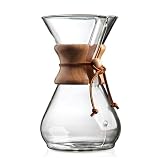
| Chemex Classic | Sharing and presentation | Glass hourglass with thick bonded filters | Three-cup up to ten-cup sizes | Glass, wood collar | Mid-range |
| Kalita Wave 185 | Forgiving, even extraction | Flat bottom, three small holes, wave filter | 1 to 2 cups | Stainless, glass or ceramic | Budget to mid |
| Fellow Stagg XF | Style and stable pour | Cone with a controlled flow design | Single cup to small batch | Ceramic | Mid-range |
| Clever Dripper | Beginners | Immersion then release | Around 18 oz in the standard size | BPA-free plastic | Budget |
| Melitta pour-over cone | Simple and cheap | Cone with one small hole | 1 to 2 cups | Plastic or porcelain | Budget |
Sizes and materials follow the makers’ published listings; many of these drippers come in several sizes, so check the model code.
Best for control: Hario V60 02
The V60’s large single hole and spiral ribs let the flow rate depend on your grind and pouring, so it rewards skill. A finer grind and a slower pour extract more; a coarser one runs faster and tastes lighter. The downside is a learning curve, because inconsistent pouring changes the cup. It is the pick if you want to dial in light roasts.
Best for sharing: Chemex Classic
The Chemex uses a very thick paper filter, which removes most oils and fine particles, giving a clean, tea-like cup. Larger sizes brew four to eight cups at once, and the carafe works as a server. The trade-offs are slower brewing, filters that cost more than average and a glass body that needs careful handling and cleaning.
Best forgiving dripper: Kalita Wave 185
The flat bed and three small holes slow the water and even out extraction, so an imperfect pour is less damaging than with a cone. Wave-shaped filters keep the paper off the walls, which helps drainage. The compact 185 size suits one or two cups, and a larger 155 size exists for single servings.
Best for style: Fellow Stagg XF
The Stagg XF is a ceramic cone designed for stable flow and heat retention, and it works with common cone filters. It suits people who want a countertop piece, though it costs more than a plastic V60 with similar brewing results.
Best for beginners: Clever Dripper
The Clever steeps grounds in water, then releases the coffee through a valve when set on a mug. Because the coffee is fully immersed, timing matters less than with a pour-over. It is the best choice if you want consistent coffee with little technique, though the cup has a little more body than a pure pour-over.
Best budget: Melitta pour-over cone
A basic Melitta cone costs little, uses widely sold filters and brews decent coffee with a slow pour. The small outlet slows flow, so grind slightly coarser than for a V60. It is the entry point if you are unsure about the method.
Worked calculation: coffee-to-water ratio
A common starting ratio is 1 gram of coffee to 16 grams of water, with the range from 1:15 for a stronger cup to 1:17 for a lighter one. Water weighs 1 gram per millilitre, so the math is simple.
| Cup size | Water | Coffee at 1:16 | Brew time target |
|---|---|---|---|
| One 8 oz mug (about 240 g) | about 250 g | about 15.5 g | 2:30 to 3:00 |
| Two mugs (about 480 g) | about 500 g | about 31 g | 3:00 to 3:30 |
| Chemex for four (about 1 L) | about 800 g | 50 g | 4:00 to 4:30 |
Because the grounds absorb about twice their weight in water, 31 grams of coffee soaks up roughly 60 grams, so 500 grams of water yields about 440 grams of coffee in the cup. Water temperature of 195 to 205 degrees Fahrenheit is the usual range, a figure widely used by industry bodies such as the Specialty Coffee Association.
What else you need
- A burr grinder. Consistent grind size matters more than the dripper. Blade grinders produce uneven particles that taste both bitter and sour.
- A scale with a timer. Weighing beats scoops because beans vary in density.
- A gooseneck kettle. The narrow spout gives a controlled flow rate.
- Paper filters matched to the dripper. Rinse them with hot water to remove paper taste and warm the vessel.
Mistakes to avoid
- Skipping the bloom. Pour about twice the coffee’s weight in water, wait 30 to 45 seconds, then continue. It releases gas that blocks even extraction.
- Using the wrong grind. If the brew drains in under two minutes, grind finer; if it stalls beyond four, go coarser.
- Pouring into the filter walls. Water that runs down the sides bypasses the grounds and weakens the cup.
- Ignoring stale beans. Coffee tastes best within a few weeks of roasting, and no dripper can fix flat beans.
Decision matrix by situation
| Your situation | Choose | Reason |
|---|---|---|
| Brew one cup before work | Hario V60 02 or Kalita Wave 185 | Quick, compact and easy to clean |
| Brew for a household of three or four | Chemex Classic, 6 to 8 cup | Brews a full carafe at once |
| Brand new to coffee and want consistency | Clever Dripper | Steeping time forgives uneven pouring |
| Travel or camping | Plastic V60 or Melitta cone | Lightweight and unbreakable |
| Want to dial in light roasts | V60 with a good grinder | Flow rate responds clearly to your technique |
| Prefer a sediment-free, tea-like cup | Chemex with bonded filters | The thick paper traps oils and fines |
A simple V60 recipe to start with
- Rinse the paper filter with hot water and discard the water to remove papery taste and warm the dripper.
- Add 20 grams of medium-fine coffee and level the bed with a gentle shake.
- Start the timer and pour 40 grams of water in a circle to wet all the grounds, then wait 40 seconds for the bloom.
- Pour slowly in small circles up to 150 grams by 1:00, then to 250 grams by 1:30, then to 320 grams by about 2:00.
- Let it drain completely; the whole brew should finish near 3:00. If it finishes early, grind finer next time.
This 1:16 recipe makes about 280 grams of coffee, a little under one large mug. Change one thing at a time, such as grind size, so you can tell what caused the difference in taste.
Reading the cup
Sour, thin or salty coffee usually means under-extraction, so grind finer, pour hotter or slow the pour. Bitter, dry or harsh coffee means over-extraction, so grind coarser, lower the water temperature slightly or shorten the brew time. If the cup is simply flat, try fresher beans before you adjust anything else.
Frequently Asked Questions
Is pour over better than a drip machine?
It gives you more control and can taste cleaner, but takes more time and attention. A good automatic drip machine is more consistent for busy mornings.
What grind size is best for pour over?
Medium, similar to table salt or a little finer, is a good starting point. Adjust finer or coarser based on how fast the water drains.
Do I need a gooseneck kettle?
It helps greatly, because it controls the flow and placement of water. You can pour carefully from a regular kettle, but results will vary more.
Which dripper is easiest for beginners?
The Clever Dripper and the Kalita Wave are the most forgiving. The V60 offers the most control but also the most room for error.
Are paper filters bad for the environment?
Paper filters are compostable and the waste is small. A metal filter removes the need for paper but gives a heavier cup with more sediment.

Write Your Review
No reviews yet. Be the first to share your experience!