

Key takeaways
- Compare the best low acid coffee beans on published pH, roast and origin, from Lifeboost and Java Planet to Volcanica and Lucy Jo's, for a gentler cup.
Quick answer: The best low acid coffee beans for most home bars are the Lifeboost Organic Medium Roast whole beans, a single-origin Nicaraguan coffee the maker states tests at a pH of 6 or higher, USDA Organic and third-party screened for mycotoxins, heavy metals and pesticides. Buyers who want a certified single origin in a full one-pound bag should look at the Java Planet Colombian, and buyers who want the lightest roast in the group should look at the Purity Coffee PROTECT. The Volcanica Low Acid Blend is the fresh-roasted blend pick with a maker-stated pH, and the Lucy Jo’s Mellow Belly is the budget pick, a certified organic ground coffee from a small family roastery.
As an Amazon Associate, we earn from qualifying purchases.
Table of Contents
- Why Low Acid Is a Specification, Not a Slogan
- How to Choose Low Acid Coffee Beans
- Quick Comparison
- 1. Lifeboost Organic Medium Roast Whole Bean Coffee, 12 oz
- 2. Java Planet Low Acid Organic Colombian Whole Bean Coffee, 1 lb
- 3. Purity Coffee PROTECT Whole Bean Coffee, 12 oz
- 4. Volcanica Coffee Low Acid Blend Whole Bean Coffee, 11 oz
- 5. Lucy Jo’s Coffee Organic Mellow Belly Low Acid Blend, Ground, 11 oz
- Safety, Identity and Care Checks
- Frequently Asked Questions
- Conclusion
Why Low Acid Is a Specification, Not a Slogan
Low acid coffee is the one corner of the coffee shelf where the headline claim has no referee. There is no federal standard in the United States that defines how low a coffee’s acid must be before the words low acid may be printed on the bag, a gap the category’s own brands concede in their published material. One bag’s low acid is a laboratory figure, a brewed pH measured and printed; the next bag’s low acid is a roastmaster’s adjective, attached to a dark roast on the theory that darker roasts taste less sharp. Both bags sit on the same shelf under the same two words, and the drinker with a sensitive stomach, who is the entire reason the category exists, has no way to tell them apart from the front of the packaging. This roundup exists to separate the two kinds: every pick below is a coffee whose maker publishes something checkable, a stated pH, a third-party testing programme, a certification, or a named process, and the specifications print which kind of evidence each pick actually carries.
The chemistry underneath is worth one paragraph, because it decides what a buyer should look for. The acids that dominate a cup of coffee are chlorogenic acids, and they respond to three levers. The first is the bean itself: coffees grown at lower elevations and in richer volcanic soils, and natural-processed lots, tend to brew gentler than high, bright, washed lots, which is why so many low acid coffees are Brazilian, Sumatran or Central American rather than Ethiopian or Kenyan. The second lever is the roast: chlorogenic acid breaks down as roasting progresses, so darker roasts carry less of it, though the effect on the brewed pH is smaller than the effect on perceived sharpness, and a dark roast is not automatically a low acid coffee. The third lever is treatment: slow, low-temperature roasting programmes and water-process decaffeination are both published by makers in this category as acid-reducing steps. A buyer who understands the levers can read any bag in the category, including bags this roundup does not cover, and sort the measured claims from the adjectives.
Scope needs stating before the picks. This site already covers espresso beans as a class, dark roast espresso beans, decaf beans and green beans for home roasting; this roundup covers the slice none of those reaches, coffees specified and sold as low acid, in whole bean form wherever the brand offers it, with one ground pick where the brand’s range and price tier make it the honest representative. The five picks are all roasted coffee for home brewing, drip, pour over, French press and espresso alike, and none is a pod, an instant or a ready-to-drink product, which are different shelves with different rules. Two boundaries follow from the drop rule this roundup always applies: a product whose Amazon identifier cannot be confirmed from listing data is dropped rather than guessed. The category’s best-known name was researched first and dropped on exactly that rule, and the checks section names it and the other near-miss in full, because a low acid roundup that quietly omits the category’s testing pioneer would mislead by silence.
How to Choose Low Acid Coffee Beans
Start with the pH claim, and grade it before you believe it. Brewed coffee ordinarily sits between about pH 4.8 and 5.0 on the figures the makers in this category publish, and the low acid claim only means something when a bag states where it lands above that range. The strongest form of the claim is a number with a tester behind it: one pick below states a pH of 6 or higher and describes third-party screening, and another states a pH band in its listing copy as the maker’s own figure. The weakest form is the bare adjective, and the category has been measured on exactly this point: a 2024 North Carolina A&T State University study of seven coffees marketed as low acid found only one of the seven brewed above pH 5.5, the threshold the researchers treated as meaningful. That result is the single most useful fact in this article. It does not make the other six coffees bad; it makes their labels unproven, and a buyer whose stomach is the reason for the purchase should weight a published, tested figure over a roast name every time.
Next, read the origin and the process, because they are the part of the claim that cannot be faked by wording. Low acid coffees are built, not labelled: shade-grown Central American beans washed in spring water, Indonesian and Brazilian lots chosen for their natural softness, blends assembled from origins that start low. Every pick below names its origin or its blend components in its listing data, and that naming is itself a quality signal, because a maker who will not say where the coffee grew is asking the buyer to take the whole claim on trust. Process matters the same way. Sun drying, spring-water washing and slow roasting are all published steps in the picks below; none is a guarantee, but a coffee with three named gentle processes and no pH figure is a better bet than a coffee with a pH adjective and no process at all.
Then decide the form, because this category punishes the wrong one. Four of the five picks are whole bean, which is the correct default for any coffee and doubly so here: the drinker who needs low acid coffee usually drinks it daily, and whole beans hold their character for weeks where ground coffee fades in days. The one ground pick is included deliberately, for the household without a grinder, and its section says plainly what that convenience costs. Bag size interacts with form: the picks run from 11 ounces to a full pound, and a daily drinker should do the honest arithmetic of how fast a bag empties, because a low acid coffee that sits open for two months has traded its one virtue for staleness. None of the listings reviewed publishes a roast date, which is the category’s shared weakness, and the checks section returns to it.
Then place caffeine, because low acid and low caffeine are different axes that shoppers constantly merge. Decaffeination by water process is itself associated with a gentler cup, and two of the brands below sell water-processed decaf versions under their own listings, but every pick in the table is the brand’s regular caffeinated coffee unless its section says otherwise, and a buyer who needs both axes lowered should shop the decaf listings of these same roasters rather than assume a low acid bag is a low caffeine one. The reverse error is just as common: a decaf bag is not automatically low acid, and the general decaf shelf this site covers elsewhere makes no acid claims at all.
Finally, weigh the certifications, and weigh them at their actual value. USDA Organic appears on four of the five picks and the fifth is roasted by a certified organic roastery; organic certification speaks to how the coffee was grown, not to its acid, and it should be bought for its own sake rather than as a proxy for gentleness. The Smithsonian Bird Friendly certification on the Colombian pick is the strictest shade standard in coffee and again orthogonal to acid. The certifications that touch the cup directly are the testing programmes: third-party screening for mycotoxins, mold, heavy metals and pesticides, published by two of the five makers, which is a food-safety discipline rather than an acid claim, and worth more to a daily drinker than any adjective on the bag. The honest summary of the category is that low acid is a claim to be audited, not a flavour to be chosen: find the number, find the origin, find the process, and the bag has told you everything it knows.
Quick Comparison
All five picks are roasted coffee sold as low acid, and they split first by how the acid claim is evidenced, then by form and roast.
| Product | Form | Roast | Acid evidence | Tier |
|---|---|---|---|---|
| Lifeboost Organic Medium Roast | Whole bean, 12 oz | Medium | Maker-stated pH of 6 or higher, third-party tested | Premium |
| Java Planet Colombian | Whole bean, 1 lb | Medium-dark | Lab-tested claim, no pH figure published | Mid-range |
| Purity Coffee PROTECT | Whole bean, 12 oz | Light-medium | Low Acid specialty in listing data, third-party tested | Premium |
| Volcanica Low Acid Blend | Whole bean, 11 oz | Medium | Maker-stated pH of 5.2 to 5.3 | Mid-range |
| Lucy Jo’s Mellow Belly | Ground, 11 oz | Medium-dark | No pH figure published; certified organic roastery | Budget |
1. Lifeboost Organic Medium Roast Whole Bean Coffee, 12 oz

The Lifeboost medium roast is the lead pick because it publishes the most complete version of the claim this category makes. The maker’s listing data states the figure outright: where most popular coffee tests at a pH of 4.85 or lower, Lifeboost states its coffee tests at a pH of 6 or higher, and it pairs that figure with the discipline that makes a number believable, third-party testing of its beans for mycotoxins, heavy metals, pesticides and, in the maker’s count, over 400 other toxins. The coffee itself is a single-origin Nicaraguan, shade-grown at high elevation in the mountains of Central America, hand-picked, sun-dried and washed in spring water, and certified USDA Organic and Non-GMO. It is, on paper, the category’s thesis statement: a naturally soft origin, gently processed, with the paperwork printed where a buyer can read it.
The case for the Lifeboost is that every element of the gentleness claim is a published specification rather than a mood. The origin is named to country and growing style. The processing is named step by step, spring-water washing and sun drying rather than a proprietary secret. The testing is named by analyte class. And the pH figure is stated as a threshold the coffee meets, not a direction it leans. For the drinker who has already discovered that ordinary coffee is a daily negotiation with their stomach, that completeness is the product: this is the bag whose maker has done the most homework in public. The medium roast is also the right centre of the line for a first purchase, full-bodied and rounded in the maker’s description, where the same roaster’s dark roast trades some of that balance for weight.
The limits are the ones its own data states. The bag is 12 ounces, the joint-smallest format in this roundup, and the line is sold at a premium tier, so the daily drinker pays for the testing programme in every bag. The pH figure and the toxin counts are the maker’s published claims for its testing, stated here with that attribution, and a buyer should read them as a brand’s lab programme rather than a regulator’s finding, because no regulator certifies coffee pH. One crawl of the Amazon listing also carried the summary line that no featured offers were available, a recurring artifact in the listing data for this category, while the brand’s Amazon-fulfilled mirror listing shows the coffee in stock; the checks section flags it, and a buyer should confirm the live offer on the pinned listing before ordering. The line’s neighbouring listings, a Swiss Water decaf and a hazelnut flavour, are separate products under separate identifiers and are not this pick. Choose the Lifeboost for the most fully documented low acid claim on the shelf, and for a single-origin coffee whose gentleness is engineered at every published step.
Specs
- Brand: Lifeboost
- Form: Whole bean, 12 ounces per listing data
- Roast: Medium per listing data
- Origin: Single origin Nicaragua, Central America; shade-grown at high elevation per maker data
- Process: Hand-picked, sun-dried and spring-water washed per maker data
- Stated acidity: pH of 6 or higher per maker data
- Testing: Third-party tested for mycotoxins, heavy metals, pesticides and over 400 other toxins per maker data
- Certifications: USDA Organic and Non-GMO per listing data
- Tier: Premium
2. Java Planet Low Acid Organic Colombian Whole Bean Coffee, 1 lb
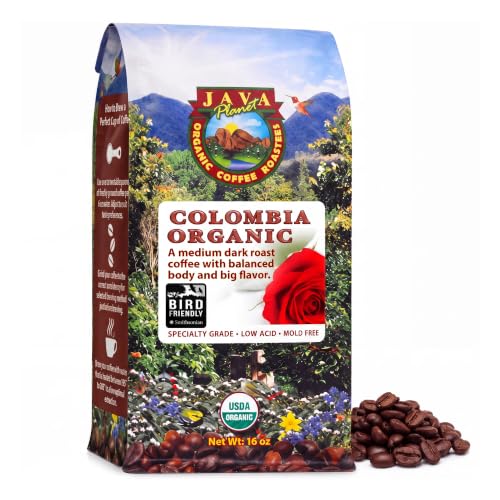
The Java Planet Colombian is the single-origin pick in its classic form: one country, one bag, a full pound of it. Java Planet is a family roastery built entirely around low acid organic coffee, and this Colombian is the listing its own copy calls its most popular, a medium-dark roast of specialty grade Arabica that the maker describes as third-party lab tested as low acid. The certifications around the bean are the strongest sourcing paperwork in the roundup: USDA Organic, and Smithsonian Bird Friendly, the shade-grown standard that requires organic certification first and then audits the canopy itself. The bag is 16 ounces, the largest in the roundup, which matters in a category where the standard bag has quietly shrunk to 11 or 12 ounces.
The case for the Java Planet is proportion. A low acid coffee is a daily coffee, bought again and again by a drinker who has settled the acid question and now just wants a good cup that behaves, and a one-pound bag of a certified single origin at a mid-range tier is the most sustainable form of that habit in this group. The maker’s testing claim is stated in its listing copy as laboratory testing for the low acid designation and separate independent testing for mold and heavy metals, and the brand publishes its wider line plainly, Peruvian, Guatemalan, Costa Rican and Sumatran single origins and an espresso blend alongside this Colombian, each under its own listing. The Colombian’s medium-dark roast is also the natural home of the low acid drinker who came from ordinary coffee and wants the cup to taste like coffee first: smooth and full-flavoured in the maker’s description, with the acidity complaint answered by sourcing rather than by roasting the life out of the bean.
The limits are evidentiary, and they are stated at full strength. The listing data reviewed publishes no pH figure for this coffee: the low acid claim rests on the maker’s statement that the coffee is lab tested as low acid, without the number printed, which places it one rung below the Lifeboost’s stated threshold on the evidence ladder this article’s guide section builds. A buyer for whom the number is the whole purchase should buy the pick above. The brand’s shelf is also a variant trap of the standard kind: the same roastery sells a Peruvian decaf, a Peruvian half caff and an espresso blend under near-identical titles, and at least one sibling listing in the data reviewed showed no featured offer while this Colombian sells normally, fulfilled by Amazon in its current mirror listings. The reference table pins the caffeinated Colombian whole bean in the one-pound bag. Choose the Java Planet for the certified single origin, the full-pound bag, and the low acid claim carried by sourcing and testing rather than by roast alone.
Specs
- Brand: Java Planet
- Form: Whole bean, 1 pound (16 ounces) per listing data
- Roast: Medium-dark per listing data
- Origin: Colombian single origin, specialty grade Arabica per listing data
- Certifications: USDA Organic and Smithsonian Bird Friendly per listing data
- Acidity: Marketed as low acid and stated by the maker to be third-party lab tested as low acid; no pH figure published in the listing data reviewed
- Testing: Independently tested for mold and heavy metals per maker data
- UPC: 854166002619 per Amazon product information
- Tier: Mid-range
3. Purity Coffee PROTECT Whole Bean Coffee, 12 oz

The Purity Coffee PROTECT is the testing-led pick, from the roaster whose entire brand is a laboratory programme. Purity roasts specialty-grade USDA Organic Arabica to what it presents as a health specification, third-party tested for mold, mycotoxins and pesticides, and its Amazon product information for this listing prints the specialty plainly: Certified Organic, Low Acid. The PROTECT is the line’s light-medium roast, the high-antioxidant entry in a small range that runs from this bag through a medium everyday roast to a water-processed decaf, and it is the only pick in this roundup roasted light of medium, which makes it the interesting test of the category’s central question: whether a coffee can be gentle by sourcing and specification rather than by roasting dark.
The case for the PROTECT is that it refuses the category’s easiest shortcut. The standard low acid recipe is to roast darker and call the softness low acid; Purity’s published approach is to start with specialty-grade organic beans, test them, and roast them light-medium, keeping the flavour compounds a dark roast burns off while the listing still carries the low acid designation. For the drinker whose complaint about low acid coffee is that it tastes like an apology, this is the bag aimed at them: a lighter, brighter cup whose gentleness is claimed on specification. The brand’s testing discipline is also the most explicitly enumerated in the group after the lead pick, named analyte by named analyte in its listing data, and the 12 ounce bag is whole bean, so the freshness discipline stays in the drinker’s hands.
The limits are documentation gaps of the familiar kind. The listing data reviewed prints the Low Acid specialty and the testing programme but no pH figure, so on this article’s evidence ladder the PROTECT stands with the Java Planet: a tested claim without a published number. Its flavour direction is also the roundup’s most polarising, because a light-medium roast keeps more of the bean’s natural brightness, and brightness is a flavour word that sits close to acidity in the cup even when the measured acid is low; a drinker whose sensitivity is to the taste of acidity rather than its chemistry may find the darker picks below easier company. The line’s variant discipline matters here too: the same brand sells a two-thirds decaf blend and a full decaf under similar titles and separate identifiers, and the table pins the caffeinated PROTECT whole bean. Choose the PROTECT for the lightest roast and the testing-first brand, and for proof inside this category that gentle does not have to mean dark.
Specs
- Brand: Purity Coffee
- Form: Whole bean, 12 ounces per listing data
- Roast: Light-medium per maker data
- Coffee: Specialty-grade USDA Organic Arabica blend per listing data
- Specialty: Certified Organic, Low Acid per Amazon product information
- Testing: Third-party tested for mold, mycotoxins and pesticides per maker data
- UPC: 850005169147 per Amazon product information
- Manufacturer: Purity Coffee, Inc. per Amazon product information
- Tier: Premium
4. Volcanica Coffee Low Acid Blend Whole Bean Coffee, 11 oz

The Volcanica pick is the blend built for the purpose. Volcanica is a roaster whose catalogue is organised by origin and altitude, and its Low Acid Blend is the one product in the line assembled from naturally low-acid coffees rather than adapted from a standard roast: a medium roast of Arabica, sold whole bean in an 11 ounce bag, fresh roasted in the maker’s description, with the listing copy stating a pH of 5.2 to 5.3 for the blend. That stated band is the second published pH figure in this roundup, and it is printed here with its attribution exactly as the listing gives it, as the maker’s figure for its own blend.
The case for the Volcanica is directness. Where the lead pick surrounds its number with a testing programme and the two picks above it ask the buyer to trust a process, this listing simply states a pH range and a construction: naturally low-acid beans, blended, roasted medium. A blend is also the honest engineering answer to the category’s problem, because no single origin is lowest in every acid that matters, and a roaster blending for a target can hold the target across crop years in a way a single-origin bag cannot promise. Volcanica’s wider reputation in its listing data is freshness, small-batch roasting across a large origin catalogue, and this blend sits inside that discipline rather than outside it. For the espresso drinker specifically, a medium roast blend of soft origins is the most familiar construction in this roundup, the closest thing here to the espresso blends this site usually covers, with the acid specification swapped in for the usual flavour specification.
The limits are the figure’s provenance and the bag’s size. The pH band is the maker’s own statement in listing copy, not a third-party result the listing names, and it should be weighed accordingly: it is a number, which puts it ahead of a bare adjective, and it is unaudited in the data reviewed, which puts it behind the lead pick’s programme. The 11 ounce bag is the smallest in the roundup, and a two-cup-a-day household will empty it inside a fortnight, which is good for freshness and demanding on reordering. The brand’s catalogue is also the variant trap at its widest: Volcanica sells dozens of single origins under similar titles, several of them naturally soft coffees that are not this blend and carry no low acid designation, and the table pins the Low Acid Blend listing itself. Choose the Volcanica for the stated pH, the purpose-built blend, and the fresh-roasted discipline of a specialist roaster.
Specs
- Brand: Volcanica Coffee
- Form: Whole bean, 11 ounces per listing data
- Roast: Medium per listing data
- Coffee: Blend of naturally low-acid coffees; Arabica per listing data
- Stated acidity: pH of 5.2 to 5.3 per listing copy, stated by the maker
- Roasting: Fresh roasted per listing data
- Dimensions: Not stated in the listing data reviewed
- Tier: Mid-range
5. Lucy Jo’s Coffee Organic Mellow Belly Low Acid Blend, Ground, 11 oz
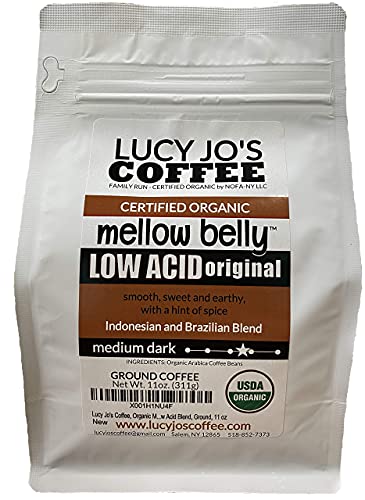
The Lucy Jo’s Mellow Belly is the small-roastery pick and the budget pick, a medium-dark ground coffee from a family-run certified organic roastery in rural upstate New York. The blend pairs Indonesian and Brazilian coffees, the two origins the low acid category returns to most often because both start naturally soft, and the roastery roasts in small batches by hand for, in its words, optimum flavour. The name is the positioning: Mellow Belly is sold squarely as the gentle coffee, a low acid blend for drinkers whose stomachs have opinions, from the smallest and most personal operation in this roundup.
The case for the Lucy Jo’s is that it is the category without the category’s markup. The two premium picks above charge for testing programmes and laboratory paperwork, and those programmes are genuinely worth money to the drinker who needs them, but the underlying recipe for a gentle cup, soft origins, a medium-dark roast, small-batch care, is fully present here at a budget tier, from a roastery whose organic certification covers the roastery itself and not just the bean. The ground form is the pick’s defining trade and it is stated without apology: this is the one pick for the household with no grinder, or the household whose grinder money went to the espresso machine, and a pre-ground low acid coffee that gets drunk fresh and fast beats a whole bean low acid coffee that its owner cannot grind. The roastery’s range around this bag, a breakfast blend, a Sumatra and a decaf version of this same blend, shows a small maker working one idea thoroughly rather than a large maker adding a label.
The limits follow from its scale and its form. The listing data reviewed publishes no pH figure and no testing programme, so the low acid claim here rests on origin, roast and the roastery’s word, the bottom rung of this article’s evidence ladder, priced accordingly. Ground coffee also stales faster than any other pick in the roundup once opened, and the honest instruction is to treat the 11 ounce bag as a two-week supply and store it sealed, not as a pantry staple. Variant discipline applies at the checkout: the decaf Mellow Belly is a separate listing under its own identifier, and one crawl of that decaf sibling carried the no featured offers summary line while this caffeinated ground listing sells as the roastery’s current range in recent category roundups. The table pins the regular caffeinated Mellow Belly ground bag. Choose the Lucy Jo’s for the small-roastery version of the category, the gentlest price of entry, and the ground coffee for the grinderless kitchen.
Specs
- Brand: Lucy Jo’s Coffee
- Form: Ground, 11 ounces per listing data
- Roast: Medium-dark per listing data
- Blend: Indonesian and Brazilian coffees per maker data
- Roastery: Certified Organic, family-run, small-batch roasted per maker data
- Stated acidity: No pH figure published in the listing data reviewed
- Manufacturer: Lucy Jo’s Coffee Roastery per Amazon product information
- UPC: Not stated in the listing data reviewed for this listing
- Tier: Budget
Safety, Identity and Care Checks
Two identity traps run through this category, and each pick was checked against them. The first is the sibling shelf. Every roaster in this roundup sells the same drinker a wall of near-identical bags: the Lifeboost line runs to a Swiss Water decaf and a hazelnut flavour beside this medium roast, the Java Planet line to a Peruvian decaf, a half caff and an espresso blend beside this Colombian, the Purity line to a two-thirds decaf and a full decaf beside this PROTECT, and the Lucy Jo’s line to a decaf Mellow Belly beside this caffeinated one. Each of those siblings carries its own identifier and its own offer state, and at least two sibling listings in the data reviewed, the Java Planet espresso blend and the Lucy Jo’s decaf, showed the summary line that no featured offers were available while the pinned listings sell normally. The reference table’s identifier, not the brand name or the bag’s front label, is the pick, and a buyer who wants the decaf should order the decaf by its own identifier rather than assume the table’s listing covers it.
The second trap is the claim itself, and it deserves the same directness as a sizing trap. Low acid has no regulated definition, the pH figures in this article are the makers’ published figures with their attributions printed, and the one independent measurement programme the guide section cites, the 2024 North Carolina A&T State University study, found most self-described low acid coffees brewed no higher than ordinary coffee. Two respected names in the category are absent from the picks for the reason this roundup always gives. Puroast, the roaster whose slow-roast process and university-verified pH claims make it the category’s most cited brand, was researched first; the only Amazon identifier that listing data confirmed for it belongs to its single-serve pods, a different product form from the bagged beans this roundup covers, and its whole bean bag identifiers could not be confirmed from the listing data available here, so the brand was dropped rather than guessed. Simpatico, the Michigan roaster of Mexican low acid coffees with published pH figures of its own, was dropped on the same rule: current roundups carry its coffees as Amazon picks, but no identifier for its bags surfaced in the listing data reviewed. Either brand, bought through its own store, may serve a reader well; neither could be pinned to the standard this table requires.
One specification conflict is named here in full. The Lifeboost medium roast’s Amazon listing data is not internally consistent about its offer state: one crawl of the listing carried the summary line that no featured offers were available, while the brand’s Amazon-fulfilled mirror listing shows the same coffee in stock with current availability, and recent low acid roundups carry it as a live pick. This article treats the listing as selling, on the weight of the fulfilled mirror and the roundup record, and flags the conflict so a buyer checks the pinned listing’s live offer before ordering rather than discovering the state of the page at the checkout. A smaller note belongs to the Lucy Jo’s specifications: the UPC printed in the data reviewed belongs to the line’s decaf listing, and this article records it as such rather than present it as the caffeinated bag’s own, because identifiers are not borrowed across listings in either direction.
The recall record for this product area was checked pick by pick, and no recall covers any of the five picks, or low acid coffee as a class. The nearest records are named here with their scope, because coffee has had two instructive ones. In August 2025 the FDA announced a recall of Clover Valley Instant Coffee in 8 ounce jars, three lots sold at Dollar General stores, for the possible presence of glass; that action covered instant coffee in jars only, has since been terminated, and touches no bag of beans or ground coffee, including the ground pick here. In March 2025 the FDA classified a recall of Our Family Traverse City Cherry Decaf Ground Coffee, withdrawn because a portion of the production labelled decaf may have contained caffeine. That second record is the one worth a low acid shopper’s attention, not because any pick is involved, none is, but because it demonstrates the category-adjacent failure that matters: a label claim a buyer relies on, wrong in the bag. It is the standing argument for this roundup’s method of pinning one identifier per pick and reading the claim off the listing rather than the shelf talker.
Care, finally, is freshness, and it divides the field by form. The four whole bean picks hold their character for weeks in a sealed bag away from heat and light, and should be ground as they are used; none of the listings reviewed publishes a roast date, so the bag’s arrival is the practical start of the clock, and a buyer who drinks slowly should favour the smaller bags over the pound. The ground pick starts its clock at the roastery and wants drinking inside a fortnight of opening, stored sealed in its bag rather than decanted into a counter canister that is opened twice a day. Freezing is the contested household practice for all five: in a sealed, portioned bag it arrests staleness honestly, and as a daily in-and-out habit it wets the coffee with condensation, and the listings reviewed take no position, so this article records the practice rather than ruling on it.
Frequently Asked Questions
Is low acid coffee actually less acidic, or is it just marketing?
Both exist on the same shelf, which is the honest answer. Low acid has no regulated definition, so any roaster may print it, and the one independent check this article cites, a 2024 North Carolina A&T State University study of seven coffees marketed as low acid, found only one brewed above pH 5.5. The claim is real when a maker publishes the evidence for it: a stated pH figure, a named testing programme, a gentle origin and process described step by step. In this roundup the Lifeboost states a pH of 6 or higher with third-party testing behind it, the Volcanica states a pH band of 5.2 to 5.3 as its maker’s figure, and the remaining picks publish tested or certified claims without a number. Grade the evidence, not the adjective, and the marketing separates itself.
Is a dark roast the same thing as a low acid coffee?
No, and the confusion is the category’s most common buying error. Roasting does break down chlorogenic acid, so a dark roast carries less of it than the same bean roasted light, and dark roasts taste less sharp, which is why the two ideas are merged on shelf talkers. But perceived sharpness is not brewed pH, and a dark roast of a bright, high-grown bean can still brew more acidic than a medium roast of a naturally soft one. That is why this roundup includes a light-medium pick, the Purity PROTECT, whose gentleness is claimed on sourcing and testing, and why the guide section treats origin and process as evidence equal to roast level. Buy the specification, not the colour of the roast.
Can I use low acid beans in an espresso machine?
Yes. Nothing about the low acid specification changes how a coffee behaves under pressure: these are ordinary roasted Arabica coffees, ground fine and extracted the same way, and two of the five roasters sell espresso-specific siblings under their own listings. The medium roast blend construction of the Volcanica pick and the medium-dark Java Planet Colombian are the most familiar espresso forms in the group, and the lighter Purity PROTECT will pull a brighter, more modern shot. The one practical note is freshness rather than compatibility: espresso exposes stale coffee faster than any drip method, which is another argument for the whole bean picks and against stockpiling bags.
Which of these should a first-time low acid buyer start with?
The one matched to why you are switching. If regular coffee has become a genuine daily discomfort and you want the strongest documented claim first, start with the Lifeboost, whose stated pH and testing programme are the most complete in the group. If you want the habit to survive its first month, start with the Java Planet Colombian, a full pound of a certified single origin at a mid-range tier, the easiest bag here to keep buying. If your complaint about low acid coffee is that it tastes dull, start with the Purity PROTECT and its light-medium roast. And if you simply want to find out whether gentler coffee suits you before spending premium money, the Lucy Jo’s Mellow Belly answers the question at a budget tier, ground and ready for the pot you already own.
Conclusion
Low acid coffee is a claim before it is a flavour, and it should be bought the way claims are bought, on evidence. The Lifeboost medium roast is the default: a single-origin Nicaraguan with a stated pH of 6 or higher and the category’s most complete published testing programme. The Java Planet Colombian is the sustainable habit, a certified single origin in a full-pound bag. The Purity PROTECT is the testing-led light roast that proves gentle does not have to mean dark, the Volcanica is the purpose-built blend with its maker’s pH stated on the listing, and the Lucy Jo’s Mellow Belly is the small roastery’s budget answer, ground for the kitchen without a grinder. Read the number where one is published, read the origin and process where one is not, pin the exact listing in the table rather than the brand on the shelf, and the gentlest shelf in the coffee aisle becomes a straightforward purchase.
More from Amazon
Programs that pair well with the guide above. Offers and eligibility are set by Amazon and may change.
Set up recurring deliveries of everyday items on eligible products. Terms and savings are set by Amazon.
Explore Subscribe & SaveCollect the home and kitchen items you want in one registry that guests can shop from.
Create a wedding registryFree shipping on eligible items, Prime Video and more. Eligible new members can start with a free trial.
Start a Prime free trialAudiobooks and podcasts to listen to on the go. Eligible new members can start with a free trial.
Try Audible freeAs an Amazon Associate we earn from qualifying purchases.

Write Your Review
No reviews yet. Be the first to share your experience!