

Key takeaways
- French press vs percolator compared by water temperature, grind, brew time, bitterness and cleanup, with a clear verdict on which to buy.
Buy a French press if you want control, a cleaner-tasting and less bitter cup, and a brewer that works anywhere you can heat water. Buy a percolator if you want a big, hot, strong batch with almost no attention, and you do not mind that the coffee is cooked harder and tastes bolder. The two brewers sit at opposite ends of the same idea: a French press steeps grounds once and stops, while a percolator pushes near-boiling water over the grounds again and again. This comparison walks through temperature, grind, timing, flavor and cleanup so you can choose with confidence.
Quick Verdict
| Choose a French press if you… | Choose a percolator if you… |
|---|---|
| want to control water temperature, steep time and grind | want a set-it-and-leave-it pot that keeps cycling on its own |
| prefer a smooth, full-bodied cup with fewer harsh notes | like very hot, strong, bold coffee |
| brew one to four cups at a time | serve a crowd, a campsite or a big office pot |
| want a small brewer that is easy to wash and store | do not mind a pot with a tube, basket and lid to clean |
| care about avoiding over-extraction | accept some bitterness as part of the style |
For most home drinkers choosing between the two, the press is the safer bet. A percolator earns its place in camping kits and large-batch situations where convenience and heat matter more than nuance.
Specs Side by Side
| Factor | French press | Percolator |
|---|---|---|
| How it brews | One steep, then a plunger separates the grounds | Water cycles up a tube and drips back through a basket of grounds repeatedly |
| Water temperature | Usually aimed at 195-205 F | Often above 205 F, close to a boil, according to brewing references |
| Contact time | Commonly 3-4 minutes, sometimes up to 6 | Varies widely by guide, from a few minutes to over ten; confirm in the manual |
| Grind | Coarse | Medium-coarse to coarse; sources disagree, so follow the manual |
| Control | High: you choose water, time and when to plunge | Lower: the cycle runs until you stop it |
| Flavor tendency | Rounder, heavier body, brighter clarity when timed well | Stronger, hotter and bolder, with more risk of bitterness |
| Heat source | Kettle plus the press; no power for the press itself | Stovetop or electric, depending on model |
| Typical capacity | 12 ounce single-serve to 34 ounce shared pots | Often larger group sizes; check the specific model |
| Cleanup | Dump grounds, wash beaker, plunger and screens | Empty basket, wash the stem, basket, lid and pot |
| Sediment | Some fine silt in the cup | Less silt if the basket holds, but coarse grounds can slip through |
Ranges here come from general brewing references and vary by guide and by model. The Specialty Coffee Association’s filter-brewing guideline calls for water of about 200 F, plus or minus five degrees, at the point of contact with the coffee, and roughly 55 grams of coffee per liter of water. A percolator tends to land above that window, which is the main reason it behaves differently.
Key Differences That Matter
1. Water temperature and extraction
The temperature gap is the biggest single difference. A French press lets you pour water that has just come off the boil and rested briefly, then steeps it once. A percolator keeps heating water and sends it over the same grounds through every cycle. More hot contact means more extraction, and extraction keeps going after the pleasant flavors are used up, which is where bitterness and a burnt edge come from.
That is why percolated coffee has a reputation for being bold but harsh. It is not that the method is broken; it is that it rewards a short perk time and a coarse grind, and punishes walking away. If you like a dark roast served very hot, that bold profile can be exactly what you want.
2. Control and consistency
A press is a timer-and-kettle method. Pour, stir, set a timer, plunge, serve. You can change one variable at a time and taste the difference, which makes it easier to repeat a good cup. A percolator is harder to fine-tune because heating rate, pot size, basket fit and stove or element all affect the outcome, so two batches in the same pot can differ.
The simplest way to improve either brewer is to weigh the coffee and water instead of scooping, and to grind fresh. For a press, start near a 1:15 to 1:17 ratio by weight and adjust. For a percolator, follow the maker’s cup markings and perk time until you learn how your model behaves.
3. Grind size and sediment
Both methods want a coarse grind, but for different reasons. In a press, coarse grounds slow extraction and stay behind the mesh screen. In a percolator, grounds sit in a perforated basket, and fine grounds can slip through the holes or over-extract quickly. Brewing guides disagree on the exact micron range for a percolator, with some recommending medium-coarse and others coarse, so use the manual and adjust to taste.
A French press cup will still contain a little silt because a metal screen is not a paper filter. If that bothers you, pour slowly, leave the last sip in the beaker and let the cup settle for a minute.
4. Batch size and where you brew
Percolators are common in camp kits and church-basement urns for a reason: they brew large amounts and keep the coffee hot. A press can serve a table too, but the coffee cools quickly and keeps extracting if you leave it on the grounds, so you usually pour it all into a thermal carafe. For a solo drinker or a couple, a 12 or 34 ounce press is the simpler fit. For a gathering, a percolator is easier to scale.
5. Materials and durability
Borosilicate glass beakers are common in presses and resist heat but can still break if dropped or hit by cold water straight after hot. Stainless steel presses are tougher and hold heat better, though some people prefer to see the brew through glass. Percolators are typically metal for stovetop use or have an electric base. Whichever you choose, check the manufacturer’s instructions for stove compatibility, dishwasher use and replacement parts.
Pros and Cons
French press
- Pro: Easy to control temperature, time and strength
- Pro: Compact, quiet and simple to travel with
- Pro: Full, rich body without a paper filter
- Pro: Wide range of sizes from one mug to several
- Con: Some fine sediment in the cup
- Con: Coffee can over-extract if left on the grounds
- Con: Glass models are breakable
- Con: Cools quickly unless you pour into a thermal carafe
Percolator
- Pro: Hot, strong coffee in larger batches
- Pro: Little attention once it starts
- Pro: Sturdy and well suited to camping or backup use
- Pro: Familiar, no-frills operation
- Con: Higher risk of bitterness from repeated boiling-hot contact
- Con: Less control and less repeatable results
- Con: More parts to wash and dry
- Con: Not ideal for lighter, more delicate roasts
Which One Should You Buy?
Your answer depends on what disappoints you most about coffee at home: weak, flat cups or harsh, bitter ones. Bitterness and muddiness are easier to avoid with a press. Weakness and lukewarm temperature are easier to avoid with a percolator. Keep that in mind as you read the recommendation below.
If you want a flexible brewer that treats good beans kindly, buy the French press. It rewards a few small habits: a coarse, even grind, water just off the boil, a timer, and pouring everything out promptly. Those habits are easy to learn and make a visible difference in the cup.
If your priority is a large, hot pot with minimal fuss, and you like robust coffee, a percolator remains a practical choice. Use a coarse grind, watch the perk time, and stop as soon as the coffee is as dark as you like. If you find the result bitter, shorten the time before changing anything else.
Many people who camp or cook for groups keep a percolator for outings and a press for everyday mornings. If you are only buying one brewer for a typical household, the press covers more situations.
Gear Mentioned
Bodum Brazil 12 Ounce French Press
As an Amazon Associate we earn from qualifying purchases at no extra cost to you.

The Bodum Brazil is a classic small press with a borosilicate glass beaker and a 12 ounce size, which is a 0.35 liter single-serve brewer by common sizing. The listing notes it is made in Portugal. It is a sensible starter press for one or two people and a low-commitment way to learn immersion brewing. Confirm the replacement parts and lid style on the listing before buying.
Bodum Kenya 4 Cup French Press

The Kenya is listed as a 4 cup, 0.5 liter press in borosilicate glass. Bodum’s cup measure is based on small servings, so treat it as roughly two mugs. It suits a couple who share a pot, and it is easy to store. Check the listing for the handle and frame material, and keep in mind that glass models need careful handling.
Bialetti Coffeepress Preziosa 8 Cup

The Bialetti Preziosa is an 8 cup stainless steel press. The exterior is metal, which holds heat longer than bare glass and is less likely to chip. Because the cup rating uses a small serving measure, plan on fewer full mugs than the number suggests. It is a good middle-sized option for a small household that wants durability.
EzDtach Glass French Press 34 Ounce, Chrome

This 34 ounce press pairs a borosilicate glass pot with a chrome finish. At that capacity it is meant for sharing, so it fits a table or small gathering. A big press needs more time to cool and more care to pour cleanly, so consider decanting the finished coffee into a carafe. Check the listing for filter details.
EzDtach Glass French Press 34 Ounce, Copper

The copper-colored version adds a double filter and 304 stainless steel plunger parts, plus two extra screens, according to the listing. Extra filtration can reduce sediment, which helps if silt in the cup is your main complaint with presses. It is another large-capacity option for shared brewing. Confirm the finish and what is included before ordering.
RAINBEAN 1 Cup French Press
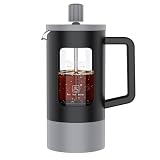
The RAINBEAN is a single-cup borosilicate glass press that also serves as a tea maker. Its listing uses the word percolator in the title, but the design described is a plunger-style press, so confirm the brewing method on the product page. It is the smallest option here and a fit for a desk or travel kit, with the usual caution for glass.
Questions
Is a percolator better than a French press?
Neither is better in every case. A press gives more control and a smoother cup, while a percolator gives hot, strong coffee in larger amounts. Choose by the cup you like and the number of people you serve.
Why does percolator coffee taste bitter?
Percolators send near-boiling water through the grounds repeatedly, which can over-extract. A coarse grind and a short perk time reduce the risk. Stop the cycle when the coffee reaches the strength you want.
Can the same grind work for both?
A coarse grind works in both, but check the percolator manual because some makers suggest medium-coarse. Avoid fine grounds in either one; they clog presses and slip through baskets.
How long should a French press steep?
About four minutes is a common starting point, and many guides range from three to six. Taste it, then change time or grind in small steps. Pour out the whole pot once you plunge.
Which is easier to clean?
A press usually has fewer parts and cleans up quickly. A percolator has a stem, basket, lid and pot to wash and dry. Follow the care instructions for your model, especially on dishwasher use.
Which is better for camping?
A stovetop percolator is a classic camp tool because it is sturdy and brews a large batch. A stainless press also works well if you can heat water separately. Pack whichever suits the group size and the stove you will have.
Update History
- October 21, 2026 – Initial publication; specifications checked against manufacturer documentation where available.
- Check the product page for current specifications and availability before buying.
Sources
- Specialty Coffee Association brewing standard for filter coffee
- General brewing references comparing immersion presses and percolators
- Manufacturer product pages and listing descriptions for the presses mentioned


Write Your Review
No reviews yet. Be the first to share your experience!