

Key takeaways
- Chemex vs French press compared: filter, grind, body, cleanup, and capacity. See which brewer fits your taste, routine, and kitchen.
If you want a clean, bright, tea-like cup and do not mind pouring slowly, the Chemex is the better brewer. If you want a heavy, rich, forgiving cup with almost no technique, a French press wins. Both make several cups at once, both are inexpensive to start with compared with an espresso setup, and both reward fresh, properly ground beans. The real split is the filter: thick bonded paper in a Chemex, a metal mesh plunger in a press. That one part changes body, clarity, cleanup, and how much attention each brew demands. This guide lays out the numbers so you can pick without guessing.
Quick Verdict
| Choose the Chemex if… | Choose the French press if… |
|---|---|
| You like a clear, clean cup with delicate fruit and floral notes | You like a full, round cup with a heavier mouthfeel |
| You enjoy a slow, deliberate pour and own or will buy a kettle with a controlled spout | You want to add water, wait, and press with no pouring skill |
| You serve two to four people and want the carafe to double as a server | You brew for one or two and want the smallest possible routine |
| You do not mind buying paper filters on a regular basis | You would rather never buy filters |
| You mostly drink light or medium roasts | You mostly drink medium or dark roasts |
Specs Side by Side
| Detail | Chemex (Classic 8-cup) | French press (typical) |
|---|---|---|
| How it works | Pour-over through a thick paper cone | Immersion steep, then press a metal mesh down |
| Capacity | 40 oz, using Chemex’s 5 oz “cup” | Varies: 12 oz, 17 oz, and 34 oz are common sizes |
| Filter | Chemex bonded paper; folded so one side has three layers | Built-in metal mesh; no paper |
| Grind size | Medium-coarse (manufacturer guidance) | Coarse, similar to coarse sea salt |
| Water temperature | About 200-205°F in one published starting recipe | 195-205°F is the commonly cited range; 200°F is typical |
| Brew time | Roughly 3:30 to 4:00 in that same recipe | 4 minutes steep is the classic time |
| Common ratio | Around 1:16 to 1:17 depending on strength | 1:15 is the usual starting point |
| Body | Light to medium, very clean | Medium to full, some sediment |
| Material | Borosilicate glass, wood collar, leather tie | Glass (borosilicate in many models) or stainless steel with a frame |
| Extra gear | Paper filters, kettle, scale | Kettle, timer; scale optional |
The Chemex row reflects the classic 8-cup model; smaller and larger sizes exist, so confirm the volume of the exact carafe you are considering on the product page.
Key Differences That Matter
The filter decides the cup
This is the whole argument in one component. A Chemex bonded filter is thick, and its folded shape leaves three layers on the side that faces the pouring spout. That paper holds back fine particles and a large share of the coffee oils, so the cup comes out light-bodied and very clear. Flavors read as distinct notes rather than a blended roast character. A French press has no paper at all. The mesh stops the grounds but lets oils and a little very fine sediment through, which is exactly why the cup feels thick and a touch gritty at the bottom. Neither is better in the abstract. If you describe your favorite coffee as “silky” or “chocolatey,” lean press. If you describe it as “juicy” or “tea-like,” lean Chemex.
Grind and timing are different games
Both brewers want a coarse-leaning grind, but for different reasons. In a press, every particle sits in water for the whole steep, so a fine grind over-extracts into bitterness fast. Most guides land on around four minutes with a coarse grind and a ratio near 1:15, using water in the 195-205°F range. The Chemex is a flow-through brewer, so the grind controls how quickly water drains through the thick paper. Chemex recommends a medium-coarse grind; go too fine and the paper clogs, the bed stalls, and the cup turns bitter and slow. A published starting recipe from one retailer pairs 36-42 g of coffee with 600-700 ml of water at 200-205°F for a 3:30 to 4:00 brew. Treat that as a starting point and adjust to taste.
Effort and consistency
A French press is almost impossible to mess up in a catastrophic way. Add coffee, add water, set a timer, press. The variable is how hard and how fast you press, and a slightly uneven press rarely ruins the cup. A Chemex asks more: a bloom, then several controlled pours that keep the water level steady, ideally from a kettle with a narrow spout. If your pouring is erratic, extraction becomes erratic, and a scale helps a lot. People who enjoy the ritual find that a feature. People who brew half-awake before work often find it a chore.
Cleanup and durability
With a Chemex, cleanup means lifting out the wet paper and grounds in one piece and rinsing the glass. The neck is narrow, so you need to be careful with brushes or sponges, and the glass is thin enough that a knock on a faucet can end it. A French press has more parts: the plunger, the mesh screen, and the glass or steel beaker. The grounds are loose, so they have to be scooped or rinsed into a trash bin or compost, not down the drain. Stainless steel presses survive drops that would destroy glass; if you are hard on equipment, that matters more than any flavor argument.
Batch size and serving
A Chemex is both brewer and server. The 8-cup size holds 40 oz, which Chemex counts as eight 5 oz cups, so in practice it comfortably serves two to four mugs. A press comes in a wide span of sizes, from small 12 oz models for a single mug to 34 oz models for a table. One warning applies to the press: coffee left sitting on the grounds keeps extracting and turns bitter, so pour it all out or transfer it to a separate server within a few minutes of pressing.
Pros and Cons
Chemex
- Very clean cup with strong clarity, especially on light and medium roasts
- Carafe doubles as an attractive server
- No sediment in the mug
- Filter and grounds discard together in one piece
- Needs bonded paper filters, an ongoing purchase
- Pouring technique and a controlled kettle matter
- Glass is fragile and the neck is hard to scrub
- Slower and more attention-demanding than a press
French press
- Easy and forgiving; hard to get badly wrong
- Full body and rich mouthfeel that works with darker roasts
- No paper filters to buy
- Available in many sizes, including stainless steel models for travel and durability
- Some sediment in the cup
- Coffee keeps extracting if left on the grounds
- Mesh screens need regular cleaning to prevent stale oils
- Less clarity; delicate flavors can blur together
Which One Should You Buy?
Pick the Chemex when the cup itself is the point. If you buy single-origin light roasts, care about acidity and aroma, and are happy to spend four minutes standing at the counter, a Chemex shows that coffee off better than a press can. Pair it with a burr grinder and a scale and it becomes one of the most rewarding setups under the espresso tier.
Pick the French press when convenience and body matter most. It is the better choice for shared kitchens, for offices, for camping with a steel model, and for anyone who finds pour-over fussy. It also copes better with coarse or slightly uneven grinds, which makes it friendlier if you use a blade grinder or grind at the store.
If you are still undecided, ask yourself one question: do you want to taste the roast or the origin? Roast-forward drinkers tend to prefer the press. Origin-forward drinkers tend to prefer the Chemex. Whichever you choose, a burr grinder is the single most useful upgrade, and fresh beans beat any brewer swap.
Gear Mentioned
The brewers below are French presses from the product list for this guide. Capacities are given as listed; confirm sizes and materials on each product page before ordering.
Bodum Brazil 12 oz French Press
As an Amazon Associate we earn from qualifying purchases at no extra cost to you.

The Brazil is the small, single-mug entry in this group. Listed at 12 oz with borosilicate glass in black, it suits one person who wants one strong mug without brewing a whole pot. Small presses like this also solve the leftover-coffee problem, since you press and pour everything straight into your cup. It is made in Portugal according to the listing. If you brew for two regularly, step up in size.
Bodum Chambord 3-Cup French Press
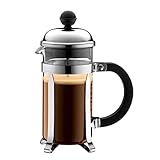
The Chambord is Bodum’s classic press shape. Bodum’s cups are small, so a 3-cup model is the same size class as the 12 oz Brazil: one generous mug or two small cups. It is a sensible pick if you want the traditional frame-and-glass look in a compact format. Confirm the finish and exact volume on the listing.
Bodum Kenya 4-Cup (0.5 L) French Press
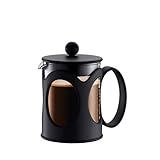
The Kenya steps up to 0.5 L, a practical size for two mugs. Borosilicate glass in black keeps the look simple. At this volume you can follow the standard 1:15 ratio with roughly 500 g of water and still get a usable amount of coffee for a couple. It is a good middle choice if the 12 oz size feels too small.
Bialetti Coffeepress 8-Cup Preziosa, Stainless Steel

The Preziosa is the larger, more design-led option, listed as an 8-cup model in stainless steel. That makes it more attractive for a table and more tolerant of bumps than an all-glass press. Check the listing for the exact capacity, since “cup” sizes vary by brand. It suits households that brew for three or four and want a sturdier body.
EzDtach 34 oz French Press, Chrome

A 34 oz borosilicate glass press is the size most families end up wanting, and the standard recipe for that volume is around 840 g of water. The listing describes a chrome finish. Look at the product page for filter construction and replacement-part availability, because mesh screens are the part that wears first.
EzDtach 34 oz French Press, Copper, Double Filter

This version of the 34 oz press adds a double filter and a 304 stainless steel build according to the listing. A double screen can cut down on fine sediment, which helps close the clarity gap with paper to some degree, though it will not match a Chemex. It is a reasonable pick if the grit in a typical press is what puts you off.
Questions
Is Chemex coffee stronger than French press coffee?
Not by default. Strength depends on your ratio, and both can be brewed strong or weak. A French press usually tastes heavier because of the oils and fines that pass through the mesh, while a Chemex tastes cleaner and lighter in body at the same ratio.
Can I use a French press grind in a Chemex?
Usually not. Chemex recommends medium-coarse, and a fully coarse press grind tends to drain too fast and taste thin. Move a notch or two finer for the Chemex.
Do I need a gooseneck kettle for a Chemex?
It is not mandatory, but a narrow spout makes the pours controllable and the results more repeatable. A scale is arguably more useful than the kettle.
Which is easier to clean?
The Chemex wins on mess because the paper and grounds go out together. The press wins on simplicity of rinsing the vessel itself. Both need regular washing; mesh screens in particular should be taken apart and scrubbed.
What roast works best in each?
Light and medium roasts shine in a Chemex, where clarity highlights origin flavors. Medium and dark roasts suit a press, where the body supports roast-driven flavors.
Why does my French press coffee taste bitter?
The usual causes are a grind that is too fine, a steep that runs well beyond four minutes, or leaving the pressed coffee sitting on the grounds. Coarsen the grind and pour out promptly after pressing.
Update History
- October 21, 2026 – Initial publication; specifications checked against manufacturer documentation where available.
- Check the product page for current specifications and availability before buying.
Sources
- Chemex manufacturer product information for the Classic series (capacity, filters, grind guidance)
- Specialty coffee retailer brewing guides and starting recipes for Chemex and French press
- Roaster and educator brewing guides covering French press ratio, grind, temperature, and steep time
- Product listings for the French presses mentioned, as published by each brand

Write Your Review
No reviews yet. Be the first to share your experience!