

Key takeaways
- Profitec Pro 500 review: E61 heat exchanger, 2 L boiler, front PID and shot timer, who should buy it and dual-boiler alternatives.
The Profitec Pro 500 is a German-built heat-exchanger espresso machine with an E61 group head, a 2-liter insulated stainless boiler and, on the current revision, a front-mounted PID display with a shot timer. It is a good match for households that make several milk drinks in a row and like the feel of a lever-style E61 machine with visible gauges. It is a worse match for anyone who wants truly independent brew-temperature control or a plumbed-in setup. This review explains how the machine works, what the specifications show, where the compromises sit, and which of the listed machines and grinders are worth comparing.
Quick Verdict
- Strong for back-to-back milk drinks: the heat-exchanger design lets you pull a shot and steam milk at the same time.
- The PID on this machine controls the boiler, not the brew water directly, so a temperature routine (a short cooling flush) still matters.
- A vibration pump and a removable tank keep installation simple, but there is no plumb-in option and no rotary pump.
- The package is built around an E61 group, dual gauges and three baskets, which suits tinkerers who want visible feedback.
- Production details differ by year and retailer, so confirm that the listing shows the front-display revision before ordering.
Key Specs
| Spec | Profitec Pro 500 (current front-PID revision, as reported by retailers) |
|---|---|
| Type | Heat exchanger, single boiler, E61 group |
| Boiler | About 2.0 L insulated stainless steel; one retailer lists 2.1 L |
| Heating element | About 1,400 W |
| Pump | Vibration pump; reservoir fed |
| Water tank | About 2.8 L removable; some listings say up to 3 L, so confirm |
| Portafilter | 58 mm |
| Temperature control | PID on the boiler with front display and shot timer (2022 revision) |
| Gauges | Two: boiler pressure and pump pressure |
| Size | About 302 x 447 x 393 mm (11.9 x 17.6 x 15.5 in), without the portafilter |
| Weight | About 23.5 kg (about 52 lb) |
| Warm-up | Around 15 minutes cited from an older manual; allow more for the group to saturate |
| Extras | ECO mode, backflush reminder; flow control is an optional extra on some listings |
| Included baskets | 7 g, 14 g and 21 g, with a bottomless portafilter and silicone spout in some packages; confirm what ships |
Steam pressure is reported differently across sources, and some listing details apply to older versions of the machine. If a specification matters to your decision, such as tank capacity or voltage, confirm it on the exact listing.
Who It Is For (and Who Should Skip It)
It suits
The Pro 500 fits a household that drinks a mix of espresso and milk drinks and wants to make them in sequence without waiting for a boiler to switch modes. It also suits buyers who enjoy the traditional E61 experience: a lever that opens the valve, a group that heats through thermosiphon circulation, and two gauges that show what is happening. People moving up from an entry-level single-boiler machine often find the larger boiler and visible controls a satisfying step. The front display and timer reduce the need for a separate shot timer on the counter.
Skip it if
Skip it if independent brew and steam temperature control is a priority. A dual-boiler machine gives you a dedicated brew boiler with its own PID, and the Pro 500 does not. Skip it if you want direct plumbing or a quieter rotary pump; this is a reservoir-fed vibration-pump machine. Skip it if your kitchen has little space, since the body is deep and heavy at roughly 52 pounds. And skip it if you want to switch on and pull a shot in a couple of minutes; E61 machines are happiest when they have had time to heat the group.
What It Does Well
Simultaneous brewing and steaming
In a heat-exchanger machine, the boiler holds water at steam temperature, and the brew water travels through a tube inside the boiler on its way to the group. That arrangement is the reason you can brew and steam together, which is the main appeal for milk-drink households. The 2-liter boiler holds enough steam capacity for several drinks in a row according to retailer and editorial descriptions.
A more readable control layout
The 2022 revision moved the PID to the front panel and added an automatic shot timer. Previously, controls were tucked away, and the machine felt more opaque. Seeing the boiler temperature and a timer on the front removes guesswork, even though the PID acts on the boiler and only indirectly on the brew water. The two black gauges for boiler and pump pressure add a visual check.
Serviceable, conventional hardware
The machine uses an E61 group, a vibration pump and a stainless boiler, all of which are common to the category. That commonality makes parts and service knowledge easy to find. It also means tinkerers can follow well-documented routines for flushing, backflushing and descaling.
A useful accessory set
Several packages include 7 g, 14 g and 21 g baskets, a bottomless portafilter, a silicone double-spout attachment, a backflush disc, a tamper and a group brush. Bottomless portafilters reveal channeling, which is useful for learning. If your listing does not include these accessories, budget for them separately.
ECO mode and reminders
A programmable ECO mode lowers energy use when the machine sits idle, and a backflush reminder helps keep the group clean. Both are small touches that suit a machine that stays powered on much of the day.
What a typical session looks like
With an E61 heat exchanger, the rhythm is different from a single-boiler or dual-boiler machine. Switch the machine on early so the boiler and the group reach a stable state. Before the first shot, run a short flush through the group to clear water that has been sitting hot in the heat-exchanger tube, then lock in the portafilter and pull the shot. For milk, use the steam wand while the boiler is already at steam temperature; because the PID holds the boiler steady, you can steam straight after a shot and then flush again before the next one. The details of flush timing depend on how long the machine has idled, which is why owners keep a notebook of what works in their kitchen. The payoff is that the routine becomes automatic after a few weeks, and the visible gauges and timer make it easy to spot when something drifts.
Water matters too. A heat-exchanger boiler holds a large amount of water at high temperature, so scale is a long-term concern in hard-water areas. Use softened or filtered water as the manufacturer recommends and descale on schedule, and check the boiler pressure gauge from time to time so you notice changes early.
Where It Falls Short
PID is indirect
The PID regulates the temperature of the steam boiler, not the water that reaches the puck. Brew temperature depends on how long the machine has been idle and on any cooling flush you run before the shot. That means a routine is still part of the workflow. A dual-boiler machine takes much of that routine away.
Warm-up and routine
Plan on a warm-up of well over ten minutes for the machine and group to settle. Idle time between shots changes brew temperature, so consistent habits matter more than on a dual-boiler machine. The upside is that, once you learn the routine, results can be very repeatable.
No rotary pump or plumb-in
The Pro 500 uses a vibration pump and a water tank. A rotary pump version would be quieter and plumb-in capable, but that is not what this machine offers. For an apartment kitchen or a quiet morning, pump noise is something to consider.
Variant and availability confusion
Editorial coverage notes that older units had a hidden controller, while the current version has the front display and timer. Flow control is an optional paid configuration on some listings. Retailers list slightly different tank sizes. Verify the exact revision, voltage and accessories on the page before ordering.
You will need a good grinder
A prosumer machine does little for you without a capable grinder. If your grinder cannot make fine, even adjustments, the Pro 500’s strengths will be wasted. Budget for a quality espresso grinder when you set a total spend.
How It Compares
| Machine | Type | Boiler | Temperature control | Best for |
|---|---|---|---|---|
| Profitec Pro 500 | Heat exchanger, E61 | About 2.0 L | PID on the boiler, indirect for brew | Back-to-back milk drinks with an E61 feel |
| Diletta Bello+ | Heat exchanger, E61 | About 1.8 L (retailer figure) | PID display and shot timer | Similar buyers who want a larger tank and programmable preinfusion |
| Rancilio Silvia Pro X | Dual boiler | 0.3 L brew, 1 L steam | Two PIDs, adjustable by degree | Compact footprint with independent brew control |
| Breville Dual Boiler BES920 | Dual boiler | Two stainless boilers | PID, programmable brew temperature | Programmable convenience and a large tank |
| Rancilio Silvia | Single boiler | 0.3 L | Thermostat, no PID unless modified | Learning manual espresso on a compact classic |
The Pro 500 is a mid-level machine in this group. It beats single-boiler designs for milk volume and trails dual-boiler models for brew-temperature precision.
Alternatives Worth Considering
Diletta Bello+ espresso machine, stainless steel – the closest rival
As an Amazon Associate we earn from qualifying purchases at no extra cost to you.

The Bello+ is also an E61 heat-exchanger machine with a PID display that works as a shot timer. Retailers describe a 1.8 L steam boiler, a roughly 3 L water tank, programmable preinfusion up to about 10 seconds, an eco mode and an Italian build. It is a natural cross-shop for Pro 500 buyers. Compare tank size, pump type and warranty terms, and confirm the finish in the title.
Diletta Bello+ espresso machine, black E61 with shot timer – another finish
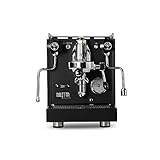
This listing describes the Bello+ with E61 group, PID temperature control, shot timer, programmable preinfusion and Italian manufacture, in black. It is the same product family as the stainless listing, so the decision comes down to finish, included accessories and listing detail. If you prefer a darker look in the kitchen, this is the one to read through. Confirm the voltage and what ships in the box.
Rancilio Silvia Pro X – why consider a dual boiler
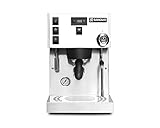
The Silvia Pro X pairs a 0.3 L brass brew boiler with a 1 L stainless steam boiler, each with its own PID and adjustment to the degree. Brewing and steaming can run together, and a front screen doubles as a shot timer. It has a built-in 2 L tank and is more compact than most E61 machines. The trade-off is a smaller brew boiler and a tank you cannot plumb. This is the white finish.
Breville Dual Boiler BES920XL – programmable and large

The BES920 has two stainless boilers, a programmable PID brew temperature range, a pressure gauge, low-pressure preinfusion and a 2.5 L removable tank, according to retailer specifications. It offers many of the dual-boiler benefits at a lower level of tinkering and with an automatic start timer. It is a wide machine at roughly 16 inches across, so measure your counter. Confirm the warranty terms with the seller.
Rancilio Silvia espresso machine – a step down in complexity
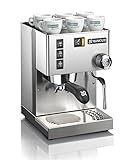
The classic Silvia is a single-boiler machine with a 0.3 L brass boiler, 58 mm portafilter, 3-way solenoid and a 2 L tank. It has no PID in its standard form and requires temperature management through timing. Consider it if the Pro 500 is more machine than you need. It cannot match the Pro 500 for back-to-back milk drinks, since one boiler serves both brewing and steaming.
SHARDOR 64mm flat burr coffee grinder – a grinder to pair with a machine like this

The listing describes a 64 mm flat burr grinder with 100 settings, an anti-static design, an all-metal chamber and a portafilter holder. A machine like the Pro 500 deserves a capable grinder, and this is one budget-oriented option to read about. Verify espresso-range adjustment, retention and noise before relying on it for dialing in, since the listing alone does not settle those points.
Questions
Is the Profitec Pro 500 a dual boiler?
No. It is a heat-exchanger machine with one boiler and an E61 group. A dual-boiler machine would have separate boilers for brewing and steaming.
What does the PID control on this machine?
The PID regulates the boiler temperature. Brew temperature is influenced indirectly, so a short cooling flush before a shot is still part of the routine.
Can I plumb it in?
Descriptions list a removable reservoir and a vibration pump, so treat it as a tank-fed machine. Confirm any plumbing option with the retailer if it matters to you.
How long does it take to warm up?
An older manual reference gives about 15 minutes. Allow extra time for the group and portafilter to saturate with heat.
Do I need a flow control kit?
No. Flow control is an optional add-on on some listings. Many users run the machine without it.
Is it good for beginners?
It can be, provided you accept a routine of warm-up, flushing and dialing in. A simpler dual-boiler or an entry machine may feel friendlier if you want fewer variables.
Update History
- October 21, 2026 – Initial publication; specifications checked against manufacturer documentation where available.
- Check the product page for current specifications and availability before buying.
Sources
- Retailer product pages and specification fields for the Profitec Pro 500 and the comparison machines
- Rancilio manufacturer specification pages for the Silvia and Silvia Pro X
- Independent editorial reviews and buying guides covering heat-exchanger and dual-boiler espresso machines
Write Your Review
No reviews yet. Be the first to share your experience!