

Key takeaways
- Rancilio Silvia review: single-boiler 58 mm semi-automatic, PID options, learning curve, pros, cons and the alternatives worth comparing.
The Rancilio Silvia is a long-running single-boiler semi-automatic espresso machine with a commercial-size 58 mm portafilter, a 0.3 liter brass boiler and a 3-way solenoid valve, built around manual control rather than automation. It rewards patient home baristas who want to learn temperature management and are willing to pair it with a good grinder. It frustrates anyone who wants fast switching between espresso and milk drinks or a machine that looks after itself. This review covers verified specifications, the real learning curve, the confusing array of Silvia listings, and the alternatives worth a look.
Quick Verdict
- A classic learning machine: commercial group size, brass boiler, 3-way solenoid and a stainless body in a compact frame.
- Single boiler means you wait between brewing and steaming, and you manage brew temperature by timing, unless you add a PID.
- The standard version has no PID, no preinfusion programming and no shot timer; some listings sell a version with a PID installed.
- Grinder quality matters more than the machine: a basic grinder will hold the Silvia back.
- Listing labels vary (frame, finish, PID, boiler wording), so confirm exactly which version you are buying.
Key Specs
| Spec | Rancilio Silvia (manufacturer and retailer figures) |
|---|---|
| Type | Semi-automatic, single boiler shared for brewing and steaming |
| Boiler | About 0.3 L brass (retailers cite roughly 10 to 12 oz) |
| Group and portafilter | 58 mm; chrome-plated brass portafilter; brass group |
| Baskets | Single and double included (about 8 g and 16 g); larger baskets up to about 21 g are possible |
| Pump | Vibration pump, 15 bar rated |
| Solenoid | 3-way solenoid valve for pressure release and backflushing |
| Water tank | About 2 L, built-in and top-accessed |
| Power | Roughly 950 to 1,000 W at 120 V per the manufacturer; some retailers list about 1,100 W |
| Temperature control | Thermostat with indicator lights; no PID in the standard version |
| Size | About 235 x 340 x 290 mm (9.3 x 13.4 x 11.4 in) |
| Weight | About 14 kg (about 31 lb) |
| Steam wand | Articulated stainless wand, single-hole tip per retailer listing |
| Warranty | Varies by seller; one retailer lists two years for the machine and six months for an installed PID |
Wattage and boiler volume are reported differently by different sellers, which suggests production changes over the years. Check the rating label or listing for your specific unit.
Who It Is For (and Who Should Skip It)
It suits
The Silvia suits someone who wants to learn espresso fundamentals on equipment that behaves like a small commercial machine. You get a 58 mm portafilter, which opens up a wide range of baskets, tampers and accessories, and a 3-way solenoid that releases pressure after a shot so the puck comes out dry. It suits a person who drinks mostly straight espresso or an occasional milk drink, with a patient routine. It also fits a small counter: the footprint is modest, and the height of about 13.4 inches slides under most cabinets.
Skip it if
Skip it if you make several lattes back to back, because one boiler serves both brewing and steaming, and you will wait for the machine to change modes. Skip it if you want programmable temperature, a shot timer or preinfusion without modifications. Skip it if you do not already own or plan to buy a capable grinder; pre-ground coffee and entry-level blade grinders will not show the machine’s potential. And skip it if you want a machine you can switch on and use in a few minutes with no technique, since the Silvia expects a warm-up period and a manual workflow.
What It Does Well
Commercial-format brewing hardware
The 58 mm group and portafilter mirror the format used in cafes. That matters for two reasons. You can pick from a huge range of baskets, bottomless portafilters, tampers and distribution tools. And the brass group head holds heat better than lightweight parts in cheaper machines. The portafilter is heavy at around a pound, which feels solid in the hand.
The 3-way solenoid
After you stop the pump, the solenoid relieves pressure from the portafilter. The puck comes out drier, cleanup is easier, and it prevents the sudden spray you get when removing a portafilter under pressure. It also allows backflushing with the included rubber disc, a basic maintenance step for any espresso machine.
Strong steam for the class
Retailer descriptions highlight rapid steam for a machine at this size, and an articulated wand with an insulated grip. The usual limit is not power but sequencing: after pulling a shot you switch the machine to steam and wait for the boiler to heat up, then steam your milk. Once you build that rhythm, a milk drink takes a couple of minutes of attention.
Repairable and well documented
The Silvia has been sold in similar form for many years. Parts, manuals and community knowledge are easy to find, and a large number of owners have documented modifications, from PID kits to steam tip swaps. If you enjoy tinkering, that body of knowledge is a real asset.
Compact for what it is
At about 31 pounds and just over a foot deep, the Silvia is easier to place than E61 machines that weigh well over 40 pounds. The top-mounted tank is easy to refill and holds around 2 liters, which covers a day of home use.
A realistic morning routine
Plan for a warm-up of fifteen to twenty minutes so the group and portafilter are properly hot, then purge a little water through the group, dose and tamp, and start the shot. If the next drink is milk, flip the steam switch and wait for the machine to reach steam temperature, steam, then cool the boiler by running water through the group until the machine signals it is ready to brew again. Owners who add a PID tend to shorten this routine because the controller reports boiler temperature instead of leaving you to infer it from a light. Either way, keep a simple log of grind setting, dose, yield and time. Because the Silvia has no timer and no programmable memory, discipline in your own routine is what turns a good machine into good coffee.
The basics of maintenance are modest: backflush with plain water after sessions, clean the portafilter and basket, wipe and purge the steam wand after every use, and descale when mineral buildup appears. Using filtered water suited to espresso machines reduces scale and extends the life of the boiler and valves.
Where It Falls Short
Temperature management is manual
The standard Silvia uses a thermostat and indicator lights. Brew temperature swings as the boiler cycles, so owners learn to time shots against the heater, a technique often called temperature surfing. It can work well once learned, but it is a skill. A PID controller removes much of the guesswork, and some sellers offer a version with a controller preinstalled. A PID installed by a third party may carry its own, shorter warranty.
One boiler, one job at a time
Brewing and steaming share the same 0.3 L boiler. After pulling a shot, you wait for steam temperature, and after steaming you need to cool the boiler before the next shot. For one or two drinks, that is acceptable. For a household that makes multiple lattes in the morning, it is a bottleneck.
No shot timer, no preinfusion programming
The standard machine gives you rocker switches and lights. There is no on-board timer, no adjustable preinfusion and no memory for settings. You can use a phone timer or a scale with a timer, and you can add preinfusion with a modification, but out of the box you do it all by hand.
A grinder is mandatory
The Silvia can only be as good as the coffee you put into it. A grinder that cannot produce fine, even grounds with small steps makes dialing in a frustrating exercise. Editorial guides commonly pair the Silvia with a quality burr grinder, and a basket limit of about 21 g means you should avoid very large doses.
Version confusion
Rancilio’s own specifications list about 950 to 1,000 W at 120 V, while some retailers show about 1,100 W. One listing for a Sage Green model describes a “0.3 L heat exchanger”, a phrase that does not match the manufacturer’s description of a 0.3 L coffee boiler. Treat unusual wording as a reason to read the full specification fields before buying.
How It Compares
| Machine | Boilers | Temperature control | Milk workflow | Best for |
|---|---|---|---|---|
| Rancilio Silvia | Single, 0.3 L brass | Thermostat; PID optional via mod or listing | Wait between brew and steam | Learning manual espresso |
| Rancilio Silvia Pro X | Dual: 0.3 L brew, 1 L steam | Two PIDs, by the degree | Brew and steam together | Same footprint style with modern controls |
| Gaggia Classic Pro E24 | Single brass boiler | No PID | Wait between brew and steam | A more affordable single-boiler path |
The Silvia sits between the Gaggia and the Pro X: more solid and conventional than the Gaggia, simpler and more manual than the Pro X.
Alternatives Worth Considering
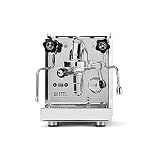
Rancilio Silvia espresso machine, stainless steel – the standard version
As an Amazon Associate we earn from qualifying purchases at no extra cost to you.

This is the base Silvia in a stainless finish: single boiler, 58 mm portafilter, 3-way solenoid and the same hardware described above. It suits someone who wants the classic machine without extra modifications. Expect a thermostat, indicator lights and manual dosing. Before buying, confirm the voltage, the included baskets and what the seller covers under warranty.
Rancilio Silvia espresso machine, iron frame and stainless side panels – the older-style listing
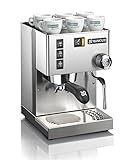
This listing describes the Silvia with an iron frame and stainless steel side panels, a 0.3 liter boiler and compact dimensions of about 11.4 by 13.4 inches. It is likely an older or alternate listing of the same core machine. If the listing appeals, read the specification fields and compare them with the current stainless listing, particularly the included accessories and any mention of the warranty provider.
Rancilio Silvia with PID installed – for temperature control out of the box

This listing is a Silvia with a PID controller installed. A PID lets you set boiler temperature and, depending on the kit, adjust preinfusion and steam behavior. It addresses the Silvia’s biggest learning hurdle. Because the controller is typically added by the seller or a third party, check who supports it and what the warranty covers, and consider the extra control against the small increase in complexity.
Rancilio Silvia Pro X – the dual-boiler step up

The Pro X adds a 1 L stainless steam boiler to a 0.3 L brass brew boiler, each with its own PID adjustable by the degree, plus soft preinfusion and a front display that doubles as a shot timer. The tank is 2 L and built in, so it cannot be plumbed. It lets you brew and steam at the same time, which solves the Silvia’s biggest workflow limit. Warm-up is cited at about 15 minutes. This listing is the stainless version.
Rancilio Silvia in Sage Green with 58 mm group and 2 L reservoir – check the wording

This listing presents a Silvia in a sage green finish with a 58 mm group, a 2 L reservoir and a “0.3 L heat exchanger” label. Rancilio describes the Silvia boiler as a 0.3 L coffee boiler in a single-boiler design, so read the full description and compare it with the manufacturer’s specification before treating the “heat exchanger” wording as accurate. If the machine matches the standard Silvia, the main draw is the finish.
Gaggia RI9380/46 Classic Pro E24 – the budget-minded single-boiler rival
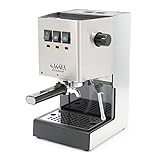
The Gaggia Classic Pro E24 is a semi-automatic single-boiler machine with a 58 mm portafilter, a 3-way solenoid, a vibratory pump and a roughly 2.1 L removable tank. It has no PID and no programming, much like the standard Silvia. One retailer measured about 90 seconds to the ready light. It suits a buyer who wants the same style of manual workflow on a tighter budget. Build and steam feel differ, so compare owner reports.
Questions
Does the Rancilio Silvia have a PID?
The standard version does not. Some listings sell a Silvia with a PID installed, and the Silvia Pro X includes PIDs on both boilers.
Can I make milk drinks on a Silvia?
Yes, but with a pause. You brew, switch to steam, wait for the boiler to heat, steam the milk and then cool the boiler before the next shot.
What grinder should I pair with it?
Choose a burr grinder that can make small, fine adjustments. Editorial guides often cite espresso-capable models such as the Eureka Mignon Specialita or Baratza Encore ESP.
How big can the basket be?
Retailer and manufacturer descriptions say the portafilter holds up to about 21 g. Larger doses are not recommended.
Is the Silvia hard to maintain?
Routine care includes backflushing, descaling with an appropriate product and cleaning the steam wand after each use. The 3-way solenoid makes backflushing straightforward.
Silvia or Silvia Pro X?
Choose the Silvia to learn the craft with a simple machine. Choose the Pro X if you make milk drinks often or want independent temperature control.
Update History
- October 21, 2026 – Initial publication; specifications checked against manufacturer documentation where available.
- Check the product page for current specifications and availability before buying.
Sources
- Rancilio manufacturer specification pages for the Silvia and Silvia Pro X
- Retailer product pages and specification fields for the Silvia, Silvia Pro X and Gaggia Classic Pro E24
- Independent editorial reviews and buying guides covering single-boiler and dual-boiler espresso machines
Write Your Review
No reviews yet. Be the first to share your experience!