

Key takeaways
- Ascaso Steel Duo review: how the dual-thermoblock PID machine brews and steams, its electrical needs, limits and the alternatives worth a look.
The Ascaso Steel Duo PID is a compact, all-metal-look semi-automatic that pairs two independent thermoblocks with PID temperature control, so you can pull a shot and steam milk without waiting for the machine to switch modes. It suits home baristas who already have, or plan to buy, a decent grinder and want more control than an entry-level machine offers, without plumbing in a commercial unit. It is a poor fit if you want push-button convenience, an E61 group with large thermal mass, or a machine that runs happily on a standard 15-amp kitchen circuit.
Quick Verdict
- Strong choice for a manual-workflow home setup: PID brew temperature, two volumetric doses, a shot timer and programmable pre-infusion on a countertop-sized body.
- Two separate thermoblocks mean brewing and steaming can overlap, which is the main reason to pick it over single-circuit machines.
- It uses a standard 58 mm portafilter, so baskets, tampers and accessories are easy to find.
- The current US version is built around a higher-amperage outlet; check your kitchen wiring before you order.
- You still need a capable espresso grinder, which is a separate purchase and often the bigger quality lever.
Key Specs
| Spec | Ascaso Steel Duo PID (V3 listing) |
|---|---|
| Machine type | Semi-automatic, dual thermoblock (separate brew and steam circuits); not a boiler machine |
| Group / portafilter | 58 mm portafilter with wooden handle |
| Temperature control | PID; Ascaso lists a brew range of roughly 80 to 110 degrees C and steam range of roughly 110 to 165 degrees C |
| Dosing | Two programmable volumetric doses plus manual mode; shot timer |
| Pre-infusion | Programmable |
| Pump | Vibratory pump with adjustable over-pressure valve and a pressure gauge; confirm brew-pressure figure on the manufacturer page |
| Water tank | About 2 liters, removable, slides out from the side (sources quote 1.8 to 2 liters; confirm on listing) |
| Power | Current US version reported as 120 V and about 2,000 W with a higher-amperage plug; confirm on listing |
| Size and weight | Roughly 11 x 12.4 x 14.8 inches and about 32 pounds (confirm on listing) |
| Warm-up | Quoted between about 3.5 and 5 minutes depending on the source |
Who It Is For (and Who Should Skip It)
This machine makes the most sense for someone stepping up from a pump machine with a basic thermostat. The PID display lets you set a brew temperature by roast level, and the volumetric dosing repeats a shot volume without you watching the cup. If you pull a cortado in the morning and steam a larger drink for a guest right after, the dual-thermoblock layout shortens the wait between those tasks.
It also suits small kitchens. The footprint is modest for a machine that offers this level of control, and the tank removes from the side rather than the rear, which helps when it sits under a cabinet.
Skip it if any of these describe you:
- You want a fully automatic experience. This is a manual-workflow machine: you grind, dose, tamp and lock in the portafilter yourself. A bean-to-cup model such as the Gaggia Accademia covered below is a better match.
- You want heat-exchanger or dual-boiler thermal mass. Thermoblocks heat water on demand rather than storing it hot, which is quick and efficient but behaves differently from a large boiler. Buyers who prize that stored heat should look at the E61 machines discussed later.
- Your kitchen only has standard 15-amp circuits. The current US model is reported to be designed around a 20-amp outlet and supplied with an adapter for 15-amp use, with possible loss of steam performance. Confirm the plug and circuit requirements on the listing and avoid extension cords with any high-wattage appliance.
- You need a built-in grinder. There is none.
What It Does Well
Simultaneous brewing and steaming
The defining feature is the pair of independent thermoblocks. Because brew and steam water are heated by separate circuits, you do not have to flip into a steam mode and wait for the machine to recover before the next shot. For households making several milk drinks in a row, this is a practical time saver, and it is the reason the Steel Duo line is usually compared with dual-boiler machines even though it is not one.
Temperature and shot control
PID control with an adjustable brew range gives you room to match temperature to the coffee: cooler for darker roasts, warmer for lighter ones. Add programmable pre-infusion and two stored volumetric doses and the machine lets you build a repeatable recipe. Manufacturer data lists temperature stability within roughly 1.5 degrees C; treat that as a design target rather than a promise for every kitchen.
Standard 58 mm ecosystem
A 58 mm portafilter means you can swap in precision baskets, bottomless handles and distribution tools without hunting for niche sizes. That matters more than it sounds once you start refining a recipe.
Compact, serviceable layout
The body is relatively small and the tank is easy to reach. A removable reservoir of around 2 liters is enough for a full morning of drinks before a refill, and the side-sliding design avoids pulling the machine out from the wall.
Where It Falls Short
- Electrical requirements. The current US version is reported as a higher-wattage machine built for a 20-amp outlet. On a shared 15-amp kitchen circuit, other appliances and the supplied adapter can limit steam performance. This is the single biggest practical caveat.
- No pressure profiling. A vibratory pump with an adjustable over-pressure valve and programmable pre-infusion is flexible, but it is not a rotary or lever machine. If you want to shape pressure through the shot, look elsewhere.
- Thermoblock behavior. Fast heat-up is a strength, but a thermoblock does not hold a reservoir of hot water the way a boiler does. Drink-to-drink consistency depends more on your routine, so plan to flush the group before the first shot and keep a repeatable rhythm.
- A grinder is mandatory. Any 58 mm-capable espresso grinder will be needed, and a weak one will cap results no matter how good the machine is.
- Spec sheets disagree. Tank volume, warm-up time and even pump pressure figures differ between retailers and review sites. The listing name itself references a V3 revision; verify the exact configuration and plug type on the product page before buying.
- Steam still takes practice. The steam circuit has more power than before according to manufacturer-reported updates, but microfoam is a skill, not a feature.
Setting It Up for Daily Use
A few habits make a thermoblock machine easier to live with. Fill the reservoir with fresh water and let the machine warm fully before the first shot, then run a short flush through the group so the first cup is not made with cold metal. Warm the portafilter and cup with a splash of hot water if your routine allows it. Because the temperature is controlled by PID, change one variable at a time: adjust the brew setpoint, then the grind, then the dose, and note each change so you can return to a working recipe.
After steaming, purge the wand and wipe it right away so milk does not dry on the tip. Rinse the drip tray regularly and descale on the schedule the manufacturer recommends for your water hardness; thermoblocks have narrow internal passages, so hard water and scale are worth taking seriously. Always switch the machine off and let it cool before moving it or fitting a cover.
How It Compares
| Machine | Heating system | Group | Milk steaming | Best suited to |
|---|---|---|---|---|
| Ascaso Steel Duo PID | Dual thermoblock | 58 mm | Independent steam thermoblock | Controlled shots plus back-to-back milk drinks |
| Ascaso Steel Duo PLUS | Dual thermoblock | 58 mm | Independent steam thermoblock, wooden steam lever | Buyers who want upgraded accessories out of the box |
| Diletta Mio | PID brew boiler (about 400 mL) with steam thermoblock | 58 mm, non-E61 | Selectable steam circuit | Boiler-based brewing in a compact body |
| Diletta Bello+ | Heat exchanger, about 1.8 L boiler | E61, 58 mm | Large steam boiler, simultaneous brew and steam | Enthusiasts who want a classic E61 machine |
| Gaggia Accademia | Super-automatic with integrated grinder | Not applicable | Integrated milk carafe plus steam wand | Convenience over manual control |
Alternatives Worth Considering
Ascaso Steel DUO PID V3 – the machine reviewed above
As an Amazon Associate we earn from qualifying purchases at no extra cost to you.

This listing is the PID model with programmable and volumetric controls and the dual-thermoblock layout described throughout this review. It is the sensible baseline of the family: PID temperature control, two stored doses, a timer and pre-infusion without the extra accessories of the PLUS version. If you already own good baskets and a bottomless portafilter, or plan to buy your own, it delivers the same core behavior. Verify the plug and amperage details on the listing, because they determine whether your kitchen circuit is a good match.
Ascaso Steel DUO PLUS – why consider it

The PLUS variant shares the PID, volumetric control and dual-thermoblock heart of the standard model. Retailer descriptions list a wooden steam lever, a modified drip tray, upgraded baskets, a different shower head and a bottomless portafilter, and note that the cup warmer is removed. Ascaso publishes the same headline specifications for both models, so the decision is mostly about accessories and cosmetics rather than a different brewing system. It makes sense if you would buy a bottomless handle and better baskets anyway; confirm the exact inclusions on the listing.
Diletta Mio – why consider it

The Mio swaps the thermoblock brew path for a small PID-controlled brew boiler, listed at roughly 400 mL by the manufacturer, with a separate thermoblock for steam. It uses a 58 mm group that is not E61, a pressure gauge and an adjustable over-pressure valve, and sources quote a reservoir of about 2 liters and a warm-up of roughly five to six minutes. Consider it if you prefer boiler-based brewing in a body of similar size. The trade-off is a longer wait to reach temperature than a thermoblock machine.
Diletta Bello+ – why consider it

The Bello+ is a different class of machine: a heat-exchanger design with an E61 group and a boiler of about 1.8 liters, plus a large tank of roughly 3 liters. A PID on the steam boiler and a built-in shot timer are the headline updates, along with programmable passive pre-infusion. Manufacturer material describes it as a heat exchanger, although some retailer fields label it a dual boiler, so rely on the brand page. It is far heavier and larger than the Steel Duo, and the long warm-up reflects that mass. Choose it for the classic E61 experience.
Gaggia Accademia – why consider it
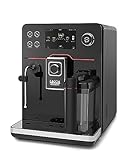
If the Ascaso’s manual routine sounds like too much, this fully automatic machine is the opposite approach. It offers 19 drink programs, a color touch display, ceramic grinders with eight levels, a 1.6-liter water tank, an integrated 0.6-liter milk carafe and a steam wand, with four user profiles. It will not give you the same control over dose, tamp and temperature, but it removes the grinder purchase and most of the learning curve. Pick it for convenience, not for tinkering.
Coffee Maker Cover for Ascaso Steel Duo – why consider it

This is an accessory rather than a machine: a fitted cover listed for the Steel Duo from 2020 through 2026. A cover keeps dust and kitchen splatter off a machine that lives on a counter, especially next to a stove. Make sure the machine is fully cool and dry before you cover it, and confirm on the listing that the dimensions match your model year before ordering. It is a small add-on, not a performance upgrade.
Questions
Is the Ascaso Steel Duo a dual-boiler machine?
No. It uses two thermoblocks, one for brewing and one for steam, which are heating elements that warm water as it passes through rather than storing it. The result is similar in workflow to a dual boiler because the circuits are independent, but the heating method and thermal behavior are different.
What is the difference between the PID and the PLUS?
Manufacturer specification tables show the same core system. Retailer descriptions of the PLUS list extra hardware such as a wooden steam lever, upgraded baskets, a different shower head and a bottomless portafilter, and note the cup warmer is removed. Check the product page for exactly what ships in the box.
Does it need a special outlet?
The current US version is reported to be designed for a higher-amperage circuit and supplied with an adapter for 15-amp use, which can reduce steam performance. Confirm the plug type on the listing, plug it directly into a wall outlet and avoid extension cords or shared circuits with other heating appliances.
Do I need a separate grinder?
Yes. The machine has no grinder, and a 58 mm portafilter needs freshly ground, finely adjustable espresso grounds. Budget for a capable espresso grinder, since grind quality affects the cup as much as the machine does.
How long does it take to warm up?
Sources quote between roughly 3.5 and 5 minutes for the thermoblock system. That is shorter than most E61 machines, but it is wise to flush the group and warm the portafilter before the first shot.
Can it steam milk and brew at the same time?
The independent steam and brew thermoblocks are designed to let you move from one task to the next without a mode-switch delay. Real-world overlap still depends on your circuit and technique, so treat it as faster sequencing rather than unlimited parallel output.
Update History
- October 21, 2026 – Initial publication; specifications checked against manufacturer documentation where available.
- Check the product page for current specifications and availability before buying.
Sources
- Manufacturer and brand product pages and specification sheets for Ascaso, Diletta and Gaggia
- Retailer listing titles and specification fields
- Published espresso-machine reviews and comparison guides
Write Your Review
No reviews yet. Be the first to share your experience!