

Key takeaways
- Best car espresso makers: six battery-powered and plug-in options compared on power source, coffee type, heat-up time and road-trip safety.
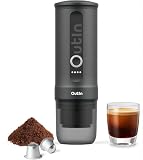
The OutIn Nano in Space Gray is the best overall car espresso maker in this group: it heats its own water, runs from a built-in battery that charges over USB-C, and takes both ground coffee and Nespresso Original-style (NS) capsules, so it needs no mains outlet at all. A “car espresso maker” is really a portable, self-heating brewer, because a countertop machine cannot run from a vehicle’s 12-volt socket. Below are six listings sorted by how well they fit road-trip use, including one mains-powered model that is a runner-up and not a true in-car pick.
Quick List
- OutIn Nano (Space Gray) – best overall for drivers who want ground coffee and capsule flexibility
- CONQUECO 12V Portable Coffee Machine – best for buyers who specifically want a car-oriented unit with a battery
- OutIn Nano (Forest Green) – best for campers and anyone who brews with ground coffee outdoors
- OutIn Nano (Teal) – best for capsule fans who want the same machine in a brighter finish
- Safashy 20 Bar Portable Coffee Maker (7800mAh) – best for a larger battery claim and 2-in-1 brewing
- IMUSA 6 or 3 Cup Electric Espresso Maker – best for the hotel room or campsite with an outlet, not for the car itself
Which One Is Right for You?
| If you… | Choose |
|---|---|
| want the most documented, well-known portable option | OutIn Nano (Space Gray) |
| like a listing that spells out 12V car use and a short heat-up time | CONQUECO 12V Portable Coffee Machine |
| mostly brew outdoors with ground coffee and want a woodland color | OutIn Nano (Forest Green) |
| mainly use capsules and want a lighter, brighter body color | OutIn Nano (Teal) |
| want a bigger stated battery and are comfortable confirming details | Safashy 20 Bar Portable Coffee Maker |
| only need Cuban-style coffee where there is a wall outlet | IMUSA 6 or 3 Cup Electric Espresso Maker |
Three of the six listings are the same OutIn Nano in different colors, so the real choice is among four machines: OutIn, CONQUECO, Safashy and IMUSA. Pick a color of the OutIn Nano last, based on taste and which variant is available in your preferred finish. The IMUSA stands apart because it plugs into a standard wall outlet and cannot be powered directly from a car.
All 6 Picks in Detail
1. OutIn Nano Portable Espresso Machine (Space Gray) – Best Overall for Road Trips
As an Amazon Associate we earn from qualifying purchases at no extra cost to you.

The Nano is a compact, self-heating electric espresso maker built for camping, RVs, hiking, offices and cars. The listing says it handles ground coffee and NS capsules and charges by USB-C. This Space Gray variant is the neutral choice: it blends into a dark center console or a gear bag and carries the same internals as the other two colors.
- Self-heating, battery-powered design with USB-C charging
- Works with ground coffee and NS capsules, per the listing name
- The maker publishes a 20 bar pump figure, roughly 80 ml of brewing capacity and a heat-up time of about 3 to 4 minutes
- Maker figures describe heating to roughly 198°F (92°C) and about 5 hot shots from a charge when starting with room-temperature water
- Weight is reported at about 670 grams; confirm on the product page
The battery detail deserves a note. OutIn’s own page describes three 2,500 mAh cells, while retailer listings often quote 7,500 mAh, which simply adds the cells together. Treat the claimed number of shots as a best case and plan to charge before every trip. If you preheat water in a thermos, the maker says the battery can stretch to well over 200 shots, because most of the energy goes into heating.
Pros:
- Documented specs, with a battery and USB-C charging that avoid fussing with the car socket
- Takes either ground coffee or NS capsules
Cons:
- Small 80 ml output means you brew one short shot at a time
- Cold-water heat-up takes several minutes, so it is a parked-car device
It is the model every other pick below is measured against, since the Forest Green and Teal listings are the same hardware in different finishes.
2. CONQUECO 12V Portable Coffee Machine – Best for Car-Focused Buyers

This listing leads with the car: it is described as a 12V car espresso maker with a battery, a roughly 3-minute heat-up time and rechargeable USB charging, and it is pitched for camping and travel. The name pairs 12V use with a built-in battery, which suggests it can be charged from a car socket and then used anywhere. Before relying on it, check on the listing whether it can brew while plugged into the socket or whether it must run off the battery.
- 12V car-oriented design, per the listing name
- Built-in battery with rechargeable USB charging
- Stated heat-up time of about 3 minutes
- Small, travel-sized electric body for camping
- Pressure, capsule compatibility and tank volume: confirm on listing
A key point about car sockets: many vehicles fuse the accessory outlet at roughly 10 to 15 amps, which works out to about 120 to 180 watts at 12 volts. A heater that draws more than the socket allows will blow a fuse, and an inverter adds another point of failure. A battery-backed machine avoids the issue because the socket only has to charge it slowly.
Pros:
- Listing explicitly targets car and camping use
- Quick stated heat-up
Cons:
- Fewer published specifications than the OutIn
- You must confirm whether it accepts ground coffee, capsules or both
Compared with the OutIn Nano, it is the one to consider if the 12V wording is the main draw, though the OutIn has the clearer specifications.
3. OutIn Nano Portable Espresso Machine (Forest Green) – Best for Outdoor Ground Coffee

Same machine, different finish: this Forest Green version matches tents, packs and trail gear, and it is the one to pick if your plan is fresh ground coffee rather than capsules. Ground coffee is where the Nano needs the most care. Writers who covered the machine commonly warn that a normal espresso-fine grind can clog the basket and produce only a trickle, so a slightly coarser grind is the usual fix.
- Same self-heating, USB-C-charged hardware as the Space Gray listing
- Ground coffee basket for beans you grind yourself
- 20 bar pump and roughly 80 ml output, per maker figures
- Water can be preheated to save battery on longer outings
- Included accessories vary by bundle; confirm on listing
For outdoor use, carry a small hand grinder, pre-measured doses in a container and a cloth. Rinse the basket right after brewing, because dried coffee oils are far harder to remove later. A tamper or the supplied scoop helps keep each dose consistent, and a second dry cup is useful for dumping the first warm-up pour.
Pros:
- Color suits camping and outdoor gear
- Lets you control the coffee, grind and dose
Cons:
- Grind size is finicky, and trial and error costs coffee
- Single small serving per brew
Choose this color over the Space Gray only for style, since the electronics and performance are the same.
4. OutIn Nano Portable Espresso Machine (Teal) – Best for Capsule Fans

The third color is Teal, and it makes the most sense for people who plan to brew NS capsules. Capsule mode removes the grinding step, which is the biggest source of trouble with portable machines: you insert the adapter, drop in the pod and press the button. Remember that “NS” refers to Nespresso Original-style capsules, not the newer Vertuo type, so check compatibility with the pods you already buy.
- Same self-heating hardware as the other two OutIn listings
- Accepts NS (Nespresso Original-style) capsules through an adapter, per the listing
- Rechargeable by USB-C; the maker mentions compatibility with 10 to 15 watt car chargers
- Cup-holder-friendly size reported at about 9 inches tall
- Color: Teal; capsule adapter and accessories: confirm on listing
Cleaning is easy in capsule mode, since the used pod holds the grounds and the brew path stays cleaner. Still, rinse the machine with plain hot water after the last brew of the day and let it dry before you pack it, to prevent odors in a closed bag or glovebox. Avoid leaving any lithium battery product in a hot parked car, because vehicle interiors can climb past the temperature limits printed in most manuals.
Pros:
- Capsule mode is the fastest way to a cup on the road
- Easy to spot, which is handy in a crowded gear bag
Cons:
- Capsules cost more per cup than ground coffee and make more waste
- Only Original-style pods fit, not every capsule system
Like the Forest Green, it matches the Space Gray in capability, so choose by color and bundle.
5. Safashy 20 Bar Portable Coffee Maker (7800mAh) – Best for a Bigger Stated Battery

The Safashy is the closest direct rival to the OutIn. Its listing describes a self-heating, battery-powered electric espresso machine with USB-C charging, a 7800mAh battery claim, a 20 bar figure and 2-in-1 use with ground coffee and NS capsules, aimed at hiking, the office and RVs. On paper it matches the OutIn feature for feature, with a slightly bigger headline battery number.
- 20 bar pump figure, per the listing name
- 7800mAh battery claim; as with similar products, confirm how the cells are wired and the real energy in watt-hours
- Self-heating, powered by USB-C charging
- 2-in-1 compatibility with ground coffee and NS capsules
- Output volume, heat-up time and weight: confirm on listing
Milliamp-hour figures alone do not tell you how many shots you get. Voltage matters, and a pack of cells in series quotes capacity differently from cells in parallel, so a bigger number is not automatically a bigger tank of energy. If the page gives watt-hours, compare that instead.
Pros:
- Matches the OutIn’s feature list at the headline level
- Larger stated battery capacity
Cons:
- Less independent documentation on real-world heat-up and shot counts
- Specs the listing name leaves out must be confirmed before purchase
Pick it over the OutIn Nano only if you value the larger stated battery and are comfortable verifying the missing details.
6. IMUSA 6 or 3 Cup Electric Espresso Maker – Runner-Up, Not a Car Pick

Be clear about what this is: an electric moka-style maker with a cast aluminum body, a detachable cool-touch base and a cool-touch handle, sold for Cuban coffee. It is a mains appliance, so it needs a wall outlet and is not designed to run from a car’s accessory socket. It makes the list as a runner-up for road trips where you will stay somewhere with power, such as a hotel, a cabin or a campsite with hookups.
- 6 or 3 cup moka-style design, per the listing name
- Cast aluminum body in a black finish
- Detachable cool-touch base and handle
- Plugs into a wall outlet; confirm voltage and wattage on the listing
- Intended for Cuban-style coffee; confirm ounce capacity
Running it from a car would require an inverter sized well above the appliance wattage, which adds risk and defeats the idea of a simple in-car brewer. Used at a campsite pedestal or in a room, it is a simple way to make strong coffee for several people at once, which none of the battery machines can do.
Pros:
- Makes several small cups per batch, unlike the single-serve units
- No battery to charge or manage
Cons:
- Cannot be used in a car without extra equipment
- Coffee style is closer to strong moka than to espresso
It is the only pick here that serves a group, so it complements a battery machine more than it competes with one.
Specs Compared
| Product | Power source | Pressure figure | Coffee type | Charging / input | Battery |
|---|---|---|---|---|---|
| OutIn Nano (Space Gray) | Built-in battery | 20 bar (maker figure) | Ground coffee and NS capsules | USB-C | 3 x 2,500 mAh cells (about 7,500 mAh quoted by retailers) |
| CONQUECO 12V Portable Coffee Machine | Battery, 12V car use per listing | Confirm on listing | Confirm on listing | Rechargeable USB | Confirm on listing |
| OutIn Nano (Forest Green) | Built-in battery | 20 bar (maker figure) | Ground coffee and NS capsules | USB-C | 3 x 2,500 mAh cells |
| OutIn Nano (Teal) | Built-in battery | 20 bar (maker figure) | Ground coffee and NS capsules | USB-C | 3 x 2,500 mAh cells |
| Safashy 20 Bar Portable Coffee Maker | Built-in battery | 20 bar | Ground coffee and NS capsules | USB-C | 7800 mAh (claimed) |
| IMUSA 6 or 3 Cup Electric Espresso Maker | Wall outlet | Moka-style, confirm on listing | Ground coffee | Corded base | None |
How We Chose These
This is a research-based roundup of the listings currently in the catalog for the car espresso keyword, written for drivers and campers who need a clear sense of power, safety and brewing limits. We compared each listing name and specification field, then cross-checked the main product against the manufacturer’s published figures and independent write-ups. We prioritized power source, because that decides whether a machine works in a vehicle at all, followed by coffee format, battery detail and how clearly the listing states its claims. Where details were missing, we say so and point you to the product page rather than guess. One mains-powered model is included on purpose and labeled as a runner-up.
What to Look For
Power Source Comes First
There are three ways a machine can be powered in a car. A built-in battery that charges by USB-C is the safest and most flexible, since the car only supplies a trickle. A true 12V heating machine plugs straight into the accessory socket and is limited by the socket’s fuse. A mains appliance needs an inverter. Because many accessory sockets are fused around 10 to 15 amps, they deliver roughly 120 to 180 watts at 12 volts, and a fast heater can easily ask for more. Check the wattage on any plug-in model before you buy, and never push past the fuse limit of the circuit.
Understand the Battery Numbers
Milliamp-hours without voltage are only half the story. Energy in watt-hours equals amp-hours times volts, so a 7,500 mAh claim made by adding cells together is not the same as a 7,500 mAh single cell at the same voltage. The practical number is shots per charge from cold water, and the biggest lever you control is the starting water temperature. Preheated water saves most of the energy, because heating is what drains the pack. A worked example: if a maker says five cold-water shots per charge, plan on three or four in cold weather and carry a power bank for longer trips.
Brew Format: Ground or Capsule
Ground coffee gives better flavor control and costs less per cup, but it demands the right grind. Portable machines usually need a coarser grind than a full-size espresso machine, because small pumps and baskets clog easily. Capsules are faster and cleaner, and an NS adapter means Nespresso Original-style pods. Decide which you will really use on the road, because a machine that handles both is only an advantage if you will carry the extra gear.
Safety on the Road
Hot water near 198°F (92°C) can scald, and a moving car is the wrong place to handle it. Brew only while parked, set the machine on a stable surface and keep it away from children. Do not leave lithium battery devices in a hot parked car, since interior temperatures can exceed the limits printed in manuals. Dry the machine before storing it, and use clean, filtered water to prevent scale buildup in the heating path.
Water, Doses and Shot Size
A short shot of about 80 ml, which is roughly 2.7 fluid ounces, is the usual capacity for pocket machines, so think in terms of one small espresso at a time. Start with cold, clean water, or better, water you have preheated in an insulated bottle at the hotel or campsite. Fill only to the marked line, use a level scoop of grounds, and press the brew control only when the machine signals that it is ready. Skipping the warm-up step is the quickest way to a weak, lukewarm shot.
Size, Cleanup and Storage
A portable brewer lives in a glovebox, door pocket or backpack, so measure before you buy. A body around 9 inches tall, like the one the OutIn maker describes, fits many cup holders, while squat designs slide into a console tray. Single-shot output of about 80 ml means one short espresso per brew, so a second small cup, a rinse bottle and a microfiber cloth belong in the same pouch. After each trip, run clean water through the machine, let every part dry and store it with the lid ajar to keep odors from settling in.
Questions
Can I use a normal espresso machine in my car?
Not directly. Countertop espresso machines are built for wall power and draw far more current than a car accessory socket supplies. An inverter large enough to run one adds cost, bulk and risk, so a battery-powered portable model is the practical route.
How long does a portable car espresso maker take to brew?
Maker figures for the OutIn Nano put the heat-up near 3 to 4 minutes from room-temperature water, followed by a short brew. The CONQUECO listing states about 3 minutes. Preheated water shortens the wait a lot.
Is the OutIn Nano in Space Gray, Forest Green and Teal the same machine?
Based on the listing names, yes: the product description is identical and only the color differs. Confirm the included accessories and bundle contents on each product page, since they can vary.
Why is my ground coffee barely coming through?
The most common cause is a grind that is too fine for a small portable pump. Try a coarser setting, use a level dose and avoid tamping hard. Capsules avoid this problem entirely.
Can I charge these machines from a car?
The USB-C models can charge from a car USB port or adapter, and the OutIn page mentions 10 to 15 watt car chargers. A higher-output charger will be faster, but follow the manual. Check the charging requirements on each listing.
Is the IMUSA usable on a road trip?
Yes, but only where you have a wall outlet, such as a hotel room or a campsite with hookups. It cannot be run straight from a car socket, so it is better as a group coffee maker than a car brewer.
Update History
- October 21, 2026 – Initial publication; product set drawn from current catalog listings.
- Check the product page for current specifications and availability before buying.
Sources
- Manufacturer product and specification pages for OutIn
- Retailer listing titles and specification fields for each product covered
- Independent outdoor and coffee write-ups discussing the OutIn Nano’s battery, heat-up time and grind advice



Write Your Review
No reviews yet. Be the first to share your experience!