

Key takeaways
- Compare the best stovetop percolators in stainless steel, glass and aluminum, with capacity, induction compatibility, brew times and care notes.
The COLETTI Bozeman 9-cup is the best stovetop percolator in this group: all-steel in the coffee path, a glass knob to watch the perk, a handle that stays cool and a size that fits four mugs. Choose the Farberware Yosemite if you want a traditional polished pot that cleans up easily. A stovetop percolator has no cord or timer. Water in the base boils, steam pushes it up a center tube, and it rains back down through the grounds until you pull the pot off the heat. Six models follow, covering steel, glass and aluminum, and we flag where listings leave details open.
Quick List
- COLETTI Bozeman 9-cup – best overall for a steel pot that suits a stove or a fire
- Farberware Yosemite 8-cup – best for a classic pot with simple cleanup
- COLETTI Bozeman 12-cup – best for brewing for a crowd on a camp stove or range
- Farberware Yosemite 12-cup – best for large batches in a familiar stainless design
- Cafe Brew glass percolator, 8-cup – best for watching the brew in a heat-safe glass pot
- Primula Today aluminum percolator, 9-cup – best for the lightest pot and the simplest kit
Which One Is Right for You?
| If you… | Choose |
|---|---|
| Want one pot that works on a range, a camp stove and an open fire | COLETTI Bozeman 9-cup |
| Serve six or more people at a cabin weekend or a family breakfast | COLETTI Bozeman 12-cup |
| Prefer a dishwasher-friendly pot with a long warranty period for a home range | Farberware Yosemite 8-cup |
| Need the same Farberware look in a size for a group | Farberware Yosemite 12-cup |
| Like to see the coffee and are willing to use a heat diffuser on electric coils | Cafe Brew glass 8-cup |
| Want a light, simple pot for occasional use or a pack-in camp kit | Primula Today aluminum 9-cup |
Three questions narrow this list quickly: how many people you brew for, whether your range is gas, coil or induction, and whether you want an all-steel coffee path. Remember that percolator cups are small, so a nine-cup pot is closer to a few mugs than to nine.
All 6 Picks in Detail
1. COLETTI Bozeman 9-Cup – Best Overall for Range and Campfire
As an Amazon Associate we earn from qualifying purchases at no extra cost to you.

COLETTI built the Bozeman around a single promise: no aluminum or plastic touches the coffee. It uses 18/8 food-grade stainless steel with a glass viewing knob and a hardwood handle, and the nine-cup size holds 45 fluid ounces, which the maker translates to about four 12-ounce mugs. That makes it the most balanced size here for a couple, a small family or a pair of campers sharing a morning pot.
- Capacity: 45 fluid ounces, counting a cup as 5 ounces
- Material: 18/8 stainless steel, glass knob, hardwood handle
- Heat: gas, electric coil, glass-ceramic and open fire
- Induction: not compatible; a separate induction model exists
- Technique: coarse grind, about a tablespoon per cup, 7 to 10 minutes over medium-low heat
- Care: top-rack dishwasher safe per the maker; hand wash the handle; one-year warranty
Pros
- All-steel brew path with filters included
- Cooler handle and easy-to-read glass knob
- Works on a fire
Cons
- Not for induction ranges
- Wood handle needs care
The glass knob is more than decoration. It shows how often the coffee perks, and a steady bubble every second or two is the sign to hold the heat where it is. Because the pot is steel and has a wooden handle, it is a good candidate for a camp box that has to survive a drop in a truck bed. Against the 12-cup Bozeman it is lighter and easier to store, and it is less likely to be too large for your burner.
2. Farberware Yosemite 8-Cup – Best for a Traditional, Easy-Clean Pot

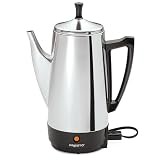
Few percolators look as familiar as the Yosemite. Farberware lists an interior and exterior of stainless steel with a glass knob, a permanent filter basket that makes paper unnecessary, and a size of 8.25 inches high on a 6.25 inch base, about 9.25 inches long with the handle. It suits anyone who wants a handsome pot for a gas or electric range and a cleanup routine that includes the dishwasher.
- Capacity: 8 cups
- Material: stainless steel inside and out, glass knob
- Basket: permanent, no paper filter needed
- Dishwasher: safe except for the knob and pump tube spring, per Farberware
- Induction: Farberware’s page says it is not induction-suitable
- Warranty: limited lifetime, per the maker
Pros
- Easy to rinse and wash
- Familiar design with a long track record
Cons
- No induction
- Handle is not described as wood, so confirm how it handles heat
Treat the permanent basket as a trade: you save paper but may see a little sediment, and a slightly coarser grind usually solves it. If the pot has been sitting unused, run a cycle of plain water and a little white vinegar, then rinse, so any dust or old oil is gone. It also stores neatly: with the knob and basket removed, the pot nests easily in a cabinet. A gentle scrub of the stem and a pipe-cleaner pass through the tube keep the water path clear, which matters more than most owners realize. Compared with the 9-cup Bozeman, it is a touch smaller and has a more traditional look, with fewer camping extras.
3. COLETTI Bozeman 12-Cup – Best for Groups and Long Mornings
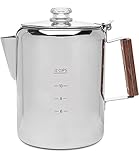
This is the same design as the 9-cup in a larger body. COLETTI lists the 12-cup at 60 fluid ounces, which is enough for about five 12-ounce mugs. It suits family cabins, tailgates, work crews and anyone who prefers to brew one big pot instead of two small ones. The materials story is unchanged: 18/8 stainless steel, a glass viewing knob and a hardwood handle.
- Capacity: 60 fluid ounces at 5 ounces per cup
- Material: 18/8 stainless steel, glass knob, hardwood handle
- Heat: gas, electric and glass-ceramic ranges and open fire
- Induction: not compatible per COLETTI
- Filters: a pack is included, per the maker
- Size: larger and heavier than the 9-cup, so confirm it suits your burner
Pros
- One pot for a full table
- Same all-steel path as the smaller size
Cons
- Bulky to pack
- A large pot of water takes longer to come to a perk
A bigger pot will not fix a weak flame. If you cook on a small camp stove, check that the burner delivers enough heat to bring 60 ounces of water to a perk in a reasonable time, and fill only to the line you need. Use the measure of a level tablespoon of coarse coffee per cup and scale it up. Compared with the 12-cup Farberware, it adds a wooden handle and a stronger camping focus, while the Farberware is simpler to wash.
4. Farberware Yosemite 12-Cup – Best for Large Batches at Home

The 12-cup Yosemite carries the same stainless look as the 8-cup and adds capacity for gatherings. Retailer listings for this model vary in their dimensions, with heights of roughly 9 to 11 inches, so confirm size and clearance under a vent hood or on a camp stove. Cup size is not spelled out in the listing, so assume the common 5 ounce percolator cup, or about 60 ounces, and confirm on the page.
- Capacity: 12 cups, about 60 ounces if the 5-ounce cup applies
- Material: stainless steel with a glass knob
- Basket: permanent filter basket
- Dimensions: vary by retailer, so confirm
- Induction: confirm on the product page; the maker states the line is not induction-suitable
- Care: Farberware’s 8-cup page excludes the knob and pump tube spring from the dishwasher; confirm the same for this size
Pros
- Large capacity at the familiar design
- Permanent basket
Cons
- Dimensions differ between listings
- No induction
This pot makes sense when the same coffee needs to serve a dozen small cups at a brunch. Since percolated coffee is hard to reheat without turning harsh, plan to pour it all into a thermal carafe if you will not drink it within a short time. Measure your burner before you buy, because a tall 12-cup pot has a higher center of gravity and a wider handle swing than the 8-cup pot, and it needs steady placement on a small range. Next to the 12-cup COLETTI, the Farberware is the easier-to-wash classic, while the COLETTI is the choice for campfires.
5. Cafe Brew Glass Percolator, 8-Cup – Best for Watching the Brew

This is the odd one out, and an interesting one: a stovetop percolator made of German borosilicate glass, holding 40 ounces, with a BPA-free lid and stand. You can see the water climb the tube, which makes the brew easy to judge. The manufacturer says it is safe on gas and electric stovetops and includes a metal heat diffuser, called a trivet, for use on exposed electric coils.
- Capacity: 40 ounces, listed as 8 cups
- Material: borosilicate glass with plastic parts, stated as BPA-free
- Heat: gas or electric; use the diffuser on coils, between the coil and the glass
- Burner size: do not use a burner wider than the glass
- Use: 4 to 8 cups of water, with a rounded tablespoon of coarse coffee per cup
- Induction: glass is not induction compatible without an adapter plate; confirm
Pros
- You can see the whole process
- No metallic flavor from the pot
Cons
- Glass can break from impact or thermal shock
- Needs a diffuser and a careful burner match
The maker warns that misuse can break the glass or melt plastic parts, so follow the instructions about lid alignment: the opening in the lid should line up with the pour spout so steam can vent. Do not set the hot pot on a cold or wet surface. Compared with the stainless Yosemite, it gives you a view of the brew in exchange for a more delicate vessel.
6. Primula Today Aluminum Percolator, 9-Cup – Best for a Light, Simple Pot
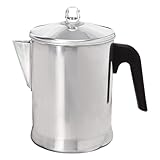
Primula sells a lightweight aluminum percolator with a clear knob, a lipped spout and a stay-cool plastic handle. It is the simplest and lightest option here, with listing dimensions of about 5.2 inches deep, 8.15 inches wide and 8.23 inches high. It suits occasional campers and anyone who wants a basic pot for a backup kitchen. It is the one pick in this guide that is neither steel nor glass, and it comes with trade-offs.
- Capacity: listed as 9 cups; check the fill line, since the cup used may be smaller than the standard 5 ounces
- Material: aluminum body, plastic handle and clear knob
- Heat: gas and electric stovetops and other flat heat sources
- Induction: not compatible unless used with an adapter plate
- Included: pot, lid and a basket with a filter screen
- Care: aluminum is usually best washed by hand; confirm the manufacturer’s instructions
Pros
- Light and simple
- Heats quickly
Cons
- Aluminum rather than steel, which some buyers want to avoid
- Real brewing volume may be lower than the nominal 9 cups
Because the plastic handle and the aluminum body are thinner than the steel pots, keep the flame under the base and well away from the handle. Use low heat as soon as the first bubble appears. Since aluminum is soft, avoid abrasive scouring and metal utensils inside the pot, and dry it after washing to prevent spotting. Compared with the 9-cup Bozeman, it is lighter but gives up the all-steel brewing path that is the Bozeman’s main point.
Specs Compared
| Pick | Capacity | Body | Knob and handle | Heat sources | Induction | Care notes |
|---|---|---|---|---|---|---|
| COLETTI Bozeman 9-cup | 45 fl oz | 18/8 stainless steel | Glass knob, hardwood handle | Gas, coil, glass-ceramic, fire | No | Top-rack safe; hand wash handle |
| Farberware Yosemite 8-cup | 8 cups | Stainless steel | Glass knob | Gas or electric range | No | Dishwasher safe except knob and spring |
| COLETTI Bozeman 12-cup | 60 fl oz | 18/8 stainless steel | Glass knob, hardwood handle | Gas, coil, glass-ceramic, fire | No | Same as the 9-cup |
| Farberware Yosemite 12-cup | 12 cups | Stainless steel | Glass knob; confirm color | Gas or electric range | Confirm on listing | Confirm on listing |
| Cafe Brew glass 8-cup | 40 oz | Borosilicate glass | Plastic parts, BPA-free | Gas or electric with diffuser | Confirm on listing | Follow glass-handling warnings |
| Primula Today 9-cup | 9 cups nominal | Aluminum | Clear knob, plastic handle | Gas, electric, flat heat sources | Only with adapter plate | Confirm; hand wash likely best |
How We Chose These
We limited the field to percolators meant for a stovetop or fire and then compared listings on capacity, body material, handle, knob and stove compatibility. Manufacturer pages for COLETTI, Farberware and Cafe Brew supplied the firm numbers, such as ounces, dimensions and the induction caveat. For the Primula pot, the listing supplies fewer details, so several lines are marked for you to confirm. We ranked pots with an all-steel path and clear care guidance first, glass second and aluminum last, and we describe each strictly by what the listing and maker say.
What to Look For
Material and what touches the coffee
Stainless steel is the default for a reason: it does not stain easily, tolerates a campfire and does not react with coffee. The 18/8 grade used by COLETTI is a common food-contact stainless. Glass lets you see the perk but needs a diffuser on coils and careful handling. Aluminum is light and heats quickly but is softer and usually washed by hand. Also look at the small parts, because a basket or lid that is plastic or aluminum changes what the coffee touches even when the body is steel.
Size and the five-ounce cup
Percolator cups are about 5 ounces. COLETTI lists its 9-cup at 45 ounces and its 12-cup at 60. As a rule of thumb, multiply your mugs by their size and divide by 5. Three 12-ounce mugs need 36 ounces, which is about seven percolator cups, so a 9-cup pot is a comfortable fit and a 12-cup is more than you need. Leave a little room, because filling to the brim invites coffee to boil over through the spout and lid. A second worked example: for a 12-cup pot at a level tablespoon per cup, a full 12 cups calls for 12 tablespoons of coarse coffee, while a half batch of 6 cups needs 6 tablespoons and gives a pot that is noticeably quicker to bring to a perk.
Stove compatibility and heat control
Gas flames and electric coils suit nearly every pot here. Smooth glass-ceramic tops want a flat base, and induction is a problem for all six: COLETTI and Farberware both say their steel pots are not induction-ready, aluminum needs an adapter plate and glass will not heat on induction. Match the base to the burner. A flame that licks the sides will scorch handles and can crack glass. Once the first bubbles climb into the knob, lower the heat so the perk settles to a steady beat of about one bubble every second or two.
Timing, grind and filters
Use a coarse grind, similar to a French press, since the basket holes are large and fine coffee falls through. COLETTI suggests about a level tablespoon of coffee per cup and 7 to 10 minutes of perking on medium-low. Go shorter for a milder cup. Percolators recirculate brewed coffee, so they can overextract and turn bitter if left on the heat. A paper filter or a cloth disc lowers sediment in a pot with a permanent basket.
Care and safety
Stovetop pots get hot everywhere. Lift them with a pot holder, keep handles away from the flame, never leave the pot to boil dry and let it cool fully before you wash it. Rinse the stem and basket after every use, since old coffee oils turn rancid. For glass, follow the diffuser and burner-size rules, and avoid sudden temperature changes.
Questions
How long should I percolate coffee on the stove?
COLETTI recommends 7 to 10 minutes on medium-low heat. Begin timing once the coffee starts bubbling into the glass knob, and lower the heat if it perks faster than about once every second or two.
What grind works best in a stovetop percolator?
Choose a coarse grind, close to what you would use for a French press. A fine grind slips through the basket holes into the cup and also overextracts.
Can I use any of these on an induction cooktop?
Not as sold. COLETTI and Farberware both say their stainless pots are not for induction, glass will not heat on induction, and aluminum needs an adapter plate. COLETTI sells a separate induction version.
Is a glass percolator safe on a stove?
The Cafe Brew maker says it is safe on gas and electric stovetops when used as directed, with a metal diffuser on electric coils and a burner no wider than the glass. Misuse can break the glass, so follow the instructions closely.
Why does my percolator coffee taste burnt?
Usually the heat is too high or the pot perked too long. Percolators send already-brewed coffee through the grounds repeatedly, so a hard boil or a long cycle pushes it toward bitterness. Lower the flame, use a coarser grind and shorten the time.
Do I need paper filters?
No, since each pot has a basket. COLETTI includes filters and Farberware promotes a permanent basket, but a paper filter is optional if you want a cleaner cup.
Update History
- October 21, 2026 – Initial publication; specifications checked against manufacturer documentation where available.
- Check the product page for current specifications and availability before buying.
Sources
- Manufacturer product and specification pages for COLETTI, Farberware and Cafe Brew
- Retailer listing titles and specification fields, including those for Primula
- General reference material on how stovetop percolators work


Write Your Review
No reviews yet. Be the first to share your experience!