

Key takeaways
- Compare five wall-mount shelves for a coffee bar, from short three-shelf sets to a long 36-inch trio, and pick the span and brackets your wall can hold.
A wall-mount shelf is a flat board fixed to the wall on hidden brackets or visible metal arms, and above a home coffee bar it turns dead wall space into the storage the counter never has. Espresso gear spreads fast: cups and saucers, a grinder, a tamper and distributor, a knock box, jars of beans, a scale, a milk pitcher, and a row of syrup bottles all compete for the same stretch of countertop, and the machine itself already takes the best part of it. A shelf lifts the light, daily items up to eye level, where they are easy to reach and easy to see, and leaves the counter clear for the work that has to happen there: dosing, tamping, and pulling the shot. The five shelves in this guide cover the whole class for a coffee corner: short three-shelf sets for cups and jars, a long 36-inch trio for a full run of gear, a wide two-shelf ledge for books and canisters, and a natural wood four-shelf set for a warmer look.
The deciding factor is always the wall, because a shelf is only as strong as its fixing. A shelf loaded with ceramic cups and glass jars is heavy, and that weight hangs away from the wall, which multiplies the pull on every screw. Drywall alone will not hold it: the brackets need a stud, a solid masonry wall, or anchors rated for the load, and the anchors that ship in the box are a starting point rather than a guarantee. Measure the wall, find the studs, and match the shelf length to the stud spacing before ordering. Get the fixing right and a wall-mount shelf holds a coffee bar together for years; get it wrong and the shelf comes down with everything on it.
As an Amazon Associate, we earn from qualifying purchases.
Table of Contents
- Why a Wall-Mount Shelf Earns Its Place
- How to Choose a Wall-Mount Shelf
- Quick Comparison
- AMADA HOMEFURNISHING Floating Shelves Black Set of 3
- BAYKA Floating Shelves Black 36-Inch Set of 3
- Sorbus Floating Shelves White 16-Inch Set of 3
- Greenco Wall Mounted Floating Shelves White Set of 2
- AMADA HOMEFURNISHING Paulownia Wood Floating Shelves Natural Set of 4
- How to Lay Out Shelves Above a Coffee Bar
- Who Should Skip a Wall-Mount Shelf
- Safety and Recall Checks
- Frequently Asked Questions
- Conclusion
- Product and ASIN Reference
Why a Wall-Mount Shelf Earns Its Place
The coffee bar is the busiest small corner in many kitchens, and that single fact explains why a shelf earns its place there. An espresso machine needs depth on the counter, a grinder needs a spot beside it, and the knock box, tamper, distributor, scale, and pitcher need to live within arm’s reach of the portafilter. Cups need a home too, and so do the beans, the cleaning tablets, the descaler, and the cloths. A counter that holds all of that has no room left to work on, and a barista who has to move three things to make room for the portafilter is working against the room rather than with it. A wall-mount shelf breaks that logjam by moving the storage up, off the counter, and onto the wall above the machine, where it costs no counter space at all.
Visibility is the second reason, and it matters more than it first appears. Gear stored in a cupboard is gear that gets forgotten: the demitasse cups at the back of the shelf, the spare basket, the bag of decaf beans, the small pitcher for a single cortado. Gear stored on an open wall shelf is gear that gets used, because the eye lands on it every morning and the hand knows where it is without opening a door. A shelf turns the coffee corner into a small display as well as a store, and that display does real work: cups are grabbed in one motion, beans are checked at a glance, and the morning routine runs on habit rather than on hunting through cupboards.
Order is the third reason, and it is the one that shows up in the shot. Espresso rewards a tidy workflow: dose, distribute, tamp, lock in, pull, steam, pour. Each step needs its tool in the same place every time, and a shelf gives each tool a fixed address. The tamper and distributor live on the middle shelf, the cups on the top shelf, the beans and scale on the lower shelf, and the routine stops depending on memory. That order also keeps the counter clean, and a clean counter matters for espresso because stray grounds on the counter end up in the cup, on the machine, and on the floor. A shelf does not make better coffee by itself, but a tidy bar makes a better routine, and a better routine makes better coffee more often.
A shelf also protects the gear. Cups stacked in a cupboard chip against each other every time the door opens, and glass jars of beans rattle against the cupboard wall. Cups standing in a row on a shelf, each with its own space, chip far less often, and jars lined up on a shelf are easy to lift down one at a time rather than dug out from behind other jars. The shelf keeps the gear where it can be seen and reached without a scramble, which is the simplest form of care a coffee corner gets.
The last reason is that a shelf is a small, simple addition with no moving parts and nothing to learn. It needs no power, it needs no calibration, and it does not change how the machine pulls a shot, because it sits above the work rather than in it. It is the kind of purchase that disappears into the routine within a day: the cups come down from the shelf, the shot is pulled, the cups go back up, and the counter stays clear. For a household that makes espresso every morning, that small change repeats hundreds of times a year, and the value of a shelf is the sum of all those small, uneventful mornings.
How to Choose a Wall-Mount Shelf
Start with the wall, not the shelf. Find the studs with a stud finder or by tapping and listening for the solid sound, and mark their centers with painter’s tape. Most studs sit 16 inches apart, so a shelf that spans two studs is the strongest arrangement, and a long 36-inch shelf will usually cross two studs while a short 16-inch shelf may catch only one. Masonry and brick walls take a different fixing: a masonry drill bit and sleeve anchors rather than wood screws. Drywall with no stud behind it needs toggle bolts or heavy-duty wall anchors, and the anchors in the box should be checked against the load rather than trusted blindly. The wall decides the shelf length, the bracket type, and the fixing, so measure it before ordering anything.
Next, measure the run. A coffee bar shelf needs to clear the machine below it, which means the lowest shelf should sit high enough that the cup warmer on top of the machine, the grinder hopper, and the steam wand all clear it with room to spare. A good rule is to hold a tape measure above the tallest item on the counter and add a hand’s width for lifting cups down. Then measure the width of the wall: a shelf that runs the full width of the coffee corner looks intentional, while a shelf that stops halfway across a wide wall looks like an afterthought. Short sets of three shelves suit a narrow corner, and a long trio suits a wide wall where one long run replaces several short ones.
Depth comes third, and it is the dimension that decides what fits. A shelf around 5 to 6 inches deep holds a row of demitasse and cappuccino cups, a line of small jars, and a tamper mat, and it keeps everything close to the wall where the load is lightest. A shelf around 9 inches deep holds a grinder accessory, a pour-over dripper, a stack of saucers, and a row of syrup bottles, but it also sticks further into the room and puts more leverage on the brackets. Measure the deepest item that will live on the shelf, add a finger’s width, and compare that number with the depth in each Specs block below. A shelf that is too shallow leaves cups hanging over the edge, and a shelf that is too deep crowds the space above the machine.
Load capacity comes next. The common figure across this class is 22 pounds per shelf, which covers a row of ceramic cups, a few glass jars, and a light accessory or two. Heavier loads change the picture: a shelf full of full bean jars, a stack of saucers, and a heavy ceramic pour-over set adds up fast, and a long shelf loaded end to end puts more strain on its brackets than a short shelf with the same total weight. Check the stated capacity in the Specs block, keep the heaviest items closest to the wall and nearest the brackets, and spread the load across the shelf rather than piling it at one end. A shelf that is loaded within its rating and fixed into studs will hold steady; a shelf that is overloaded or fixed into bare drywall will sag, tilt, or fall.
Material comes after capacity. Most shelves in this guide are engineered wood with a laminate or matte finish, which is light, smooth, and easy to wipe clean after a splash of milk or coffee. Solid paulownia wood is lighter still and has a visible grain that suits a warmer coffee corner, while a matte black or white laminate suits a modern machine and disappears against a painted wall. The finish matters for cleaning: a smooth matte surface wipes down with a damp cloth, while a rough or open-grained surface holds coffee dust in its texture. Pick the material that matches the machine and the room, and remember that a shelf above a steaming espresso machine will see moisture every day, so a sealed finish lasts longer than a raw one.
Brackets are the last choice, and they decide both the look and the strength. Hidden brackets slide inside the shelf and leave no visible support, which gives the floating look that suits a clean coffee bar. Visible metal arms and triangular brackets show their work and hold more weight, which suits a long shelf or a heavy load of jars. Corner shelves use their own small brackets and suit a tight corner where a straight shelf will not fit. Either style works, but the bracket should match the load: a hidden bracket suits light cups and jars, and a triangular or visible bracket suits a long run or a heavy row of full bean jars. Check the bracket type in the Specs block, and confirm that the mounting hardware in the box suits the wall on the counter: wood screws for studs, masonry anchors for brick, and toggle bolts for bare drywall.
Finally, think about the set. A set of three short shelves suits a corner where cups live on one shelf, jars on the next, and accessories on the third. A set of two long shelves suits a wide wall where one shelf holds the daily cups and the other holds the beans and brewing gear. A set of four suits a household that wants a full wall of storage, with a shelf for each part of the routine. Buy the set that matches the wall and the routine, and leave a spare shelf in the box only when the wall truly has room for it later.
Quick Comparison
| Product | Shelves | Length | Material | Tier |
|---|---|---|---|---|
| AMADA HOMEFURNISHING Floating Shelves Black Set of 3 | 3 | Short set | Faux wood, matte finish | Budget |
| BAYKA Floating Shelves Black 36-Inch Set of 3 | 3 | 36 inches | Engineered wood | Premium |
| Sorbus Floating Shelves White 16-Inch Set of 3 | 3 | About 16 inches | MDF with PVC brackets | Mid-range |
| Greenco Wall Mounted Floating Shelves White Set of 2 | 2 | About 26 inches | MDF with laminate | Budget |
| AMADA HOMEFURNISHING Paulownia Wood Floating Shelves Natural Set of 4 | 4 | Short set | Paulownia wood | Mid-range |
AMADA HOMEFURNISHING Floating Shelves Black Set of 3

The AMADA black set is the plain starting point for a coffee bar, and that plainness is its main strength. Three matching shelves in black faux wood with a matte finish give a corner three separate levels: cups on one, jars on the next, and the tamper, distributor, and small tools on the third. The invisible brackets slide inside each shelf, so no metal shows below the board and the shelf appears to float against the wall, which keeps the look clean above a machine that already has plenty of steel and chrome on show. Black suits a dark machine, a black grinder, and a black tamper handle, and it reads as part of the coffee gear rather than as a piece of furniture that wandered into the kitchen.
The matte finish is the detail that matters for daily use above an espresso machine. A matte surface does not show every fingerprint and water spot the way a gloss surface does, and it wipes down with a damp cloth after a splash of milk or a puff of coffee dust. The faux wood build keeps each shelf light, which makes installation a one-person job: hold the bracket level, mark the holes, fix the bracket, and slide the shelf on. The set format is the whole argument for a coffee corner, because three short shelves can be staggered up the wall, mounted side by side for one long run, or spaced apart so the tallest shelf clears the grinder hopper and the lowest clears the machine. A single long shelf cannot be rearranged that way, and a corner that changes as the gear changes will use that flexibility.
The limits are the ones that come with any short hidden-bracket shelf. The set suits light coffee-bar loads: ceramic cups, small glass jars, a tamper, a distributor, and a few small accessories. It does not suit a row of full bean jars, a stack of heavy saucers, and a ceramic pour-over set all on one shelf, and a buyer who loads it that way should fix the brackets into studs and keep the heaviest items close to the wall. The black finish also shows pale coffee dust and dried milk spots, so the shelf needs a wipe as part of the daily routine rather than once a month. Buy the set when the coffee corner needs three short levels for cups, jars, and tools and the wall has studs to fix into, and skip it when the wall needs one long run or the load is a full shelf of heavy jars.
Specs
- Form Floating shelves, set of 3
- Material Faux wood with a matte finish
- Color Black
- Mount Invisible brackets
- Model AMFS07
- Use Cups, jars, and small coffee tools
- Tier Budget
BAYKA Floating Shelves Black 36-Inch Set of 3
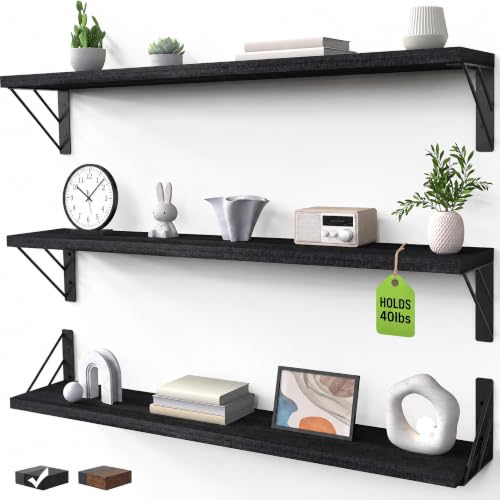
The BAYKA 36-inch set is the long-run pick in this guide, and its length is the reason to choose it. Three shelves, each 36 inches long, cover a full coffee bar wall in one purchase: the top shelf holds the cups for the household, the middle shelf holds the beans, the scale, and the brewing gear, and the lower shelf holds the daily cups within easy reach of the machine. A long shelf changes how a coffee corner looks, because one unbroken line of board reads as intentional where three short shelves can read as scattered. It also changes how the corner works, because a long shelf holds a full row of cups without gaps, and a full row is faster to scan in the morning than cups split across short boards.
The brackets are the second reason to choose it. Each shelf is reinforced with sturdy triangular brackets, and the listing states a capacity of 40 pounds per shelf, which is nearly double the 22-pound figure that most short shelves in this class carry. That capacity matters above a coffee bar, where a shelf can end up holding a row of full bean jars, a stack of saucers, and a heavy ceramic dripper at the same time. Triangular brackets show their work where hidden brackets hide it, and that visible support is honest about the load: the shelf is built for weight, and the brackets say so. The black engineered wood finish matches a dark machine and a black grinder, and the protective sealant on the boards resists warping, which matters above a machine that steams milk and throws off heat and moisture every day.
Installation needs more care than a short shelf, because a 36-inch board crosses more wall and its leverage is greater. The board will usually cross two studs, and fixing into both is the way to use its capacity: mark the studs, level the brackets, and fix every bracket into solid material rather than bare drywall. A long shelf also needs a level check across its full length, since a small tilt at one end reads as a large tilt across 36 inches, and cups will slide toward the low end. The set weighs 6.1 pounds in the box, which is light enough for one person to handle, but a second pair of hands helps when the board is being lifted onto the brackets and leveled.
The limit is the wall itself. A 36-inch shelf needs a 36-inch run of clear wall above the machine, and a narrow corner or a wall broken by a window, a cabinet, or a light switch will not take it. The triangular brackets also suit a buyer who is happy to see the support, and a buyer who wants the floating look with no visible bracket should pick a hidden-bracket set instead. Buy the set when the coffee bar has a wide, clear wall and the load includes full jars and heavy cups, and skip it when the wall is narrow, the load is light, or the floating look matters more than capacity.
Specs
- Form Floating shelves, set of 3
- Material Engineered wood with a protective sealant
- Length 36 inches per shelf
- Brackets Reinforced triangular brackets
- Stated capacity 40 pounds per shelf
- Item weight 6.1 pounds
- Model FSS5V177
- Color Black
- Tier Premium
Sorbus Floating Shelves White 16-Inch Set of 3

The Sorbus set is the tidy middle of this guide: three white shelves, each about 16 inches long, that suit a coffee corner where the machine is light-colored and the wall is pale. White shelves disappear against a white wall, which makes the cups and jars on them stand out rather than the boards themselves, and that is the right effect above a coffee bar, where the gear is the display. Each shelf measures about 16.25 inches long, 5.50 inches wide, and 1.5 inches thick, which is deep enough for a row of cappuccino cups and a line of small jars, and thick enough to look like a real shelf rather than a thin board. The set has been on sale since January 2022, which is a long run for a shelf, and that longevity means the sizing and the hardware are settled rather than new.
The build is MDF with PVC brackets, and the mounting hardware is included in the box. Installation follows the same three steps as the other hidden-bracket shelves here: fix the bracket to the wall with the included anchors and screws, slide the shelf onto the bracket, and secure it in place. The listing states that assembly takes less than five minutes per shelf, which matches the reality of a short board with one bracket: level it, mark it, fix it, and slide it on. Each shelf supports up to 22 pounds, which covers a row of ceramic cups, a few glass jars, and a light accessory, and the white finish wipes clean with a damp cloth after a splash. The set weighs 2.59 pounds in total, so the boards are light in the hand and easy to hold level while the holes are marked.
The depth is the dimension to check before ordering. At 5.50 inches deep, the shelf holds cups, jars, and small tools, but it will not hold a deep item such as a large pour-over dripper with its base, a wide canister, or a stack of saucers with room to spare. Measure the deepest item that will live on the shelf and compare it with the 5.50-inch figure: a cappuccino cup sits comfortably, a syrup bottle stands with its base near the edge, and a wide jar will overhang. The white finish also shows coffee dust and dark grounds clearly, so the shelf needs a wipe as part of the daily routine, and a buyer who dislikes that upkeep should pick a darker board. Buy the set when the coffee corner needs three short white shelves for cups and jars above a light-colored machine, and skip it when the items are deep or the load is heavy.
Specs
- Form Floating shelves, set of 3
- Material MDF with PVC brackets
- Dimensions About 16.25 x 5.50 x 1.5 inches per shelf
- Stated capacity Up to 22 pounds per shelf
- Mount Hidden brackets, hardware included
- Model WD-NTSHLV3-WH
- Item weight 2.59 pounds
- Color White
- Tier Mid-range
Greenco Wall Mounted Floating Shelves White Set of 2

The Greenco set is the wide-ledge pick in this guide, and its shape is the reason to choose it. Two shelves, each 25.59 inches wide, 7.87 inches deep, and 5.12 inches high including the bracket, give a coffee bar two long, deep ledges rather than three short boards. The extra depth matters: at nearly 8 inches deep, the shelf holds a row of cups with room behind them for a small jar, a stack of saucers, or a pour-over dripper, and the raised bracket edge keeps light items from sliding off the front. A two-shelf set suits a wall where the routine splits in two: daily cups and tools on the lower shelf, beans, brewing gear, and display pieces on the upper shelf.
The build is MDF faced with laminate in a white finish, which is smooth, light, and easy to wipe after a splash of milk or coffee. The laminate skin resists moisture better than raw wood, which matters above a machine that steams every day, and the white finish matches a light machine, a white grinder, and a pale wall. The set ships with step-by-step instructions and all necessary mounting hardware, and the brackets are visible metal arms rather than hidden rods, which gives the shelf a ledge look and a solid feel under the hand. The visible bracket is also a practical advantage: it is easy to see whether the bracket is level and firmly fixed before the board goes on, and easy to check later that nothing has worked loose.
The two-shelf format is both the strength and the limit. Two long shelves cover a wide wall with fewer boards and fewer fixings than a three- or four-shelf set, and the long span suits a full row of cups without a break. But two shelves give only two levels, so a household that wants a separate level for cups, jars, tools, and display pieces will run out of levels and end up stacking items on top of each other. The shelf is also wider than a short set, so it needs a wider run of clear wall, and a narrow corner will not take a 25.59-inch board. Buy the set when the coffee bar has a wide wall and the routine splits cleanly into two levels with deep items on each, and skip it when the corner is narrow or the gear needs three or four separate levels.
Specs
- Form Wall mounted floating shelves, set of 2
- Material MDF faced with laminate
- Dimensions About 25.59 x 7.87 x 5.12 inches per shelf, including bracket
- Mount Visible metal brackets, hardware included
- Color White
- Use Cups, saucers, jars, and pour-over gear
- Tier Budget
AMADA HOMEFURNISHING Paulownia Wood Floating Shelves Natural Set of 4

The AMADA paulownia set is the natural-wood pick in this guide, and its material is the reason to choose it. Four shelves in paulownia wood with a natural finish bring visible grain and warmth to a coffee corner, which suits a wooden counter, a brass-accented machine, or a kitchen where the coffee bar is meant to look like furniture rather than equipment. Paulownia is a light wood that resists warping and cracking, which matters above an espresso machine, where the air swings between cool mornings and warm, steamy afternoons. The four-shelf format gives the most levels in this guide: cups on one, jars on the next, tools on the third, and display pieces or spare gear on the fourth, so the whole routine can live on the wall at once.
The set suits a household that is still building its coffee corner, because four shelves can be mounted all at once for a full wall or two now and two later as the gear grows. They can be staggered up the wall beside the machine, mounted in a straight column for a narrow corner, or split across two walls when the bar wraps around a corner. The natural finish also ages well: small marks from cups and jars blend into the grain rather than standing out the way they do on a white or black board, and the wood can be wiped with a damp cloth and left to dry without any special care. The shelves are light in the hand, which makes them easy to hold level while the brackets are marked, and the set format means the fixings and the finish match across all four boards.
The limits are the ones that come with any light natural-wood shelf. Paulownia is a soft, light wood, so the shelves suit light and medium coffee-bar loads: cups, jars, a tamper, a scale, and small accessories. A shelf loaded with full bean jars and heavy ceramic pieces should be fixed into studs and loaded with the heaviest items close to the wall, and a buyer who wants to store heavy gear should check the stated capacity in the listing before ordering. The natural finish also needs more care than a sealed laminate when milk or coffee splashes on it, so a wipe after a spill keeps the wood looking its best. Buy the set when the coffee corner needs four levels in warm natural wood and the load is cups, jars, and light tools, and skip it when the look needs to be black or white, or when the load is a full shelf of heavy jars.
Specs
- Form Floating shelves, set of 4
- Material Paulownia wood, natural finish
- Model AMFS15
- Mount Wall mount, hardware included
- Use Cups, jars, tools, and display pieces
- Tier Mid-range
How to Lay Out Shelves Above a Coffee Bar
Layout starts with the machine, not the shelf. Measure the tallest item on the counter: the machine with its cup warmer, the grinder with its hopper, and the steam wand at full swing. The lowest shelf should sit above all of them with a hand’s width to spare, so cups can be lifted down without knocking the hopper and the wand can be swung without hitting the board. A shelf that sits too low crowds the machine and makes every morning a careful reach; a shelf that sits too high turns the daily cups into a stretch. Hold a cup at the height where the hand naturally reaches, mark that height on the wall, and let it set the lowest shelf.
Next, space the shelves by what lives on them. Cups need a shelf gap taller than the tallest cup plus a finger’s width for lifting it clear, and a row of cappuccino cups needs more height than a row of demitasse cups. Jars need a gap taller than the tallest jar plus room for the hand to grip the lid. Tools need less height but more depth, since a tamper and distributor lie flat. A good layout puts the daily cups on the lowest shelf, where the reach is shortest, the beans and scale on the middle shelf, and the display pieces and spare gear on the top shelf, where they are seen but not grabbed every day. That order keeps the morning routine to one short reach per item.
Then check the studs against the layout. A shelf that is fixed into two studs holds far more than a shelf fixed into one stud and a drywall anchor, so the shelf positions should follow the studs rather than fight them. Mark the stud centers with painter’s tape, hold the shelf against the wall, and shift it a few inches left or right until the brackets land on solid timber. A long shelf will usually cross two studs on its own, while a short shelf may need to move to catch one. When a bracket cannot land on a stud, use a toggle bolt or a heavy-duty anchor rated for the load, and test the fixing by pulling down firmly on the bracket before the shelf goes on. A fixing that moves under a pull will not hold a shelf full of cups.
The rest of the layout should respect steam and heat. The shelf directly above the machine sees steam every time milk is frothed, and that steam rises straight up onto the underside of the board. A sealed laminate or a well-finished board handles that moisture, while a raw board will show it over time. Leave a gap between the machine and the lowest shelf so steam can escape sideways rather than pooling under the board, and wipe the underside of the lowest shelf as part of the weekly clean. Keep paper filters, cloths, and anything that should stay dry on a higher shelf, away from the steam path, and keep the grinder hopper clear of the shelf edge so beans can be poured in without lifting the hopper out.
Finally, load the shelves from the wall outward and from the brackets inward. The heaviest items sit closest to the wall and nearest the brackets, where the leverage is smallest, and the lightest items sit at the front edge. A row of full bean jars belongs against the wall, a row of empty cups can sit at the edge, and a heavy ceramic dripper belongs over a bracket rather than between two brackets. Spread the load across the shelf rather than piling it at one end, and leave a little space between items so each one can be lifted down without knocking its neighbor. A shelf that is loaded with care holds steady and looks tidy; a shelf that is loaded carelessly sags at one end and chips cups at the other.
Who Should Skip a Wall-Mount Shelf
A wall-mount shelf is a simple, single-purpose piece of storage, and several buyers should skip it. Anyone who rents and cannot drill into the wall has nothing to gain from a shelf that needs screws, anchors, and studs, and a no-drill adhesive hook or a freestanding rack suits that home better. A shelf held up by adhesive strips will not hold a row of ceramic cups, and a shelf that falls takes the cups with it. The same applies to a wall that is glass, thin paneling, or a hollow partition with no solid fixing point: the wall decides whether a shelf is possible, and a wall that cannot be fixed into is a reason to skip the shelf rather than to force it.
A buyer whose coffee gear already lives in a cupboard next to the machine should also skip it. A shelf earns its place when the counter is crowded and the gear is hard to reach, and a household with a deep cupboard, a pull-out drawer, or a dedicated coffee cabinet already has the storage the shelf would add. The shelf would hold the same gear in the open, where it gathers coffee dust and steam, rather than behind a door where it stays clean. The same logic applies to a household that makes espresso once a week: the gear is used rarely, the counter is rarely crowded, and a shelf is decoration rather than storage.
Drinkers whose wall has no matching shelf length in this guide should skip these picks rather than force a fit. A 36-inch shelf cannot be cut down to fit a narrow corner, and a short shelf mounted on a wide wall with a gap on each side looks unfinished. Measure the wall first, and if no shelf here matches the run, wait for a shelf cut for that length rather than ordering the closest size and hoping. Finally, a buyer who needs to store heavy gear should not buy a light floating shelf expecting it to hold it: a shelf rated for cups and jars will not hold a full set of heavy ceramic canisters and a cast-iron pour-over stand, and that load needs a bracketed shelf or a freestanding unit built for weight.
Safety and Recall Checks
Wall-mount shelves are simple boards with brackets and no heating element, no pressure vessel, and no electrical parts, and no CPSC recall for a floating wall shelf, wall-mount shelf, or shelf bracket of the kind in this guide was found in a search of the CPSC recall database. A shelf cannot burst, overheat, or expel hot liquid, so the safety questions are the ordinary ones for any heavy object fixed to a wall: a sound fixing, a level board, and a habit of checking that nothing has worked loose.
The recall that does exist in this area covers a different product, and it is worth knowing so the classes are not confused. In October 2024 the CPSC announced a recall of about 46,750 Manhattan Comfort Floating Wall Theater Entertainment Centers and Panels, sold under the Cabrini, City, and Utopia names, because panels attached to drywall without toggle bolts can detach and fall, and the bottom panel can detach when its safety screw is not installed. The firm received 51 reports of panels detaching, including three minor injuries. Those products are large TV wall panels, not coffee-bar shelves, and none of the five shelves in this guide is a Manhattan Comfort product, a TV panel, or an entertainment center. The recall still teaches the right lesson for any wall-mounted board: fix into studs or use the correct heavy-duty anchors, install every safety screw the hardware includes, and keep the space below clear until the fixing has been checked.
The practical safety checks for a shelf are short. Check the wall before drilling and confirm the fixing suits the wall: wood screws into studs, sleeve anchors into masonry, and toggle bolts into bare drywall. Check the bracket after fixing by pulling down firmly on it before the shelf goes on, and check the shelf after loading by watching for any tilt or sag over the first week. Keep the load within the stated capacity in the Specs block, keep the heaviest items close to the wall and near the brackets, and never let a child climb on a shelf or hang from one. Wipe the shelf and the brackets during the weekly clean so coffee dust and moisture do not hide a loose screw, and re-check the fixings every few months, since vibration from the grinder and daily use can work a screw loose over time. Store a spare anchor and screw with the coffee gear so a loose fixing can be tightened the day it is noticed rather than the month after.
Frequently Asked Questions
How much weight can a wall-mount shelf hold above a coffee bar?
It depends on the shelf and the fixing. Most short shelves in this guide are rated around 22 pounds per shelf, while the long BAYKA set is rated at 40 pounds per shelf. The fixing matters as much as the rating: brackets fixed into studs hold far more than brackets fixed into bare drywall, so check the studs and the anchors before loading the shelf.
Will a floating shelf hold ceramic cups and glass bean jars?
Yes, when the load stays within the stated capacity and the brackets are fixed into studs or solid masonry. Keep the heaviest jars close to the wall and near the brackets, spread the load across the shelf, and leave the front edge for light cups rather than full jars.
How high should shelves sit above an espresso machine?
High enough to clear the tallest item on the counter with a hand’s width to spare: the machine, the grinder hopper, and the steam wand at full swing. The daily cups belong on the lowest shelf, where the reach is shortest, and display pieces belong higher up.
Do I need a stud finder to install a wall-mount shelf?
It helps a great deal, and it is the most reliable way to find solid timber behind drywall. A shelf fixed into two studs holds far more than a shelf fixed into anchors alone, so mark the studs before drilling and shift the shelf until the brackets land on them.
Conclusion
The right wall-mount shelf is the one that fits the wall, fits the load, and holds the coffee routine at eye level. The AMADA black set gives a corner three short levels for cups, jars, and tools, the BAYKA 36-inch set covers a wide wall in one long run with the strongest brackets here, the Sorbus white set gives three tidy levels above a light-colored machine, the Greenco set gives two deep ledges for cups and pour-over gear, and the AMADA paulownia set gives four warm natural-wood levels for a household that is still building its bar. All five lift storage off the counter, keep the gear visible and within reach, and wipe clean with a damp cloth.
Start with the wall, find the studs, and choose the length that matches the run: short sets for a narrow corner, a long trio for a wide wall, and a deep ledge when the items need the depth. Fix every bracket into solid material, load the heaviest items close to the wall, and check the fixings now and then. The machine will not pull a better shot because of a shelf, but a bar where every cup, jar, and tool has a fixed place makes every morning easier, and that is exactly what a good shelf should do.
Product and ASIN Reference
| Product | ASIN |
|---|---|
| AMADA HOMEFURNISHING Floating Shelves Black Set of 3 | B088ZW8427 |
| BAYKA Floating Shelves Black 36-Inch Set of 3 | B0G4C6417W |
| Sorbus Floating Shelves White 16-Inch Set of 3 | B09P46SSZT |
| Greenco Wall Mounted Floating Shelves White Set of 2 | B07TFH3XBQ |
| AMADA HOMEFURNISHING Paulownia Wood Floating Shelves Natural Set of 4 | B08X13T37V |
More from Amazon
Programs that pair well with the guide above. Offers and eligibility are set by Amazon and may change.
Set up recurring deliveries of everyday items on eligible products. Terms and savings are set by Amazon.
Explore Subscribe & SaveCollect the home and kitchen items you want in one registry that guests can shop from.
Create a wedding registryFree shipping on eligible items, Prime Video and more. Eligible new members can start with a free trial.
Start a Prime free trialAudiobooks and podcasts to listen to on the go. Eligible new members can start with a free trial.
Try Audible freeAs an Amazon Associate we earn from qualifying purchases.


Write Your Review
No reviews yet. Be the first to share your experience!