

Key takeaways
- OutIn Nano vs Wacaco Pixapresso compared on dose size, temperature control, heat-up, weight and battery, with a clear pick for each buyer.
Between the OutIn Nano and the Wacaco Pixapresso, the Pixapresso wins for anyone who cares about shot quality: it takes a bigger dose out of the box, offers three temperature presets, and holds more water. The Nano wins for people who value low weight, speed and a one-button routine. Both are battery-powered, self-heating travel espresso makers rated around 20 bar. Their real difference is how much control you get and how much you want to carry.
Quick Verdict
| Choose the OutIn Nano if… | Choose the Wacaco Pixapresso if… |
|---|---|
| You want the lightest, simplest option with one button | You want more control over temperature and dose |
| You mostly brew a single small shot on the go | You want a proper 16 g double-shot capability without buying extras |
| You like the idea of buying a bigger basket later, only if needed | You prefer a larger 120 ml tank and replaceable battery cells |
| Quick heat-up matters more than fine-tuning | Espresso quality matters more than a minute or two of waiting |
Specs Side by Side
| Spec | OutIn Nano | Wacaco Pixapresso |
|---|---|---|
| Stated pressure | 20 bar | 20 bar |
| Water heating | Self-heating; up to 92 C | Self-heating; 88, 92 or 96 C presets |
| Stated heat-up | About 200 seconds | About 180 seconds (small volume at 88 C) |
| Tank size | Up to 80 ml | 120 ml |
| Ground basket | About 6-8 g stock; 16-18 g with optional Basket Plus | 44 mm basket, 8-16 g |
| Capsules | Nespresso Original-style via adapter | Nespresso Original-style via capsule module |
| Battery | Pack listed as 3 x 2,500 mAh by the maker; some retailers say 7,500 mAh (confirm on listing) | 3 x 3,000 mAh, 3S pack |
| Brews per charge (cold water) | Up to 5 | Up to 5 |
| Charging | USB-C or car charger | USB-C, about 2.5 hours |
| Weight | About 670 g | About 755 g |
| Height | Confirm on listing | About 181 mm (7.1 in) |
| Controls | One button | LED touch-sensitive display, auto power-off after 1 minute |
| Warranty | Confirm on listing | 1 year per the maker |
Where a cell is marked “confirm on listing,” the manufacturer page and retailer pages did not agree or did not state the figure. Capacity numbers for the Nano battery vary by seller because three cells of 2,500 mAh equal 7,500 mAh.
Key Differences That Matter
Dose size: 8 g versus 16 g
This is the single biggest gap. The Pixapresso ships with a basket that handles 8 to 16 grams of ground coffee, which covers both a single and a full double. The Nano’s stock basket holds roughly 6 to 8 grams and is typically described as pressurized. To match the Pixapresso’s 16 gram capability, Nano owners add the Basket Plus kit, which takes 16 to 18 grams. That kit is a separate purchase, so the effective gap in cost and convenience is real. If you will pull doubles regularly, the Pixapresso starts ahead.
Temperature control
The Pixapresso lets you choose among 88, 92 and 96 C. The Nano heads for a single target of up to 92 C and gives no choice. For dark roasts that suits most people. For light roasts, which often extract better with hotter water, the Pixapresso’s top preset gives you room the Nano lacks. Published reviewers who cover light roasts tend to point to this as the Nano’s weak spot.
Speed and weight
The Nano has the advantage in how long it takes. One side-by-side review recorded the Nano bringing 60 ml of water to 92 C in about 2 minutes 15 seconds, while the Pixapresso took about 4 minutes 35 seconds to reach its target in the same comparison. Those numbers will vary with starting water temperature and the chosen preset, so treat them as a rough guide rather than a promise. The Nano is also lighter, at about 670 g against roughly 755 g. If every gram and every minute counts on a trail, the Nano makes sense.
Battery behavior
Both machines quote up to 5 brews per charge when heating room-temperature water, and both quote over 200 brews when you add pre-heated water. In practice, one reviewer reported three to five shots per charge from the Nano and never got past four. The Pixapresso’s battery cells are described as replaceable, which may extend its working life over several years. The Nano’s pack is the part to check on the listing, since the maker and retailers describe it differently.
Tank size and drink variety
A 120 ml tank gives the Pixapresso room for longer drinks, and Wacaco includes two cups in the box, 100 ml and 300 ml. The Nano’s 80 ml tank suits a single espresso or a small lungo and not much more. If you like an Americano-style pour, the larger tank is helpful.
Capsules, accessories and upgrades
Both machines accept Nespresso Original-style capsules through an adapter or module, which makes them useful when you want zero grinding on the road. Beyond that, the two brands take different upgrade routes. Wacaco sells extra basket sets and a case for the Pixapresso, and the standard basket already spans 8 to 16 grams. OutIn sells a Basket Plus kit that raises the Nano from its stock 6 to 8 grams to 16 to 18 grams, along with a basket pack for the smaller size. In other words, the Pixapresso starts closer to the finish line, while the Nano lets you add capability later. If you enjoy tinkering and prefer to spend only on what you actually use, the Nano’s approach has appeal. If you want the full capability in the box, the Pixapresso is simpler.
A typical day with each machine
Picture a morning at a campsite. With the Nano you fill the tank, load the small basket or a capsule, press the button for two seconds and wait a few minutes. The routine is short, and the machine does the thinking. With the Pixapresso you also fill the tank, but you choose a temperature preset on the touch display, load an 8 to 16 gram dose and start the cycle. It takes a little longer to prepare and to heat, and it gives you a few more decisions to make. Neither is complicated. The difference is whether you want a device that makes the decisions for you or one that lets you make them.
Cleanup is similar on both: rinse the basket and brew parts after use, wipe the capsule module or adapter, and let everything dry before packing. Because both contain batteries and electronics, avoid submerging the main body, and follow the maker’s care notes on the product page.
Pros and Cons
OutIn Nano
- Lighter and quicker to heat
- One-button operation
- Upgradeable with a larger basket
- Works with ground coffee and capsules
- Stock basket is small and pressurized
- No selectable temperature
- Bigger dose needs an extra purchase
- Smaller tank
Wacaco Pixapresso
- 8-16 g basket works as a single or double
- Three temperature presets
- 120 ml tank and two cups included
- Cells described as replaceable
- Heavier and slower to heat in published comparisons
- More to learn than a one-button device
- Larger and taller
- Costs a bit more at purchase than the stock Nano, per published comparisons
Which One Should You Buy?
Start by writing down how you will actually use the machine. A weekend camper who makes two shots a morning, with a flask of hot water nearby, will be happy with either one, and the lighter Nano may win on packing. A commuter who wants a daily double shot at a desk, with a grinder at home and a battery that is charged each night, will appreciate the Pixapresso’s larger basket and temperature presets.
If espresso quality is the goal, the Pixapresso is the stronger pick. The larger dose range and temperature presets give you the tools to adjust a shot, and the cost difference narrows once you add the Basket Plus kit that a Nano needs to reach a similar dose. If you hike, fly or travel light and want a quick single shot, the Nano is the easier companion. It heats sooner, weighs less and asks less of you.
A practical middle path exists: buy the Nano if your priority is a pocketable coffee fix and you intend to drink medium or dark roasts. Choose the Pixapresso if you drink light roasts, want repeatable double shots, or plan to experiment with grind size and dose. Neither is an everyday replacement for a countertop machine, and both depend on a decent hand grinder or pre-ground coffee at the right fineness.
One last factor is accessories. Pixapresso accessories such as extra baskets and a protective case are listed below, and the Nano has its own basket kit. Make sure whatever you add matches the exact model generation, because both brands have released newer versions with different fits.
Gear Mentioned
WACACO Pixapresso Espresso Machine (Tuscan Red)
As an Amazon Associate we earn from qualifying purchases at no extra cost to you.
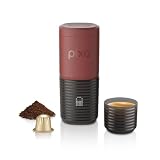
The Pixapresso is the electric portable machine discussed throughout this comparison. The listing highlights four coffee types, fast heat-up, a three-cell 3,000 mAh battery and a patented 8 to 16 gram basket. Wacaco states 20 bar and a choice of three brewing temperatures. It also supports Nespresso Original-style capsules through a separate module. Choose this version if you want the machine in its standard configuration; the color is a matter of taste, and specifications should match other variants.
WACACO Pixapresso Dark Burgundy with Case

This listing bundles the Pixapresso in a darker finish with a carrying case. If you already know you want a protective cover for backpack travel, a bundle can save you from buying separate parts. Check the listing for what is included, because bundle contents can differ from the standard box. The machine itself should offer the same stated features: 20 bar, 8 to 16 gram basket and three temperature presets.
WACACO Pixapresso Basket Set

An accessory pack for the Pixapresso, listed with two additional filter baskets and a protective case for the baskets. Extra baskets are handy if you want to keep a single and a double ready, or if you want a backup while one is drying after a rinse. As with any accessory, confirm on the listing that the baskets fit your specific Pixapresso before you buy.
WACACO Pixapresso Case

A dedicated protective case sized for the Pixapresso. Because the machine contains a lithium battery pack and a stainless tank, a snug case helps limit scratches and knocks in a bag. It is a simple purchase for anyone who bought the machine without a bundle and plans to carry it regularly. Confirm the dimensions on the listing to be sure it suits your version.
Questions
Which is better for light roasts?
The Pixapresso has the advantage because it offers a 96 C preset, while the Nano’s stated maximum is 92 C. Published comparisons also note that the Nano can taste thin with light roasts.
Do both machines use Nespresso capsules?
Both list compatibility with Nespresso Original-style capsules through an adapter or module. Vertuo-style pods are not what these machines are described as supporting, so confirm on the listings.
Is the Nano’s Basket Plus worth adding?
If you want a double-shot dose of 16 to 18 grams, it is the way to get there on a Nano. It also changes the brewing style to a non-pressurized setup, which rewards a fine, consistent grind.
How many shots can I make on a single charge?
Both makers say up to 5 from room-temperature water. Adding pre-heated water raises that dramatically, to over 200 according to the manufacturers, because the battery no longer heats the water.
Which is easier to pack?
The Nano is lighter at about 670 g versus roughly 755 g, but the Pixapresso is a compact cylinder as well, about 74 mm wide and 181 mm tall per Wacaco. Both fit in a daypack.
Can I fly with either one?
Each contains a lithium battery pack, so airline rules apply. The Nano maker says to carry it on board and not to use it in flight. Check your airline and the battery details on the listing.
Update History
- October 21, 2026 – Initial publication; specifications checked against manufacturer documentation where available.
- Check the product page for current specifications and availability before buying.
Sources
- Manufacturer product pages for the OutIn Nano and Wacaco Pixapresso
- Retailer listings and published specification sheets
- Independent written reviews and side-by-side comparisons of portable espresso makers

Write Your Review
No reviews yet. Be the first to share your experience!