

Key takeaways
- Group gaskets. They harden from heat and detergent; replace them every 6 to 12 months.
- Shower screens. Coffee oils clog the holes; soak screens in dissolved Cafiza and rinse.
- Solenoid valves. They clog with coffee particles; backflushing keeps them clear.
- Steam wands. Milk residue dries inside the tip; purge and wipe after every use.
- Warranty. De’Longhi recommends its own tablets for warranty compliance, and Jura similarly requires its own products. Read the manual before choosing a cleaner.
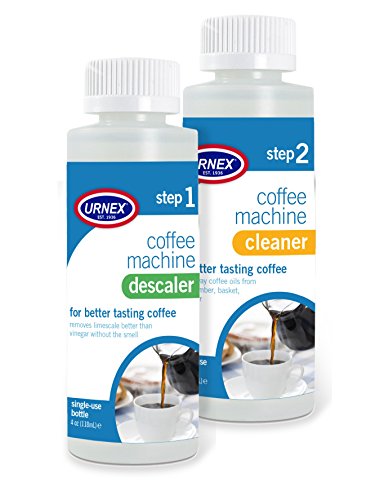
The best espresso machine cleaning kit in 2026 is not one box but a short list: Urnex Cafiza for backflushing, Urnex Dezcal for scale, a group head brush such as the Rhinowares model for daily wiping, and a grinder cleaner for the burrs. Most roundups name Cafiza as the professional standard for detergent cleaning, and a Cafiza-plus-Dezcal pairing is widely described as the most cost-effective way to handle both coffee oils and mineral scale. If you own a Breville with a 54 mm basket, its BEC250 tablets and a 54 mm backflush disc are the simpler match.
Espresso machines need two different kinds of cleaning, and they use different chemicals. Coffee oils and fines build up on the group head, shower screen and inside the three-way valve, and they go rancid within days. Mineral scale builds up in boilers, heat exchangers and tubing, and it does not respond to the same detergents. Treating both with the wrong product is the most common cleaning mistake, so this guide separates picks by job, shows how often to use each, and explains how to calculate what a year of maintenance costs.
Our top picks


As an Amazon Associate we earn from qualifying purchases at no extra cost to you.
Quick comparison of the seven picks
| Product | Job | Best for | Dose and details | Price tier |
|---|---|---|---|---|
| Urnex Cafiza (powder) | Backflush detergent | Best overall for semi-automatic machines | Up to 1/2 tsp (about 3 g) per group head; 900 g tub is about 300 backflushes at 3 g | Low per use |
| Puly Caff Plus | Backflush detergent | Cafiza alternative with denser foam | Follow label; comparable effect to Cafiza in roundups | Low-mid |
| Urnex Dezcal | Descaler | Scale removal | One 28 g packet in about 1 L (32 oz) of lukewarm water | Low-mid |
| Breville BEC250 tablets | Backflush tablets | Breville owners who want original parts | Pack of 8 tablets for the shower screen and baskets; 54 mm disc sold separately | Low |
| Rhinowares group head brush | Daily brush | Cleaning shower screen and gasket | Arched head, built-in dosing scoop, replaceable bristles (3-packs) | Low |
| Urnex Grindz | Grinder tablets | Cleaning burrs without disassembly | Food-safe tablets that absorb oils and fines | Low-mid |
| Pallo GrindMinder | Grinder brush | Chute and burr sweeping | Dual-ended brush with stiff and soft bristles | Low |
The figures come from manufacturer instructions and retailer listings. Several roundups of cleaning products are affiliate-driven, so this guide relies mainly on the product instructions rather than rankings, and prices are shown as tiers since they vary by retailer and pack size. All of these items cost far less than a service call.
Best overall backflush cleaner: Urnex Cafiza
Cafiza is the detergent that cafes have used for decades, and it is sold as a powder and as tablets. Urnex’s own instructions for the powder say to place a blind filter in the portafilter, add up to half a teaspoon (about 3 g) of powder, and run a cycle of 10 seconds of brewing, then 10 seconds of rest, repeated five times. After that, rinse the portafilter and repeat the cycle without powder to flush the group. For soaking removable parts, retailers cite one teaspoon (about 6 g) per 32 oz (1 L) of hot water for 30 minutes.
One 900 g tub holds roughly 300 backflushes at 3 g each, which is more than five years of weekly use for a single group head. Third-party guides sometimes suggest slightly higher home doses up to about 5 g for a single-group machine, but staying near 3 g is enough and easier to rinse. Cafiza tablets are also sold; the dose details were not available in the sources checked, so follow the label for those.
Who it suits: anyone with a semi-automatic machine that has a three-way solenoid valve. Trade-offs: it is a strong detergent, so thorough rinsing is essential, and it should not be used on bean-to-cup machines unless the manufacturer says so.
Best alternative backflush cleaner: Puly Caff Plus
Puly Caff is an Italian detergent and is described in roundups as equally effective as Cafiza, with slightly denser foam during backflushing. It usually costs a bit more, though promotions often bring the two to parity. The usage is similar: a small dose in a blind basket, followed by a cycle of short pulses, then clear-water rinses.
Because both products serve the same purpose, the practical choice comes down to availability and price. Pick one and stay with it rather than mixing them, and follow the label dose because concentrations differ between formulas.
Who it suits: people who prefer an Italian brand or find it at a better price. Trade-offs: the same rinsing requirements as Cafiza, and fewer retail options in some regions.
Best descaler: Urnex Dezcal
Dezcal is a descaling agent, not a backflush cleaner, and one roundup calls it the most effective descaler it evaluated. The label dose is one packet (28 g) in about a liter (32 oz) of lukewarm water. You run the solution through the machine the way you would brew, then flush with several tanks of clean water. Retailers describe it as a roughly monthly product for heavy use, though the correct interval depends on your water.
The ideal pairing, according to a number of guides, is Cafiza for oils and Dezcal for scale. That combination avoids using a descaler as a detergent, which is ineffective, and avoids using a detergent as a descaler, which can leave deposits behind. Before descaling, check the manual: some machines specify citric acid or the manufacturer’s own product, and using something else could void a warranty.
Who it suits: owners of machines with boilers, thermoblocks or heat exchangers in hard-water areas. Trade-offs: it requires flushing several tanks, and some manufacturers restrict approved descalers.
Best for Breville owners: BEC250 tablets and a 54 mm disc
The Breville BEC250 tablets come in a pack of eight and are designed to remove coffee oils and residues from the shower screen and filter baskets. Roundups recommend them for Breville owners who want original-manufacturer assurance. A 54 mm silicone backflush disc is sold separately, mostly by third parties, and typical listings cite compatibility with the BES870XL, BES878BSS, BES880 and similar models. Third-party kits vary, bundling the disc with a metal blind basket, water filters and extra tablets.
Tablets use detergents such as sodium carbonate, sodium percarbonate and surfactants according to one third-party label, which is a similar chemistry to powder cleaners. The advantage of tablets is pre-measured dosing; the disadvantage is higher cost per use than a tub of powder. Because the Breville cleaning cycle depends on the model, follow the machine’s manual for the correct procedure, and note that not every Breville model is intended to be backflushed in the way a commercial machine is.
Who it suits: Breville Barista Express, Pro and Touch owners. Trade-offs: higher cost per use, and only suitable for the 54 mm size.
Best daily tool: Rhinowares group head brush
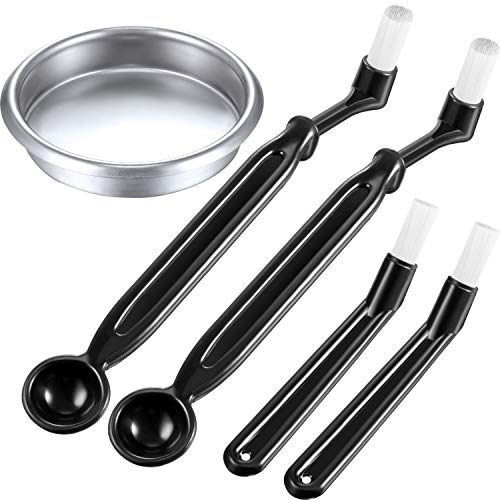
A group head brush looks too simple to review, but it does a job that no chemical can: removing wet grounds from the shower screen and gasket after each session. The Rhinowares version has an arched head so hot water does not run onto your hand, a built-in dosing scoop in the base for backflush powder, and bristles that can be replaced in 3-packs by unscrewing the old head. It is priced as a low-cost accessory.
Use it after every few shots or at the end of the day: wipe the shower screen, scrub around the gasket and rinse. This prevents a layer of baked-on coffee from forming and extends gasket life. Replace the bristles when they flatten or discolor.
Who it suits: every espresso machine owner. Trade-offs: brush bristles wear out, and the plastic handle can warp if left in hot water.
Best grinder cleaner: Urnex Grindz
A grinder holds coffee oils and fines just like the machine does, and rancid grounds taste bad in any shot. Urnex Grindz is a food-safe tablet product that you run through the grinder like beans; the tablets absorb oils and scour particles from burrs and casings without disassembly. Retailers list a canister at roughly the price of a modest bag of coffee, and the grinder should be run with a few beans afterward to clear remaining residue. Do not confuse it with Urnex Full Circle, a tablet formulation for bean-to-cup super-automatics; grinder tablets and machine tablets are different products.
Who it suits: owners of any home grinder who cannot or do not want to disassemble it often. Trade-offs: tablets do not replace a brush and occasional deep cleaning, and some grinder manufacturers say not to use them.
Best grinder brush: Pallo GrindMinder
The Pallo GrindMinder is a brush, not a chemical. One end has stiff bristles for sweeping the counter, and the other has softer, angled bristles that reach into the chute and around the burrs without scratching. It is a good complement to tablets, since it removes the grounds that tablets leave behind. One reviewer noted that it cleans the top burr of a Breville grinder well but is less suited to the bottom burr. A combined Complete Grinder Cleaning Kit that bundles Grindz tablets, Wipz wipes, a GrindMinder, a synthetic brush and a microfiber cloth is also sold.
Who it suits: anyone who wants a brush that fits into narrow grinder chutes. Trade-offs: access to some burr areas still requires disassembly.
How to choose: a decision matrix
| Your machine | Backflush product | Descaler | Daily tools |
|---|---|---|---|
| Semi-automatic with a three-way valve (E61, dual boiler, heat exchanger) | Cafiza or Puly Caff | Dezcal or manufacturer approved | Group head brush, blind basket |
| Breville Barista series (54 mm) | BEC250 tablets with 54 mm disc | Manufacturer approved | Group head brush, steam wand cloth |
| Bean-to-cup super-automatic | Brand-approved tablets (for example, Urnex Full Circle or manufacturer tablets) | Manufacturer descaler | Wipes, rinse cycles |
| Machine with no three-way valve (many pod or pressurized-basket machines) | Do not backflush; soak parts | Descaler if allowed | Brush, wipe |
| Home grinder with oily dark roasts | Grindz every 1-2 months | Not applicable | GrindMinder weekly |
The numbers that actually matter
How often to clean
Different guides give different schedules, so use them as ranges. One guide suggests a detergent backflush about every two weeks for standard group heads, and every one to two months for E61 group heads to avoid stressing the seals. For daily use, a wipe of the shower screen with a brush and a purge of the steam wand are enough. Descaling depends on water hardness: in soft or filtered water, every six months; in hard water, every one to three months.
Worked cost of a year of maintenance
Say you backflush weekly with Cafiza powder at 3 g, which is 156 g a year, or about 17 percent of a 900 g tub. You descale four times a year with Dezcal packets, which is four 28 g packets. Add a replacement set of brush bristles and a gasket. Even with generous retail prices, the whole routine usually costs less than a single café drink per month. The expensive scenario is skipping maintenance: a scale-clogged boiler or a failed solenoid valve can lead to repair bills many times the cost of cleaners.
Why rinsing matters
Cafiza and other detergents are alkaline cleaners. If residue remains, it can flavor the next shot and, in large amounts, harm gaskets. The standard sequence is to backflush with detergent, then run at least five or more clear-water cycles through the group, and finally pull a throwaway shot before drinking anything.
Ownership realities: what wears first
- Group gaskets. They harden from heat and detergent; replace them every 6 to 12 months.
- Shower screens. Coffee oils clog the holes; soak screens in dissolved Cafiza and rinse.
- Solenoid valves. They clog with coffee particles; backflushing keeps them clear.
- Steam wands. Milk residue dries inside the tip; purge and wipe after every use.
- Warranty. De’Longhi recommends its own tablets for warranty compliance, and Jura similarly requires its own products. Read the manual before choosing a cleaner.
Common mistakes with cleaning kits
- Using a descaler as a detergent. Descalers dissolve minerals, not oils.
- Backflushing a machine that cannot be backflushed. Without a three-way valve, backflushing can force water into places it should not go.
- Using too much powder. More detergent does not mean cleaner; it means more rinsing.
- Skipping the rinse cycles. Residual detergent flavors coffee.
- Mixing chemicals. Never combine acidic descalers and alkaline detergents in the same cycle.
Step-by-step: a basic backflush
- Warm the machine and remove the portafilter basket; install the blind basket (or silicone disc).
- Add the measured dose of powder or a tablet, about 3 g for Cafiza powder.
- Lock in the portafilter and run the pump for 10 seconds, then stop for 10 seconds; repeat five times.
- Remove the portafilter, rinse it well, and re-lock it in the group with no powder.
- Repeat the cycle with plain water at least five times, until the water runs clear.
- Scrub the shower screen with a brush and wipe the group gasket.
- Pull a shot and discard it before you brew anything to drink.
Building a simple cleaning calendar
The easiest way to keep up is to tie each task to something you already do. The schedule below is a reasonable starting point for a household that pulls one to three shots a day; adjust it for heavier use or hard water, and always defer to your machine’s manual.
| Frequency | Task | Product or tool | Time needed |
|---|---|---|---|
| After every session | Purge and wipe steam wand, knock out puck, rinse portafilter | Damp cloth | About 1 minute |
| Daily or every few days | Brush shower screen and gasket, rinse group with a blank shot | Group head brush | About 2 minutes |
| Weekly | Brush out grinder chute and burr area; empty drip tray | GrindMinder or soft brush | About 5 minutes |
| Every 1-2 weeks (standard) or 1-2 months (E61) | Detergent backflush | Cafiza, Puly Caff or BEC250 tablet | About 10 minutes including rinse |
| Every 1-2 months | Grinder tablet run | Grindz | About 5 minutes |
| Every 1-6 months, by water hardness | Descale boiler and lines | Dezcal or approved descaler | About 30 minutes plus flushing |
Written on a card taped inside a cabinet door, a calendar like this removes the guesswork. The weekly and monthly tasks together take under half an hour a month, which is a small price for keeping shots clean and a machine running for years.
Frequently Asked Questions
How often should I clean my espresso machine?
Wipe the shower screen and steam wand daily, backflush with detergent about every one to two weeks for a standard machine, and descale according to your water hardness. E61 machines can go longer between detergent backflushes.
Can I use vinegar to descale?
Many manufacturers advise against it because vinegar can damage seals and leave a strong smell. Use a descaler approved for your machine or citric acid if the manual allows it.
Do I need a cleaning kit for a bean-to-cup machine?
You need products designed for that style of machine. Tablets such as Urnex Full Circle are made for super-automatics, and some brands require their own tablets for warranty reasons.
What is the difference between backflushing and descaling?
Backflushing uses a detergent to dissolve coffee oils in the group head and valve, while descaling uses an acid to dissolve mineral scale in the boilers and tubing. They solve different problems and use different products.
Can I clean the grinder with rice?
Some people do, but rice is hard and can damage burrs on some grinders. Purpose-made tablets like Urnex Grindz are formulated to be safe, though you should check your grinder manual.
Is a branded cleaning kit worth it compared with separate products?
A kit can be convenient, especially for Breville machines. For a semi-automatic with a three-way valve, buying powder, descaler and a brush separately usually costs less per use and lets you choose each part.




Write Your Review
No reviews yet. Be the first to share your experience!