

Key takeaways
- Mixing descalers. Never combine products, or follow one with another, without rinsing completely.
- Skipping the steam path. The wand and milk lines collect scale and milk film together.
- Using hot solution on sensitive models. Some bean-to-cup makers, including Jura, specify lukewarm water not above 40 degrees Celsius.
- Relying on a filter alone. Filters reduce hardness but expire; a descale reminder still applies.
- Ignoring boiler type. Machines with aluminum boilers prefer gentler lactic products over strong citric soaking.
The best descaling kit for most espresso machines in 2026 is Urnex Dezcal for general-purpose use, Durgol Swiss Espresso for fast, no-fuss treatment of home machines, and De’Longhi EcoDecalk or the brand’s own descaler when the manual or warranty calls for it. The right choice depends less on brand than on three facts: what acid the product uses, what metals and seals your machine contains, and how hard your water is.
Descaling is the single maintenance task that most affects an espresso machine’s lifespan. Limescale insulates the heating element, narrows pipes, and eventually blocks the solenoid valve or thermoblock, which is why a machine that “just stopped heating” is often a machine that was never descaled. The guide below compares six options by chemistry, dosing and use case, then explains how to descale step by step and how often.
Our top picks


As an Amazon Associate we earn from qualifying purchases at no extra cost to you.
Quick comparison of the descaling options
| Product | Main active ingredient | Format and dose | Best for | Price tier |
|---|---|---|---|---|
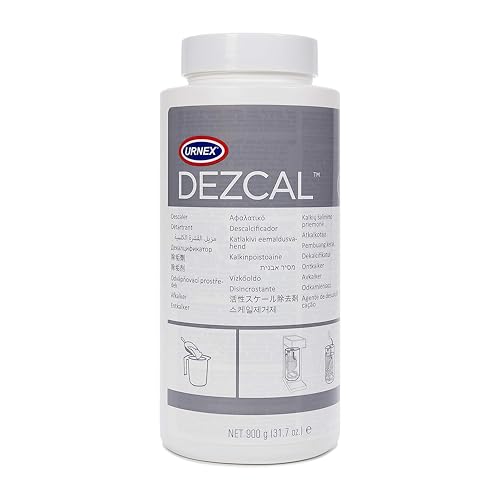
| Urnex Dezcal | Citric acid base | Powder in 28 g (1 oz) packets or larger jars; 28 g per 1 L of water | All-round use, boilers and group heads | Low per use |
| Durgol Swiss Espresso | Sulfamic acid with silicon polymers (per retailers) | Two 125 ml single-use bottles per box | Fast, simple home descale | Mid per use |
| De’Longhi EcoDecalk | Lactic acid, plant-derived (per De’Longhi) | 500 ml bottle, 100 ml per cycle, about 5 doses | Super-automatics and De’Longhi or Breville-type machines | Mid per use |
| Jura 2-Phase tablets | Maleic and sulfamic acids with protective agents | Blister of 3 tablets per cycle | Jura machines | Higher per use |
| Breville-branded or compatible descaler | Commonly citric acid (compatible brands) | Single bottles, usually multi-use packs | Breville and Sage machines | Low to mid per use |
| Food-grade citric acid powder | Citric acid | About 1 tablespoon per liter of warm water | Budget descaling on simple machines | Lowest per use |
What a descaling kit actually does
Hard water carries dissolved calcium and magnesium. When it heats, calcium carbonate comes out of solution and settles as scale on the hottest surfaces, which means the boiler or thermoblock, the heating element, and the narrow pipes right after it. A descaler is an acid that converts that carbonate into soluble salts that rinse away. The acid type decides speed, rinsing effort and the risk to rubber seals, aluminum and brass.
Citric acid
Citric acid is cheap, food safe and effective on calcium carbonate. It acts quickly at warm temperatures, but if it is not rinsed thoroughly it can leave a white film. It is also more likely to attack aluminum and some solder if left in contact for a long time, so short exposure and thorough rinsing are key.
Lactic acid
Lactic acid is slower but gentler. Guides generally describe it as kinder to rubber gaskets and aluminum boilers, which is why De’Longhi markets its plant-based EcoDecalk this way. If you are not sure what is inside your machine, it is the safest default.
Sulfamic acid
Sulfamic acid is common in fast-acting commercial descalers. Durgol Swiss Espresso is listed by retailers as water, sulfamic acid and silicon oxide polymers. It dissolves heavy scale quickly and is usually sold in single-use portions, which makes dosing foolproof.
What to avoid
Household vinegar is not recommended. Acetic acid leaves a strong odor and residue that is hard to rinse from a boiler, and it can degrade rubber seals over time. Backflush detergents such as Cafiza are for cleaning coffee oils from group heads on machines with a three-way valve; they do not remove scale, so they cannot replace a descaler.
Urnex Dezcal: best all-round descaler
Dezcal is the product many roasters and cafes use, and it is sold in single-use 28 gram (1 oz) packets, 200 gram bags and 900 gram jars, plus a liquid version. It is citric-acid based and described by the maker as phosphate-free, biodegradable and odorless. For home machines, Urnex’s directions are 1 ounce (28 grams) of powder per 32 ounces (1 liter) of water, dissolved in hot water and run through the machine before rinsing twice with clean water.
For vessel soaking, such as removable group heads or portafilter parts, Urnex suggests 1 ounce per 16 ounces of hot water and up to 30 minutes of soaking, then thorough rinsing. The maker recommends descaling about every three months and always following the machine’s manual for the descaling cycle.
Who it suits: anyone with a single boiler, heat exchanger or thermoblock machine whose manual does not mandate a proprietary solution. Trade-off: as a citric product it needs diligent rinsing, and it is not ideal for machines with aluminum components that dislike prolonged contact.
Durgol Swiss Espresso: best for quick home descales
Durgol Swiss Espresso comes as a box of two 125 ml bottles, and each bottle is meant for one descale of a household machine. Per the maker’s information relayed by retailers, one 125 ml bottle can dissolve up to 10 grams of limescale. Directions are straightforward: pour the bottle into the water tank, add roughly 250 to 375 ml of clean water, run the descaling program, then rinse with clean water. For machines with tanks larger than 1.5 liters, one retailer notes you may need two bottles.
A larger 500 ml bottle equals four single doses. Suggested descaling intervals from sellers range from every two to three months or after about 100 uses. Who it suits: people who want predictable dosing and no measuring. Trade-off: the pre-portioned format makes it costlier per use than powder, and there is no partial-dose flexibility for small machines.
De’Longhi EcoDecalk: best for machines that ask for it
EcoDecalk is De’Longhi’s descaler, sold in a 500 ml bottle with five 100 ml doses. De’Longhi describes it as a lactic-acid formula of vegetable origin. Its key advantage is compatibility: the maker’s descale prompts on bean-to-cup machines expect this solution, and users report it works on Breville, Gaggia and Saeco machines as well, with no reported compatibility problems.
Note that some review sites describe commercial descalers, including EcoDecalk, as citric acid with surfactants, so check the label on the bottle you buy rather than relying on a roundup. Who it suits: owners of De’Longhi Magnifica and Dinamica machines, and anyone with aluminum boilers. Trade-off: slower action on heavy scale, and the 100 ml dose is fixed.
Jura 2-Phase tablets: best for Jura machines
Jura’s two-phase tablets come in packs of nine or 36 and are used three tablets at a time. Phase one removes scale. Phase two seals the water system and protects the piping and thermoblock against corrosion. The tablets are dissolved in lukewarm water not hotter than 40 degrees Celsius, with the water volume depending on the machine; Jura’s data sheet lists 0.5 liter for IMPRESSA C, E, F and J classes. According to Jura’s information sheet the tablets contain maleic acid, sulfamic acid, sodium bicarbonate and benzotriazole, and they are phosphate-free.
Some retailers say they can be used in other bean-to-cup machines, but this should be confirmed against your manual. Who it suits: Jura owners. Trade-off: higher cost per descale and a formula built around one brand’s system.
Breville and brand-matched descalers: best for warranty peace of mind
Breville sells a descaler designed for its own espresso machines, and there are many third-party packs marketed as compatible. Several of these compatible packs list citric acid as their active ingredient and are sold as two-bottle or twelve-month supplies. If your machine is under warranty and the manual specifies the maker’s solution, using it avoids disputes. Once the warranty ends, a well-rinsed citric product generally does the same job for less.
The same logic applies to other manufacturers that sell their own descaling products, such as Gaggia and Saeco. Who it suits: owners in the first year or two of a warranty. Trade-off: higher cost per use than powders, and quality varies between third-party brands, so read the ingredient list.
Food-grade citric acid: cheapest option for simple machines
Plain citric acid powder dissolved at about 1 tablespoon per liter of warm water is the lowest-cost descaler and rinses cleanly. It suits pump machines with brass or stainless parts and no sensitive sensors. Who it suits: budget-minded owners who read their manual first. Trade-off: there are no surfactants or corrosion inhibitors, you must measure the dose yourself, and it is not for super-automatics with proprietary descale routines.
How often to descale: match to your water
The right frequency depends on hardness, expressed in grains per gallon (gpg) or milligrams per liter of calcium carbonate. The intervals below are common rules of thumb based on the typical manufacturer guidance of every one to three months for hard water; always follow your manual if it gives a number.
| Water hardness | Approx. gpg | Suggested interval for a daily machine | Signs you waited too long |
|---|---|---|---|
| Soft | 0 to 3.5 | Every 6 months | Rare, light film in tank |
| Moderately hard | 3.5 to 7 | Every 3 to 4 months | Slower flow, lower shot temperature |
| Hard | 7 to 10.5 | Every 2 to 3 months | Noisy pump, steam wand weakens |
| Very hard | Over 10.5 | Every month, or switch to filtered water | Heater trips, descale light stays on |
Because every interval depends on how much water passes through the boiler, a household that steams milk twice a day will build scale faster than one that pulls a single shot. When in doubt, check the steam wand and the shower screen: white crusts are a clear sign.
Worked example: cost per descale
Suppose you descale four times a year in a hard-water area.
- With a 28 gram Dezcal packet used per 1 liter of water, a 900 gram jar contains about 32 doses, which is enough for eight years at four descales a year, though you should check the powder remains dry.
- With Durgol, one 125 ml bottle per descale means eight bottles over two years, which is four boxes of two.
- With EcoDecalk, a 500 ml bottle holds five doses, so you buy one bottle roughly every 15 months.
The pattern is that powders give the lowest cost per use, single-dose bottles give the lowest effort and tablets sit at the top of the price scale in exchange for brand-specific protection.
Step-by-step descaling, with the reason for each step
- Read the manual first. Some machines need the steam wand and group head removed, or the descale program started with the water filter taken out. The manual overrides any generic guide.
- Empty the tank and remove the water filter. Filter cartridges can be damaged by acid and would waste the solution.
- Mix the solution at the stated ratio. Over-concentration does not speed descaling and can stress seals.
- Run the solution through in stages. Pump about a third through the group head, a third through the steam wand, and leave the machine to sit for 10 to 20 minutes so the acid works on boiler scale.
- Flush with clean water. Run at least two full tanks through every outlet. Taste a small sample: any sour or chemical taste means rinse again.
- Clean removable parts separately. Soak the shower screen, portafilter basket and drip tray in the solution, then rinse.
- Record the date. A sticker on the machine keeps the interval honest.
Mistakes to avoid
- Mixing descalers. Never combine products, or follow one with another, without rinsing completely.
- Skipping the steam path. The wand and milk lines collect scale and milk film together.
- Using hot solution on sensitive models. Some bean-to-cup makers, including Jura, specify lukewarm water not above 40 degrees Celsius.
- Relying on a filter alone. Filters reduce hardness but expire; a descale reminder still applies.
- Ignoring boiler type. Machines with aluminum boilers prefer gentler lactic products over strong citric soaking.
Choosing by machine type
Machine design changes which kit makes sense, so match the product to the hardware before comparing brands.
| Machine type | Scale risk | Sensible kit | Extra note |
|---|---|---|---|
| Single boiler (entry semi-automatic) | Boiler and 3-way valve | Citric powder or lactic liquid | Flush through the steam wand as well |
| Heat exchanger | Exchanger tube and boiler | Powder mixed at full strength, then long rinse | Check the manual for a fill-and-soak method |
| Dual boiler | Two boilers and mixing valve | Manufacturer-recommended product | Descale each circuit in turn |
| Thermoblock (compact home machine) | Narrow channels clog first | Pre-dosed liquid or tablets | Descale before the flow drops |
| Bean-to-cup super-automatic | Brew unit, thermoblock, milk system | The maker’s own descaler or an explicitly compatible one | Follow the on-screen program exactly |
Water quality is the cheaper fix
Descaling treats the symptom, while water treatment prevents it. If your tap water sits above roughly 7 grains per gallon, a filter pitcher or an in-tank cartridge can double the time between descales. The aim for espresso is moderate hardness, because water with some calcium and magnesium extracts better than distilled water, and many specialty roasters point to a target in the region of 50 to 100 milligrams per liter as total hardness. Fully demineralized water can also trigger sensor errors in machines that read conductivity, so do not go to zero without checking the manual.
A practical routine is to test your tap with an inexpensive hardness strip, pick the interval from the table above, and set a calendar reminder. Then keep the receipt for your kit and note the batch on the machine. If you travel often and leave water in the tank, empty it before leaving: stagnant water raises mineral concentration as it evaporates and speeds deposits.
Safety and disposal notes
Descalers are acids. Wear gloves if you have sensitive skin, avoid splashing onto stone countertops, which can etch, and never mix a descaler with bleach or chlorine products. Rinse solution through the drain with plenty of water. If a product causes irritation or is swallowed, follow the safety data sheet on the label and contact a medical professional or poison control line; this guide offers general information only.
Frequently Asked Questions
Can I use vinegar to descale an espresso machine?
It is not recommended. Acetic acid leaves odor and residue that is hard to rinse out, and it can wear rubber seals and some metal parts. A purpose-made descaler or plain citric acid is a safer choice.
Is citric acid or lactic acid better?
Citric acid is faster and cheaper but needs careful rinsing. Lactic acid is gentler on seals and aluminum but works more slowly. Pick based on your machine’s materials and the maker’s recommendation.
How do I know it is time to descale?
Typical signs are slower flow, a weaker steam wand, a noisier pump, cooler shots, and visible white crust on the shower screen. Many machines also show a descale light, which you should treat as a final warning rather than a schedule.
Do I still need to descale if I use filtered water?
Yes, though less often. A cartridge reduces hardness but does not remove it entirely, and cartridges lose effectiveness over time, so keep a calendar reminder.
Is descaling solution safe to drink if some stays in the machine?
It should not be consumed. Rinse until no taste remains and follow the product’s instructions, which for most kits require at least two full tanks of clean water. If you have a health concern, consult the manufacturer’s safety data sheet or a professional.
Can I use a coffee-maker descaler in an espresso machine?
Often yes for citric-based products, but check that the label lists espresso machines and that your manual permits it. Machines with sensors or proprietary cycles may require the maker’s own product.




Write Your Review
No reviews yet. Be the first to share your experience!