

The best espresso distribution tool for most home baristas in 2026 is a needle-style WDT tool, with the Normcore WDT V4 as the strongest all-round pick because it combines retractable needles, a working length of about 47 mm and replaceable parts. Add a leveling distributor such as the Normcore Coffee Distributor V4 or the Nucleus NCD V3 only if you want the top of the puck flat without extra effort, and finish with a spring-loaded tamper so every puck gets the same pressure.
Distribution is the step between grinding and tamping, and it is where most channeling begins. Ground espresso clumps because static and oils make particles stick together, so the grounds land in the basket as lumps with air pockets around them. Water takes the path of least resistance, flows through the gaps, and leaves the rest of the puck under-extracted. A good distribution tool breaks the clumps and spreads the dose evenly, which is cheaper than changing the machine or the grinder and often reduces shot-to-shot variation more than either. This guide covers seven real tools, shows how to choose among them with numbers, and walks through a puck prep routine.
Our top picks


As an Amazon Associate we earn from qualifying purchases at no extra cost to you.
Quick comparison of the seven picks
| Tool | Type | Best for | Key specs | Price tier |
|---|---|---|---|---|
| Normcore WDT V4 | Retractable needle WDT | Best overall | Twist mechanism, up to 14 needles, about 47 mm working length, 7 spare needles | Low-mid |
| Subminimal Flick | Retractable needle WDT | Compact and quick | Needles about 42 mm long, 48 g, stand and wall mount, replacement needles included | Low-mid |
| Barista Hustle Comb | Fixed-needle comb WDT | Large doses, wide baskets | 0.35 mm needles, about 90 mm needle length, 15 g body | Low-mid |
| Normcore WDT V3 | Needle WDT with stand | Budget needle tool | 9 needles at a time, 0.25 mm and 0.3 mm options, about 50 mm length | Low |
| Normcore Coffee Distributor V4 | Leveler (fins) | Value leveler | 58 mm and 54 mm sizes, 7 depth positions, stainless steel | Low-mid |
| Nucleus NCD V3 (formerly OCD) | Leveler (angled blades) | Premium leveler | Fits 58.5 mm baskets, adjustable depth, about 290 g | Upper |
| Crema Pro distributor | Leveler (flat disc) | Cheapest leveling step | 58 mm and 54 mm sizes, fixed depth, stainless disc | Low |
Specifications come from manufacturer pages and retailer spec sheets. Where versions or listings disagree (needle diameters on Normcore models, for example, are listed differently across versions), the table gives what is consistent. Prices are given as tiers because they change by retailer and promotion: most tools here cost roughly the same as a bag or two of good coffee, and the Nucleus costs several times that.
Best overall: Normcore WDT V4
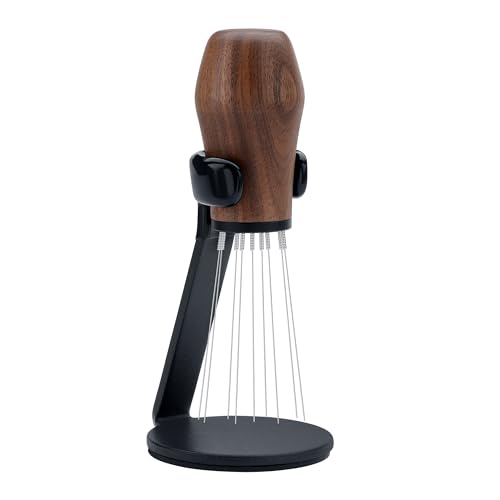
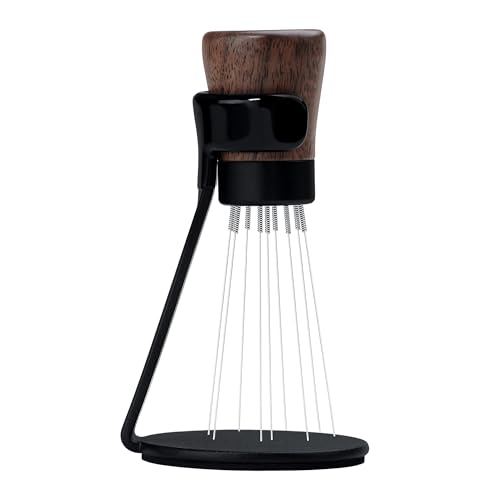
The WDT V4 is a retractable tool: a twist mechanism extends or retracts the needles with one full turn, and the layout supports up to 14 needles so you can run a light pattern for small doses or a dense one for larger ones. Normcore lists a working needle length of about 47 mm (65 mm total), a body length of 73 mm and a maximum diameter of about 32.5 mm, built from anodized aluminum, POM and 304 stainless steel. Seven replacement needles are included. Needle diameter is not stated on the V4 listing, but earlier Normcore versions used 0.25 mm and 0.3 mm needles.
The retractable design matters because bare needles are easy to bend in a drawer or on a counter. Pulling them into the body protects them and your fingers. A roundup comparing WDT tools advises stirring from the lower layer upward and finishing at the surface.
Who it suits: nearly everyone who pulls two or more shots a day. Trade-offs: needle diameter is not documented on current listings, and a tool with more needles takes slightly longer to clean. Replacement needles are inexpensive but not interchangeable with other brands.
Best compact option: Subminimal Flick
The Flick is a retractable, magnetic WDT tool with a short, light body: roughly 110 by 18 by 18 mm and 48 g. It ships with 0.5 mm needles installed (some listings still show older 0.4 mm figures) and a set of 0.35 mm replacement needles. The needle length is about 42 mm, which is enough to reach the floor of a standard 58 mm basket through most dosing funnels. The box includes six replacement needles, a stand, a wall mount and an Allen key.
Thicker needles are stiffer, so the Flick resists bending but moves slightly more coffee as it passes. If you grind finely for light-roast espresso, the thinner 0.35 mm needles disturb the bed less. Switching needles takes a few minutes with the included key.
Who it suits: baristas who want a short tool and like a magnetic stand on the counter. Trade-offs: shorter reach than the Normcore V4 and Barista Hustle Comb, which matters if you use a tall dosing funnel.
Best for big doses: Barista Hustle Comb
The Barista Hustle Comb is a fixed-needle tool with a silicone handle, and retailer specifications give needles of about 0.35 mm in 501 stainless steel with rounded ends. Needle length is about 90 mm, the body weighs about 15 g and dimensions are roughly 110 by 27 by 27 mm. Listings describe up to 30 needles, so one pass covers more of the puck than a 9-needle tool. A newer AutoComb version is also sold, with twelve needles installed, spare needles and adjustable needle depth, though its needle diameter is not listed on the page found.
A comb-style tool is a good fit for 20 g or larger doses in deep baskets, where a narrow tool needs more circles to cover the same depth. The long needles help with tall funnels, and the rounded ends reduce the chance of scoring the basket floor.
Who it suits: people with large baskets, 20 g plus doses or tall funnels. Trade-offs: the long needles can bend if stored loose, and the many-needle design is harder to clean between uses.
Best budget needle tool: Normcore WDT V3
The V3 is the previous generation of Normcore’s WDT. It holds nine needles at once and listings describe two thicknesses, 0.25 mm and 0.3 mm, supplied so you can choose how stiff you want the tool. The needle length is about 50 mm, and it comes with a stand. A comparison from a coffee site puts it at about 37 on sale and 50 at regular price, which is in the low tier.
Nine needles are enough to stir a standard 18 g dose in about 10 to 15 seconds. The trade-off against the V4 is that the needles are exposed rather than retractable, so you need to protect them on the stand.
Who it suits: people on a tighter budget who still want the Normcore design and a choice of needle gauge. Trade-offs: exposed needles and fewer features than the newer model.
Best value leveler: Normcore Coffee Distributor V4
A leveler flattens the top of the bed and, with angled fins, moves grounds from high spots to low spots. The Normcore Coffee Distributor V4 is sold in 58 mm and 54 mm sizes, is made of stainless steel and has a seven-position depth adjustment designed for doses from roughly 15 g to 20 g. It sits in the low-mid price tier and is one of the most popular choices in roundups.
Depth adjustment is stepped, so it can be coarser than premium models, and the fins can dig at aggressive settings, but the finish is functional rather than decorative.
Who it suits: baristas who want a fin-style leveler that adapts to different doses without a premium price. Trade-offs: stepped adjustment and a plain finish.
Best premium leveler: Nucleus NCD V3 (formerly OCD)
The Nucleus distributor, long known as the OCD, was renamed NCD, and you will see it sold under both names. The V3 fits 58.5 mm baskets (IMS and VST sizes), weighs about 290 g and has four angular slopes designed to redistribute grounds below the surface. Depth is adjustable by loosening the top section, setting depth and tightening again, and the tool comes in black, titanium and silver. Retailers describe the materials as stainless steel with an anodized aluminum adjuster, while one review site calls it CNC-machined brass and stainless steel, so check the version you receive.
It is the benchmark in many specialty cafes, but for home users it is premium-priced. The main benefit is repeatable depth settings and a strong finish, which matters if you share the machine among several people or change doses often.
Who it suits: enthusiasts who want a durable, precise leveler and already own a WDT tool. Trade-offs: price, weight and the need for correct basket sizing.
Best cheapest leveler: Crema Pro distributor
The Crema Pro is a simple stainless disc in 58 mm and 54 mm sizes with fixed depth. Because it has no adjustment, it works best when your dose is consistent, and it is less effective on pronounced center domes than a fin-style leveler. It pairs well with a separate WDT tool.
Who it suits: beginners who want to try a leveling step cheaply. Trade-offs: no depth adjustment and less ability to correct high spots.
How to choose: a decision matrix
| Your situation | Best match | Why |
|---|---|---|
| Only one tool budget, daily shots | Normcore WDT V4 | Breaks clumps through the whole bed |
| Short funnel, want a pocket-sized tool | Subminimal Flick | Light, 42 mm needles, magnetic stand |
| 20 g+ doses or tall dosing funnel | Barista Hustle Comb | Long needles, many needles per pass |
| Tight budget but want WDT | Normcore WDT V3 | 9 needles, stand included |
| Dose varies 15-20 g | Normcore Coffee Distributor V4 | Seven depth positions |
| Wants repeatability and shares the machine | Nucleus NCD V3 | Precise depth, durable build |
| Wants a first leveling step cheaply | Crema Pro | Lowest price |
The numbers that actually matter
Needle length must reach the basket floor
The needles need to reach the bottom of the basket through your dosing funnel. A funnel adds roughly 10 to 15 mm of height above the basket rim, and a standard 58 mm basket is about 25 to 30 mm deep, so a tool with less than about 40 mm of usable needle length may not reach the floor. That is why the 42 mm Flick and 47 mm Normcore V4 are borderline for tall funnels, and why the 90 mm Comb gives plenty of margin. Measure your funnel and basket before buying.
Needle diameter and the trade-off
Thinner needles (about 0.25 to 0.35 mm) disturb the bed less and break clumps without moving large volumes of coffee, but they bend more easily. Thicker needles (0.4 to 0.5 mm) hold their shape better but can pull grounds upward. For fine espresso grinds of light roasts, thinner needles generally work better; for dark roasts or coarser grinds, thicker needles are fine.
Worked example: the value of a minute of prep
Assume you pull two shots a day and a clumpy dose causes a channeled, sour shot one time in five. That is roughly 146 wasted shots a year, and at 18 g of coffee each, about 2.6 kg of beans. A WDT stir costs 10 to 15 seconds per shot, or about 25 minutes a year, and the tool itself costs less than a single bag of specialty beans. If it halves the wasted shots, it pays for itself within the first year.
A puck prep routine that uses these tools
- Weigh the dose directly into a dosing cup or the basket on a scale accurate to 0.1 g. Consistent weight is the foundation of repeatable shots.
- Place the funnel on the portafilter so grounds do not spill and the needle tool has room to work.
- Insert the WDT needles to the bottom and stir in small circles across the whole basket, working upward and finishing at the surface. Three to five passes (about 10 seconds) is typical.
- Tap the portafilter lightly on the counter or the side of your palm to settle the bed.
- If you use a leveler, set the depth so the blades just touch the surface and spin once or twice.
- Tamp level with a calibrated or spring-loaded tamper. Normcore sells V4 and V4.1 tampers with interchangeable 15, 25 and 30 lb springs, and a 58 mm base is common.
- Wipe the basket rim of stray grounds and lock in right away.
Ownership realities: what wears first
- Needles bend. Store tools on a stand or in the supplied body. Replacement needles are consumables.
- Cleaning. Coffee oils collect on needles; wipe with a dry cloth after each use and rinse with warm water occasionally.
- Static. Dry weather makes grounds cling to levelers. A tiny spritz of water on the beans before grinding helps.
- Threaded depth adjusters. They can seize if grounds work into the threads. Brush after use.
- Basket fit. A leveler built for 58.5 mm baskets may fit loosely in a 58 mm basket and leave a gap at the edge.
- Stirring too hard. Aggressive stirring can mix fine and coarse particles and make the bed uneven. Use small, gentle circles.
- Skipping the tap. If the bed is not settled, a leveler may leave voids.
- Using a leveler alone. It only moves grounds near the surface and does not break clumps deeper in the bed.
- Changing dose without adjusting depth. A leveler set for 18 g will compress a 15 g dose or fail to reach a 20 g one.
- Expecting tools to fix a poor grinder. Distribution helps, but a grinder that produces many fines will still channel.
Common mistakes with distribution tools
Reading your puck: how to tell distribution is the problem
Before buying anything, look at the evidence your shots already give you. Distribution problems leave consistent clues, and matching the clue to the fix saves money.
| What you see | Likely cause | Tool that helps |
|---|---|---|
| Fast streams or spurts from one side of a bottomless portafilter | Channeling through a low-density area | WDT tool, then a level tamp |
| Shot time varies by more than 3 to 4 seconds with the same grind and dose | Inconsistent bed density from clumps | WDT tool |
| Dome in the center or a sloped surface before tamping | Uneven fill from the grinder spout | Leveler, or a finger sweep plus WDT |
| Puck is wet and cracked after the shot, with dark and pale patches | Uneven extraction and channels | WDT plus a calibrated tamper |
| Grounds stuck to the basket walls or rim | Static and oil buildup | Funnel, a light water spritz and a brush |
A bottomless portafilter is the most useful diagnostic tool you can own, because it shows the flow pattern directly. A healthy shot begins with dark droplets that merge into a single centered stream, then lightens to a golden color. Instead of changing three variables at once, change one tool, pull three shots, and compare timing and appearance. If the spread in shot time narrows, the tool is working.
It also helps to separate distribution from dose. If your scale shows 17.6 g one day and 18.4 g the next, no distribution tool can make the shots match. Fix the weight first, then the stir, then the level, and only then consider changing the grind.
Frequently Asked Questions
Do I need both a WDT tool and a leveler?
Not necessarily. A WDT tool does the most important work by breaking clumps, and many baristas skip the leveler. If your shots look uneven or you see a dome in the center of the puck, adding a leveler can help.
What needle diameter is best for WDT?
Between 0.25 and 0.4 mm is common. Thinner needles work well for fine grinds and light roasts, while thicker ones last longer and are fine for general use.
Can I use a paper clip or toothpick instead?
Yes, as a trial. A bent paper clip or a handful of toothpicks will break clumps, but they do not distribute as evenly as a purpose-built tool and can be awkward to clean.
Does distribution replace tamping skill?
No. Distribution makes the bed even, and tamping compresses it level. A spring-loaded or calibrated tamper helps give consistent pressure, but evenness matters more than force.
Will these tools work with 54 mm or 51 mm portafilters?
Needle tools generally work with any basket size. Levelers are size-specific, and Normcore and Crema Pro sell 58 mm and 54 mm versions. Check your basket diameter before ordering.
How do I clean a WDT tool?
Wipe the needles with a dry or slightly damp cloth after use, and give them a warm-water rinse occasionally. Avoid soaking tools with magnets or springs, and dry thoroughly before storing.





Write Your Review
No reviews yet. Be the first to share your experience!