

Key takeaways
- Breville Bambino vs Bambino Plus compared: steam wand, tank size, footprint and espresso system, with a clear pick for each kind of buyer.
For most households that drink milk-based coffee, the Bambino Plus is the better buy, because the automatic steam wand and the larger tank remove the two biggest day-to-day annoyances of the base model. For espresso and americano drinkers, or anyone who enjoys learning to steam by hand, the standard Bambino gives you the same 54mm portafilter, the same three-second ThermoJet heater and the same pre-infusion system in the same compact shape. The espresso itself is not what separates these machines; the milk workflow is.
Quick Verdict
| Choose the Bambino if… | Choose the Bambino Plus if… |
|---|---|
| You mostly drink espresso, americanos or one small milk drink | You drink lattes or cappuccinos most days |
| You want to learn manual milk texturing | You want a hands-free option plus a manual wand when you feel like it |
| Every inch of counter width matters | You can spare a little extra width for the larger body and tank |
| You make one or two drinks at a time | You often make several drinks or fill the tank less often |
| You want to keep the spend as low as possible | You value consistency and less fuss in the morning |
Specs Side by Side
| Spec | Bambino (BES450) | Bambino Plus (BES500) |
|---|---|---|
| Portafilter | 54mm, 18 g dose design | 54mm, 18 g dose design |
| Heating system | ThermoJet, about 3 seconds | ThermoJet, about 3 seconds |
| Extraction | Low-pressure pre-infusion, then 9 bar (15 bar pump) | Low-pressure pre-infusion, then 9 bar |
| Steam wand | Manual only | Automatic and manual |
| Milk presets | None | 3 temperature levels, 3 texture levels |
| Water tank | 1.4 L (47 fl oz) | 1.9 L (64 fl oz) |
| Milk jug in box | Included; confirm size on listing | 16 fl oz jug included |
| Filter baskets | Single and dual wall, 1 and 2 cup | Single and dual wall, 1 and 2 cup |
| Approximate width | About 6 inches | A little under 8 inches |
| Grinder | None | None |
Dimensions and weights vary between spec sheets, so treat the width row as a rough guide and check the exact figures on the listing you buy from. The tank sizes come from Breville’s instruction books.
Key Differences That Matter
Milk steaming: manual versus automatic
This is the difference that justifies the step up. The Bambino has a manual wand: you position the jug, open the steam, and stop when the milk is hot and textured. The Bambino Plus can do the same manually, but it also offers an automatic mode in which you choose one of three temperature levels and one of three texture levels. Breville describes the steam from the Plus as reaching 266 degrees Fahrenheit, and reviewers report that it heats a jug of milk faster than the base model, in the neighborhood of 30 to 35 seconds versus 50 to 60. Those timings depend on the milk volume, so treat them as direction, not a promise.
Automatic does not mean flawless. You still have to use fresh, cold milk, pour in the right amount and position the jug correctly. But it removes the timing and feel that make manual steaming hard to repeat, which is why beginners tend to get consistent results sooner.
Tank capacity: 1.4 L versus 1.9 L
The base model holds 1.4 L, the Plus holds 1.9 L. A double shot of espresso uses a small amount of water, but steaming milk uses water too, and descale or cleaning cycles take some. If you drink two lattes before work, the smaller tank still covers you for several days. If you host guests or make drinks for a family, the Plus tank means fewer interruptions. It is also easier to forget to refill a small tank, and the machine does not forgive running it dry.
Size and counter fit
Both machines are among the narrowest options with a 54mm portafilter. The Bambino is the slimmer of the two, at roughly 6 inches wide, while the Plus is a little under 8 inches. In a crowded kitchen, that difference can decide whether the machine tucks next to the kettle. Measure the height under your cabinets too, since you need room to lift the tank out and pull it forward.
Espresso quality: effectively the same
This point surprises people who assume the more expensive model pulls better shots. Both use the same 54mm portafilter, the same ThermoJet heater, the same low-pressure pre-infusion into 9 bar and the same basket choices. Differences in the cup will come from your grinder, your dose, your tamping and your beans, not from which Bambino sits on the counter. If a seller or video claims a big espresso-quality gap, be skeptical.
Learning curve
Manual steaming on the Bambino is a skill worth having. It teaches stretching, swirling and temperature feel, and those skills transfer to any machine you buy later. The Plus lets you postpone that learning without closing the door on it, because the manual wand is still there. That flexibility is useful if you are not sure how much you will enjoy the ritual.
A morning with each machine
On the base Bambino, a latte means two separate skills in sequence: pull the shot, then steam by ear and by touch. You stop the steam when the pitcher feels too hot to hold for long, purge the wand, wipe it, then pour. The routine is quick once learned, and it has a certain satisfaction, but the first few weeks bring scorched, bubbly or thin milk.
On the Plus, you pull the shot, place the jug under the wand, pick a level and press the steam button. The machine stops when the milk reaches the selected temperature. While it works, you can rinse the portafilter or wipe the counter. That small amount of freed-up attention is the benefit reviewers most often highlight, particularly on rushed weekdays.
Cleaning and upkeep
Both machines need the same routine: purge and wipe the wand after every use, rinse the portafilter and basket, empty the drip tray, and descale on the schedule in the instruction book. A wand that sits with dried milk is a problem on either model, and an automatic wand does not excuse you from cleaning it. With a bigger tank, the Plus needs fresh water less often, but stale water in any tank should be replaced every few days.
What neither model changes
Neither Bambino offers a shot timer, a pressure gauge or temperature settings you can adjust in a menu, and neither includes a grinder. Think of both as simple, fast machines that reward good coffee, good grinding and consistent puck preparation. If you already know you want to experiment with water temperature or want a display with shot timing, step up to a Barista Pro or a similar machine instead of agonizing over the difference between these two.
Pros and Cons
Breville Bambino
- Narrowest body of the two
- Same espresso system as the Plus
- Simple three-button interface
- Manual wand builds real milk skills
- Smaller 1.4 L tank
- No automatic milk texturing
- Manual steaming takes practice and is harder to repeat at first
- No grinder included
Breville Bambino Plus
- Automatic steaming with temperature and texture presets
- Manual mode still available
- Larger 1.9 L tank
- Same compact espresso system and ThermoJet speed
- Slightly wider footprint
- Higher cost than the base model
- No grinder included
- Automatic mode is still sensitive to milk type and jug placement
Which One Should You Buy?
Look at your daily drink. If most of your cups include milk, buy the Bambino Plus. The automation saves the time a beginner would otherwise spend failing at microfoam, and the larger tank will not feel like a restriction. If your drinks are mostly black espresso or americanos, the standard Bambino gives you the same extraction for less money and a smaller footprint.
Either way, remember what neither includes. Neither has a grinder, so set aside part of the budget for a burr grinder that can adjust finely, and consider a scale. A modest machine with a good grinder will beat a better machine paired with a weak one. One bundle option pairs the Bambino Plus with a Baratza Encore ESP grinder, which can be a convenient way to shop for both at once; check the listing for exactly what ships.
There are also two more-expensive directions. If you want a grinder built in, look at the Barista Express family. If you want fast heat-up and a built-in grinder, look at the Barista Pro. Both take more counter space than either Bambino.
A simple way to decide
Write down the last five coffees you ordered at a cafe. If at least three had milk in them, the Plus is the safer pick. If at least three were black, the base Bambino matches your habits and leaves the savings for a better grinder. Households with two coffee drinkers who each want a different milk drink should also lean toward the Plus, because the presets make it easy to produce similar results back to back.
Finally, think about how long you plan to keep the machine. A buyer who expects to outgrow the Bambino in a year, perhaps by moving to a machine with a built-in grinder, may prefer the cheaper base model as a stepping stone. A buyer who wants one machine for several years of daily milk drinks gets more from the Plus, whose automation and larger tank continue to pay off with every cup.
Gear Mentioned
Breville Bambino Plus in brushed stainless steel
As an Amazon Associate we earn from qualifying purchases at no extra cost to you.

The BES500BSS is the standard Bambino Plus and the one most buyers should look at first. It pairs automatic milk texturing, with three temperature and three texture settings, with the same 54mm portafilter and ThermoJet system as the base model. The 1.9 L tank reduces refills. Confirm the accessories listed for your seller, which normally include a tamper, jug, baskets and cleaning tools.
Breville Bambino in brushed stainless steel
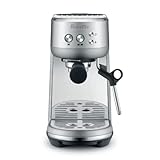
The BES450BSS is the original Bambino. It is the better choice for black coffee fans, tight counters and anyone who wants to learn to steam by hand. Remember the 1.4 L tank, and the fact that milk textured by hand needs practice. For straight espresso, the extraction system matches the Plus.
Breville Bambino Plus Bundle with Baratza Encore ESP Grinder

This bundle packages a Bambino Plus with an Encore ESP espresso grinder, which solves the problem both machines share: neither includes a grinder. If you do not yet own a burr grinder that can adjust finely for espresso, this combination is a convenient one-purchase route. Confirm the machine color, the grinder specifications and whether the bundle changes any included accessories before ordering.
Breville Bambino Plus in Damson Blue

The BES500DBL is the Plus in a deep blue finish. It is a styling choice rather than a functional upgrade, so the features match the other Plus models: automatic and manual steam, ThermoJet and a 1.9 L tank. Pick it if color matters in your kitchen, and check that the seller lists the same accessory set.
Questions
Is the espresso better on the Bambino Plus?
No meaningful difference is expected. Both models share the 54mm portafilter, ThermoJet heating and pre-infusion followed by 9 bar extraction. Your grinder, coffee and technique will matter far more.
Is the Plus worth the extra cost if I only make lattes occasionally?
Probably not. If you make a milk drink a couple of times a week, the manual wand on the base model is adequate once you practice. The Plus becomes worth it when milk drinks are a daily habit.
Can the Bambino Plus steam milk manually?
Yes. The Plus has both an automatic mode and a manual mode, so you can switch between them depending on whether you want convenience or control.
Do either of them have a built-in grinder?
No. Both require a separate burr grinder. A bundle with a grinder is available for the Plus if you prefer to buy both together.
Which one takes less space?
The base Bambino is narrower, at roughly 6 inches wide versus a little under 8 inches for the Plus. Confirm exact dimensions on the product page, because spec sheets vary.
What milk works best in the automatic mode?
Fresh, cold milk is the safest starting point. Plant-based milks behave differently, and some brands steam better than others, so expect to adjust. Start with the middle temperature and texture settings and change one at a time.
Update History
- October 21, 2026 – Initial publication; specifications checked against manufacturer documentation where available.
- Check the product page for current specifications and availability before buying.
Sources
- Manufacturer product pages for both machines
- Manufacturer instruction books for tank capacities
- Retailer specification sheets for dimensions and accessories
- Published comparison write-ups covering steaming speed and everyday use


Write Your Review
No reviews yet. Be the first to share your experience!