

Key takeaways
- Breville Barista Express vs Barista Pro compared: heat-up, grind settings, display versus gauge and which one fits your routine best.
The Barista Pro is the better machine for most buyers who care about speed and a clearer interface, and the Barista Express is the better value for anyone who is content with analog controls and a slower warm-up. Both are built around a 54mm portafilter, an integrated conical burr grinder, a manual steam wand and low-pressure pre-infusion into 9 bar extraction. The real differences are the heating system, the grinder range and the way you read and control the machine.
Quick Verdict
| Choose the Barista Express if… | Choose the Barista Pro if… |
|---|---|
| You like a front-facing pressure gauge and physical dials | You want an LCD showing grind, shot time and prompts |
| You can wait for a thermocoil to warm up | You want ThermoJet, ready in about 3 seconds |
| 16 grind settings feel like enough | You want 30 settings for finer adjustment |
| You want the lower-cost way into the family | You will pay more for a more modern interface |
| Simplicity matters more than menus | Digital control and convenience matter more |
Specs Side by Side
| Spec | Barista Express (BES870) | Barista Pro (BES878) |
|---|---|---|
| Portafilter | 54mm, 18 g dose design | 54mm |
| Heating system | Thermocoil, 200 degrees F, PID | ThermoJet, about 3 seconds |
| Grinder | Integrated conical burr, 16 settings | Baratza European precision burrs, 30 settings |
| Interface | Analog, volumetric shot control (1 and 2 shot, or manual) | LCD display, 1 and 2 shot or manual |
| Extraction | Low-pressure pre-infusion, then 9 bar (15 bar pump) | Low-pressure pre-infusion, then 9 bar (15 bar pump) |
| Steam wand | Manual | Manual, 4-hole tip reported by reviewers |
| Water tank | About 2 L | About 2 L |
| Bean hopper | About 250 g (8.8 oz) per listings | About 250 g (8.8 oz) per listings |
| Rated power (US manuals, as reported) | 1750 W | 1680 W |
| Dosing funnel included | Yes | Yes |
Breville’s pages are the source for the heating, grinder and interface rows. Tank, hopper and wattage values come from manuals and retailer listings as summarized by reviewers and sometimes differ, so confirm them on the listing. Outside dimensions also vary by source, but the Pro is listed as slightly larger in both depth and height.
Key Differences That Matter
Heat-up: ThermoJet versus thermocoil
The Barista Pro uses ThermoJet, which Breville says reaches extraction temperature in about 3 seconds and uses roughly 32 percent less annual energy than thermoblock systems. The Barista Express uses a thermocoil with PID control targeting 200 degrees Fahrenheit. Reviewers describe the thermocoil warm-up as roughly 30 seconds or longer from cold, with some sources giving longer figures. The practical effect is the first-cup experience: on the Pro you can grind and pull a shot almost immediately, while on the Express you leave it for a little while. As with any machine, warm the portafilter and group head with a blank shot to get consistent temperature in the first cup, especially on the Pro, where the water heats faster than the metal parts do.
Grinder range: 16 versus 30 settings
The Express lists 16 grind settings, though some sources cite 18, and an internal burr adjustment lets you change the overall range. The Pro lists 30 settings with Baratza precision burrs. More settings mean finer steps between them, which helps when you are dialing in a shot that is only slightly too fast or slow. On the Express, a single step can feel like a large jump, so some owners use the internal adjustment or change dose slightly to fine tune. If you enjoy pursuing small improvements, the Pro’s grinder is the clearer advantage.
Interface: gauge versus display
The Express has a front pressure gauge that shows what is happening during the shot. It is a nice visual cue, and it shows pre-infusion pressure rising into the target range. The Pro replaces it with an LCD that shows grind size, shot time and prompts. Both have volumetric shot control with 1-shot and 2-shot options and a manual override. Some buyers prefer the analog look and the lack of menus; others prefer the timer and guidance of a digital display. A shot timer is useful because shot time is the quickest way to know whether to change the grind.
Steam and milk
Both machines use manual steam wands, so milk texturing is a skill you build. Reviewers report that the Pro has a four-hole steam tip, which can feel more powerful and more even, but as with other specs, confirm the details on the listing. Neither machine textures milk automatically. If automation matters, the Barista Touch is the family member to examine.
Size and workflow
Both are similar in footprint, with the Pro a little larger according to Breville’s listed dimensions. Each needs space for the hopper, the tank at the back and clearance above for filling the hopper. Measure your cabinet height before buying either model.
Daily use
A typical session on either machine begins with a fill of beans, a purge and a pre-warm. The Express encourages a slower, more deliberate routine. The Pro rewards a quicker one, which matters on weekday mornings. The two models share the same overall workflow: grind into the portafilter, level, tamp, pull the shot, then steam milk.
Dialing in beans: how each machine helps
Shot time is the main feedback loop when you adjust a grinder. On the Pro, the display makes that loop immediate: you see the timer while the shot runs, change the grind by a step, and compare. On the Express, you rely on the gauge, the look of the stream and an external timer such as a phone. Neither approach is wrong, but the Pro shortens the path for beginners, while the Express asks you to build more habits by feel.
A common starting recipe on either machine is about 18 grams of coffee in the basket for roughly twice that weight in liquid, in a window around 25 to 30 seconds. Treat it as a starting point and let taste decide. With the Express’s coarser steps, you may land between two settings and need to adjust dose by a fraction of a gram. With the Pro’s 30 steps, the jump between settings is smaller, so landing closer to the sweet spot is easier.
Upkeep and longevity
Both machines need the same care: descale as the manual directs, replace or rinse the water filter, brush out the grinder area, and clean the steam wand after every use. Neither design removes the need for those habits, and skipping them hurts flavor more than the choice between Express and Pro. A thermocoil and a ThermoJet both depend on clean water paths, so use filtered water if your tap water leaves scale. Check Breville’s warranty terms on the listing, since coverage details can vary by seller.
Pros and Cons
Breville Barista Express
- Front pressure gauge and analog controls
- Same 54mm portafilter and pre-infusion as the Pro
- Typically the more affordable of the two
- Simple interface with few menus
- Slower warm-up from the thermocoil
- Fewer grind settings, with larger steps between them
- No digital shot timer
- Manual milk only
Breville Barista Pro
- ThermoJet heating in about 3 seconds
- 30 grind settings for finer dialing in
- LCD with grind size, shot time and prompts
- Manual milk with a four-hole tip, as reported by reviewers
- No pressure gauge
- Higher cost than the Express
- Menus can feel more complex to some users
- Manual milk only
Counter space and placement
Because both machines have a hopper on top and a tank at the back, placement matters more than the small difference in footprint. Leave room to lift the hopper lid, slide the tank out and open the drip tray without moving the machine. Under a low cabinet, check the height with the lid open. Keep the machine away from direct sun and heat sources, which can warm the beans in the hopper.
Which One Should You Buy?
If budget is the main constraint and you are comfortable with a slower start, the Barista Express remains a capable machine. Its analog controls are easy to read, and it teaches the full manual workflow. If your mornings are rushed or you dial in different beans regularly, the Barista Pro’s quicker heating, finer grinder and display make daily use smoother. Households that value a clean learning path often choose the Pro for the shot timer alone.
Two other directions are worth a look. For consistent puck preparation without practice, the Barista Express Impress adds assisted dosing and tamping to the Express formula. For automatic milk and a touchscreen, the Barista Touch is the step up. Both cost more and take more space, so decide whether the extra automation matches how you actually drink coffee.
Whichever you pick, buy fresh beans, use filtered water if your tap water is hard, and follow the cleaning schedule in the manual. Those habits influence the cup as much as the machine.
Gear Mentioned
Breville Barista Pro in brushed stainless steel
As an Amazon Associate we earn from qualifying purchases at no extra cost to you.
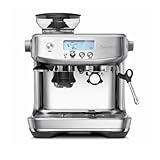
The BES878BSS is the Pro discussed above. It pairs ThermoJet with a 30-setting grinder and an LCD display, in a package with a dosing funnel, a milk jug and cleaning supplies. It suits buyers who want fast starts and clearer feedback while dialing in. Confirm the current accessory list and dimensions on the listing before ordering.
Breville Barista Express in brushed stainless steel
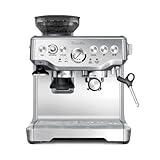
The BES870XL is the original Express. Expect a thermocoil, 16 grind settings, an analog interface and a pressure gauge. It includes a dosing funnel, a razor dose trimming tool, an integrated tamper, a milk jug and a water filter and holder according to Breville. It is the more traditional, more affordable route into the line.
Breville Barista Express Impress in brushed stainless steel

The BES876BSS keeps the Express formula and adds assisted dosing and tamping with a constant 22 pounds of pressure and a 7-degree twist. It has 25 grind settings. If tamping consistency is your main worry, it fits between the Express and the touchscreen models. Remember that grind adjustments and milk steaming remain manual.
Breville Barista Touch in brushed stainless steel

The BES880BSS adds a touchscreen and guided drink making with an automatic milk system, for buyers who want more hands-off operation than either machine above. It sits at a higher level of cost and counter size, so confirm its features and dimensions on the listing before comparing it with the Express or Pro.
Questions
Is the Barista Pro worth it over the Barista Express?
It is worth it if you value quick heat-up, finer grind adjustment and a digital display. If you prefer analog controls and a front pressure gauge, the Express gives you most of the same espresso system for less.
Do they use the same portafilter?
Both use a 54mm portafilter and similar basket styles, with low-pressure pre-infusion followed by 9 bar extraction. Check the listing for what baskets and accessories ship in the box.
How many grind settings does each have?
Breville lists 16 settings for the Express and 30 for the Pro. Some retailer pages cite 18 for the Express, so confirm the figure on the listing you are buying from.
Which one heats up faster?
The Barista Pro. Its ThermoJet system is rated at about 3 seconds, while the Express thermocoil takes noticeably longer.
Can either machine steam milk automatically?
No. Both use manual wands. For automatic milk, the Barista Touch family is the more suitable option.
Which is easier for a beginner?
Both are beginner friendly. The Express has fewer menus. The Pro gives more feedback, such as shot time, which can speed up learning. Beginners who struggle with tamping may prefer the Express Impress instead.
Update History
- October 21, 2026 – Initial publication; specifications checked against manufacturer documentation where available.
- Check the product page for current specifications and availability before buying.
Sources
- Manufacturer product pages for the Barista Express, Barista Pro and related models
- Manufacturer manuals and retailer specification sheets for tank, hopper and power figures
- Published comparison articles on heating, grinder settings and interface differences

Write Your Review
No reviews yet. Be the first to share your experience!