

Key takeaways
- Lelit Bianca review: how the dual boiler, paddle flow control and PID perform, who it suits, and which alternatives fit a smaller or simpler setup.
The Lelit Bianca is a dual-boiler, E61-group prosumer espresso machine built around a manual flow-control paddle, and it is worth it for a home barista who wants to shape pressure during a shot rather than just press a button. It brews and steams at the same time, holds temperature with PID control, and can be plumbed into a water line. It is overkill for anyone who wants push-button convenience or a built-in grinder. This review covers what the Bianca does, where it asks for patience, and which of the machines below make more sense for different kitchens.
Quick Verdict
- Best fit: a hobbyist who already owns, or plans to buy, a quality standalone grinder and wants direct, manual control of pre-infusion and pressure profiling via the paddle.
- Standout feature: the paddle on the E61-style group lets you vary flow into the puck, with a pressure gauge at the group so you can see what the change does.
- Main strength: separate brew and steam boilers, each under PID control, so shot temperature stays steady while milk is steaming.
- Main limit: it is a large, heavy, learn-as-you-go machine with a warm-up period and a real maintenance routine.
- Skip it if you want a built-in grinder, automatic milk drinks, or a machine that is ready in under a minute.
Key Specs
The figures below come from manufacturer-style product pages and specialty retailer listings for the current V3 version. Retailers disagree on a few numbers, so those rows say to confirm on the listing.
| Spec | Lelit Bianca (PL162T, V3) |
|---|---|
| Type | Dual boiler, semi-automatic |
| Brew boiler | About 0.8 L, stainless steel, PID controlled |
| Steam boiler | About 1.5 L, stainless steel, PID controlled |
| Group | E61-style group with a manual flow-control paddle |
| Portafilter | 58 mm commercial size |
| Pump | Rotary pump, plumbable to a water line |
| Water reservoir | About 2.5 L, can be mounted at the rear, left or right |
| Shot timer | Built in; keeps running through programmable pre-infusion and soak |
| Gauges | Group-head brew pressure gauge plus pump and steam pressure gauges |
| Steam and hot water | No-burn arms |
| Electrical draw | Listings vary – confirm on the listing for your region |
| Dimensions and weight | Listings vary between versions – confirm on the listing |
Who It Is For (and Who Should Skip It)
A good match
The Bianca suits the person who enjoys the process. If you like adjusting a variable, pulling a shot, tasting it and changing one thing at a time, the paddle gives you something concrete to adjust. It also suits households that make several milk drinks in a row, because a dedicated steam boiler does not force you to wait between brewing and steaming. People who can plumb the machine into a water line will appreciate skipping the refill routine altogether.
A poor match
Someone who wants a quick cappuccino before work without thinking about grind, dose, and pressure will find the Bianca slow and fussy. It has no grinder, so you need a separate one that can hold a fine, consistent grind; a mediocre grinder will waste the machine’s potential. Small kitchens also need to measure carefully: the machine is a full-size, heavy prosumer unit. Renters who move often may not enjoy hauling it around.
What It Does Well
Flow control that is easy to read
The paddle sits on the group and changes the water flow into the brew head, which in turn changes brew pressure. Because there is a group-head pressure gauge, you can watch the needle respond. That feedback loop is the point: many machines claim pressure profiling, but few show you what is happening. A common approach is to open the paddle partway for a gentle pre-infusion, then open it fully for the main extraction, or to ease off near the end of the shot for a softer finish. The right approach depends on the coffee, so treat any recipe as a starting point.
Temperature stability from two PID-controlled boilers
With a separate brew boiler and steam boiler, the Bianca does not share one heater between two jobs. That is the real benefit of the dual-boiler layout. Brew temperature is set on the display and the PID works to hold it, while the steam boiler stays at steaming temperature in the background. On a single-boiler machine you wait for the unit to change modes; here you can pull a shot and steam milk in the same minute.
Shot timer and programmable pre-infusion
A built-in shot timer is a small feature that gets used every morning. On the Bianca it keeps counting through the programmable pre-infusion and soak period, so the displayed time matches what actually happened to the puck. That removes the need for a separate scale-timer for basic timing, though many enthusiasts still brew onto a scale to track yield.
Plumb-in option and a quiet pump
The rotary pump is quieter than a vibration pump, and the option to connect directly to a water line removes the daily tank routine. If you prefer the reservoir, the 2.5 L tank can be positioned to suit your counter layout. Both features are practical rather than glamorous, and they are the sort of details that shape long-term satisfaction.
Serviceable design
The E61-style group and stainless boilers follow a familiar pattern that technicians and parts suppliers know. That helps if you plan to keep the machine for many years and expect to replace gaskets or other wear items along the way.
What a typical morning looks like
A realistic routine goes like this. Switch the machine on, give the group time to come up to temperature, and weigh your dose while it heats. Flush the group briefly, lock in the portafilter, and start the shot with the paddle at your chosen setting while watching the timer and the gauge. When the shot finishes, close the paddle, wipe the basket, and move straight to steaming because the second boiler is already ready. Cleanup takes a minute: purge the wand, rinse the portafilter, and empty the drip tray. The routine becomes second nature quickly, but it is a routine, and anyone who dislikes ritual should weigh that honestly.
Why the grinder matters so much
Espresso extraction is sensitive to grind size, and flow control raises the stakes. A paddle lets you compensate for a slightly fast or slow shot, but it cannot fix an uneven grind. Pair the Bianca with a grinder that offers fine step adjustment and produces consistent particles, then use the paddle to refine rather than to rescue. If your budget has to be split, a good grinder with a simpler machine usually beats a premium machine with an average grinder.
Where It Falls Short
- Warm-up time. E61 groups are thermally heavy. Plan to switch the machine on well before your first drink; confirm the manufacturer’s guidance for the V3 before you build a morning routine around it.
- Learning curve. The paddle does nothing for you until you know what you are aiming for. Expect several bags of coffee before the shots feel consistent.
- Grinder required. The machine is only as good as the grinder feeding it. Budget for a capable burr grinder, ideally one that can make fine adjustments.
- Size and weight. It is a substantial machine, and listings disagree on exact dimensions and weight. Measure your counter, cabinet clearance, and the space needed to lift the tank or reach the rear.
- Maintenance. Dual-boiler machines need descaling attention, backflushing habits, and periodic gasket replacement. None of that is unusual for the category, but it is more than an entry-level machine asks.
- Power draw. Retailer listings quote different electrical figures. Confirm the electrical figure for your region and make sure your outlet and circuit can support it, especially if other appliances share the line.
How It Compares
The table compares the Bianca with the machines listed here. Entries for the other machines use what their listings and manufacturer pages state; where a value is not confirmed, the table says so.
| Machine | Boiler layout | Group and portafilter | Control highlights | Best for |
|---|---|---|---|---|
| Lelit Bianca | Dual boiler | E61-style, 58 mm | Manual flow-control paddle, dual PID, shot timer | Tinkerers who want visible pressure control |
| Diletta Alto | Dual boiler (about 0.75 L brew, 1.6 L steam) | 58 mm | PID, shot timer, adjustable over-pressure valve, pre-infusion | Dual-boiler performance in a tank-fed machine |
| Diletta Bello+ | Heat exchanger (about 1.8 L) | E61, 58 mm | PID display, shot timer, programmable pre-infusion | E61 character with a simpler layout |
| Rocket Appartamento TCA | Heat exchanger (1.8 L) | E61, 58 mm | Hybrid PID with four brew temperature choices | Compact, classic-looking HX machine |
| Breville Barista Pro | Single heating system (ThermoJet) | 54 mm | Built-in grinder with 30 settings, PID, pre-infusion | Fast, integrated, beginner-friendly setup |
Alternatives Worth Considering
The Bianca is not part of the product list below, so these are the closest listed machines to consider if it feels like too much, too little, or simply the wrong shape for your kitchen.
Diletta Alto – the closest dual-boiler rival
As an Amazon Associate we earn from qualifying purchases at no extra cost to you.
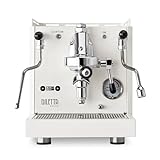
The Alto is the listed machine that mirrors the Bianca’s layout most closely. It pairs a brew boiler of roughly 0.75 L with a steam boiler of roughly 1.6 L, both PID-controlled, so brewing and steaming can overlap. The listing also mentions a shot timer and an adjustable over-pressure valve. It uses a 3 L tank; it is not described as plumbable, which matters if a direct water line is on your wish list. Manufacturer information shows a separate version with flow control, so check which variant the listing describes before assuming a paddle or similar feature is included. Choose it if the dual-boiler workflow appeals and the tank-fed design is acceptable.
Diletta Bello+ – E61 character with a simpler boiler
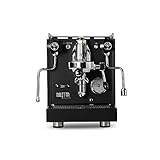
The Bello+ is a heat-exchanger machine with an E61 group, a 58 mm portafilter, a front PID display that controls the steam boiler, and a shot timer. Manufacturer details describe programmable passive pre-infusion of up to about 10 seconds and a large boiler near 1.8 L. It brews and steams at the same time, as heat-exchanger machines do, but without separate boilers or a flow paddle. Some retail text calls it a dual boiler; the manufacturer information points to heat exchanger, so go by that. It suits a buyer who loves the E61 look and the weight of a classic machine but does not need pressure profiling.
Rocket Appartamento TCA – compact heat-exchanger classic

The Appartamento TCA is described as an E61 heat-exchanger machine with a 1.8 L boiler and a hybrid PID offering four selectable brew temperature settings. It is built for smaller counters than many prosumer machines, though dimensions in the listings should be measured against your space. Retailers disagree on the reservoir size and the electrical figures, so confirm both on the listing. It lacks the Bianca’s dual boilers and paddle, but its simpler setup and compact shape make it attractive to someone who wants a long-lived, traditional espresso machine without sizing up to a full dual-boiler footprint.
Breville Barista Pro – the integrated, easier path
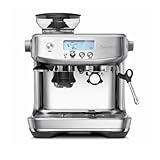
If the Bianca sounds like more of a project than you want, the Barista Pro is the other end of the spectrum. Manufacturer materials describe a ThermoJet heater that reaches brewing temperature in about three seconds, a 54 mm portafilter, a built-in conical burr grinder with 30 settings, a 2 L tank, and a manual steam wand. It switches between brewing and steaming rather than doing both at once, and the 54 mm size limits accessory choices. For a household that values speed and convenience over pressure control, it is a very different, and much simpler, route into home espresso.
Questions
Is the Lelit Bianca worth it?
It is worth it if you will use the paddle, own or plan to buy a strong grinder, and value dual-boiler workflow. If you mostly want fast, repeatable drinks with little tinkering, a simpler machine delivers more of what you will actually use.
Does the Lelit Bianca need a separate grinder?
Yes. It has no built-in grinder, so you need a standalone burr grinder that can produce a fine, consistent grind. The grinder often matters as much as the machine in determining how the coffee tastes.
Can the Bianca be plumbed into a water line?
Product pages describe it as plumbable, and it also has a reservoir of roughly 2.5 L that can be mounted in several positions. Confirm the required fittings and local plumbing rules before connecting it.
What does the flow-control paddle actually do?
It adjusts how much water flows into the group, which changes the pressure applied to the coffee puck. With the group-head gauge, you can see that effect while the shot runs. It is a tool for experimenting, not a switch that improves every shot automatically.
How is the Bianca different from a heat-exchanger E61 machine?
A heat-exchanger machine uses one boiler for steam and passes brew water through a tube inside it, while the Bianca has a separate brew boiler. Separate boilers make brew temperature easier to hold and adjust, at the cost of more components and a larger footprint.
Do I need to use the paddle on every shot?
No. You can leave the paddle fully open for a conventional shot and use the programmable pre-infusion for a gentle start. Think of the paddle as an optional tool to reach for when a particular coffee needs a softer or longer ramp-up.
Update History
- October 21, 2026 – Initial publication; specifications checked against manufacturer documentation where available.
- Check the product page for current specifications and availability before buying.
Sources
- Manufacturer product and specification pages for Lelit, Diletta, Rocket Espresso, and Breville
- Specialty espresso retailer product pages and specification fields
- Retailer listing titles for the products named above
Write Your Review
No reviews yet. Be the first to share your experience!