

Key takeaways
- Best 100 cup coffee makers for catering: six 15 to 16 liter stainless urns compared by capacity, wall construction, power and brew time.
For most caterers and event hosts, the SYBO SR-CP-100B is the strongest all-around 100-cup urn in this group: it has the largest stated capacity (16 liters), a keep-warm mode with a ready light, and level markings inside the tank. A “100-cup” urn is a big electric percolator that fills with water and ground coffee, then holds the finished batch hot for service. If your gatherings are smaller or you want a budget-minded 15-liter alternative, the VEVOR, NUPANT and OSTBA models are close behind. All six listings are sorted by use case below, with the caveats you should know before ordering.
Quick List
- VEVOR 100 Cup 15 L Urn – best for church halls and community events that want a dripless faucet
- SYBO SR-CP-100B 16 L Urn – best overall for caterers who want the largest tank and a certified build
- Zulay 100 Cup Percolator Urn – best for double-wall, easy-to-handle buffet service
- NUPANT 100 Cup 15 L Urn – best for 304 stainless construction with a dual coffee and hot water role
- OSTBA 100-Cup 1500W Urn – best for fast-brewing claims with a stated wattage
- Garvee 14 L Double-Wall Urn – best for weddings and buffets where a slightly smaller batch is enough
Which One Is Right for You?
| If you… | Choose |
|---|---|
| want the biggest stated tank in the group (16 L) | SYBO SR-CP-100B |
| pour for a crowd and care about a dripless faucet | VEVOR 100 Cup 15 L |
| want a double-wall body to reduce hot-surface contact | Zulay 100 Cup Urn or Garvee 14 L |
| also want to dispense hot water for tea and cocoa | NUPANT 100 Cup 15 L |
| want a listing that states 1500W up front | OSTBA 100-Cup |
| usually serve closer to 80 to 90 five-ounce cups | Garvee 14 L |
If you only remember one rule, remember this: pick the urn whose rated capacity matches your largest realistic crowd, then confirm the wattage on the listing and the label before you plan the electrical side. All six of these units are used the same way, so the differences come down to tank size, wall construction, faucet design and how clearly the listing documents power and certifications.
All 6 Picks in Detail
1. VEVOR 100 Cup 15 L Urn – Best for Community Events With a Dripless Faucet
As an Amazon Associate we earn from qualifying purchases at no extra cost to you.
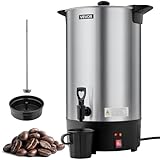
The VEVOR listing describes a 100-cup, 15-liter hot beverage dispenser in stainless steel with a dripless faucet and quick-brewing design. That faucet detail matters more than it sounds. At a fellowship hall or a fundraiser, the urn sits on a folding table for hours, and a spigot that drips onto a tablecloth is a daily annoyance. A 15-liter tank works out to roughly 500 ounces, which lines up with the usual urn convention of counting each “cup” as about 5 ounces rather than a full mug.
Think about where this urn will live. Church basements, school gyms and community centers often have a single wall outlet near the serving table, so a unit with a faucet that does not leak onto a cloth runner earns its place quickly. Cleaning also gets easier when drips do not dry on the base. The trade-off is that the listing name does not spell out wattage or wall construction, so read the full product page before you build an event plan around it.
- Stated capacity: 100 cups, 15 liters
- Stainless steel body with dripless faucet, per the listing
- Marketed as quick-brewing; confirm the wattage and brew time on the product page
- Works as a percolator-style batch brewer for ground coffee
- Intended for commercial, catering and event service
Pros
- Dripless faucet is a real convenience on a buffet line
- 15 liters covers a typical 60 to 90 person gathering
Cons
- Wattage, certification and wall construction are not clear from the listing name
- Slightly smaller stated tank than the SYBO
Compared with the NUPANT, which has nearly identical capacity, the VEVOR is the one to pick if faucet behavior is your priority, while the NUPANT puts its emphasis on the percolator and the 304 grade of steel.
2. SYBO SR-CP-100B 16 L Urn – Best Overall for Caterers
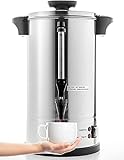
SYBO’s SR-CP-100B is marketed as a commercial-grade stainless steel percolator and hot water urn for catering, with a 100-cup, 16-liter capacity. Retailer and reseller pages for this model describe 304 stainless steel, an automatic keep-warm function, an indicator light for when coffee is ready, internal level markings and ETL certification. Those details are what separate a catering workhorse from a novelty urn: someone can read the fill line, trust the shutoff, and walk away.
For a working caterer, the paperwork matters almost as much as the metal. A unit carrying an ETL mark in its product literature is easier to defend to a venue manager or a health inspector who asks what you plugged into their wall. The long brew time is the usual trade-off with any percolator urn, and the practical answer is to fill it and switch it on well before setup is finished, then let the keep-warm mode carry you through service.
- Stated capacity: 100 cups, 16 liters (about 4.2 gallons)
- Stainless steel percolator with a stainless filter basket, per product pages
- Automatic keep-warm and a ready indicator light
- Power: 1500W at 120V appears on at least one listing; confirm on the label or manual
- Brew time varies by listing, from about 40 to 60 minutes for a full batch
Pros
- Largest stated tank in this group
- Safety certification and keep-warm behavior are documented
Cons
- Different production years (including an “upgrade” version) can change specs, so check the exact listing
- A full batch takes close to an hour, so start early
Compared with the Zulay, the SYBO offers more documented safety and capacity detail, while the Zulay leans on its double-wall body.
3. Zulay 100 Cup Percolator Urn – Best for Double-Wall Buffet Service
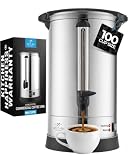
The Zulay listing calls this a commercial coffee maker and 100-cup urn with a double-wall stainless steel body. A double wall can mean a cooler outer surface and better heat retention between the layers, which is useful when guests are reaching across a table. The listing name is cut off after “Commerci”, so details such as wattage, tank volume in liters and certifications need to be confirmed on the product page before you commit to it for a paid event.
Double-wall bodies are popular at buffet lines because the outer shell stays far cooler to the touch than a single skin of steel, though no hot beverage urn should be treated as cool. If you serve at a school, senior center or wedding where guests of all ages reach for the spigot, that extra margin is welcome. Because the visible listing text stops early, treat the unseen specifications as unknown and read the full page for wattage, tank volume and any safety marks.
- Stated capacity: 100 cups
- Double-wall stainless steel construction, per the listing
- Large percolator-style brewer
- Tank volume, wattage and certification: confirm on listing
- Best used with a coarse, percolator-style grind
Pros
- Double-wall design is helpful around guests and children
- Straightforward batch brewing for large groups
Cons
- Fewer specifications visible in the listing name than the SYBO or OSTBA
- You must verify power draw yourself
Next to the Garvee, which also advertises a double wall, the Zulay holds a full 100 stated cups instead of a slightly smaller tank.
4. NUPANT 100 Cup 15 L Urn – Best for Coffee Plus Hot Water Duty

NUPANT describes this as a 100-cup, 15-liter coffee dispenser with an “upgraded percolator” in 304 stainless steel, and it also calls it a hot water urn and beverage dispenser. That makes it a good fit for a mixed-drink table: coffee first, then hot water for tea bags, cocoa and oatmeal once the brew is done. The 304 grade is a food-service staple because it resists staining and is easy to wipe down between events.
A dual-purpose urn can simplify a beverage table. You brew coffee at the start of the event and, once the tank is rinsed, reuse it for plain hot water during the cleanup hours or the next gathering. Keep coffee and tea water as separate batches, since oils from coffee linger in the basket and stem, and give the tank a thorough rinse in between so tea does not pick up a roasted flavor.
- Stated capacity: 100 cups, 15 liters
- 304 stainless steel, per the listing
- Upgraded percolator assembly
- Positioned as both a coffee dispenser and a hot water urn
- Wattage and brew time: confirm on listing
Pros
- Clear 304 stainless callout
- Flexible for hot beverage tables
Cons
- Details about faucet design and insulation are not visible in the name
- Power rating needs confirmation
The OSTBA is the closest rival here, and it wins on a clearly stated wattage, whereas the NUPANT wins on the explicit hot-water-urn positioning.
5. OSTBA 100-Cup 1500W Urn – Best for Stated Wattage and Fast-Brew Claims
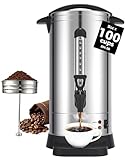
The OSTBA listing leads with the numbers: a 100-cup, 15-liter, 304 stainless steel percolator with 1500W for fast brewing, working as both a coffee maker and a hot water dispenser. Knowing the wattage up front lets you plan the circuit before event day. At 120 volts, 1500W draws about 12.5 amps, which is close to the practical limit of a standard 15-amp household circuit for a sustained load.
A fast-brew claim should be read in context. Even at 1500W, heating roughly 15 liters of cold water through a percolator takes a long while, and listings for comparable urns quote 40 minutes to an hour for a full batch. The value of the higher wattage is that it brings the tank to temperature steadily rather than crawling. Plan to switch it on early, keep the lid closed during the cycle, and avoid sharing the circuit with a space heater, toaster or second urn.
- Stated capacity: 100 cups, 15 liters
- 304 stainless steel percolator
- 1500W stated power
- Coffee maker and hot water dispenser in one body
- Wall construction beyond the cut-off listing text: confirm on listing
Pros
- Wattage is stated clearly, which simplifies planning
- Same 15-liter class as VEVOR and NUPANT
Cons
- Needs its own circuit during a long brew
- Certification details are not in the visible name
Compared with the SYBO, the OSTBA offers a similar power class but a smaller stated tank and less certification detail in its title.
6. Garvee 14 L Double-Wall Urn – Best for Weddings and Mid-Size Buffets

Garvee lists this urn as 14 liters, or 3.8 gallons, for “100 cups,” with a double-wall body aimed at buffets, weddings and gatherings. The numbers deserve a careful read. At about 5 ounces per cup, 14 liters yields roughly 95 servings, so the “100” is a rounded marketing figure. For a wedding with 80 guests who each take one small cup, that is plenty; for 120 guests who refill, it is not.
The 14-liter figure is useful because it removes guesswork: you know the tank is smaller than the 15 and 16 liter units, so you can plan a second brew or a backup carafe for refills. For a banquet where coffee is served once with dessert, one batch from this size usually covers it. For an all-day conference with repeated refills, step up to the SYBO or one of the 15-liter models.
- Stated capacity: 14 liters (3.8 gallons), sold as 100 cups
- Double-wall construction, per the listing
- Marketed for buffet, catering and wedding use
- Large-capacity hot coffee service
- Wattage and certifications: confirm on listing
Pros
- Double wall reduces hot-surface contact
- Right-sized for events of up to about 90 small servings
Cons
- Smallest tank in the group
- Limited visible specification detail
Next to the Zulay, the Garvee gives up a little capacity in exchange for a clearly stated metric volume you can plan around.
Specs Compared
| Model | Stated capacity | Material | Wall | Power | Hot water use |
|---|---|---|---|---|---|
| VEVOR 100 Cup | 100 cups / 15 L | Stainless steel | Confirm on listing | Confirm on listing | Hot beverage dispenser |
| SYBO SR-CP-100B | 100 cups / 16 L | Stainless steel (304 per product pages) | Confirm on listing | 1500W on at least one listing; confirm | Hot water urn |
| Zulay 100 Cup | 100 cups | Stainless steel | Double wall | Confirm on listing | Confirm on listing |
| NUPANT 100 Cup | 100 cups / 15 L | 304 stainless steel | Confirm on listing | Confirm on listing | Hot water urn |
| OSTBA 100-Cup | 100 cups / 15 L | 304 stainless steel | Confirm on listing | 1500W | Hot water dispenser |
| Garvee 14 L | 100 cups / 14 L (3.8 gal) | Confirm on listing | Double wall | Confirm on listing | Confirm on listing |
How We Chose These
This list is based on desk research into the six listings and the published product literature behind them. We compared stated capacity in both cups and liters, the material named in each title, wall construction, power information, and whether a model is positioned for catering rather than home use. Manufacturer and retailer product pages were checked where they existed, and where a listing name was cut off or silent on a detail, we say “confirm on listing” instead of guessing. We also weighed how much documentation each listing offers, because an urn that publishes its wattage and certifications is easier to plan around than one that does not.
What to Look For
Capacity and what a “cup” really means
Urn makers count a cup as about 5 ounces, not the 8 to 12 ounces of a typical mug. A 100-cup urn therefore holds roughly 500 ounces, which is about 14.8 liters or 3.9 gallons. Served in 8-ounce paper cups, that is around 60 servings; served in small 5-ounce cups, it is closer to 100. Use the maximum-fill line inside the tank, not the cup numbers printed on the side, because markings are not standardized between brands. A simple rule of thumb: divide your guest count by 0.6 if everyone gets a standard 8-ounce cup to find the batch size you need in “urn cups”.
Power draw and circuits
Many 100-cup urns draw around 1500W while heating. At 120 volts, that is 12.5 amps, and a standard 15-amp circuit is generally planned for continuous loads of about 80 percent, or 12 amps. In practice, this means the urn should have a circuit to itself, plugged straight into the wall rather than through a thin extension cord. If you must use a cord, choose a heavy-duty one rated for the load, and never run a second large appliance on the same line. Check the wattage on the label before the event.
Materials and construction
Look for food-grade stainless steel, ideally 304, plus a stainless filter basket so you do not need paper filters. Double-wall bodies keep the outer surface cooler. A sturdy faucet with a clear path for cleaning matters more than most buyers expect, because sediment builds up at the spigot. Handles that stay cool and a lid that locks reduce spills when the urn has to be moved between rooms.
Brew time and holding
Percolator urns are slow. Listings for similar models quote about 40 to 60 minutes for a full batch, and some operators plan for longer. Start with cold water, because the automatic cycle is timed for it, and plan to finish brewing at least an hour before guests arrive. After the cycle, the urn drops into keep-warm mode. Coffee held for several hours can turn bitter, so brew closer to service time when you can, and remove the basket and stem once brewing finishes.
Coffee amounts and grind
Use a coarse, percolator-style grind. Many urn guides suggest roughly 6 to 8 cups of ground coffee for a full 100-cup batch, depending on how strong you want it, but follow your manual’s measurements first. Minimum batch size also matters: some urn manuals say not to brew fewer than 25 to 40 cups at a time, so a 100-cup unit is a poor choice for small gatherings.
Planning a worked example. Say you are catering a 90-guest reception where each guest takes one 6-ounce cup. That is 540 ounces, slightly more than a nominal 100-cup urn holds, so either choose a 16-liter unit and accept a little less than a full pour, or bring a second brewer. Add refills and you are comfortably into two-urn territory. A backup thermal airpot or a second urn also protects you if one unit trips a breaker mid-cycle, which is far less stressful than apologizing to a room full of guests.
Safety and cleaning. Fill with water and grounds before plugging in, never run the urn empty, do not move it while full and hot, and keep the cord off the table edge. Let the unit cool before taking it apart. Rinse the tank, spigot and basket after each event, and descale periodically if your water is hard.
Questions
How many people does a 100-cup urn serve?
If each person takes a small 5-ounce cup, it serves about 100 people. With standard 8-ounce cups it serves closer to 60, so size up if guests will refill.
Why does the urn take so long to brew?
It is a very large percolator heating a full tank of cold water. Product pages for similar models quote 40 to 60 minutes, and operators often plan for more.
Can I make a smaller batch in a 100-cup urn?
Not well. Many manuals set a minimum batch of 25 to 40 cups, and the heating element and percolator tube are designed for larger volumes. Check the manual for your exact model.
Can these urns also heat plain water?
Several listings describe the unit as a hot water urn or dispenser as well as a coffee maker. Confirm that on the product page, and clean the basket and stem thoroughly if you switch from coffee to tea water.
What grind and amount of coffee should I use?
Use a coarse grind meant for percolators, and start with the amounts in the manual. A common range is about 6 to 8 cups of grounds for a full batch.
Do I need a special outlet?
Most of these units plug into standard 120-volt power, but their draw is high. Use a dedicated circuit, avoid long extension cords and confirm the wattage on the label.
Update History
- October 21, 2026 – Initial publication; product set drawn from current catalog listings.
- Check the product page for current specifications and availability before buying.
Sources
- Manufacturer and retailer product and specification pages for SYBO and the other brands listed
- Retailer listing titles and specification fields
- Coffee urn operating guides and manuals describing cup sizes, brew times and minimum batch volumes


Write Your Review
No reviews yet. Be the first to share your experience!