

Key takeaways
- The best glass French presses compared: six 34 oz borosilicate picks with filter layers, frame materials, care notes and a decision table.
The Bodum Chambord 34 oz is the best glass French press in this group for most people: a borosilicate carafe in a stainless steel frame, sold in a size that serves two to four and backed by a long-running design. If you want a press where no plastic touches the coffee or the hot water, the Veken 34 oz is the closest match among the other five. A glass press lets you watch the brew and shows the carafe’s cleanliness at a glance, and every pick below uses borosilicate glass, which is built to take hot water better than ordinary glass.
Quick List
- Veken 34 oz, Cold Brew Pot Listing – best for avoiding plastic contact with hot coffee
- Bodum Chambord 34 oz – best overall for a classic steel-framed glass press
- Basics French Coffee Press 34 oz – best for easy dishwasher-friendly cleanup
- Veken 34 oz, Heat-Resistant Listing – best as the second route to the same Veken design
- Utopia Kitchen 34 oz Glass Press – best for a plain black everyday pot
- QUQIYSO 34 oz Glass Press – best for those who want extra filter layers
Find Your Glass Press Fast
| If you… | Choose |
|---|---|
| want a stainless frame and a design with a long track record | Bodum Chambord 34 oz |
| want to avoid plastic touching the coffee | Veken 34 oz |
| put as many parts as possible in the dishwasher | Basics French Coffee Press 34 oz |
| want a straightforward black press with a stainless plunger | Utopia Kitchen 34 oz |
| dislike silt in the cup and want a four-layer filter | QUQIYSO 34 oz |
| find the first Veken listing unavailable | Second Veken 34 oz listing |
All six hold 34 oz, or about a liter, so you are choosing on filter design, frame material, and care instructions rather than size. If you are unsure, the Chambord is the lowest-risk pick because its parts and replacement carafes are the easiest to find. The other five are worth a look if you care about a specific feature, such as no plastic in contact with coffee or dishwasher-safe components.
All 6 Picks in Detail
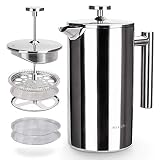
1. Veken 34 oz, Cold Brew Pot Listing – Best for Avoiding Plastic Contact
As an Amazon Associate we earn from qualifying purchases at no extra cost to you.

Veken markets this press with a “no plastic touching” design, using 304 stainless steel and food-grade silicone where the coffee and water make contact. The carafe is thickened borosilicate glass, and the filter is described as four layers, including a spiral plate, a cross plate, and two fine mesh screens. The same listing language calls it suitable for cold brew. Listings differ on the glass’s heat limit, quoting 360 degrees Fahrenheit in some places and a lower figure in others, so confirm on this page.
- Volume: 34 oz (1 liter)
- Carafe: thickened borosilicate glass
- Contact materials: 304 stainless steel and food-grade silicone per descriptions
- Filter: four-layer stainless system per descriptions
- Care: parts separate for washing; dishwasher guidance varies, confirm on listing
Pros:
- Designed to keep plastic away from the brew
- Multi-layer filter for a cleaner cup
Cons:
- Heat-tolerance figures differ between listings
- More filter parts to wash
It is the pick to choose over the Chambord if material contact is your priority.
2. Bodum Chambord 34 oz – Best Overall Glass Press

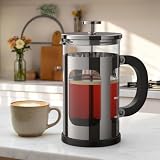
The Chambord is the reference design in this category, and the listing describes a high-heat borosilicate carafe in a polished stainless steel frame, made in Portugal. Bodum sizes it as an eight-cup press, counting a cup as 4 oz. A stainless plunger and filter handle the grounds, and the knob and handle are plastic. Because the frame wraps the glass, it is more forgiving of bumps than a bare carafe, and spare carafes are widely available. The shape has barely changed in decades, which is a feature for anyone who wants a press they can recommend or replace without research. It is also the pick to hand to a guest who has never used one, since the plunger action is the textbook example. Pour slowly and keep the lid on, because the spout can drip if you tilt it too fast.
- Volume: 34 oz (about 1 liter), eight cups by Bodum’s count
- Carafe: high-heat borosilicate glass
- Frame: polished stainless steel
- Plunger and filter: stainless steel
- Origin per listing title: Portugal
Pros:
- Long-established, easy-to-replace design
- Metal frame protects the glass
Cons:
- Plastic handle and knob limit direct-heat use
- Single-layer filter style passes more fines than multi-layer designs
Against the Veken it offers the proven shape, while the Veken offers more filter layers.
3. Basics French Coffee Press 34 oz – Best for Easy Cleanup

The retailer’s house-brand press is a plain 34 oz glass pot. Its listing names borosilicate glass, a BPA-free build, a triple filtration system, and dishwasher-safe parts. The description of the filter is a fine mesh screen, a spring disc, and a cross plate. Most of the frame is plastic, so it is lighter than the Chambord, and it is a reasonable choice if the quick wash matters more than a metal frame. For a household that brews every morning, the dishwasher-friendly parts mean the plunger stack gets cleaned thoroughly rather than rinsed in a hurry. Check the listing to see exactly which parts are marked dishwasher safe, and whether they belong on the top rack.
- Volume: 34 oz
- Carafe: borosilicate glass per the listing name
- Filter: triple filtration system per the listing
- Frame: mostly plastic; confirm on the listing
- Care: dishwasher-safe parts per the listing name
Pros:
- Simple cleanup with dishwasher-safe parts
- Lightweight and easy to pour
Cons:
- Plastic frame feels less premium
- Glass holds heat less well than double-wall steel
Compared with the Utopia, it puts care instructions front and center.
4. Veken 34 oz, Heat-Resistant Listing – Best as the Second Veken Option

This is a second record for the Veken 34 oz press, with title wording that emphasizes heat-resistant thickened borosilicate glass and a stainless steel brewer. The product description, features, and size match the previous entry, and the likeliest difference is a color or seller record. Compare the finish, the included accessories, and the stated heat limit on each page. If they are identical, choose by availability. Cold brew is a natural second use for a glass press with a fine filter: coarse grounds and cold water in the refrigerator overnight, then a slow press in the morning. Because the carafe is clear, you can see when the brew has darkened enough.
- Volume: 34 oz (1 liter)
- Carafe: heat-resistant thickened borosilicate glass
- Contact materials: stainless steel and silicone per descriptions
- Filter: multi-layer stainless filter per descriptions
- Color and accessories: confirm on the listing
Pros:
- Same design as the first Veken listing
- A fallback if one record is unavailable
Cons:
- Little to distinguish it from the first listing
- Heat limits quoted differently across Veken pages
Treat the two Veken listings as one product with two entries.
5. Utopia Kitchen 34 oz Glass Press – Best for a Plain Black Everyday Pot

Utopia’s press is a classic-shaped pot in black with a borosilicate carafe, an insulated plastic frame, and a stainless steel plunger. The listing describes a filter system of several layers, with an 80-mesh screen in recent descriptions, though older records call it a triple filter. A small coffee spoon is mentioned in some listings. It does the basics at a no-fuss level and suits first-time press users. The black frame is practical in a busy kitchen because it hides splashes and coffee drips between washes. The single biggest thing to verify on the live page is the filter description, since older records of this product call it a triple filter and newer ones describe a four-filter sieve.
- Volume: 34 oz (1 liter)
- Carafe: borosilicate glass
- Frame: insulated plastic per descriptions
- Plunger: stainless steel with multi-layer filter; layer count varies by record
- Included extras: confirm on the listing
Pros:
- Familiar shape and a stainless plunger
- Black finish hides coffee stains
Cons:
- Filter layer count is described differently across records
- Plastic frame limits durability
It is simpler than the QUQIYSO and a bit less filter-focused.
6. QUQIYSO 34 oz Glass Press – Best for Extra Filter Layers
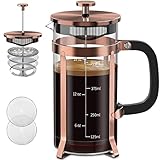
QUQIYSO builds its presses around a four-layer 304 stainless steel filter and thickened borosilicate glass. Some models in the line quote glass thickness of about 2.5 mm, but the figure varies by size and color, so verify it on this listing. The listing title emphasizes ease of cleaning and four filters. It is a good match for anyone It is a good match for anyone who finds silt in the cup and wants the finest mesh available in this group. Eighty-mesh screens are fine enough to hold back most of a coarse grind, but a very fine or powdery grind will still slip through. Pair it with coarse grounds and a slow plunge to get the benefit of the extra layers.
- Volume: 34 oz
- Carafe: thickened borosilicate glass; thickness varies by model
- Filter: four-layer 304 stainless steel per descriptions
- Frame: stainless steel and plastic parts; confirm on listing
- Care: parts separate; dishwasher guidance varies
Pros:
- Multi-layer filter targets sediment
- Thick glass is more reassuring in daily use
Cons:
- Spec details vary across the brand’s listings
- Filter parts need regular cleaning
It sits between the Veken and the Utopia in feature set, with a stronger filter than the Utopia and less documentation than the Veken.
Specs Compared
| Product | Volume | Carafe | Frame | Filter | Care note |
|---|---|---|---|---|---|
| Veken 34 oz (cold brew listing) | 34 oz | Thickened borosilicate | Stainless steel with silicone | Four-layer stainless | Dishwasher guidance varies |
| Bodum Chambord 34 oz | 34 oz | Borosilicate | Polished stainless steel | Stainless plunger and filter | Confirm on listing |
| Basics 34 oz | 34 oz | Borosilicate | Plastic and glass body | Triple filtration | Dishwasher-safe parts |
| Veken 34 oz (heat-resistant listing) | 34 oz | Thickened borosilicate | Stainless steel with silicone | Multi-layer stainless | Dishwasher guidance varies |
| Utopia Kitchen 34 oz | 34 oz | Borosilicate | Insulated plastic frame | Multi-layer, count varies | Confirm on listing |
| QUQIYSO 34 oz | 34 oz | Thickened borosilicate | Stainless and plastic parts | Four-layer 304 stainless | Dishwasher guidance varies |
How We Chose These
This guide comes from desk research on the six catalog listings. We read each title and specification field, compared them with manufacturer descriptions where available, and noted every point where sellers disagree, such as glass heat limits and filter layer counts. Picks were ordered by how well a listing explains its glass, frame, and filter, and by how much of the design has a record of use. Duplicate Veken entries are flagged, not counted as separate products. No performance claims are made beyond what the maker or listing states. Where a feature appears only in a seller description, it is labeled that way. The aim is to help you compare like with like: the same 34 oz volume, the same glass family, and clearly different filter and frame choices. Read the live page before you buy, because listing details change.
What to Look For
Borosilicate Glass: What It Does
Borosilicate glass has a low rate of thermal expansion, which means it handles the jump from room temperature to near-boiling water better than ordinary soda-lime glass. It is the standard material in lab glassware and quality presses. It is not unbreakable, and an impact against a sink or a counter can still crack it. Thickness helps, so thicker walls are more forgiving in daily handling, but heat limits quoted on listings vary and should be checked on the page.
Filter Layers and Silt
A press filter is a plunger with a mesh screen and a metal plate. More layers, such as a spiral plate, a cross plate, and extra mesh, press the grounds more evenly and catch more particles. No press delivers paper-filtered clarity, and a little silt at the bottom of the cup is normal. The grind matters as much as the filter. Use a coarse grind about the size of coarse sea salt, and stop pouring when the cup starts to look cloudy.
Frame Material
The frame holds the glass, forms the handle, and protects the carafe. Steel frames are rigid and last long. Plastic frames are light and less expensive to make, and they can warp or yellow with age. The Veken descriptions say silicone and stainless steel take the place of plastic where hot coffee touches the press, though you should confirm that on the listing. If you drop things, the frame will matter more than any other feature.
Ratio, Time, and a Worked Example
A common starting point is about one gram of coffee for every sixteen grams of water. In a 34 oz press filled to about 28 oz, that is roughly 830 grams of water and about 52 grams of coffee. Use water just off the boil, around 195 to 205 degrees Fahrenheit, stir once, and steep for about four minutes before pressing slowly. If the cup tastes sour, grind slightly finer or steep a little longer. If it tastes bitter, go coarser or shorten the steep.
Matching Press Size to Your Household
Though every pick here is 34 oz, it helps to know what that means in the cup. Bodum counts eight 4 oz cups from a full pot, but a normal mug holds 10 to 12 oz, so a full pot makes about three mugs. If you usually drink one mug, you will be filling the pot only partway, which cools the coffee faster and wastes grounds on a thin layer. For one person, fill the pot to the lower marks and use a proportionally smaller dose, or look for a 12 or 17 oz press instead.
Grinder Quality Matters More Than You Expect
A press is forgiving of many things but not of an uneven grind. Pulverized dust passes through the screen and over-extracts, while large chunks leave the brew thin. A burr grinder set coarse gives the most consistent results. If you buy pre-ground coffee, look for a bag marked for French press or coarse grind, and use it within a couple of weeks of opening.
Troubleshooting Common Complaints
- Gritty cup: the grind is too fine, or the plunger was pushed too fast. Go coarser and press slowly.
- Weak coffee: the dose was too small or the steep too short. Add a few grams or wait another thirty seconds.
- Plunger sticks: grounds have packed under the screen. Coarsen the grind and stir once before steeping.
- Coffee cools too fast: preheat the carafe and pour out the whole pot soon after pressing.
- Off flavors: old oils in the filter stack. Take the plunger apart and wash each layer.
Choosing by Counter Space and Storage
A 34 oz press stands roughly nine inches tall with the plunger down, and taller with the plunger raised, so check the clearance under your cabinets. Wider frames like the plastic-bodied models take up a little more shelf space than a slim steel frame. If the pot will live on a shelf, pick a finish you will not mind seeing every day, and store it with the plunger lifted so the filter air-dries. Keep the carafe away from the table edge, since a tipped glass pot is the most common way these presses break.
Care, Cleaning, and Safety
Warm the carafe with hot tap water before pouring in boiling water, and never set a hot carafe on a cold wet surface. Replace any carafe with a chip or crack. Take the filter apart after each use because grounds collect between layers. Follow the dishwasher guidance on the specific listing, since silicone parts, metal finishes, and plastic frames each have limits.
Questions
Is a glass French press better than a stainless steel one?
Glass lets you see the brew and does not hide stains, while steel retains heat longer and resists breakage. Taste comes down to grind, ratio, and time in either material. Choose glass if you like to watch the bloom and judge the steep by color, and steel if the pot will travel or sit for a while.
Can borosilicate glass go on the stove?
Not in these presses. The frames and handles are not designed for direct heat, so heat water in a kettle and pour it in.
Do I need a four-layer filter?
No, but multi-layer designs usually leave less silt than single-layer ones. If you drink your coffee quickly and do not mind a little body, a standard filter is fine.
How long should I steep the coffee?
Four minutes is the usual starting point with a coarse grind. Adjust by thirty seconds either way to suit your taste.
Why do the two Veken listings look the same?
Marketplaces often keep several records for one product, created by different sellers or color variants. Compare the details on each page and choose the one with clearer information and current availability. If the pages differ on heat limits or included parts, trust the one that cites a specific figure and ask the seller about the other.
Can I use these for cold brew or tea?
Several listings mention both. Use a coarse grind for cold brew and a longer steep in the fridge, and use loose leaf tea with the plunger held up until the steep is done.
Update History
- October 21, 2026 – Initial publication; product set drawn from current catalog listings.
- Check the product page for current specifications and availability before buying.
Sources
- Manufacturer product and specification pages for Bodum and the other listed brands where available
- Retailer listing titles and specification fields
- Specialty coffee education resources on grind size, ratios, and brewing temperature

Write Your Review
No reviews yet. Be the first to share your experience!