

Key takeaways
- Expecting dramatic effects. Most blends contain modest or undisclosed mushroom doses, so treat benefits as uncertain.
- Ignoring allergies. People with mushroom allergies, or with sensitivity to a specific fungus, should avoid these products. Check ingredient lists for dairy, collagen and tree nuts too.
- Assuming it is caffeine free. Most coffee blends contain 40 to 105 mg per serving. Only certain flavors, like MUD\WTR Turmeric, are caffeine free.
- Using boiling water. Very hot water can scorch instant powders and make them bitter; water just off the boil is usually better.
- Skipping medication checks. Some functional mushrooms may interact with blood thinners, blood sugar or immune medications; ask a pharmacist or doctor.
- Storing in a humid cupboard. Powders clump and lose flavor; keep bags sealed and dry.
The best mushroom coffee brand for most people in 2026 is Four Sigmatic Organic Mushroom Coffee, because it is a simple organic instant coffee with lion’s mane and chaga at about 50 mg of caffeine per serving. RYZE is the best-known multi-mushroom blend, Everyday Dose is the pick for a creamy, frothed drink, and MUD\WTR is the choice if you want a coffee alternative rather than coffee. This ranking compares six brands by ingredients, caffeine, format and transparency. It gives general information only and is not medical advice; if you take medication, are pregnant or have a health condition, speak to a doctor or registered dietitian before adding functional mushrooms to your routine.
Our top picks



As an Amazon Associate we earn from qualifying purchases at no extra cost to you.
Quick Ranking Table
| Rank | Brand and product | Best for | Mushrooms listed | Caffeine per serving | Format |
|---|---|---|---|---|---|
| 1 | Four Sigmatic Organic Mushroom Coffee | Best overall | Lion’s mane, chaga | About 50 mg | Instant packets or pods |
| 2 | RYZE Mushroom Coffee | Best multi-mushroom blend | Reishi, cordyceps, lion’s mane, shiitake, turkey tail, king trumpet | About 48 mg | Instant powder |
| 3 | Everyday Dose | Best creamy texture | Lion’s mane, chaga | About 40-45 mg (mild roast), higher in medium | Powder |
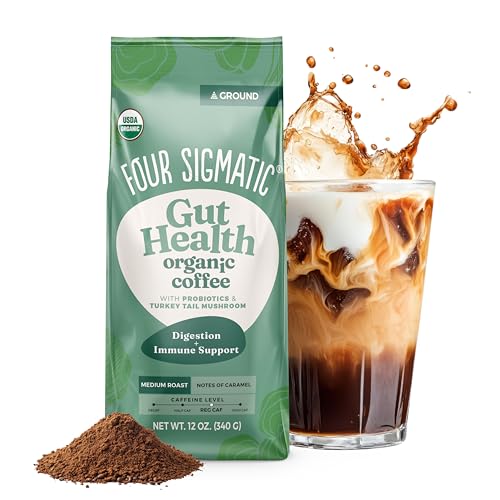
| 4 | Four Sigmatic Gut Health Ground Coffee | Best brewed option | Chaga, turkey tail | Varies with brew strength | Ground coffee |
| 5 | MUD\WTR | Best coffee alternative | Lion’s mane, cordyceps, chaga, reishi | 0-55 mg depending on flavor | Powder |
| 6 | Laird Superfood Instant Latte | Best latte style | Chaga, lion’s mane, maitake, cordyceps | About 104 mg (Sweet and Creamy) | Instant powder |
Figures come from manufacturer labels and published brand comparisons; caffeine varies by flavor and preparation, so read the current label before buying.
What Mushroom Coffee Is and What It Is Not
Mushroom coffee is coffee blended with powdered extracts of functional mushrooms such as lion’s mane, chaga, reishi, cordyceps and turkey tail. These are not the button mushrooms found in the produce aisle, and they are not psychoactive. Brands usually sell them as a way to get the ritual of a morning coffee with less caffeine and a more earthy, rounded taste. A typical serving contains roughly half the caffeine of a standard 8 oz cup of drip coffee, which is about 95 mg.
It is important to be realistic about the evidence. A registered dietitian’s review notes that research on mushroom coffee benefits is limited, with many studies carried out in animals or laboratory models. Lion’s mane has some early research on cognition and mood, turkey tail has small studies on gut bacteria, and reishi has been studied for sleep, but most blends contain lower or undisclosed amounts compared with doses used in studies. Treat mushroom coffee as a lower-caffeine coffee with a distinctive taste, not as a treatment for any condition.
Ranked: The Six Best Mushroom Coffee Brands
1. Four Sigmatic Organic Mushroom Coffee: Best Overall
Four Sigmatic is the longest-established name in the category. Its organic mushroom coffee uses instant coffee blended with lion’s mane and chaga extracts, with caffeine reported at about 50 mg per serving, and some listings also mention additional ingredients such as rhodiola depending on the blend. It is USDA Organic, keto friendly and gluten free, and the company states that products are checked by third-party labs. It comes in single-serve packets or pods, and reviewers describe a mild caramel note that works black or with cream.
Who it suits: first-time buyers who want a familiar-tasting cup. Main trade-off: the label does not break out mushroom amounts clearly, and the blend has only two mushrooms.
2. RYZE Mushroom Coffee: Best Multi-Mushroom Blend
RYZE blends organic Arabica coffee with six mushrooms (reishi, cordyceps, lion’s mane, shiitake, turkey tail and king trumpet) plus MCT oil powder. The company reports a total mushroom blend of 2,000 mg per serving and about 48 mg of caffeine. It is vegan and fits keto and paleo patterns. Reviewers often say it tastes like a mild, slightly earthy coffee.
Who it suits: those who want many mushroom types in one scoop and a vegan product. Main trade-off: individual mushroom amounts are not disclosed, and several reviewers say the flavor is on the thin side.
3. Everyday Dose: Best Creamy Texture
Everyday Dose combines lion’s mane, chaga, L-theanine, grass-fed collagen and coffee extract in a powder that mixes best with a frother. Caffeine is about 45 mg in the mild roast, and closer to 90 mg in the medium roast. Reviewers praise its smooth, latte-like texture and subtle earthiness.
Who it suits: people who prefer a latte-style drink made at home. Main trade-off: the collagen means it is not vegan, and subscription terms can be a hassle for some buyers.
4. Four Sigmatic Gut Health Ground Coffee: Best Brewed Option
For people who prefer to brew in a drip machine, French press or pour-over, Four Sigmatic offers ground coffee blends. The Gut Health version lists chaga, turkey tail, yacon powder and the probiotic Bacillus subtilis DE111 alongside coffee. Because it is brewed coffee, the caffeine is closer to a normal cup, with one source suggesting about 150 mg per 12 fl oz cup, so it is not a low-caffeine product.
Who it suits: coffee drinkers who want to keep their brewing method. Main trade-off: the mushroom content in brewed coffee is diluted, and the probiotic claims should be treated as general information.
5. MUD\WTR: Best Coffee Alternative
MUD\WTR is not coffee. It is a powder with a cacao and chai-style spice base mixed with chaga, reishi, lion’s mane and cordyceps. The manufacturer lists a mushroom blend of 2,240 mg per serving and about 35 mg of caffeine for the original, with the Matcha flavor at 55 mg and the Turmeric flavor caffeine free. It is USDA Organic, vegan and Whole30 approved and comes with a frother in some bundles.
Who it suits: people cutting back on coffee who like a spiced, chai-like drink. Main trade-off: reviews on taste are polarised, and some people find the texture gritty.
6. Laird Superfood Instant Latte: Best Latte Style
Laird’s Instant Latte uses chaga, lion’s mane, maitake and cordyceps with a vanilla and coconut flavor. The Sweet and Creamy version is reported at about 104 mg of caffeine, so it is the strongest of the six. It also contains about 8 g of added sugar and tends to be more expensive per serving than rivals.
Who it suits: those who want a sweet, creamy latte and do not want to cut caffeine much. Main trade-off: added sugar and a price per cup that is higher than most competitors.
The Mushrooms Explained
| Mushroom | Common marketing claim | State of the evidence | Found in |
|---|---|---|---|
| Lion’s mane | Focus and mood | Early research, small human studies | Four Sigmatic, RYZE, Everyday Dose, MUD\WTR, Laird |
| Chaga | Antioxidant support | Mostly laboratory research | Four Sigmatic, Everyday Dose, MUD\WTR, Laird |
| Reishi | Calm and sleep support | Limited human data | RYZE, MUD\WTR |
| Cordyceps | Energy and stamina | Mixed, small studies | RYZE, MUD\WTR, Laird |
| Turkey tail | Gut and immune support | Small trial on prebiotic activity | RYZE, Four Sigmatic Gut Health |
| Maitake | General wellness | Limited human data | Laird |
Marketing claims in this table describe how brands talk about each mushroom, not proven effects. Being on a label does not mean the amount is high enough to matter, which is why disclosed doses are worth looking for.
How to Read a Mushroom Coffee Label
Start with the supplement facts or nutrition panel and look for the serving size. A scoop of 2 g and a scoop of 6 g are not comparable, and a “2,000 mg blend” may include coffee, fillers or MCT powder. Next, check whether the label names the part of the mushroom used. Fruiting body extracts are generally what researchers study, while mycelium grown on grain can include leftover grain starch. Look for the words “extract” or “dual extract” and, where present, a standardised percentage of beta-glucans.
Then look at the other ingredients: sweeteners, flavorings, creamers or collagen. Finally, check for testing statements such as heavy metal or microbial screening, and whether the brand names the lab. A company that is willing to publish a certificate of analysis is easier to trust than one that only says “tested for purity”.
Taste Notes and Pairing Ideas
Expect an earthy backbone under the coffee flavor in every blend. Four Sigmatic leans toward gentle caramel, RYZE is closer to a mild cup of diner coffee, Everyday Dose is smooth and creamy when frothed, MUD\WTR tastes of cacao and warming spice, and Laird is sweet with vanilla and coconut. A pinch of cinnamon, a splash of oat milk or a few drops of vanilla extract smooths the earthy edge without adding much sugar. If you dislike the aftertaste of a first sample, try another brand before giving up on the category, because the base coffee and flavoring differ widely from one product to the next.
Serve temperature matters too: a cup that is too hot flattens the subtle flavors, so let it rest for a minute or two before the first sip and notice how the aroma develops as it cools.
Alternatives to Consider
If you want less caffeine without paying for functional mushrooms, there are cheaper options. Half-caf blends, decaf coffee, chicory coffee and matcha all reduce caffeine and taste good. If you are interested in mushrooms specifically, capsules provide a stated dose without the coffee flavor, and cooking with culinary mushrooms such as shiitake adds food-based nutrients. Mushroom coffee sits in between: it is a convenient morning ritual with a modest amount of mushroom extract and a modest amount of caffeine.
Worked Example: Caffeine and Cost Per Day
Suppose you normally drink two 8 oz cups of drip coffee a day. That is about 190 mg of caffeine. Swapping both cups for RYZE would give about 96 mg, roughly half. Swapping one cup would give about 143 mg. If you moved to MUD\WTR Original, two servings would come to about 70 mg. Laird’s Sweet and Creamy would give about 208 mg, higher than your starting point.
For cost, divide the price of a bag by the number of servings, which is usually 25 to 30. A bag priced like a premium coffee at around the price of a restaurant lunch that yields 30 servings works out to a few currency units per cup, and two cups a day uses a bag in 15 days. That is considerably more than a bag of ordinary beans, which can make 40 or more cups at home. Mushroom coffee is therefore a premium pantry item rather than a cheap swap.
Decision Matrix
| Your situation | Best match | Why |
|---|---|---|
| Trying it for the first time | Four Sigmatic Organic Mushroom Coffee | Simple recipe, single-serve, familiar taste |
| Want many mushroom species | RYZE | Six mushrooms plus MCT oil powder |
| Prefer creamy lattes | Everyday Dose | Designed for frothing, collagen adds body |
| Brew in a drip machine | Four Sigmatic Gut Health Ground Coffee | Ground format, normal brewing |
| Cutting caffeine | MUD\WTR | 0-55 mg depending on flavor |
| Want a sweet latte | Laird Superfood Instant Latte | Vanilla and coconut flavor |
| Vegan diet | RYZE or MUD\WTR | Both listed as vegan; Everyday Dose has collagen |
How to Choose a Mushroom Coffee
1. Decide what you want from it
If you simply want less caffeine and a rounder taste, nearly any of these will do. If you want specific mushrooms, read the ingredient panel instead of the front label.
2. Check transparency
Look for a supplement facts panel, named mushroom parts (fruiting body or mycelium) and any third-party testing claims. Brands that list only a “proprietary blend” give you less information to compare.
3. Compare caffeine
Caffeine comes from coffee, tea or matcha in the mix, not from the mushrooms. Check the label for the specific flavor, especially with MUD\WTR where the range is wide.
4. Look at extra ingredients
Added sugar, collagen, MCT oil powder and probiotics change the nutrition and diet fit. Vegans should avoid collagen blends, and people limiting sugar should check the grams per serving.
5. Consider format and prep
Instant powders mix quickly but may need a frother for a smooth finish, while ground blends need your usual brewer. Pods and packets are convenient for travel.
Ownership Realities and Common Mistakes
- Expecting dramatic effects. Most blends contain modest or undisclosed mushroom doses, so treat benefits as uncertain.
- Ignoring allergies. People with mushroom allergies, or with sensitivity to a specific fungus, should avoid these products. Check ingredient lists for dairy, collagen and tree nuts too.
- Assuming it is caffeine free. Most coffee blends contain 40 to 105 mg per serving. Only certain flavors, like MUD\WTR Turmeric, are caffeine free.
- Using boiling water. Very hot water can scorch instant powders and make them bitter; water just off the boil is usually better.
- Skipping medication checks. Some functional mushrooms may interact with blood thinners, blood sugar or immune medications; ask a pharmacist or doctor.
- Storing in a humid cupboard. Powders clump and lose flavor; keep bags sealed and dry.
How to Prepare a Better Cup
- Heat water to just below boiling, around 90 to 95 degrees Celsius.
- Add one scoop or packet to a cup, following the serving size on the label.
- Pour in about 6 to 8 oz of hot water, then froth or whisk for 15 to 20 seconds to break up clumps.
- Add milk or a plant-based alternative if you like a latte, and sweeten sparingly.
- Taste after a minute and adjust the next cup rather than adding extra scoops, which raises caffeine and cost.
Who Should Be Careful
General information only: pregnant or breastfeeding people, children, those who are sensitive to caffeine, and anyone with allergies, autoimmune conditions or scheduled surgery should talk to a healthcare professional before using functional mushroom products. Supplements are not a substitute for medical care, and a stronger flavor or a premium label is not proof of quality. Buy from brands that publish ingredient amounts, store products as directed and stop use if you notice any adverse reaction.
Frequently Asked Questions
Does mushroom coffee taste like mushrooms?
Mostly no. Reviewers describe earthy, slightly nutty or cocoa-like notes that blend into the coffee, with the strength depending on the brand and roast.
How much caffeine is in mushroom coffee?
Most coffee-based blends have around 40 to 50 mg per serving, about half a regular cup. Some, like Laird’s Sweet and Creamy latte, are closer to 100 mg, and brewed ground blends can match normal coffee.
Is mushroom coffee proven to improve focus or digestion?
Research is limited and mostly preliminary. Some small studies on individual mushrooms exist, but blends often use lower doses than those studies and do not disclose amounts, so claims should be viewed cautiously.
Is mushroom coffee vegan?
It depends. RYZE and MUD\WTR are described as vegan, while Everyday Dose includes collagen and is not. Always read the label.
Can I drink mushroom coffee every day?
Many people do, but daily use is a decision to make with a professional if you have a health condition or take medication. Rotating with regular coffee or tea is a simple way to avoid overreliance.
Is mushroom coffee worth the extra cost?
It is worth it if you value the lower caffeine, the convenience of instant preparation or the taste. If you are mainly buying it for health benefits, the limited evidence suggests you should weigh that against the higher price.


Write Your Review
No reviews yet. Be the first to share your experience!