

For most gatherings, a 3.8 L (128 oz) stainless airpot such as the Zojirushi SR-AG38XA or a Bunn lever-action airpot is the best choice, because one fill serves roughly 20 to 25 cups and holds heat for hours without a hot plate. Smaller crowds of 10 to 15 people are well served by a 2.2 to 2.5 L model, and anyone who only needs occasional capacity can pick a glass-lined Thermos for less. Match the pot to your headcount, then check the lid type and how you will fill it.
Our top picks


As an Amazon Associate we earn from qualifying purchases at no extra cost to you.
Quick Comparison of the Picks
| Pick | Best for | Capacity | Approx. cups (6 oz) | Liner | Price tier |
|---|---|---|---|---|---|
| Zojirushi SR-AG38XA | Best overall, large events | 3.8 L (128 oz) | 20-25 | Stainless, vacuum | Upper |
| Zojirushi 9-cup airpot (2.2 L / 74 oz) | Best for mid-size parties | 2.2 L | 12-14 | Glass liner | Mid |
| Bunn lever-action airpot (3.0 L) | Best for self-service buffet | 3.0 L | 16-20 | Stainless | Mid to upper |
| Bunn lever-action airpot (3.8 L) | Best for repeat commercial use | 3.8 L | 20-25 | Stainless | Upper |
| Thermos 2-quart glass-lined airpot | Best entry level | 1.9 L (2 qt) | 10-12 | Glass | Budget |
| Wilbur Curtis ThermoPro (2.2 L) | Best for brewer-fill setups | 2.2 L | 12-14 | Stainless | Mid |
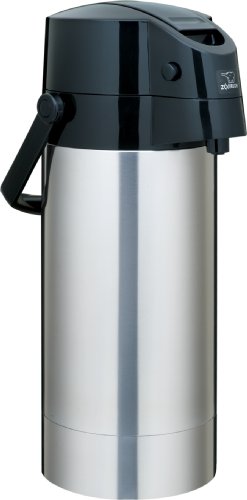
Best Overall: Zojirushi SR-AG38XA
This 128 oz stainless pot is the one to buy for weddings, church socials, offices and school events. It carries NSF certification, which matters if you serve the public, and it has a Brew-Thru lid that lets you fill it straight from a commercial brewer. Manufacturer and retailer descriptions point to long heat retention, though real-world hours depend on how full it is and how hot the water was at fill.
The trade-offs are weight and cost. A full 3.8 L pot weighs around 8 kg with the liquid, so it needs a sturdy table, and the pump action takes a firm press to dispense.
Best for Mid-Size Gatherings: Zojirushi 9-Cup Airpot
At 2.2 L (74 oz), this model covers a family gathering, a small meeting or a brunch of 12 to 14 people. It uses a glass liner, which does not hold flavors but is more fragile if dropped. It is lighter and easier to carry than the large pot, and the footprint is small enough for a kitchen counter.
Best for Self-Service Buffets: Bunn Lever-Action Airpot
Bunn sells 2.5 L, 3.0 L and 3.8 L airpots with stainless liners and brew-through lids. The lever-action spout is easier for guests to use than a pump, because you push it with a cup rather than pressing a top button. The 3.0 L version stands about 15.8 inches tall on a 6.3-inch footprint, which is stable on a buffet table. Bunn lists a two-year warranty on the large model. The drawback is that a lever spout can drip if it is not seated properly, so keep a small tray under it.
Best Entry Level: Thermos 2-Quart Airpot
This pot has a glass liner and is aimed at occasional use. It suits a holiday morning or a small office meeting. Expect shorter hot-hold time than stainless commercial models, and treat the glass liner gently. It is the pick if you host a couple of times a year and do not want to invest in a heavy-duty unit.
Best for Brewer-Fill Setups: Wilbur Curtis ThermoPro
Wilbur Curtis pots are designed to sit under a brewer outlet and fill directly. If your church or office already has a commercial brewer with a standard airpot opening, check the pot height and lid style against the brewer’s clearance before buying. They are a practical alternative when a brand-name airpot is out of budget.
How Many Cups Do You Need? A Worked Calculation
Standard coffee cups at a gathering are 6 to 8 oz. Plan on 1.5 cups per coffee drinker for a morning event and 1 cup for an afternoon event.
- Estimate the number of coffee drinkers, usually 60 to 70 percent of adults.
- Multiply by cups per person, for example 40 guests x 65% = 26 drinkers x 1.5 cups = 39 cups.
- Multiply by 6 oz per cup: 39 x 6 = 234 oz.
- Divide by pot size: 234 / 128 = 1.8 pots, so use two 3.8 L pots or one large plus one 2.2 L pot.
| Guests | Morning coffee need (oz) | Suggested setup |
|---|---|---|
| 10 | about 60 | One 2.2 L pot |
| 25 | about 145 | One 3.8 L pot plus refills |
| 50 | about 290 | Two 3.8 L pots |
| 100 | about 580 | Four to five 3.8 L pots, staggered brewing |
How to Choose an Airpot
- Liner type. Stainless handles knocks and travel. Glass is cheaper but breaks.
- Dispensing style. Pump tops are neat and less likely to drip. Lever spouts are easier for guests.
- Brew-through lid. Saves a transfer step if you have a commercial brewer.
- Height. Measure under your brewer and the shelf where it will sit.
- Cleaning access. Wide openings and removable pump tubes are easier to keep sanitary.
Ownership Realities and Care
Preheat the pot with hot water for a few minutes before filling to improve hold time. The tube and pump are the first parts to build up coffee oils, so remove and clean them after each event, and descale occasionally if you use hard water. Do not leave coffee sitting more than a day, and never fill with milk-based drinks unless the manufacturer says it is safe. Replace worn gaskets rather than overtightening lids, since a poor seal drains heat fastest.
Choosing an Airpot Step by Step
An airpot is a simple device, but the best choice depends on the event more than on the pot. The models covered here, the Zojirushi SR-AG38XA, the Zojirushi 9-cup airpot, the Bunn lever-action airpots, the Thermos 2-quart and the Wilbur Curtis ThermoPro, each answer a slightly different need. Use this sequence to match yours.
- Estimate the guest count and the time of day. Morning events consume the most coffee per person. Use the calculation earlier in this guide to turn that into total volume.
- Decide how coffee will get into the pot. If you have a commercial brewer, a brew-through lid and correct height matter most. If you pour from a carafe or kettle, a wide opening is the priority.
- Decide who will dispense. A staffed table can use a pump. A self-serve buffet is easier with a lever.
- Decide how often you will use it. A few times a year suggests a modest glass-lined pot. Weekly use justifies a stainless, commercial-style model.
- Check storage space. Tall pots do not always fit in cupboards. Measure the shelf height and the path through the door.
- Set a tier. The entry tier covers occasional hosting, mid-range suits regular groups and the upper tier is for heavy repeated use.
Who Should Skip an Airpot
- Households that serve only a few people. A regular insulated carafe is lighter and easier to pour from.
- Anyone who wants to serve milk-based drinks. Airpots are made for coffee, tea and hot water, and dairy is hard to clean from the pump tube.
- Hosts with limited arm strength. A full large pot is heavy, and pushing the pump takes force. A smaller pot or a lever style may be easier.
- Event organisers who need to hold coffee for a whole day. Coffee that sits for many hours loses flavour even in a good vacuum pot. Brewing in batches gives a better cup.
- People who dislike cleaning tubes. The pump tube and lid parts need attention after every event. If that sounds unappealing, a simpler carafe may be a better fit.
Scenario-Based Picks From This Guide
| Event | Closest pick | Reason |
|---|---|---|
| Wedding reception or church social | Zojirushi SR-AG38XA | Large capacity and a brew-through lid |
| Family brunch | Zojirushi 9-cup airpot | Moderate size that fits a kitchen counter |
| Office breakfast with self-service | Bunn lever-action airpot | Guests can dispense with a cup |
| Holiday morning with a few guests | Thermos 2-quart airpot | Low commitment and simple use |
| Community hall with a commercial brewer | Wilbur Curtis ThermoPro | Designed to sit under a brewer outlet |
| Long day with several brew cycles | Two large stainless pots | Staggered fills keep coffee fresh |
Fit, Placement and Serving Setup
Check height under the brewer
Measure from the counter to the underside of the brewer outlet while the lid is on the pot. A pot that is a few millimetres too tall will not fit, and forcing it risks damage to both items. If your brewer has an adjustable shelf, set it before the event, not during setup.
Choose a stable table
A full pot is heavy, and a flimsy folding table may flex or tip. Place the pot near a support leg rather than at the centre, and avoid the edge where a sleeve could catch.
Plan the drip area
Set a tray or a folded towel under the spout. Lever spouts in particular can drip after use. Keep cups, napkins and stirrers nearby so guests do not need to move around the pot with hot drinks.
Label what is inside
If you have regular and decaf pots, tag them clearly with a card. This avoids queues and mistakes, and it is especially important when guests have dietary reasons for avoiding caffeine.
Think about the flow of people
Put the dispensers at the side of the room away from the entry, so guests do not form a queue in the doorway. A second station reduces waiting at larger events.
Stage the supplies
Set out cups, lids, sugar, sweetener and stirrers before guests arrive. Provide milk or creamer in a separate container with its own ice or cold storage, since it should not go into the airpot.
Lifespan, Cleaning and Storage
- After every event. Empty the pot, remove the lid and pump, and wash all parts. Rinse well and let everything air-dry with the lid off so odours do not build up.
- Monthly or after heavy use. Run a vinegar solution or a descaler suitable for food equipment through the pot and tube, then rinse several times.
- Gaskets and seals. Inspect them for flattening, cracks or stains. A damaged seal loses heat quickly and can leak.
- Glass liners. Avoid sudden temperature changes, such as pouring cold water into a hot pot. Handle with care, since the liner is fragile if the pot is dropped.
- Storage. Keep the pot in a dry place with the lid slightly open. Closed, damp storage encourages stale smells.
Common Problems and Fixes
Coffee goes cold sooner than expected
Preheat the pot, fill it nearly full and check the seal. A half-empty pot cools faster because there is more air inside. If the pot is old, the vacuum or liner may have degraded.
The pump feels stiff or does not dispense
Check that the tube is fully seated and not kinked. Clean it, since oil buildup can cause drag. Make sure there is enough coffee in the pot to reach the tube.
The spout drips
For a lever spout, confirm that the valve seat is clean and the lever returns fully. Rinse out coffee grounds, which can prevent a good seal.
Coffee tastes metallic or stale
Old oils may be sticking to the inside of the pot or tube. Clean thoroughly, replace worn parts and avoid leaving coffee in the pot overnight.
The pot leaks at the lid
Reseat the gasket and check the lid threads. Do not overtighten, since that deforms the seal over time.
A Practical Timeline for Event Day
Coffee service goes smoothly when the work is spread across the morning instead of crammed into the last half hour. A simple schedule helps whether you are hosting a family brunch or a larger community event.
- The night before. Wash and dry every pot, lid, pump and tube. Check seals, set out cups, and confirm that you have enough ground coffee, filters and water.
- Two hours before. Set up the table in its final spot, level and clear of clutter. Place a drip tray and a stack of napkins within reach.
- One hour before. Preheat each pot with hot water and begin the first brew. Start a second batch while the first is being poured so the next pot is ready when the first runs low.
- Thirty minutes before. Empty the preheating water, fill the pot with fresh coffee and close the lid firmly. Put a small card on the pot naming what it holds.
- During the event. Check the level every so often and refill before the pot runs dry. Wipe the spout and tray, and keep the area tidy.
- Afterwards. Pour out leftovers, rinse promptly and leave the lid open to dry.
Having one person responsible for the coffee table, even for a short period, prevents the common situation where everyone assumes someone else will refill the pot. For larger groups, two people can alternate tasks so that cleaning and refilling never overlap with serving.
More Questions Buyers Ask
Can I use an airpot for iced coffee or cold drinks?
Vacuum-insulated pots keep cold drinks cold as well as hot ones, but check the maker’s guidance. Avoid sugary or acidic liquids left for long periods, and clean thoroughly afterward.
How early can I brew and fill the pot before an event?
Fill it shortly before guests arrive so the coffee is at its best. Preheating the pot is more effective than filling very early. If you must prepare ahead, brew fresh and top up later rather than reheating old coffee.
Are airpots safe for hot tea and hot water?
Yes, they are commonly used for both. Rinse well between drinks so flavours do not carry over. For herbal infusions, remove the leaves before pouring into the pot.
Do I need multiple pots for decaf and regular?
If you expect both kinds of drinkers, separate pots avoid confusion. Label them clearly and keep the decaf pot away from the regular one to reduce mix-ups.
How should I transport an airpot?
Empty it where possible, or keep it upright and secure it in the car with padding. Hot liquid in a moving vehicle can spill or leak, so close the lid tightly and hold the pot steady.
Frequently Asked Questions
How long does coffee stay hot in an airpot?
It depends on model, fill level and starting temperature. Stainless vacuum pots typically hold drinkable heat for many hours when full, while glass-lined models cool sooner. Preheating the pot with hot water extends the time.
How many cups does a 128 oz airpot serve?
About 20 to 25 cups at 5 to 6 oz each, or roughly 16 cups at 8 oz. Plan one pot for about 25 guests.
Can I pour milk or hot chocolate into an airpot?
Many makers recommend coffee, tea and hot water only. Dairy can spoil and leave odors that are hard to remove. Check the manual first and clean the pot immediately after any non-coffee use.
Should I choose a pump or a lever airpot?
Pump tops give cleaner pours and less dripping, which suits staffed events. Lever spouts are quicker and easier for self-serve, but they need a drip tray.
How do I clean an airpot?
Remove the lid, pump and tube. Wash with warm soapy water and a long bottle brush, rinse well and air-dry with the lid off. Run a vinegar solution through occasionally to remove mineral and oil buildup.
More from Amazon
Programs that pair well with the guide above. Offers and eligibility are set by Amazon and may change.
Set up recurring deliveries of everyday items on eligible products. Terms and savings are set by Amazon.
Explore Subscribe & SaveCollect the home and kitchen items you want in one registry that guests can shop from.
Create a wedding registryFree shipping on eligible items, Prime Video and more. Eligible new members can start with a free trial.
Start a Prime free trialAudiobooks and podcasts to listen to on the go. Eligible new members can start with a free trial.
Try Audible freeAs an Amazon Associate we earn from qualifying purchases.


Write Your Review
No reviews yet. Be the first to share your experience!