

Key takeaways
- A commercial coffee machine solves a problem that a household brewer cannot: a line of people who all want a cup within the same ten minutes.
A commercial coffee machine solves a problem that a household brewer cannot: a line of people who all want a cup within the same ten minutes. Whether the setting is a small café, a church hall, a break room, or a catered event, the buying decision is driven by volume per hour, how refills are handled, and whether the machine needs a plumbed water line. The search for “best commercial coffee machines” therefore starts with a simple question about how many cups must be ready, and how often, before any feature list matters.
This guide looks at seven drip and airpot brewers, all judged only from the details in their listing titles, such as cup counts, carafe numbers, warmers, water line connection, and stainless steel construction. Voltage, power draw, and plumbing requirements beyond what is stated should be confirmed on the listing, and any permanent water connection or dedicated circuit may call for a licensed professional and compliance with local codes. For 2026 buyers, the practical goal is to match capacity to peak demand without paying for a machine that sits half empty.
Quick Picks
Our top picks



As an Amazon Associate we earn from qualifying purchases at no extra cost to you.
| Product | Best for | Key spec from the title |
|---|---|---|
| VEVOR 24-Cup Dual-Head | Offices needing two brews at once | 24 cups, dual-head, stainless steel |
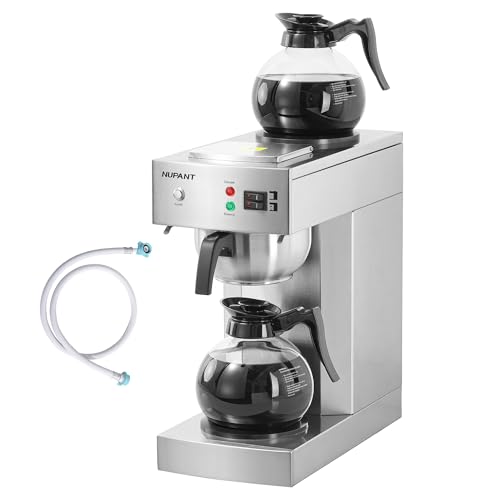
| NUPANT 12-Cup Water Line Brewer | Plumbed small shops | 1.8L auto-fill, 2 carafes, 2 warmers |
| VEVOR 12-Cup Drip | Entry-level commercial use | 12 cups, stainless steel |
| NUPANT 2.2L Airpot Brewer | Self-serve counters | 2.2L / 74oz, 24H insulated carafe |
| NUPANT 12-Cup With Hot Water Dispenser | Coffee plus tea service | Water line, hot water dispenser, 3 warmers |
| NUPANT 14-Cup Airpot Auto-Fill | Quiet, carafe-free serving | 14 cups, 74oz thermal carafe, hot water |
| NUPANT Dual Drip 200 Cup/H | High-volume events | 200 cups/hour, 7.2L, 4 carafes, 4 warmers |
How to Choose
Start With Cups per Hour, Not Cups per Brew
The cup count on the title often describes one batch, not an hourly output. A 12-cup machine (one listing here mentions a seven-minute brew) can yield only a handful of batches an hour, while the top model here lists 200 cups per hour. Estimate peak demand, for example 60 people in a 15-minute break, and divide by batch size to see how many brew cycles are needed. If the machine cannot keep up, lines form no matter how good the coffee is. Choose capacity for the rush, not the average hour.
Warmers and Carafes Versus Airpots
Glass carafes on a warmer plate keep coffee hot but gradually cook it, so flavor degrades with time. Airpots, as on the 2.2-liter and 14-cup models, store coffee in an insulated thermal vessel that the listing says holds temperature for up to 24 hours, and they dispense with a pump lever. Airpots suit self-serve counters and events, while carafes with warmers suit staffed service where pots turn over quickly. Count how many carafes come in the box, since extra glass pots add up for busy sites.
Water Line or Manual Fill
Several models include a water line connection with auto-fill, which removes the need to pour water by hand. This is a major convenience at high volume but also means plumbing work, a nearby shutoff, and possibly a filter. Manual-fill machines are simpler to place anywhere with an outlet. If the machine will be plumbed in, have the connection checked by someone qualified and follow local plumbing and electrical rules.
Power, Footprint, and Cleaning
Commercial brewers draw more current than home machines, and the title for the airpot model shows a 120-volt rating, so check the circuit before ordering. Measure the counter, including clearance above for lifting the brew basket. Stainless steel bodies, named across the group, are easier to wipe down and hold up better to daily use. Budget machines tend to skimp on thermostat quality and spray head design, so look for descaling instructions and plan a regular cleaning schedule.
What to ignore: slogans about “high efficiency” or “restaurant grade” without any figure. The numbers that matter are cups per hour, carafe count, and the water source.
Budget tiers help narrow the field. Entry-level units, such as the simple VEVOR 12-cup, trade capacity and extras for a low cost and an easy start. The mid-range is where plumbed machines with two carafes and two warmers sit. The premium tier belongs to the large-volume dual brewers with four carafes and four warmers. In every tier, the point where budget models cut corners is usually the warmer plate quality and the thickness of the stainless panels, so check what the listing says about construction.
Staffing matters as much as hardware. A machine with a hot water dispenser and an auto-fill system suits a setting where nobody is assigned to watch the brewer, while manual-fill machines assume someone is nearby to refill the tank. Think about who will clean the machine at closing time, and choose a model whose parts can be reached without tools.
The 7 Best Options
VEVOR 24-Cup Dual-Head Drip Brewer
This stainless steel machine lists 24 cups across a dual-head design and is described for restaurants, offices, and homes. It suits a small business that wants two batches at once without buying two machines.
- Strength: two brewing heads double the output in a single footprint.
- Strength: stainless steel construction is easy to wipe and durable.
- Trade-off: the title does not mention a water line, so it likely needs manual filling.
Skip it if the venue needs the volume of a plumbed, high-output machine.
NUPANT 12-Cup Brewer With Water Line
The NUPANT combines a 1.8-liter auto-filling brew system with two glass carafes and two warmers in stainless steel. It fits a small café or office that wants plumbed convenience at modest volume.
- Strength: auto-fill with a water line removes manual pouring.
- Strength: two carafes and two warmers let one pot brew while another serves.
- Trade-off: it requires a plumbing connection, which limits placement.
Skip it if the counter has no nearby water supply.
VEVOR 12-Cup Commercial Drip Brewer
A simpler 12-cup stainless steel drip machine marketed for restaurant, office, and home use. It suits a first commercial purchase for a low-traffic spot, such as a small waiting room or a shop that serves coffee as a side offering instead of the main product.
- Strength: the single-brewer layout is straightforward to operate.
- Strength: it can sit anywhere an outlet exists.
- Trade-off: 12 cups per batch will not satisfy a large rush.
Skip it if the crowd is bigger than a small team or a handful of walk-ins.
NUPANT 2.2L Commercial Airpot Brewer
This airpot brewer holds 2.2 liters, or 74 ounces, in a 24-hour insulated thermal carafe made of stainless steel, and the title lists 120-volt operation. It suits self-serve stations at events, waiting rooms, or hotel lobbies.
- Strength: the insulated carafe keeps coffee hot without a warmer plate.
- Strength: pump dispensing makes self-serve easy.
- Trade-off: a single airpot limits output compared with multi-carafe models.
Skip it if guests expect fresh pots to appear continuously.
NUPANT 12-Cup Brewer With Hot Water Dispenser
This water line model adds a filter, auto-fill, a hot water dispenser, and three warmers with three carafes. It fits a break room or small restaurant that also serves tea or instant drinks.
- Strength: three carafes allow rotating brews through a long shift.
- Strength: the hot water dispenser widens the drink menu.
- Trade-off: more features mean more cleaning and descaling work.
Skip it if only plain coffee is served and a simpler machine would do.
NUPANT 14-Cup Airpot Auto-Fill Brewer
An auto-fill airpot brewer with a 74-ounce thermal carafe, a hot water dispenser, and stainless steel construction. It suits busy offices and churches where carafes would be fumbled by many hands.
- Strength: auto-fill and a thermal carafe reduce staff attention.
- Strength: the hot water dispenser adds flexibility.
- Trade-off: it relies on a water line and one airpot at a time.
Skip it if multiple simultaneous pots are needed.
NUPANT Dual Drip Brewer, 200 Cups per Hour
The largest model here is billed at 200 cups per hour with a 7.2-liter auto-fill system, four carafes, and four warmers. It targets catering, conference centers, and large dining rooms, where a staff member can swap carafes while the next batch brews. Because a machine this size is a fixed installation rather than a movable appliance, measure the doorway and the counter before purchase.
- Strength: the highest output in the group, built for rush periods.
- Strength: four carafes and four warmers support continuous service.
- Trade-off: a large footprint and plumbing needs demand planning.
Skip it if the venue serves only a small crowd, since the machine will be oversized.
Which One Fits Your Situation
A Busy Event or Catering Business
The NUPANT Dual Drip at 200 cups per hour is the clear match, with the 24-cup VEVOR a lighter alternative where plumbing is unavailable.
An Office Break Room With Tea Drinkers
The NUPANT 12-cup model with a hot water dispenser serves both coffee and hot water, and its three carafes handle shift changes.
A Self-Serve Counter
The NUPANT airpot brewers keep coffee hot in an insulated vessel and dispense on demand, which suits unattended stations.
A First Commercial Purchase on a Tight Budget
The VEVOR 12-cup brewer is the entry point, and it can be paired later with a second machine if traffic grows.
For businesses that depend on coffee all day, a spare 12-cup machine is cheap insurance against a breakdown during a rush, and it gives a decaf option without cleaning the main brewer between batches. A final sanity check before ordering: write down the expected peak crowd, the number of brewers and carafes that crowd requires, the water source, and the circuit available. If any of those four answers is uncertain, pause and confirm it on the listing or with an electrician. Machines at this scale are heavy and awkward to return, so a few minutes of planning avoids a costly mismatch.
Common Mistakes
- Buying by single-batch cup count instead of cups per hour at peak.
- Ignoring the plumbing or electrical needs until delivery day.
- Leaving coffee on a warmer plate for hours, which degrades flavor.
- Skipping regular descaling, which shortens the life of heating elements.
- Forgetting to budget for spare carafes, filters, and cleaning supplies.
Related guides
- Bottomless Portafilters For Commercial Machines
- Breville Barista Express Vs Delonghi La Specialista
- Compact Espresso Machines For Small Kitchens
Frequently Asked Questions
Do commercial coffee machines need a water line?
Not always. Some brewers are manual-fill and only need an outlet, while others connect to a water line for auto-fill. Plumbed models need a qualified installer and should follow local codes.
What is the difference between an airpot and a glass carafe?
An airpot is an insulated vessel that dispenses with a pump and keeps coffee hot without a heating plate. A glass carafe sits on a warmer plate and is better for staffed service.
How often should a commercial brewer be descaled?
That depends on water hardness and usage, so follow the manufacturer’s schedule. Regular descaling protects the heating system and flavor. Filtered water also reduces scale buildup, which is one reason some of these listings mention a water filter.
Can these machines make espresso?
No. These are drip and airpot brewers that make filter-style coffee, not espresso. An espresso setup needs a separate machine and grinder.
More from Amazon
Programs that pair well with the guide above. Offers and eligibility are set by Amazon and may change.
Set up recurring deliveries of everyday items on eligible products. Terms and savings are set by Amazon.
Explore Subscribe & SaveCollect the home and kitchen items you want in one registry that guests can shop from.
Create a wedding registryFree shipping on eligible items, Prime Video and more. Eligible new members can start with a free trial.
Start a Prime free trialAudiobooks and podcasts to listen to on the go. Eligible new members can start with a free trial.
Try Audible freeAs an Amazon Associate we earn from qualifying purchases.

Write Your Review
No reviews yet. Be the first to share your experience!