

Key takeaways
- Compare 6 best French press insulated sleeves and insulated presses: cozy, double-wall steel, tumbler styles, capacities and fit notes before you buy.
The GSI Outdoors JavaPress is the best match here for anyone who wants a French press that stays warm without extra hardware, because its listing describes an insulated design and the maker supplies a foam-padded cozy for the carafe. An insulated sleeve is simply a layer around the pot that slows heat loss, and in this set you get that layer in three ways: a removable cozy, a double-wall steel body, or a tumbler with the press built in. Only one of the six listings is a true standalone sleeve. The rest build the insulation into the press itself, which is why this guide sorts them by how each one solves the same cold-coffee problem.
Quick List
- PRESSE by Bobble 13 oz Tumbler – best for a pocketable press-and-sip cup
- Iconikal 16 oz Insulated Tumbler – best for commuters who want a larger built-in press mug
- GSI Outdoors JavaPress 50 fl oz – best for camp mornings and big batches that need a padded cozy
- Playing Lorikeet Insulated Cup Sleeve – best for adding hand protection to a cup you already own
- Secura 34 oz Stainless Press – best for keeping a full pot warm on the kitchen table
- Utopia Kitchen 17 oz Stainless Press – best for a smaller double-wall pot for one or two cups
Which Insulation Style Fits You?
| If you… | Choose |
|---|---|
| brew for four people outdoors and want a padded wrap | GSI Outdoors JavaPress |
| want a one-liter steel pot that holds heat through a long breakfast | Secura 34 oz Stainless Press |
| mostly brew one or two cups at home or at a desk | Utopia Kitchen 17 oz Stainless Press |
| want a compact tumbler that brews and travels in the same body | PRESSE by Bobble 13 oz |
| want a larger commuter tumbler with a built-in plunger | Iconikal 16 oz Tumbler |
| already own a cup and only need something to hold it by | Playing Lorikeet Insulated Cup Sleeve |
Think about where the coffee will sit after it is brewed. A pot that spends an hour on a table needs a different kind of insulation than a tumbler that spends the same hour in a cupholder. If your goal is to retrofit a glass press you already own, none of these six is a fitted cover for that exact pot, so read the sleeve entry below before assuming it will wrap around a carafe.
All 6 Picks in Detail
1. PRESSE by Bobble 13 oz Tumbler – Best for a Pocketable Press-and-Sip Cup
As an Amazon Associate we earn from qualifying purchases at no extra cost to you.

The Presse is a travel tumbler with a plunger system built into the body, so the insulation and the brewer are one object. Retail descriptions mention stainless steel construction, a silicone top, and a reusable micro-filter, and describe a brew of about three minutes with medium-coarse grounds. Wall construction is described inconsistently across sellers (some say triple-wall, others double), so confirm on the listing if the exact insulation matters to you. The small footprint is the draw: it slides into a bag or sits in a standard cupholder, and the plunger travels inside the same body you drink from.
- Capacity: 13 oz per the listing name
- Body: stainless steel tumbler with built-in plunger
- Filter: reusable micro-filter per retailer descriptions
- Grind guidance: medium-coarse, brew around three minutes per retailer descriptions
- Dimensions and weight differ between listings; check the page
Pros:
- One piece to carry and wash
- Can double as a plain tumbler or loose-tea cup
Cons:
- Small volume, so one serving at a time
- Leak protection should be confirmed before it travels in a bag
It is smaller than the Iconikal and a better fit for a single cup before a short trip.
2. Iconikal 16 oz Insulated Tumbler – Best for Commuters Who Want More Volume

The Iconikal follows the same idea as the Presse with three extra ounces of room. Its listing calls it an insulated coffee tumbler with a built-in French press at 16 ounces. Third-party descriptions mention a mesh filter and a silicone sealing ring, but independent spec detail is thinner for this one, so the listing is the authority on lid style, materials, and care. That is a reason to read the product page carefully before buying, not a reason to skip it. If you commute by car, the larger volume and the single-piece design are the points that matter most.
- Capacity: 16 oz per the listing name
- Design: tumbler with a built-in press
- Insulation: described as insulated; confirm wall type and hold time on the page
- Filter: mesh filter per third-party descriptions
- Lid and dishwasher care: confirm on the listing
Pros:
- Larger than the Presse for longer drives
- Press and mug in one piece
Cons:
- Limited published detail beyond the listing
- Fine grounds can slip through any mesh filter
Pick it over the Presse if 13 ounces never feels like enough.
3. GSI Outdoors JavaPress – Best for Camp Mornings and Big Batches

This is the closest thing in the set to a press with a removable insulating sleeve. The listing calls it an insulated French press at 50 fluid ounces, and GSI describes the product with a foam-padded cloth cozy around the carafe and a double-walled lid. The maker says it brews for roughly four people, though retail listings sometimes quote six smaller cups, so treat serving counts as flexible. If you usually pour for a crowd, that is the main appeal: one pass at the stove or camp kettle fills several mugs. Because the carafe is shatter-resistant plastic rather than glass, it suits tents, cabins, and anywhere a dropped pot would be a problem.
- Capacity: 50 fl oz (about 1.5 liters) per the listing name
- Insulation: padded cozy plus insulated lid; confirm exactly what ships with your color on the listing
- Carafe: shatter-resistant copolyester per manufacturer descriptions
- Plunger: silicone-ringed to limit grounds bypassing the filter
- Care: the cozy generally needs hand washing; confirm on the product page
Pros:
- The cozy can be pulled off for cleaning
- Large enough for a group without a second batch
Cons:
- Bulky for a backpack compared with the tumbler presses
- Plastic carafes can hold onto coffee oils over time
Compared with the Secura, it trades rigid steel walls for a lighter, padded design that is friendlier to rough handling.
4. Playing Lorikeet Insulated Cup Sleeve – Best for Adding Hand Protection to a Cup
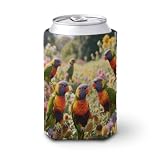
This is the only true sleeve in the set, and it needs a frank description. The listing calls it a reusable insulated cup sleeve, which in this product category normally means a neoprene or fabric wrap for a drinking cup, not a fitted cover for a French press carafe. Its size, material, and diameter are not stated in the listing name, so nothing here confirms it fits a press. It is the right choice if you want to protect your hand from a hot tumbler or paper cup, and a runner-up for anyone trying to wrap a glass carafe. Buy it for what it is, an accessory, and measure first if you hope to use it on a press.
- Type: reusable insulated cup sleeve per the listing name
- Fit and diameter: confirm on the listing before buying
- Material: not stated in the listing name; confirm on the page
- Use case: cups and tumblers, not a French press cover by default
- Care: confirm on the page
Pros:
- Light, easy-to-pack layer that protects your hand
- Works with a cup you already own
Cons:
- Not confirmed to fit any French press carafe
- Does not change how the coffee is brewed or filtered
Unlike every other pick, it holds no coffee and brews nothing.
5. Secura 34 oz Stainless Press – Best for Keeping a Full Pot Warm at the Table

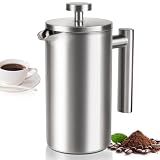
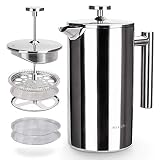
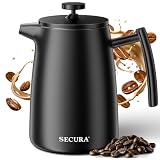
The Secura is a classic one-liter press rebuilt in double-wall stainless steel, so the insulation is part of the pot rather than something you slip on. The listing name states 304-grade stainless steel and two extra screens, and other sellers describe a layered filter you can stack for a cleaner cup. Steel also takes the glass-breakage worry off the table, though it hides the brew from view, so timing is down to a kitchen timer instead of watching the color. For a household that drinks coffee in waves through the morning, a pot like this means the second and third cups do not start out lukewarm.
- Capacity: 34 oz (1 liter) per the listing name
- Body: 304-grade stainless steel, double-wall construction per descriptions
- Filter: stainless screen with two spare screens included
- Handle: cool-touch handle and knob per seller descriptions
- Dishwasher guidance varies by seller, so confirm on the listing
Pros:
- No separate sleeve to lose or wash
- Extra screens give you a spare if one bends
Cons:
- You cannot see the coffee while it steeps
- Steel presses can feel heavy when full
Next to the Utopia 17 oz it is the better choice when more than two people drink from the same pot.
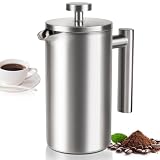
6. Utopia Kitchen 17 oz Stainless Press – Best for a Smaller Double-Wall Pot

At 17 ounces, this is a half-liter press sized for one big mug or two small cups, which is exactly where double-wall steel earns its keep. The listing stresses a four-level filtration system and extra filters. A small pot loses heat fast because there is less water to hold it, so a double wall matters more here than on a one-liter pot. It will not sit as comfortably on a crowded table, but it fits on a desk or a camper counter. It also suits people who only want one strong mug and would rather not waste half a liter of coffee that goes cold.
- Capacity: 17 oz (about 0.5 liter) per the listing name
- Body: 304-grade stainless steel, double-wall per the listing title
- Filtration: four-level system with spare filters included
- Finish: black per the listing; other colors exist in the line
- Suitable for coffee and loose tea; confirm lid fit on the page
Pros:
- Right-sized for one or two drinkers
- Spare filters are included
Cons:
- Too small for a group
- Opaque steel means no visual brew check
Choose it over the Secura when counter space and portion size matter more than volume.
Specs Compared
| Product | Type | Capacity | Insulation | Body material |
|---|---|---|---|---|
| PRESSE by Bobble | Travel tumbler | 13 oz | Insulated body (wall count varies by seller) | Stainless steel |
| Iconikal | Travel tumbler | 16 oz | Insulated (confirm on listing) | Confirm on listing |
| GSI Outdoors JavaPress | Press with cozy | 50 fl oz | Padded cozy and insulated lid (confirm on listing) | Shatter-resistant plastic carafe |
| Playing Lorikeet | Cup sleeve | Not applicable | Sleeve layer | Confirm on listing |
| Secura 34 oz | Press pot | 34 oz | Double-wall steel | 304-grade stainless steel |
| Utopia Kitchen 17 oz | Press pot | 17 oz | Double-wall steel | 304-grade stainless steel |
How We Chose These
This is a research-based roundup built from the product set in the current catalog. We read each listing name, compared it with manufacturer descriptions and retailer specification fields where those existed, and flagged every spec that sellers describe inconsistently. Picks were sorted on four questions: where does the insulation come from, how much coffee does it hold, how is the grounds filter built, and how clearly does the listing explain what you are buying. Where a spec was missing or contradicted between sellers, this guide says to confirm it on the product page instead of guessing.
What to Look For
Sleeve, Wall, or Cozy: Where the Insulation Lives
A sleeve is an add-on, usually fabric, neoprene, or felt, that wraps a pot or cup from the outside. A double-wall press holds heat inside the body itself, with an air gap or vacuum layer between the walls. A cozy sits in the middle: a padded wrap shaped for one specific carafe. The practical difference is fit. A true press cozy is cut for a particular diameter and height, while a generic cup sleeve is cut for cups. If you plan to wrap a glass press you already own, measure the carafe diameter and match it to the sleeve opening, and be prepared to return it if the fit is off.
Why Capacity Changes How Fast Coffee Cools
A large volume of liquid holds heat longer than a small one, because it has less surface area relative to its mass. That is why a 34 oz steel pot can hold coffee warm longer than a 13 oz tumbler even with similar walls. If you are brewing a single cup, the insulation needs to be better and the lid needs to seal, since the lid is where most of the heat escapes. A rough rule: if the coffee will be sitting longer than 30 minutes, pour it into a separate preheated insulated container or choose a double-wall body.
Filter Design and Grind Size
Every French press filter is a mesh screen on a plunger. More screen layers generally catch more fine particles, and listing phrases like three-level or four-level filtration refer to stacked plates and screens. A coarse grind that looks like breadcrumbs works best, because fine grounds slip through any mesh and keep extracting after you press. A common starting point is about one gram of coffee for every fifteen to seventeen grams of water. For a worked example, 17 oz of water is roughly 500 grams, which would take about 30 to 33 grams of coffee on that ratio. Adjust to taste from there.
Material, Leaks, and Cleaning
Stainless steel resists breakage and does not hold odors the way some plastics can, but it cannot be heated on a stove unless the maker says so, and the lid and plunger often use silicone seals that trap old coffee oils. Take the plunger apart after each use and rinse every layer of the filter. For travel tumblers, check whether the lid is described as leak-resistant or leakproof; those terms are not interchangeable, and a press lid with a vent or plunger hole will rarely be fully sealed when tipped over. Always check the dishwasher guidance on the specific listing, because sellers sometimes disagree about top-rack safety.
A Quick Fit Check Before You Buy a Sleeve
Measure three things on the pot you want to cover: the widest outside diameter of the carafe, its height from the base to just under the lid band, and the handle position. A wrap that is too narrow will not close, and one that is too loose will slide down as soon as you pick the pot up. Cup sleeves are usually sized by drink volume, so a listing that says it fits a 16 to 32 oz cup says very little about a straight-sided glass press. When the listing gives no dimensions at all, which is the case for the sleeve in this set, treat it as a cup accessory until the seller proves otherwise.
Preheating: The Free Layer of Insulation
Whatever you choose, rinse the empty press or tumbler with hot water before brewing. A cold steel or glass wall pulls heat out of the first few minutes of the brew, and the water can lose several degrees before the plunger ever moves. Preheating costs nothing, works with every pick above, and often does more for the first cup than the difference between one insulation style and another. After pressing, pour the coffee out of the grounds into a warmed insulated container if you want it hot for the next hour.
Safety Notes for Hot Liquids
Hot coffee pressurizes slightly in a sealed container, so open lids slowly and pointed away from you. Do not microwave metal bodies. Do not pour boiling water into a cold glass or thin plastic carafe; warm it first with a splash of hot water. If a plastic part cracks, retire it instead of patching it.
Questions
Can I put a cup sleeve on my glass French press?
Only if the sleeve opening matches the carafe diameter and the material is rated for hot surfaces. A generic cup sleeve is cut for cups, so check dimensions against the pot you own before relying on it.
Does a double-wall French press keep coffee hot all day?
No insulated pot holds coffee hot indefinitely, and any hold-time figure on a listing is the seller’s claim, not a guarantee. Coffee left on the grounds also keeps extracting and turns bitter, so pour it into a second container after pressing.
Is a padded cozy better than a steel body?
A cozy can be removed and washed and protects the carafe from bumps, while a steel body is a single piece with no fabric to maintain. Padded wraps suit outdoor use, and steel suits the kitchen table.
Are insulated tumbler presses leakproof?
Not automatically. Some listings say leak-resistant and some say leakproof, and the plunger hole in the lid is a common weak point. Confirm the claim on the listing and keep the tumbler upright in a bag.
What grind should I use in an insulated press?
Coarse, about the texture of sea salt or coarse breadcrumbs, whatever the body is made of. Finer grounds clog the mesh and pass through it into the cup.
How do I clean the filter on a stainless press?
Unscrew or unstack the plunger layers after each brew, rinse out the grounds, and wash with warm soapy water. Let every layer dry before putting the press back together to avoid trapped moisture.
Update History
- October 21, 2026 – Initial publication; product set drawn from current catalog listings.
- Check the product page for current specifications and availability before buying.
Sources
- Manufacturer product pages and descriptions for GSI Outdoors and the other listed brands where available
- Retailer listing titles and specification fields
- General brewing guidance from specialty coffee educators on grind size and brew ratios

Write Your Review
No reviews yet. Be the first to share your experience!