

Key takeaways
- Compare 4 benchtop jointers with adjustable fences for flat faces and square edges. Fence travel, cutterhead type, table size and dust ports explained.
A jointer earns its place on the bench when rough lumber arrives twisted, bowed, or with one edge that will not sit square against a fence. The real decision is not whether to buy a jointer at all, but which fence and cutterhead combination will keep your boards flat and your edges true without taking over the whole workshop. A fence that drifts while you tighten it, or one that cannot tilt for a bevel, turns every pass into a correction instead of progress.
This article is for hobby woodworkers setting up a first bench, small-shop builders flattening boards for furniture and cabinets, and anyone upgrading from a hand plane who wants repeatable square edges. The four jointers below were picked from their Amazon product listings, using the model name, motor, cutterhead, table size, and fence details stated on the listing page.
Quick Picks
As an Amazon Associate we earn from qualifying purchases
| Product | Best for | Key spec from title |
|---|---|---|
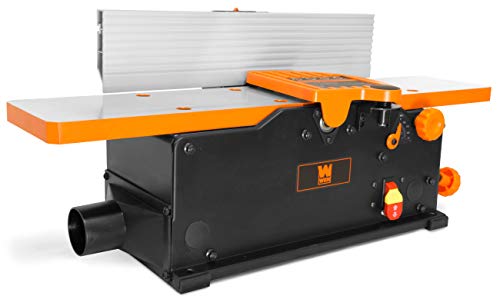
| WEN JT630H 10-Amp 6-Inch Spiral Benchtop Jointer | Fine-finish edge jointing in a small shop | Spiral cutterhead with 12 staggered HSS blades |
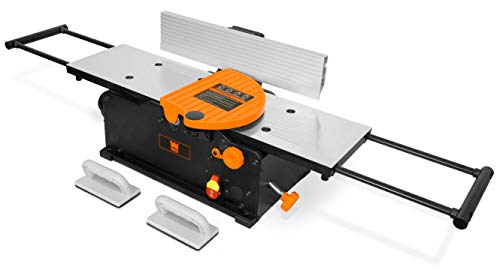
| WEN JT833H 10-Amp 8-Inch Spiral Benchtop Jointer with Extendable Table | Wider boards and long stock on a bench | 8-inch spiral cutterhead with extendable table |
| PORTER-CABLE Benchtop Jointer, Variable Speed, 6-Inch (PC160JT) | Matching cutter speed to hard and soft wood | Variable speed from 6,000 to 11,000 RPM |
| CRAFTSMAN Benchtop Jointer, Up to 22,000 Cuts per Minute, 10 Amp (CMEW020) | Variable-speed jointing with a center-mounted fence | Up to 22,000 cuts per minute |
How to Choose
Fence adjustment range and locking
The fence is the part of a jointer you touch most, so its adjustment range decides what the machine can actually do. Look for a fence that tilts to 45 degrees for bevelled edges and locks firmly at 90 degrees for square work, because a fence that shifts while you tighten it will leave every edge slightly out of square. Check the fence size too: a taller fence supports a board standing on edge, while a longer fence keeps long stock steady through the cut. Before choosing, confirm how the fence locks in the listing, and whether it has positive stops at the angles you will use most often.
Cutterhead type: spiral inserts or straight knives
A spiral cutterhead uses many small staggered blades, while a straight-knife cutterhead uses two long knives. Spiral heads spread the cutting action across more edges, which tends to leave a finer finish and makes blade changes a matter of rotating or swapping small inserts rather than setting two long knives. Straight knives are simpler and cheaper to replace, and a two-knife head with jackscrew levelling lets you set each knife height precisely. If you joint figured or tear-out-prone wood, the spiral design is usually the safer pick; if you want the lowest running cost, straight knives win.
Table length and jointing width
Table length matters more than most buyers expect, because the outfeed table supports the board after the cut and the infeed table supports it before. A 30-inch table handles common board lengths for furniture and cabinet work, while an extendable table that reaches past 50 inches supports long stock without a helper or an extra roller stand. Jointing width sets the widest board face you can flatten: six inches covers most edge jointing and narrow face work, while eight inches opens up wider panels. Match the width to the boards you actually buy, not the boards you imagine buying.
Dust collection and bench footprint
Jointers throw a surprising volume of shavings, so the dust port size decides whether your shop vacuum or dust collector can keep up. A 2-1/2-inch port suits a standard shop vacuum hose, while a machine with both 2-1/2-inch and 4-inch ports gives you the choice between a vacuum and a full dust collector. Footprint matters just as much in a small shop: a six-inch benchtop jointer fits on a bench and stores on a shelf, while an eight-inch model with extension arms needs a longer bench and more clearance around it. Measure the bench before ordering.
The 4 Best Options
WEN JT630H 10-Amp 6-Inch Spiral Benchtop Jointer
The JT630H suits a hobbyist who wants a spiral cutterhead without moving to a floor-standing machine. Its 10-amp motor and six-inch cutting width cover edge jointing and face flattening for the boards used in most furniture, cabinet, and small-project work. The spiral head with 12 staggered HSS blades spreads the cut across more edges, and the 30-inch table gives useful support for boards up to a few feet long. The fence bevels to 45 degrees, so angled edges and chamfered joints are within reach without a second setup.
Specs
- 10-amp motor rotating the cutterhead up to 12,000 times per minute
- Spiral cutterhead with 12 staggered HSS blades
- 30-by-6-inch table
- Adjustable 19-3/4 by 4-1/4-inch fence bevels up to 45 degrees
- Removes 0 to 1/8 inch of material per pass
- Onboard depth-of-cut scale
- 2-1/2-inch dust port
- Includes two push blocks
Best for: Hobbyists who want a fine spiral-cutterhead finish on a benchtop footprint.
Watch out for: The aluminum table can scratch, so keep the surface clean and avoid dragging rough-sawn stock across it.
WEN JT833H 10-Amp 8-Inch Spiral Benchtop Jointer with Extendable Table
The JT833H is the pick for woodworkers whose boards are wider than six inches or longer than a standard benchtop table can support. Its eight-inch spiral cutterhead uses 16 staggered HSS blades, and the 33-by-8-inch table extends with support arms up to 51 inches, which steadies long boards through the whole pass. The same 10-amp motor drives the head at up to 12,000 rotations per minute, and the fence bevels to 45 degrees for angled work. Dual dust ports mean it connects to either a shop vacuum or a larger collector.
Specs
- 10-amp motor rotating the cutterhead up to 12,000 times per minute
- Spiral cutterhead with 16 staggered HSS blades
- 33-by-8-inch table with support arms extending up to 51 inches
- Adjustable 19-3/4 by 4-1/4-inch fence bevels up to 45 degrees
- Removes 0 to 1/8 inch of material per pass
- Onboard depth-of-cut scale
- 2-1/2-inch and 4-inch dust ports
- Includes two push blocks
Best for: Home shops jointing wider boards and long stock that a six-inch table cannot support.
Watch out for: At around 55 pounds with extension arms, it needs a longer, sturdier bench than a six-inch jointer, so check bench space before ordering.
PORTER-CABLE Benchtop Jointer, Variable Speed, 6-Inch (PC160JT)

The PC160JT fits woodworkers who switch between soft and hard lumber and want the cutter speed to match the material. Its variable speed range runs from 6,000 to 11,000 RPM, so you can slow the head for dense hardwoods and speed it up for softwoods. The two-knife cutter head adjusts with a jackscrew, and the fully adjustable aluminum fence has stops to hold its position. The extra-large table adds support while you level boards, and the machine stays compact enough for a bench in a crowded shop.
Specs
- Variable speed from 6,000 to 11,000 RPM
- Two-knife cutter head with jackscrew adjustment
- 6-inch jointing width
- Fully adjustable aluminum fence with stops
- Extra-large table for added board support
- Spring-loaded blade guard
Best for: Hobbyists and DIY woodworkers who want speed control for different wood types.
Watch out for: Straight knives need careful setting after a blade change, so allow time for setup and check knife height before the first pass.
CRAFTSMAN Benchtop Jointer, Up to 22,000 Cuts per Minute, 10 Amp (CMEW020)

The CMEW020 suits a buyer who wants variable speed and a center-mounted fence in one machine. Its 10-amp motor drives a two-knife cutter head at 6,000 to 11,000 RPM, reaching up to 22,000 cuts per minute, which gives you room to tune the cut to the wood in front of you. The center-mounted fence provides support on both sides of the cutterhead, and it tilts to 90 and 135 degrees for square and angled work. The fence height of 4-1/4 inches supports boards standing on edge.
Specs
- 10-amp motor
- Cutterhead speed from 6,000 to 11,000 RPM
- Up to 22,000 cuts per minute
- Two-knife cutter head with jackscrew levelling
- Center-mounted adjustable fence, 4-1/4 inches high
- Fence tilts to 90 and 135 degrees
- 6-inch jointing width
Best for: Woodworkers who want variable speed and a center-mounted fence for square and bevelled edges.
Watch out for: Check the fence for wobble during setup and tighten the fence lock fully before jointing, since a loose fence shows up as an edge that is not square.
Which One Fits Your Situation
You want the finest finish on a small bench
Choose the WEN JT630H. Its spiral cutterhead with 12 staggered HSS blades is built for a smooth finish on hard and soft woods, and the 30-inch table fits a normal workbench without crowding it. The fence bevels to 45 degrees, so you can cut square edges and bevels with the same machine. It is the most compact spiral option in this article.
Your boards are wider than six inches or very long
Choose the WEN JT833H. The eight-inch cutterhead handles wider faces, and the table extends to 51 inches so long boards stay supported through the cut. The 16-blade spiral head keeps the finish fine even on wider stock. Make sure your bench has room for the extended arms before it arrives.
You switch between softwoods and hardwoods often
Choose the PORTER-CABLE PC160JT. Its variable speed from 6,000 to 11,000 RPM lets you slow the cutterhead for dense hardwoods and run faster on softwoods, which is the main reason to pick this machine over a fixed-speed jointer. The adjustable fence with stops holds its angle while you work through a batch of boards.
You want variable speed with a center-mounted fence
Choose the CRAFTSMAN CMEW020. The center-mounted fence supports the board on both sides of the cutterhead, and the variable speed range up to 22,000 cuts per minute covers both soft and hard lumber. The fence tilts to 90 and 135 degrees, giving you square edges and angled cuts from one setup.
Common Mistakes
- Buying a six-inch jointer when most of your boards are wider than six inches, then trying to flatten wide faces in two passes that never meet cleanly.
- Ignoring fence lock-up during setup, then wondering why every edge comes out slightly out of square.
- Taking too deep a cut on the first pass instead of removing a thin layer and checking the result before going deeper.
- Jointing without dust collection connected, which leaves shavings on the table and under the board, and that changes the cut.
- Skipping the depth-of-cut scale and guessing the infeed table height, which leads to uneven passes and wasted stock.
Frequently Asked Questions
What does an adjustable fence do on a benchtop jointer?
An adjustable fence guides the board past the cutterhead and sets the angle of the cut. At 90 degrees it produces a square edge, and tilted to 45 degrees it cuts a bevel or chamfer. A fence that locks firmly at the angle you set is what keeps repeated edges consistent, so check the locking mechanism and any positive stops before you buy.
Is a spiral cutterhead better than straight knives?
A spiral cutterhead uses many small staggered blades, which spreads the cutting action and usually leaves a finer finish with less tear-out on figured wood. Straight knives are simpler and cheaper to replace, and a two-knife head with jackscrew levelling can be set very precisely. Either type works well; the choice comes down to finish quality against running cost.
How wide a board can a benchtop jointer flatten?
The jointing width is the widest face the machine can flatten in one pass. Six-inch jointers flatten faces up to six inches wide, while eight-inch models like the WEN JT833H handle faces up to eight inches wide. For edge jointing, the width matters less, since the board stands on its edge and the fence supports it.
Do I need dust collection for a benchtop jointer?
Yes, in practice you do. A jointer produces a large volume of shavings in a short time, and shavings left on the table can lift the board and change the cut. A 2-1/2-inch port connects to a shop vacuum, while a 4-inch port suits a dust collector, so match the port to the extraction you already own.
More from Amazon
Programs that pair well with the guide above. Offers and eligibility are set by Amazon and may change.
Set up recurring deliveries of everyday items on eligible products. Terms and savings are set by Amazon.
Explore Subscribe & SaveCollect the home and kitchen items you want in one registry that guests can shop from.
Create a wedding registryFree shipping on eligible items, Prime Video and more. Eligible new members can start with a free trial.
Start a Prime free trialAudiobooks and podcasts to listen to on the go. Eligible new members can start with a free trial.
Try Audible freeAs an Amazon Associate we earn from qualifying purchases.
Write Your Review
No reviews yet. Be the first to share your experience!