

Key takeaways
- Looking for the best electric coffee grinders? Six blade grinders compared on capacity, safety lids, cleanup and grind control for drip and French press.
The Hamilton Beach Fresh Grind is the best all-around electric coffee grinder in this group, because its removable grinding chamber makes the weekly cleanup far less annoying than on a fixed bowl. Every grinder here is a blade grinder, meaning a spinning blade chops beans instead of crushing them between burrs. That suits drip, French press and cold brew just fine, but it is a poor match for espresso. If you want a grinder for a drip pot, a pour-over cone or a spice jar, pick from below. If you pull espresso shots, read the burr section first.
Quick List
- Hamilton Beach Fresh Grind – best for easy cleanup thanks to a removable chamber
- BLACK+DECKER One Touch – best for a simple push-button routine with published grind times
- KRUPS Precision (F203 style) – best for a larger 3 oz bowl and a stronger listed motor
- Basics Fast Electric Grinder – best for documented run limits and a clear safety lid
- Aromvel Electric Grinder – best for a scoop-and-brush accessory in one tool
- Wancle One Touch Grinder – best for a compact body that comes with a cleaning brush
Which One Is Right for You?
| If you… | Choose |
|---|---|
| hate scraping grounds out of a fixed bowl | Hamilton Beach Fresh Grind |
| want a published grind-time chart to follow | BLACK+DECKER One Touch |
| grind enough for a full pot and want the biggest bowl | KRUPS Precision |
| care about stated duty cycle and a see-through lid | Basics Fast Electric Grinder |
| want a scoop and brush built into one accessory | Aromvel Electric Grinder |
| need a small grinder that stores in a drawer | Wancle One Touch Grinder |
| pull espresso shots every day | None of these; buy a burr grinder |
Most buyers should start with the Hamilton Beach or the BLACK+DECKER, since both have clear manufacturer documentation. The KRUPS earns a look when bowl size matters. The two newer-brand grinders, Aromvel and Wancle, are fine choices when you want a lightweight, inexpensive option and accept less published detail.
All 6 Picks in Detail
1. Hamilton Beach Fresh Grind – Best for Easy Cleanup
As an Amazon Associate we earn from qualifying purchases at no extra cost to you.

This is the grinder for people who want to rinse the part that holds the coffee. Hamilton Beach describes a removable grinding chamber, which means you lift the stainless bowl out of the base instead of tapping grounds into a sink. The listing says it handles enough beans for up to 12 cups, and the manufacturer chart ties 12 cups to about 9 tablespoons of ground coffee.
- Listed power: about 125 watts on the manufacturer page
- Capacity: up to 9 tablespoons of beans, enough for 12 cups per the brewing chart
- Stainless steel blades with an on/off button
- Removable chamber; the manufacturer’s Canadian page says the chamber and lid are dishwasher safe, so confirm on your listing
- Approximate size: 7 in tall, 3.5 in wide and 3.7 in deep
- Cord storage built into the base
Pros:
- Cleaning is faster than on any fixed-bowl model here
- Also handles spices, so one chamber can be a dedicated spice cup
- Compact enough for a cabinet shelf
Cons:
- Lower listed wattage than the others, so large loads take longer
- Still a blade grinder, so particle sizes vary
Who it suits: households that grind a little every morning and clean the bowl every few days. If you brew a standard drip pot, the 12-cup chart on the manufacturer page gives you an easy starting dose, and the removable chamber means you can swap between beans and spices without a lot of fuss. Skip it if you want a bowl that holds more than a pot’s worth, or if you plan to chase a fine, even grind.
Compared with the BLACK+DECKER, it trades a published grind-time chart for easier cleaning.
2. BLACK+DECKER One Touch – Best for a Simple Routine
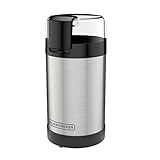
BLACK+DECKER keeps the design plain: a stainless bowl, a lid that must lock before the blades spin, and one big push button. The company’s manual gives grind times for a full 2/3 cup of beans, which is a rare courtesy among budget blade grinders. Those numbers give new users a starting point instead of guesswork.
- Listed power: 150 watts on the manufacturer page
- Capacity: up to 2/3 cup of whole beans, roughly 155 ml
- Manual grind times for a full bowl: coarse about 10 to 12 seconds, medium about 14 to 16 seconds, fine about 24 to 28 seconds
- Safety lid: blades run only when the lid is locked
- Stainless steel blades and bowl
- Manufacturer page lists a two-year limited warranty; confirm for your unit
Pros:
- Clear manual guidance on timing
- Lid lock adds a real safety margin
- Small footprint
Cons:
- Fine grinds take long enough that heat can build in the bowl
- Bowl is fixed, so cleaning needs a brush or a dry cloth
Who it suits: first-time grinder buyers who want rules to follow. The manual’s seconds-per-grind chart removes much of the trial and error, and the lid lock makes it a calm choice in a busy kitchen. It is less suited to anyone who regularly brews more than about four cups at a time, since the bowl tops out at 2/3 cup of beans.
Next to the KRUPS, it holds less but is easier to learn.
3. KRUPS Precision – Best for a Bigger Bowl

The KRUPS name on this listing is “Precision,” but the design is the familiar F203-style blade grinder. Its selling points are a 3 oz capacity and a 200-watt motor, both larger than most rivals here. If you brew a full pot at once and do not want to grind in two batches, the extra room is useful.
- Listed power: 200 watts
- Capacity: about 3 oz, or 85 g, of beans
- Stainless steel blades and bowl
- Lid-activated safety switch stops the blades when the lid lifts
- No grind-size dial; the grind is set by how long you hold the button
- Also handles herbs, nuts and spices per the listing
Pros:
- Largest bowl in the group
- Strong listed motor power for quick coarse grinds
- Long-running, widely sold design
Cons:
- Owners often describe it as loud
- Uneven particles are likely at fine settings, so it is not an espresso grinder
Who it suits: people who brew a full pot, make cold brew concentrate in batches, or grind spices in bulk. The extra 200-watt motor power helps with coarse grinds, which are the sweet spot for this style of grinder. Keep the pulses short, because a fixed bowl and a strong motor can warm the beans if you hold the button for too long.
Against the Basics model, you gain bowl size but lose the published duty-cycle guidance.
4. Basics Fast Electric Grinder – Best for Clear Operating Limits
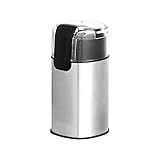
This store-brand blade grinder stands out for how plainly its manual states limits. The documentation lists a maximum run of 45 seconds followed by a three-minute cool-down, plus a 60 g maximum load. For a motor of this size, that is the kind of guidance that protects the grinder from burnout.
- Listed power: 150 watts at 120 V
- Maximum capacity: 2.1 oz (60 g) per the manual
- Manual grind times: about 8 to 10 seconds coarse, 10 to 15 seconds medium and around 30 seconds fine
- Duty cycle: 45 seconds on, then 3 minutes off
- Clear safety lid with a heavy-duty stainless blade
- Approximate size: 3.7 in by 3.5 in by 6.9 in
Pros:
- See-through lid lets you watch the grind progress
- Documented run and rest limits
- Light enough to store anywhere
Cons:
- No cleaning brush mentioned in the listing name
- Blade grinder inconsistency applies here too
Who it suits: buyers who like clear rules. Because the manual spells out how long to run and how long to rest, it is a good fit for shared kitchens, dorms and offices where several people might use the same grinder. It is less ideal if you want a cleaning brush in the box, since the listing name does not mention one.
Compared with the Wancle, its documentation is stronger while the capacity is similar.
5. Aromvel Electric Grinder – Best for the Scoop-and-Brush Tool
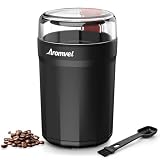
Aromvel is a newer brand, and its listing leads with a two-in-one scoop and cleaning brush plus a safety lid. Retail pages cite a motor near 180 watts and a capacity around 2.3 oz, but those figures come from retailer text and not from a long manual history, so confirm them on the listing before buying.
- Listing name: one-touch coffee mill with stainless steel blades
- Safety lid that stops the blades when opened, per retail descriptions
- Retail pages cite about 180 watts and about 2.3 oz capacity; confirm on listing
- Scoop on one end and brush on the other for cleanup
- The title says “adjustable”; on a one-touch grinder that almost certainly means timing, not a dial
- Approximate size: 3.6 in by 3.4 in by 5.9 in on one listing
Pros:
- Accessory tool saves hunting for a brush
- Safety lid and see-through design
- Compact
Cons:
- Thinner track record than the established brands
- Specs vary by retailer text
Who it suits: casual brewers who want one tool for measuring and brushing, and who are comfortable with a newer brand. Because the specs vary a little between retailer pages, read the product page for wattage, capacity and warranty terms before you order, and keep your expectations in line with any one-touch blade grinder.
It is the one to choose over the Wancle when you prefer a scoop to measure beans.
6. Wancle One Touch Grinder – Best for Small Kitchens
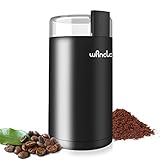
Wancle sells a slim one-touch grinder that ships with a cleaning brush. Retail descriptions give 150 watts, a 60 g bowl and a quick under-15-second grind for drip coffee. It is small and light, which is its main advantage.
- Listed power: 150 watts at 120 V, 60 Hz
- Capacity: 60 g of beans per retail pages
- Stainless steel blades and bowl with a plastic body
- One-touch operation; release to stop
- Includes a cleaning brush
- Approximate size: 3.5 in by 3.5 in by 6.6 in
Pros:
- Small and light for drawers
- Brush included
- Quick grinds for drip
Cons:
- Retail descriptions note the lid sits loose and needs a hand holding it down while running
- Uneven particles make it unsuitable for espresso
Who it suits: small apartments, dorm rooms and travelers who need a grinder that disappears into a drawer. It is a sensible choice for one or two cups of drip coffee a day. If you plan to grind every morning for years, a model with a locking lid or a removable chamber may feel less fiddly.
Next to the Hamilton Beach, it is smaller but harder to clean.
Specs Compared
| Model | Type | Listed power | Capacity | Safety lid | Cleaning aid |
|---|---|---|---|---|---|
| Hamilton Beach Fresh Grind | Blade, removable chamber | About 125 W | About 9 tbsp (12 cups) | Confirm on listing | Removable chamber |
| BLACK+DECKER One Touch | Blade | 150 W | 2/3 cup | Yes | Confirm on listing |
| KRUPS Precision | Blade | 200 W | 3 oz | Yes (lid switch) | Confirm on listing |
| Basics Fast Electric Grinder | Blade | 150 W | 2.1 oz (60 g) | Yes (clear lid) | Confirm on listing |
| Aromvel Electric Grinder | Blade | About 180 W per retail pages | About 2.3 oz per retail pages | Yes | Scoop and brush tool |
| Wancle One Touch Grinder | Blade | 150 W | 60 g | Loose-fit lid | Brush included |
How We Chose These
This ranking is research-based. We compared manufacturer product pages, owner manuals where available and the specification fields on each retailer listing. Weight went to documented safety features, stated capacity and run limits, how easy the bowl is to clean, and how clearly the maker explains what the grinder can and cannot do. Where a listing name did not state a value, we left it as “confirm on listing” instead of guessing. We also kept the whole group honest about the category: every product here is a blade grinder, so none is positioned as an espresso grinder.
What to Look For
Blade versus burr: the one decision that matters most
A blade grinder spins a propeller-style blade that smashes beans into pieces of many sizes. A burr grinder crushes beans between two abrasive surfaces set a fixed distance apart, so the particles come out much closer in size. Even particles matter for espresso because water finds the path of least resistance through a puck. If the puck has fines and boulders, some of the coffee over-extracts while the rest under-extracts. That is why every grinder in this list is better suited to drip, French press, cold brew or spices than to a portafilter. If you own an espresso machine, budget for a burr grinder with a stepped or stepless adjustment, and treat these models as a backup or a spice mill.
Capacity, power and run limits
Capacity on blade grinders is stated in ounces, grams or tablespoons, and manufacturers usually describe a maximum fill line. Do not fill to the maximum if you can avoid it. Smaller loads move more freely around the blade and come out more even. Power is shown in watts, and the listings here range from about 125 W to 200 W. More watts help the blade keep its speed under a full load, but they do not fix uneven particles. Look for a stated duty cycle as well. The Basics model’s manual lists 45 seconds on and three minutes off, which is a sensible pattern for any small motor.
A quick rule of thumb: a common brewing ratio is 1 part coffee to 16 parts water by weight. A full 60 g load therefore covers about 960 g of water, or roughly four 8-oz cups. If you brew a single mug, grind 15 to 20 g and leave the rest of the bowl empty.
Getting a more even grind from a blade model
Use short pulses of one to two seconds instead of one long press, and shake the grinder between pulses so large pieces fall back to the blade. For coarse grinds, stop early. For medium grinds, follow a manufacturer chart if one exists, such as the BLACK+DECKER manual times above, and adjust by a second or two. A long, fine grind builds heat in the bowl and can flatten the aroma. If grounds clump to the lid from static, tap the lid gently and let the dust settle before opening.
Safety and cleaning
Always unplug the grinder before you open it or clean it, and keep fingers away from the blade even when it seems stopped. Look for a lid lock or switch that cuts power when the lid lifts. Do not submerge the motor base in water. For a fixed bowl, wipe with a dry cloth or the supplied brush, and avoid wet sponges that can leave moisture near electrical parts. A removable chamber such as the Hamilton Beach’s is easier, but check the manufacturer page to see which pieces are dishwasher safe. Blades are sharp, so handle them with a brush rather than your fingers.
Match the grinder to how you brew
Drip machines and pour-over cones forgive blade grinders more than other methods because paper filters catch fines. French press and cold brew need a coarse grind, and blade grinders often produce dust that passes through the mesh and muddies the cup. If you want a cleaner cup from a blade grinder, sift out the fines with a fine mesh strainer. If you grind spices as well, use one grinder per purpose, or wipe and clean thoroughly in between so cumin does not show up in your morning cup.
Questions
Can I make espresso with an electric blade grinder?
Not reliably. Espresso needs fine, even particles, and a blade grinder produces a mix of dust and chunks. That mix leads to channeling and inconsistent shots, so a burr grinder is the better tool for a portafilter.
How long should I grind for drip coffee?
Start with the manufacturer’s chart if the model has one. The BLACK+DECKER manual suggests about 14 to 16 seconds for a medium grind with a full bowl, while the Basics manual suggests about 10 to 15 seconds. Start shorter and add a second or two until the grounds look like coarse sand.
Why do the grounds come out uneven?
The blade hits beans at random, so some pieces are cut many times and others only once. Pulse, shake the grinder between pulses and fill the bowl no more than halfway for the most even result.
Can I use the same grinder for spices?
Yes, most of these list spice grinding as a use. Strong spices leave oils behind, so clean the bowl well before switching back to coffee, or keep a second grinder dedicated to spices.
How do I clean a blade grinder?
Unplug it first, brush out loose grounds and wipe the bowl with a dry or slightly damp cloth. Never run water into a fixed bowl, and let any removable parts dry fully before putting them back.
Is a bigger motor always better?
No. Higher listed wattage helps the blade hold its speed, but particle consistency depends mostly on the design, the amount of beans and your pulsing technique. Duty-cycle limits matter as much as raw power.
Update History
- October 20, 2026 – Initial publication; product set drawn from current catalog listings.
- Check the product page for current specifications and availability before buying.
Sources
- Manufacturer product and specification pages for Hamilton Beach and BLACK+DECKER
- Owner manuals and user guides where available, including grind-time charts and duty-cycle limits
- Retailer listing titles and specification fields for each model
- Published product descriptions for the KRUPS, Aromvel and Wancle grinders


Write Your Review
No reviews yet. Be the first to share your experience!