

Key takeaways
- Compare the best espresso grinders for home baristas: one standalone burr grinder and five machines with built-in grinders, plus dialing-in tips.
The Breville Barista Express is the strongest pick here for home baristas who want a quality grinder without buying separate gear: its built-in conical burr grinder feeds a 54 mm portafilter directly, and the machine around it is well documented. Only one of the six listings, the SHARDOR burr grinder, is a standalone grinder; the other five are espresso machines with grinders built in, which is how most beginners meet grinding for the first time. An espresso grinder is a burr grinder that can produce a fine, uniform grind in small adjustable steps, because espresso punishes uneven particles.
Quick List
- Breville BES870XL Barista Express (Brushed Stainless Steel) – best overall built-in grinder and machine combination
- AMZCHEF Espresso Machine with Grinder (44 settings) – best for the widest grind range among the built-in options
- Breville BES870BTR Barista Express (Black Truffle) – best for the same Breville setup in a darker finish
- SHARDOR Burr Coffee Bean Grinder (32 settings) – best as the only standalone grinder in the group
- AMZCHEF Espresso Machine with Grinder (20 settings) – best for a simpler built-in grinder with a short heat-up
- Espresso Machine with Grinder and Frother (30 settings) – best for a built-in grinder with a steam wand at a middle step count
Which One Is Right for You?
| If you… | Choose |
|---|---|
| want a proven integrated conical burr grinder and 54 mm portafilter | Breville BES870XL Barista Express |
| prefer a dark finish with the same Breville workflow | Breville BES870BTR Barista Express |
| want to buy a grinder only and keep your current machine | SHARDOR Burr Coffee Bean Grinder |
| want fine control with the most grind steps in an all-in-one | AMZCHEF Espresso Machine with Grinder (44 settings) |
| want fewer steps to manage and a fast warm-up | AMZCHEF Espresso Machine with Grinder (20 settings) |
| want a middle ground of 30 steps and a steam wand | Espresso Machine with Grinder and Frother (30 settings) |
The first question is whether you need a machine at all, because that splits this list in two. If you already own an espresso maker, the SHARDOR is the only listed way to add a grinder alone, though you should confirm its fineness range suits espresso. If you do not own a machine, an all-in-one saves counter space and gets you drinking sooner. Within the all-in-ones, Breville is the one with the longest documented record, and the AMZCHEF and 30-setting models offer more steps on paper.
All 6 Picks in Detail
1. Breville BES870XL Barista Express (Brushed Stainless Steel) – Best overall built-in grinder and machine
As an Amazon Associate we earn from qualifying purchases at no extra cost to you.
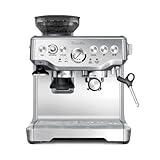
The Barista Express has been a reference point for home users for years. Manufacturer and retailer pages describe a stainless steel conical burr grinder built into the body, a 54 mm portafilter, a 15-bar Italian pump, a thermocoil heater with PID temperature control, a pressure gauge, and a manual steam wand. Most retailers list a removable tank of around 67 oz and a grind-size dial with about 16 numbered settings, though sources differ, so check the current page.
Who it suits: beginners and enthusiasts who want one machine that grinds, doses, and brews. The integrated grinder drops beans straight into the portafilter, so there is no transferring and little mess. The stainless finish suits most kitchens.
- Integrated conical burr grinder with a bean hopper
- 54 mm portafilter with single and dual wall baskets per retailer pages
- 15-bar Italian pump per manufacturer pages
- Thermocoil heating with PID temperature control per manufacturer pages
- Pressure gauge and manual steam wand
Pros:
- Beans to espresso without separate gear
- Gauge and steam wand help you learn technique
Cons:
- Larger footprint than machines without a grinder
- Grinder cannot be replaced if you outgrow it
It is the same machine as the Black Truffle version below, so pick by finish. Compared with the AMZCHEF models, its biggest advantage is the clarity of its published specifications, and its biggest drawback is the amount of counter space it needs.
2. AMZCHEF Espresso Machine with Grinder, 44 Grind Settings – Best for the widest grind range

This AMZCHEF listing leads with 44 grind settings, temperature control, a built-in grinder, hot and cold brew options, and a milk frother for cappuccinos and lattes. The number of settings is the most in this group, which gives you finer steps between coarse and fine. Whether those steps translate into real, repeatable differences depends on the burr design, which the title does not specify, so read the product page for burr type and material.
Who it suits: tinkerers who like to adjust and are happy to keep notes. Beginners can start in the middle and change one step at a time.
- Built-in grinder with 44 settings
- Temperature control per the listing
- Milk frother
- Hot and cold brew options
- Burr type, pump pressure, and tank size: confirm on listing
Pros:
- Fine adjustment steps
- Feature-rich all-in-one
Cons:
- Burr details are not in the title
- More settings can mean more trial and error
Compared with the Breville, it offers more steps but less documentation.
3. Breville BES870BTR Barista Express (Black Truffle) – Best for the Breville workflow in a darker finish

The Black Truffle edition is the same Barista Express formula in a different color. The listing shows the same line, craft cafe-quality shots, lattes, and cappuccinos at home, and the same hardware: an integrated conical burr grinder, 54 mm portafilter, pressure gauge, and manual steam wand. If your kitchen has black or dark-wood accents, this finish is easier to blend in.
Who it suits: shoppers who already decided on the Barista Express and want the darker finish. Verify that the accessories included are the same as the stainless version by checking the box contents on each page.
- Integrated conical burr grinder
- 54 mm portafilter
- 15-bar pump per manufacturer pages
- Pressure gauge and manual steam wand
- Included accessories: confirm on listing
Pros:
- Same trusted hardware as the stainless model
- Dark finish hides fingerprints better
Cons:
- Same large footprint
- Stock and accessories can differ between colors
It is functionally the BES870XL in a different coat, and the choice is purely about looks.
4. SHARDOR Burr Coffee Bean Grinder, 32 Settings – Best as the standalone grinder

The SHARDOR is the only true standalone grinder on this list. The listing calls it an electric burr grinder with 32 settings, a 40-second timer, a chamber cleaning button, and adjustable grind time controls. A timer-based design means you set a time rather than a weight, so use a scale to calibrate your dose. Whether the finest setting reaches true espresso fineness is not stated in the title, so check the product page, because many burr grinders aimed at drip and French press stop short of espresso range.
Who it suits: people who want to try a separate grinder with an existing machine, or who brew a mix of espresso and filter coffee and want one tool for both. If espresso is your main goal, confirm its fine range first.
- Electric burr grinder
- 32 grind settings per the listing
- 40-second timer
- Chamber cleaning button
- Burr type and espresso-range fineness: confirm on listing
Pros:
- Works with any brewer you own
- Simple controls and a cleaning feature
Cons:
- May not reach espresso fineness; verify before buying
- Timer-based dosing needs a scale for accuracy
It is the only entry on this page that does not come with a machine, so it suits a different buyer than the other five. If the product page confirms a fine enough range for your portafilter, pair it with a scale and a small brush; if it does not, treat it as a filter-coffee grinder and choose one of the all-in-one machines for espresso.
5. AMZCHEF Espresso Machine with Grinder, 20 Bar, 20 Grind Settings – Best for a simpler grinder and quick warm-up

This second AMZCHEF listing offers a 20-bar machine with a built-in grinder with 20 settings, hot and cold brew options, latte and cappuccino capability, and a 30-second heat-up claim. With fewer settings than the 44-setting model, the learning curve is gentler. A 30-second heat-up claim is quick for espresso, though real shot consistency usually benefits from a few more minutes of preheating.
Who it suits: those who want an all-in-one that is less overwhelming. Twenty steps cover most beginner needs, from coarse for cold brew to fine for espresso, with fewer ways to go wrong.
- Built-in grinder with 20 settings
- 20-bar pump per the listing
- 30-second heat-up per the listing
- Hot and cold brew options
- Burr type, tank size, and steam wand: confirm on listing
Pros:
- Fewer settings, easier start
- Fast warm-up claim
Cons:
- Coarser steps between settings
- Less detailed documentation
It is the simpler sibling to the 44-setting AMZCHEF.
6. Espresso Machine with Grinder and Frother, 30 Grind Settings – Best for a middle step count with a steam wand

This listing describes a 20-bar machine with a built-in grinder offering 30 settings, hot and cold brew, a steam wand, and temperature control for lattes and cappuccinos. The title does not name a maker, so look for the brand and warranty on the product page. Thirty settings fit between the 20-step and 44-step AMZCHEF models.
Who it suits: buyers who want a grinder-equipped machine with a proper steam wand and a moderate number of grind steps, and who are comfortable researching an unbranded name.
- Built-in grinder with 30 settings
- 20-bar pump per the listing
- Steam wand and frother
- Temperature control
- Brand, burr type, and tank size: confirm on listing
Pros:
- Balanced number of grind steps
- Steam wand for milk drinks
Cons:
- Unnamed brand in the title
- Limited detail on the grinder
It is the middle option between the two AMZCHEF models and the Breville machines.
Specs Compared
| Model | Type | Grinder | Grind settings | Portafilter | Pump | Steam wand |
|---|---|---|---|---|---|---|
| Breville BES870XL | Machine with grinder | Integrated conical burr | About 16 numbered per most retailers | 54 mm | 15 bar | Manual |
| AMZCHEF (44 settings) | Machine with grinder | Built-in; burr type confirm on listing | 44 | Confirm on listing | Confirm on listing | Frother per listing |
| Breville BES870BTR | Machine with grinder | Integrated conical burr | About 16 numbered per most retailers | 54 mm | 15 bar | Manual |
| SHARDOR Burr Grinder | Standalone grinder | Burr; type confirm on listing | 32 | Not applicable | Not applicable | Not applicable |
| AMZCHEF (20 settings) | Machine with grinder | Built-in; burr type confirm on listing | 20 | Confirm on listing | 20 bar | Confirm on listing |
| 30-setting machine | Machine with grinder | Built-in; burr type confirm on listing | 30 | Confirm on listing | 20 bar | Steam wand |
How We Chose These
We started from the six listings provided and noted that five are machines with grinders rather than standalone grinders. We then compared them on grinder-related criteria: burr type where stated, number of grind settings, how the ground coffee reaches the portafilter, and how well the maker documents the grinder. We read listing titles and manufacturer and retailer specification pages for the Breville products and marked anything unstated for confirmation. Setting counts are used as a rough guide, because the number of steps matters less than the spacing and burr quality. The comparison is desk research from published specifications, not laboratory measurement.
What to Look For
Burr Type: Conical or Flat
Espresso grinders use burrs, two abrasive rings that crush beans to a uniform size, rather than blades that chop them unevenly. Conical burrs are common in home machines, run cooler and quieter, and retain a little less coffee, while flat burrs are common in high-end grinders and can give very clear flavor. For a home barista, either works; what matters is consistent particle size and a fine enough range. Avoid blade grinders for espresso entirely, because a mixture of dust and boulders produces channeling and bitter, sour shots in the same cup.
Grind Settings and Stepped Versus Stepless
Most home grinders are stepped, meaning the dial clicks through fixed positions, and the count is shown on the box. More steps give finer control, but spacing matters: if the steps near espresso range are far apart, you may jump from sour to bitter. Stepless grinders adjust continuously and are favored by enthusiasts. For a first grinder, 30 or more steps can be a sign of finer spacing, though a good 16-step grinder with a secondary adjustment can outperform a poor 40-step one.
Dosing: Timer, Weight, or Direct to Portafilter
Integrated grinders usually dose by time or a dial and drop grounds straight into the portafilter. Standalone grinders like the SHARDOR use a timer, so you must calibrate it. A worked example: if your grinder yields about 0.45 grams per second at your chosen setting, an 18 gram dose takes about 40 seconds, so a 40-second timer would give a full double basket. Weigh the first few doses on a scale and adjust the time, since beans of different roast levels and ages grind at different rates.
Retention, Cleaning, and Noise
Grinders keep a small amount of old grounds inside, called retention, which can make the first shot of the day taste stale. Brush the chamber weekly, and look for models with a cleaning button or removable burr for easier maintenance. Expect a loud grinder; many sit at 80 dB or higher, so use it away from sleeping family members.
Integrated Grinder or Separate Grinder?
An integrated grinder saves space, reduces cost, and keeps the workflow simple, since the beans are ground directly into the portafilter. The trade-off is that you cannot upgrade the grinder without replacing the whole machine, and a fault in either part can sideline the entire appliance. A separate grinder lets you upgrade each piece over time, use the same grinder for filter coffee, and often reach finer, more consistent results. If you have room for two devices and enjoy the hobby side of espresso, separate components are the long-term route. If you want to start quickly with minimal fuss, an all-in-one is the pragmatic choice.
Matching the Grinder to the Basket
The basket in the portafilter sets how much coffee you can dose. A 54 mm portafilter, as on the Barista Express, typically takes a dose of about 18 grams in a double basket. A smaller basket needs a smaller dose, and overfilling can leave no headspace, which causes uneven extraction. Check the basket size and recommended dose in the manual of any machine you buy, then program or time your grinder to match. Single-wall baskets are less forgiving and reward a good grinder, while dual-wall pressurized baskets forgive a coarser, less even grind and are a sensible starting point.
Bean Freshness and Storage
Even the best grinder cannot rescue stale beans. Buy beans with a roast date, use them within about two to six weeks of roasting, and store them in an opaque, airtight container away from heat and light. Avoid filling a hopper with a month of beans, because oils and aroma escape. Fill it with what you will use in a few days, especially if the hopper is clear.
Dialing In From the Start
Start with an 18 gram dose and aim for about 36 grams of liquid in 25 to 30 seconds. If the shot runs fast and tastes sour, grind finer. If it runs slowly and tastes bitter, grind coarser. Change one setting at a time and let the grinder run empty briefly after each adjustment so old grounds clear.
Reading Shot Symptoms
Your cup tells you what the grinder is doing. A shot that gushes in under 15 seconds, looks pale, and tastes sharp or watery is under-extracted, so move finer. A shot that drips slowly, takes more than 35 seconds, and tastes harsh or ashy is over-extracted, so move coarser. Uneven results from one shot to the next, such as one fast and one slow at the same setting, point to inconsistent grinding or tamping, and a thorough cleaning or a check of the burr gap often helps. Keep the hopper lid closed and avoid grinding directly after a long idle period without a purge of a few grams.
As a rule of thumb, change only one thing per shot: grind setting, dose, or yield. If you alter two at once you will not know which fix worked. Taste is the final judge, and a scale and a timer simply make the notes you take repeatable from one day to the next.
What Makes a Grinder Good
In general, a grinder’s quality comes from the burr set, the motor, and how rigidly the burrs are held in alignment. Wobble leads to uneven particles even with excellent burrs. When a listing shows only a setting count and a timer, treat those as convenience features and look for any mention of burr material, burr diameter, and motor type. Larger burrs grind faster and cooler, which helps preserve aroma, and the all-in-one machines here make different trade-offs on that front than a dedicated grinder would.
Questions
Is a built-in grinder good enough for espresso?
For most home users, yes. Integrated conical burr grinders like the one in the Barista Express can produce good shots, and they remove a second device from your counter. Enthusiasts who want maximum control often move to a separate grinder later.
Can the SHARDOR make espresso-fine grounds?
The listing does not state its finest particle size, so you need to confirm on the product page and in the manual. Many grinders designed for drip and pour-over do not go fine enough for a true espresso extraction. If the manufacturer does not mention espresso, treat it as a filter coffee grinder.
How many grind settings do I need?
Thirty or more fine steps give comfortable control, but the quality of the burrs and the spacing near the fine end matter more than the total. Choose a model with clear documentation of its range.
Do I need to clean the grinder?
Yes. Brush out the chamber and hopper every week or two, and wipe oils from the bean hopper. Old oils turn rancid and affect taste. Follow the manufacturer’s instructions for removing the burr, if allowed.
Should I buy pre-ground coffee instead?
Pre-ground coffee loses aroma within days and prevents you from adjusting the grind to your machine. Whole beans ground just before brewing give a noticeably more aromatic cup, and a grinder lets you correct sour or bitter shots.
What is the difference between the two Breville listings?
They are listed as the same Barista Express in different finishes, stainless steel and Black Truffle. Check each page for accessories and included items, but the machine and grinder are described the same way.
Update History
- October 20, 2026 – Initial publication; product set drawn from current catalog listings.
- Check the product page for current specifications and availability before buying.
Sources
- Manufacturer product and specification pages for Breville, used for the Barista Express grinder, portafilter, pump, and heating details
- Retailer listing titles and specification fields for each product named above


Write Your Review
No reviews yet. Be the first to share your experience!