

Key takeaways
- Grinding too fine, which clogs the filter and over-extracts.
- Letting the burner run during the steep, which pushes water back down prematurely.
- Skipping the stir, which leaves dry pockets of grounds floating on top.
- Storing a wet cloth filter in a dry cupboard.
The best siphon coffee maker for most people is the Hario Technica in its 5-cup size: a Japanese borosilicate glass set with a 600 ml capacity, a reusable cloth filter and an alcohol burner. If you want zero open flame, the Bodum ePebo is the easiest electric option, and if you want a lower-cost way into the method, the Yama Glass 5-cup tabletop set does the same job with simpler hardware. The right pick depends on your heat source, batch size and how much ritual you want on a weekday morning.
A siphon (also sold as a vacuum pot) brews by vapor pressure. Water in the lower bowl heats, expands and is pushed up a tube into the upper bowl, where it meets ground coffee. When you remove the heat, the lower bowl cools, pressure drops and the finished coffee is pulled back down through a filter. The result is a very clean, tea-like cup with high clarity and a fragrant aroma, which is why siphons stay popular with people who already like pour-over. The trade-off is time, glassware and a learning curve. Below are six real, currently sold siphon brewers, a comparison table with concrete numbers, a worked example of ratios and timing, and the ownership details that decide whether you will still be using the pot a year from now.
Our top picks
As an Amazon Associate we earn from qualifying purchases at no extra cost to you.
Quick Comparison of the Best Siphon Coffee Makers
| Pick | Best for | Capacity | Heat source | Filter | Price tier |
|---|---|---|---|---|---|
| Hario Technica TCA-5 | Best overall | 600 ml (5 cup) | Alcohol burner (included, fuel separate) | Cloth | Mid-range |
| Hario Technica TCA-3 | Best for one or two cups | 360 ml (3 cup) | Alcohol burner | Cloth | Mid-range |
| Hario Next NXA-5 | Best for filter flexibility | 600 ml (5 cup) | Alcohol burner | Stainless steel plus cloth | Mid-range |
| Bodum Pebo (1.0 L) | Best for larger batches | 1.0 L (4 to 8 cup) | Your stove or a burner | Cloth | Mid-range |
| Bodum ePebo | Best electric, no flame | 1.0 L (0.75 L minimum) | Built-in 1000 W heater | Cloth | Premium |
| Yama Glass 5-cup tabletop | Best entry-level set | About 15 to 20 oz depending on listing | Alcohol burner | Cloth | Budget to mid-range |
Capacities follow the manufacturers’ own figures where available. “Cup” in siphon language is a small serving of roughly 3 to 4 ounces, so a 5-cup pot usually makes two generous mugs or three smaller cups, not five full mugs.
Best Overall: Hario Technica TCA-5
The Technica is the siphon most reviewers and baristas point to first, and for good reasons. Hario lists the TCA-5 at 600 ml capacity with a footprint of roughly 160 by 110 millimeters and a height of about 360 millimeters. The upper and lower bowls are heatproof borosilicate glass, the stand is a metal alloy, the gaskets are silicone and the clamp hardware is brass. It ships with a glass alcohol burner and a cloth filter, though the fuel is not included, and the whole set is made in Japan.
What sets it apart is balance. The stand is stable enough that bumping the table does not threaten the glass, the 101 mm upper opening is wide enough to stir comfortably, and replacement parts such as gaskets, filters and burner wicks are widely stocked, which matters because every siphon eventually needs a new gasket. At 600 ml it makes a pot for two people without wasting coffee on a single mug.
Who it suits: anyone buying their first siphon who wants a set they can keep for years and service with off-the-shelf parts.
Main trade-off: it uses an open alcohol flame, so you need a stable, heat-safe surface and a few extra cleanup steps compared with a drip machine. The cloth filter also needs ongoing care, covered in the ownership section below.
Best for One or Two Cups: Hario Technica TCA-3
The TCA-3 is the same design in a smaller body. Hario lists a 360 ml capacity, a height near 333 millimeters and a 101 mm upper opening, with the same glass alcohol burner, stainless-steel and alloy stand, silicone gaskets and cloth filter. Because the lower bowl is smaller, it reaches temperature faster and uses less fuel per brew.
Smaller batches suit the siphon method better than people expect. Vapor pressure and heat are easier to control with less water, and a single-serve brew finishes in a few minutes of active work. If you live alone or brew mostly for yourself, the 3-cup size avoids the common mistake of making a full pot you cannot finish before it cools.
Who it suits: solo drinkers, couples who share one cup, small kitchens and desks.
Main trade-off: if guests drop by you will be brewing twice. The two Technica sizes share a design family, but the glass bowls are not interchangeable between sizes, so choose the capacity deliberately.
Best for Filter Flexibility: Hario Next NXA-5
The Next is Hario’s more modern-looking take on the same principle. Per Hario’s listing it holds 600 ml for five cups, with markings on the lower bowl at 400, 500 and 600 ml, which removes the guesswork when you fill it. The overall size is about 115 by 180 by 390 millimeters and it weighs roughly 1.4 kg with its box. The upper bowl, lower bowl and alcohol burner are heatproof glass, and, importantly, it includes a stainless-steel filter in addition to the original cloth filter.
That second filter is the practical difference. A metal filter is permanent and easy to rinse, so it suits people who do not want to maintain a cloth. It lets more fine particles and oils through, which gives a heavier body and a less polished cup. A cloth filter, by contrast, gives the clean, bright profile siphon is known for. Having both in one box lets you decide by taste rather than by what the retailer packed.
Who it suits: people who want to compare filter styles, and those who like the volume markings on the glass.
Main trade-off: some retailers list the model number as NXAR-5 instead of NXA-5, so check that the set you order includes the burner and both filters before paying.
Best for Larger Batches: Bodum Pebo 1.0 L
The Bodum Pebo is a classic, widely available vacuum pot with a 1.0 liter (34 ounce, 8 cup) capacity. Bodum’s specification gives its dimensions as roughly 14.8 by 27.5 by 22.5 centimeters, a weight near 0.76 kilograms, and a brewing range of 4 to 8 cups (0.5 to 1.0 liter) in about 5 to 11 minutes, depending on how much water you start with. Construction is borosilicate glass with plastic components, and the parts are rated dishwasher safe, which is unusual in this category.
The Pebo is designed to sit on a heat source rather than own one. It suits electric or denatured-alcohol cookers directly, while on a gas stove Bodum notes you need a heat diffuser, which is not included. A separate bundle (K1218-16) adds a burner and accessories if you want a self-contained set. The flat-bottomed lower chamber is what lets it sit on a stovetop, and that is its biggest convenience over the Hario designs.
Who it suits: households that brew for four people, anyone who prefers stovetop heat, and buyers who value dishwasher-safe parts.
Main trade-off: the plastic-assisted design feels less like lab glass and more like an appliance, and stovetop heat still needs your attention. The larger water volume also takes longer to move through the cycle.
Best Electric, No Open Flame: Bodum ePebo
The ePebo takes the same vacuum idea and automates the heating. It is a 1000 W unit with a 1.0 liter (8 cup) capacity, a borosilicate glass funnel, a BPA-free Tritan plastic jug, temperature control that heats water to about 94 degrees Celsius, and a warming function that keeps coffee hot for up to 30 minutes. Bodum lists the brew time as about 4 minutes after the water has heated, with a minimum brew volume of 0.75 liter. The funnel and filter are dishwasher safe, and its dimensions are about 23 by 36 by 20 centimeters.
For many households, the ePebo is the most realistic way to enjoy a vacuum brew every day, because you press a button instead of lighting a burner. It also removes the single biggest objection to siphons: fear of open flame near children, pets or a cluttered counter.
Who it suits: busy mornings, shared kitchens, offices and anyone uncomfortable with alcohol burners.
Main trade-off: the 0.75 liter minimum means it is not a single-cup brewer, and an electric heater has a finite service life compared with a glass burner you can replace cheaply. You also lose the visual theater and fine heat control of a manual setup.
Best Entry-Level Set: Yama Glass 5-Cup Tabletop Siphon
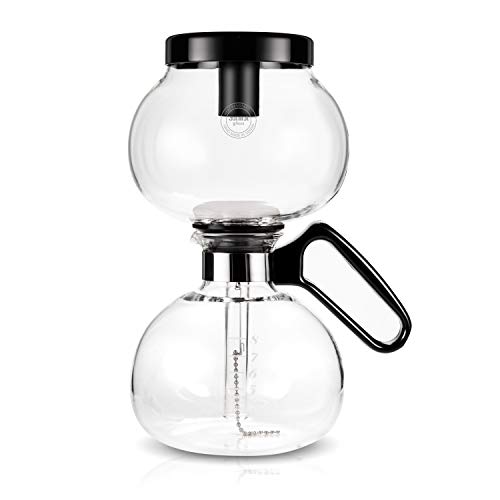
Yama Glass sells a five-cup tabletop siphon built around hand-blown borosilicate glass, an alcohol burner and a reusable cloth filter. It is one of the most commonly recommended starter sets because it gives you the full experience with fewer extras. Retailers disagree about capacity, with some listing 20 ounces and others about 15 ounces, which is mainly a function of how “cup” is measured, so treat it as a three to four serving brewer. The glass is tempered and heat resistant, the lid doubles as a stand once brewing finishes, and the listed dimensions are approximately 4 by 4 by 14 inches. The set includes a filter assembly and measuring spoon, but you buy the burner fuel separately.
Many roundups describe it as great value because it does the same physics as the Hario sets for less. The compromise is fit and finish: seating the filter and gasket takes a little more care, and replacement parts can be harder to find locally than Hario’s.
Who it suits: budget-conscious beginners and gift buyers.
Main trade-off: product listings are inconsistent about capacity and model numbers, so read the specification block closely before ordering.
A Note on Electric Hario Siphons
Hario also sells an electric siphon, the ECA-3-B, with a 360 ml capacity. Its heater is designed for 100 volt Japanese power, and retailers and reviewers recommend a transformer when using it elsewhere. Because of that voltage issue it is a niche import choice rather than a default recommendation, and the Bodum ePebo is a safer electric option for most buyers. Hario’s separate beam heater, a halogen unit sold for use with its siphons, is another option for people who want a flameless heat source but already own a Technica.
How to Choose a Siphon Coffee Maker
Match the heat source to your kitchen
The heat source shapes everything else. Alcohol burners are compact and let you control the flame, but they require fuel, a steady surface and care. Stovetop-compatible pots like the Pebo cover the same job with your existing cooker. Electric models like the ePebo remove the flame entirely. If you have an induction cooktop, remember that glass bowls are not magnetic, so a burner or an electric model is the realistic route.
Pick the batch size honestly
The most useful rule is to size the pot to the cups you actually drink, not the cups you might serve once a year. A 360 ml brewer is perfect for one mug. A 600 ml set serves two. A 1.0 liter pot is for gatherings. Brewing a very small amount in a very large pot works poorly because the water level can fall below the stem.
Cloth versus metal filter
Cloth gives the cleanest, most delicate cup, but it stains, needs rinsing and eventually must be replaced. Metal filters are durable but allow more sediment. If you are unsure, the Hario Next gives you both.
Decision Matrix by Situation
| Your situation | Choose | Why |
|---|---|---|
| First siphon, brewing for two | Hario Technica TCA-5 | Balanced size, widely available parts |
| Brewing mostly for yourself | Hario Technica TCA-3 | Faster heat-up, less fuel, no leftover coffee |
| Want to compare filters | Hario Next NXA-5 | Includes both stainless and cloth filters |
| Feeding four people or more | Bodum Pebo 1.0 L | 4 to 8 cup range, dishwasher-safe parts |
| No open flame allowed | Bodum ePebo | Built-in 1000 W heater and auto warming |
| Lowest barrier to entry | Yama Glass 5-cup | Full set with burner and cloth filter |
How to Brew With a Siphon, Step by Step
- Prepare the filter. Rinse a cloth filter in hot water, wring it out and seat it flat on the upper bowl’s spring and chain so it is centered. A crooked filter lets grounds slip through.
- Measure water into the lower bowl. Use hot water rather than cold to shorten the burner time. Wipe the outside of the glass dry, because water on the exterior can crack hot glass.
- Weigh the coffee. A common starting ratio is about 1 gram of coffee for every 15 to 16 grams of water, using a medium grind slightly coarser than drip. Finer grinds slow the drawdown and raise bitterness.
- Heat the lower bowl. Insert the upper bowl at a slight angle first, then seal it once bubbles begin. Water will rise as pressure builds.
- Add coffee and stir. When most of the water is up, wait for it to settle, add the grounds and stir gently three times to wet everything.
- Time the steep. Steep for roughly 45 to 60 seconds for light roasts and a little less for dark roasts, then stir once more.
- Remove the heat. Take away or extinguish the burner. The coffee draws down through the filter in about 30 to 60 seconds.
- Serve right away. Lift the upper bowl, set it on its stand and pour. Siphon coffee tastes best fresh.
Worked Example: Brewing a 600 ml Pot
Suppose you fill the lower bowl of a Technica TCA-5 to the 500 ml mark, because you want about 450 ml of finished coffee after some water is retained by the grounds. At a ratio of 1 to 15.5, you need about 32 grams of coffee. Preheating with hot water saves around two to three minutes of burner time. Rising water, a 50 second steep and a 40 second drawdown means the active brew takes about 5 minutes once the water is moving.
Compare that to a 1.0 liter Pebo at its 0.75 liter low end: 0.75 liters of water at the same ratio needs roughly 48 grams of coffee, and Bodum’s 5 to 11 minute range means a bigger batch will sit at the longer end. For a single mug, a smaller siphon wastes less coffee. The point is not to chase exact numbers, but to keep ratios consistent so you can change one variable at a time.
Fuel use is the other running figure. A small alcohol burner typically needs only a few milliliters of fuel per brew, so a bottle lasts many dozens of brews, and the cloth filter replacement every few months is the main consumable. An electric ePebo has no fuel cost at all, only the electricity of a 1000 W heater running for several minutes.
Durability and Ownership Realities
Gaskets and filters wear first
The silicone gasket that seals the upper and lower bowls is the first thing to go. It hardens or stretches over months of heating, and a leaking seal prevents the vacuum from forming. Keep a spare. Cloth filters stain and eventually slow the drawdown, and most owners replace them every few months with regular use.
Cloth filter care
After each brew, rinse the cloth under running water without soap, then store it submerged in clean water in the refrigerator in a lidded container. Letting a cloth dry out traps oils and leads to a stale taste. Replace it when it no longer rinses clean.
Glass handling
Borosilicate glass handles heat well but not shocks. Never place a hot bowl on a cold, wet surface, never wash hot glass, and check for chips near the rim before every brew. Small chips grow into cracks.
Burner fuel
Alcohol burners use denatured alcohol or similar fuel. Keep fuel stored away from heat sources, refill only when the burner is cool, and trim the wick to keep the flame even. Because burn temperature affects brew time, fuel choice matters: hotter fuel brings water up faster.
Common mistakes
- Grinding too fine, which clogs the filter and over-extracts.
- Letting the burner run during the steep, which pushes water back down prematurely.
- Skipping the stir, which leaves dry pockets of grounds floating on top.
- Storing a wet cloth filter in a dry cupboard.
Siphon Versus Other Brewing Methods
| Method | Typical brew time | Cup character | Effort | Equipment risk |
|---|---|---|---|---|
| Siphon | 5 to 11 minutes | Clean, aromatic, tea-like | High | Glass and flame |
| Pour-over | 3 to 4 minutes | Clean, bright | Medium | Low |
| French press | 4 minutes | Full-bodied, heavier | Low | Low |
| Automatic drip | 5 to 7 minutes | Balanced, consistent | Very low | Very low |
If you simply want a good morning coffee with the least effort, a quality drip machine remains the sensible choice. A siphon is for people who enjoy the process itself, and who will take the time to clean and store the parts correctly.
Coffee Selection for Siphon Brewing
Siphon brewing rewards coffees with distinct aroma and acidity. Light and medium roasts from Ethiopia, Kenya, Colombia or Guatemala usually do well because the method preserves delicate floral and fruit notes. Very dark roasts tend to taste ashy and flat because the hot, fully immersed brew extracts bitter compounds easily. Use freshly roasted beans, ground just before brewing. If your grinder offers a drip or pour-over setting, start slightly coarser than that, then adjust finer only if the cup tastes thin and sour. Consistent particle size matters more here than in a French press, because fines slip through a cloth and cloud the cup, so a burr grinder is a worthwhile companion purchase.
Safety and Setup Tips
Place the siphon on a level, heat-resistant surface away from the edge of the counter. Keep the burner cap nearby so you can smother the flame instantly. Never leave a lit burner unattended, and use the stable stand supplied rather than improvised support. If you are brewing around children, the electric ePebo is the safer fit. Always let glass cool fully before cleaning, and keep the cloth filter away from the flame while it is damp and loose.
Which Siphon Should You Buy?
If you want one answer, buy the Hario Technica TCA-5. It balances capacity, parts availability and build quality, and most of the knowledge you find online about technique assumes this pot. Choose the TCA-3 if you drink alone, the Next if you want to compare cloth and metal filtration, the Pebo if you brew for a household and prefer stovetop heat, and the ePebo if open flame is a deal breaker. The Yama set is a sensible way to find out whether you enjoy the method before investing in a premium setup. Whichever you choose, budget a little for spare gaskets, a spare cloth filter and a good burr grinder, because those small items decide how the coffee tastes.
Frequently Asked Questions
Is a siphon coffee maker worth it compared with pour-over?
It depends on what you value. A siphon gives a very clean cup and a memorable brewing ritual, but takes more time, more cleanup and more care. If you enjoy the process, it is worth it; if you only want speed, pour-over or drip is simpler.
What grind size works best in a siphon?
A medium grind, slightly coarser than a typical drip setting, works for most coffees. Too fine a grind clogs the filter and slows the drawdown, which causes bitterness, while too coarse a grind produces weak, sour coffee.
Can I use a siphon on an induction stove?
Not directly in most cases. Glass lower bowls are not magnetic, so they will not heat on an induction cooktop. Use an alcohol burner, a halogen beam heater, or choose an electric model like the Bodum ePebo.
How often should I replace the gasket and filter?
Silicone gaskets typically need replacing once they harden, crack or stop sealing, which for regular use is often within a year. Cloth filters are commonly replaced every few months, or sooner if they stain or slow the drawdown.
What fuel do alcohol burners use?
Denatured alcohol is the usual choice because it burns cleanly and hot. Some buyers use isopropyl alcohol, which burns cooler and slower. Always follow the manufacturer’s instructions and refill only when the burner is cold.
Is a siphon the same as a vacuum coffee maker?
Yes. The terms siphon, syphon and vacuum pot all describe the same pressure-driven brewing method, though the vacuum refers to the drawdown stage, when cooling creates a partial vacuum that pulls the coffee down through the filter.




Write Your Review
No reviews yet. Be the first to share your experience!