

Our Top Picks
 CASABREWS 3700 Essential Stainless Steel Espresso Machine with13.0*6.5*12.1 inches8.14 poundsCheck on Amazon
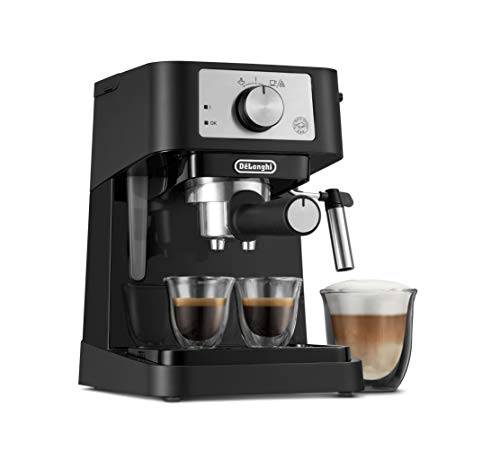

The De’Longhi EC155 is a plain, compact, manual pump espresso machine built for people who want a real portafilter and a steam wand without paying for a grinder, a touchscreen or a pressure gauge. It suits first-time buyers, small kitchens and anyone who mostly drinks milk-based coffee made with pre-ground beans or pods. It is a poor match if you plan to chase a precise shot, because the basket design and the single control scheme trade accuracy for forgiveness. Here is what the machine does, where it stumbles, and which neighbors in the same family deserve a look first.
Quick Verdict
- Good fit: beginners, dorm rooms, offices and small counters where a basic, forgiving espresso machine beats a capsule system.
- Strongest points: a 15 bar pump rating, a manual steam wand, a roughly one-liter removable tank and a filter holder that accepts ground coffee or pods.
- Main limits: no built-in grinder, no pressure gauge, no shot presets and a thermostat-based heating setup that makes you wait between brewing and steaming.
- Skip it if you want to dial in shots with a proper dose, a precise grind and a bottomless portafilter. A model with a gauge or a preset system is a better stepping stone.
- Alternatives in the same family and from budget rivals are covered below, along with the EC155 itself.
Key Specs
| Feature | EC155 detail |
|---|---|
| Type | Manual pump espresso and cappuccino machine, no grinder |
| Pump pressure | 15 bar (pump rating, not the pressure at the coffee puck) |
| Power | 1100 W, 120 V for the US model |
| Water tank | About 1 liter (35 oz) per most sources; one reference lists a larger figure, so confirm in the manual |
| Temperature control | Two thermostats, one for brewing water and one for steam |
| Filter holder | Three-in-one holder: one-cup basket, two-cup basket and a position for single-serve pods (confirm pod format on the listing) |
| Milk | Manual steam wand with a cappuccino system |
| Tank and tray | Removable water tank, removable drip tray |
| Weight | Roughly 7 lb on one listing; confirm on the product page |
| Dimensions | Sources conflict, so confirm on the listing before measuring your shelf |
| Colors | Black with stainless accents; a metal-trim version is sold as the EC155M |
One caution on the numbers: dealer pages for this machine disagree on dimensions and a few other figures, and some recycle details from sibling models. Treat the manufacturer’s manual as the tie-breaker and check the listing you are actually buying.
Who It Is For (and Who Should Skip It)
Buy it if
- You are moving up from a capsule or drip machine and want to learn how espresso works with a minimum of fuss.
- Your drinks are mostly lattes, cappuccinos and Americanos, where milk and syrup forgive an imperfect shot.
- You already own a grinder, or you are happy buying beans ground for espresso, or you plan to use pods.
- Counter space is tight. The footprint is among the smaller ones in the category.
- You want a low-risk first machine that you can replace later without guilt.
Skip it if
- You want to adjust brew temperature, pre-infusion or shot volume. Nothing here is adjustable beyond how long you let the pump run.
- You care about reading pressure. There is no gauge, so you judge extraction by flow and taste.
- You plan to buy a separate burr grinder and a precision basket. The pressurized-style baskets common at this tier hide the benefit of a good grinder, and upgrading the portafilter is limited on a machine this size.
- You make more than a few milk drinks in a row. A thermostat machine pauses while it recovers heat for steam, which adds minutes to a round of drinks.
- You want a machine that starts a shot at the press of a single button. The EC155 is manual from start to finish.
What It Does Well
It keeps the learning curve short
The control layout is about as simple as a pump machine gets: a power switch and a handful of controls for brewing and steam. There are no menus. A new owner can pull a first shot out of the box within a few minutes of rinsing the tank. For many buyers that simplicity is the whole appeal, because it removes the intimidation that comes with larger machines and lets you focus on the cup.
The filter holder is flexible
The three-in-one holder accepts ground coffee in a one-cup or two-cup basket and also has a position for single-serve pods. That matters at the start. Pods give a consistent dose with no scale and no tamping, and pre-ground coffee lets you start without buying a grinder. When you are ready to change, you can switch to freshly ground beans in the same holder. Confirm the pod format named on the listing, since pod standards vary by brand.
Baskets of this type forgive grind mistakes
Machines in this class generally use pressurized-style baskets, which add resistance at the exit so that a coarse or uneven grind still produces a crema-topped shot. That feature is not a sign of cheapness. It is what lets a beginner get a drinkable cup with pre-ground coffee from a grocery shelf. The trade-off, covered below, is that those baskets cap how good the shot can get.
The steam wand is real, not a pannarello gimmick
A manual wand lets you stretch and swirl milk yourself. That is a skill worth learning, and it is the reason many buyers choose a manual machine over a capsule system. Expect the first dozen pitchers to be inconsistent. After that, a simple latte with smooth, glossy milk is within reach. Steam strength on a small thermostat machine is modest, so use cold milk, a cold pitcher and modest quantities to get the best result.
Compact and quick to live with
The removable tank and drip tray make refilling and cleaning easy, and the body is light enough to move between a counter and a cupboard. A tank of about a liter covers a day of regular use for one or two people without constant refills. Wipe the wand right after steaming and rinse the portafilter, and the maintenance load stays low.
Where It Falls Short
No grinder means extra gear
To get the most out of any espresso machine you need a decent burr grinder. The EC155 has none. Pre-ground coffee goes stale quickly, so what comes out of the cup depends heavily on what you put in. If you buy this machine and later add a grinder, budget for that second purchase from the start.
The 15 bar figure is marketing, not performance
The number printed on the box describes the pump’s maximum capability. Espresso is normally brewed around 9 bar at the coffee puck, and a pressurized basket releases pressure through a small hole so that the actual pressure is managed for you. A higher pump number does not mean a better shot. Judge the machine by the shots it produces and by how consistent it is, not by the label.
Brewing and steaming share a wait
With a thermostat design, steam temperature is hotter than brew temperature, so switching modes means a short wait. Going from steam back to brewing usually calls for a cool-down step, such as running water through the group until the temperature falls. If you forget, the next shot can taste scorched. Learn the routine described in the manual and the experience becomes smooth. Ignore it and drinks come out inconsistent.
Temperature stability is limited
Machines at this level do not hold brew temperature as tightly as models with a PID controller or a more advanced heating block. Temperature drifts between the first and third shot, and the effect is audible in the cup as sourness or bitterness depending on how long the machine has been on. Warm the portafilter and cup before the first shot and allow time to heat up. Most of the gap can be closed with habits rather than hardware.
Plastic where you notice it
Entry-level machines at this tier lean on plastic for much of the body, and the EC155 is no exception on most dealer descriptions, so confirm the materials on your listing. It is fine for light use, but it will not feel like a heavy appliance. Do not expect long-term durability of a commercial unit. Treat it as a starter machine that earns its keep over a few years.
How It Compares
| Model | Pump rating | Tank | Standout trait | Better for |
|---|---|---|---|---|
| De’Longhi EC155 | 15 bar | About 1 L | Pod-capable three-in-one filter holder | Beginners wanting simplicity |
| De’Longhi Stilosa | 15 bar | 1 L | Stainless boiler and an included tamper | Buyers who want a sturdier-feeling entry model |
| De’Longhi Classic Signature | 15 bar | 57 oz | Pressure gauge, shot presets, adjustable steam wand | Buyers who want feedback and more control |
| CASABREWS CM5418 | 20 bar (rated) | 34 oz | Pressure gauge and pre-infusion | Buyers who prefer a feature-heavy budget machine |
| CASABREWS 3700 Essential | 20 bar (rated) | 43.9 oz | Larger tank, simple presets | Buyers who want a bigger reservoir |
The comparison shows a pattern. The EC155 is the simplest in the group, the Stilosa is its direct sibling with a few build improvements, and the Classic Signature adds the features that give you real feedback while you learn. The CASABREWS machines put more specifications on the box for similar money, at the cost of less brand-backed service history. Confirm tank size, pressure rating and accessories on each listing, because retailers sometimes list different variants under the same name.
Alternatives Worth Considering
De’Longhi EC155 – the machine this review covers
As an Amazon Associate we earn from qualifying purchases at no extra cost to you.

If the points above fit your kitchen, the EC155 itself is the straightforward choice. It gives you a portafilter, a steam wand and a pod-capable filter holder in a small body, with a short learning curve and few controls to misuse. It is the simplest route into espresso, and a safe pick for a gift or a first apartment. Keep expectations modest on shot precision, plan for a grinder if you outgrow pre-ground coffee, and read the manual’s cool-down steps for switching between brewing and steaming. Confirm the exact color and variant on the product page before ordering.
De’Longhi Stilosa – a sturdier-feeling sibling
The Stilosa covers the same ground as the EC155 with a few upgrades that show up in daily use. It has a stainless steel boiler, a one-liter removable tank, a manual steam wand and a portafilter with two baskets, plus a separate tamper in the box. Baskets are pressurized, which keeps shots forgiving with pre-ground coffee. De’Longhi lists a 15 bar pump and 1100 W. Choose it if you want a slightly more solid, modern-looking entry machine from the same maker, and compare the pod support against the EC155 before you buy, since that is the feature this machine’s three-in-one holder emphasizes.
De’Longhi ECP3420 15 bar pump – narrow and tidy

This compact model from the same brand has an advanced cappuccino system that mixes steam and milk, a removable tank and a slim body of about seven inches deep. Dimensions on one listing are roughly 7.25 by 9.6 by 11.9 inches, so it slips under most wall cabinets. It uses a 15 bar pump and a manual frother arrangement. Consider it if width is your main constraint or if you prefer a frother that is easier to manage than a classic wand. Because the same listing page can show related styles such as ECP3630, confirm the exact model on the page you buy from.
CASABREWS CM5418 – a feature-heavy budget option

The CM5418 packs a lot of specifications into a small stainless body: a 20 bar rated pump, 1350 W, a 34 oz removable tank, a steam wand and a built-in pressure gauge. It uses a 51 mm portafilter with pressurized baskets, and the gauge is the real advantage because it shows what the machine is doing during a shot. It has a single boiler, so brewing and steaming still require a wait. Consider it if you want feedback and presets on a short budget. As with the EC155, there is no grinder, so a separate one is worth planning for.
De’Longhi Classic Signature – gauge, presets and a larger tank

This step-up model from the same brand adds the features the EC155 lacks. It has a visual pressure gauge, two programmable one-touch shot presets, an adjustable two-setting steam wand and a removable tank of about 57 oz, with a 1350 W thermoblock heater and a 15 bar pump. It uses pressurized baskets, brews from pre-ground coffee and does not include a grinder. It is a good choice if you want the same simple workflow with more feedback and room to grow. Confirm the exact accessories in the box and which variant of the name you are viewing.
CASABREWS 3700 Essential – bigger reservoir, simple controls

The 3700 Essential is built around a 43.9 oz removable tank, a 20 bar rated pump, a 1350 W thermoblock heater and a 51 mm portafilter with single and double dual-wall baskets. It uses simple button controls, preset single and double shots and a manual steam wand. Dealer pages differ on whether it carries a pressure gauge or temperature control, since those details belong to a related model, so confirm what the listing promises. It is a reasonable pick when tank size matters more than brand name, for example in a busy household. No grinder is included.
Questions
Does the EC155 need a separate grinder?
It does not include one. You can use pre-ground espresso coffee or single-serve pods at the start. If you move to whole beans, plan for a burr grinder that can produce a fine, consistent grind, because a blade grinder usually gives uneven particles and sour or bitter shots.
Can I use pods in the EC155?
The filter holder is described as three-in-one, with a position for single-serve pods. Pod sizes and formats are not universal, so check the pod type named in the manual and on the listing before buying a large supply.
Is 15 bar enough for real espresso?
Yes, because the figure is the pump’s maximum rating. Espresso is typically extracted near 9 bar, and a pressurized basket manages pressure at the coffee for you. The label number alone says little about shot quality.
How long should I wait between steaming and brewing?
Follow the instructions in the manual. On thermostat machines the usual practice is to let the water temperature drop after steaming, often by running water through the group until the temperature indicator returns to brewing mode. Skipping this step is the most common cause of burnt-tasting shots.
Is the EC155M the same machine?
The M version is sold with metal trim and similar core specifications. Compare the listing details for wattage, tank and accessories to be sure, because retailers sometimes mix details across variants.
How do I keep it running well?
Rinse the portafilter and baskets after each use, wipe and purge the steam wand right after steaming, empty the drip tray, and descale on the schedule given in the manual. Using filtered or softened water in hard-water areas reduces scale and helps the machine last longer.
Update History
- October 21, 2026 – Initial publication; specifications checked against manufacturer documentation where available.
- Check the product page for current specifications and availability before buying.
Sources
- Manufacturer user manual and technical data for the De’Longhi EC155
- Manufacturer product pages for the De’Longhi Stilosa, Classic Signature and related models
- Brand product pages for the CASABREWS CM5418 and 3700 Essential
- Retailer specification tables and independent reviews, used to cross-check figures and flag disagreements
Write Your Review
No reviews yet. Be the first to share your experience!