

Key takeaways
- Gaggia Classic Evo Pro review: 58 mm group, 9 bar, no PID. See the specs, pros and cons, how the E24 differs and who should skip it.
The Gaggia Classic Evo Pro is a manual, single-boiler espresso machine with a commercial-size 58 mm portafilter, a 9 bar pressure setting and no electronics to hide behind. It is a very good buy for someone who wants to learn how espresso works and already owns, or plans to buy, a capable grinder. It is a poor fit for anyone who wants a push-button drink in under a minute. This review covers what the machine does well, where it is demanding, how the E24 and Evo Pro listings differ, and which buyers should look elsewhere.
Quick Verdict
- Best for: beginners who are happy to learn technique and want a machine that rewards it, plus tinkerers who like to modify.
- Strongest points: 58 mm group and portafilter, a 3-way solenoid valve that leaves a dry puck, a simple rocker-switch layout and a large water tank.
- Main compromise: there is no PID, so brew temperature depends on your timing, a habit enthusiasts call temperature surfing.
- Milk drinks are possible, but the single boiler means a wait between brewing and steaming.
- Budget extra for a burr grinder; the machine will not make good shots from stale or coarsely ground coffee.
Key Specs
| Spec | What is reported |
|---|---|
| Type | Manual, semi-automatic style with rocker switches (brew, steam, power) |
| Portafilter and group | 58 mm commercial-style; portafilter material varies by revision (confirm on listing) |
| Pump and pressure | Vibratory pump rated at 15 bar, limited by the overpressure valve to roughly 9 bar at the group |
| Boiler | Single boiler; aluminum on earlier Evo Pro units, brass reported on the E24 revision (confirm on listing) |
| Temperature control | Thermostat only, no PID |
| Valve | 3-way solenoid |
| Water tank | About 2.1 liters (roughly 72 ounces), removable |
| Steam wand | Commercial-style wand; tip design has varied by region (confirm on listing) |
| Approximate size | About 9.5 inches wide, 14.2 inches tall, 8 inches deep |
| Approximate weight | Around 18 to 20 pounds |
| Power | Varies by market and voltage; confirm on the product page |
| Baskets in the box | A pressurized basket is typically supplied with single and double non-pressurized baskets (confirm contents on listing) |
Who It Is For (and Who Should Skip It)
The Classic line has lasted for decades because the layout never changed much: a heavy portafilter, a brass group, three switches and a drip tray. The Evo Pro keeps that formula. If you enjoy the process of dialing in a shot, weighing beans, adjusting grind and seeing the result in the cup, this is the sort of machine that teaches you.
A good match if you:
- want a 58 mm platform, which opens up a wide world of baskets, tampers, distribution tools and screens that fit the standard size;
- drink mostly straight espresso, Americanos or one or two milk drinks at a time;
- are comfortable with a learning curve and a few weeks of sour or bitter shots while you adjust;
- like the idea of upgrading later, since a large community supports modifications, from pressure adjustments to temperature controllers.
Skip it if you:
- do not own a grinder and have no plan to buy one; pre-ground coffee is the fastest way to be disappointed with this machine;
- want consistent results with no technique, no waiting and no cleaning routine;
- make four or five milk drinks in a row regularly, because a single boiler recovers slowly between brew and steam;
- want a built-in grinder or automatic milk system; a super-automatic machine fits that need better.
What It Does Well
A real 58 mm group at an entry-level footprint
The 58 mm portafilter is the standard size on commercial machines. It matters because accessories are abundant, baskets come in many capacities, and any technique you pick up transfers to other machines if you upgrade. The group itself is described as brass with a stainless-steel surround on current revisions, which holds heat better than the thin stamped parts found on many cheaper machines.
The 3-way solenoid valve
After a shot, the solenoid releases pressure from the group so the puck comes out relatively dry and easy to knock out. It also reduces the drip and mess that cheaper machines produce. This is a small feature that makes a daily routine feel more professional.
Pressure set where it should be
The pump is a 15 bar vibratory unit, a common spec. The overpressure valve in the current Evo Pro limits the pressure at the group to about 9 bar, the figure most baristas aim for. One retailer note says the setting is made for North American units and that machines from other regions may need a manual adjustment, so check your region if you buy a grey-market import.
Simple controls and a big tank
There are three rocker switches and a few indicator lamps. Nothing to program, nothing to break on a circuit board, and no screens to confuse guests. The roughly 2.1 liter reservoir is generous for a machine this size, so you will not be refilling it after every second drink.
Easy to learn from
Because every variable is visible, changes are easy to trace. If a shot runs fast, grind finer. If it tastes sour, extend the shot or let the machine heat longer. A beginner who keeps notes on dose, time and taste can improve noticeably within a couple of weeks.
Room to grow
Many owners add a bottomless portafilter, a better tamper, a distribution tool or a dispersion screen. More advanced owners add a PID kit or a pressure gauge. None of this is required, but knowing the path exists is a reason many people choose the Classic over sealed-box machines.
Where It Falls Short
No PID, so you manage temperature yourself
The thermostat swings the boiler temperature up and down. Owners commonly manage this with temperature surfing: run the brew switch briefly or time the steam switch against the heater light so the shot starts in the middle of the heating cycle. One reviewer reports about 2 degrees Fahrenheit of variance during extraction and an average near 200 degrees Fahrenheit. That is workable, but it takes practice, and shots are less repeatable than on a PID-equipped machine.
Single boiler means waiting between brew and steam
Switching from brewing to steaming requires the boiler to heat to steam temperature, and the reverse requires a cooling flush. One source cites roughly 45 seconds of waiting between modes. Steaming a small pitcher of milk typically takes around a minute, per reviewers. If you make milk drinks for several people, plan on a slow sequence.
A grinder is not optional
The machine will produce a drink with pre-ground supermarket coffee and the pressurized basket, but it will not shine. A true espresso grinder with fine adjustment is what unlocks the non-pressurized baskets. This adds cost and counter space on top of the machine itself.
Included accessories are basic
The plastic tamper and the scoop in the box are starter items. Most owners replace the tamper early. Expect to buy a scale and a knock box as well.
Variations between revisions
The Classic name has covered several revisions. Listings for the Evo Pro and the E24 look similar, yet retailers describe the E24 as the version with the brass boiler, while earlier Evo Pro units used aluminum. Some third-party comparison sites contradict each other on this point, so read the listing details and the manufacturer page for the exact unit you are buying.
How It Compares
| Feature | Classic Evo Pro | Entry thermoblock machine | PID single-boiler machine | Super-automatic |
|---|---|---|---|---|
| Portafilter size | 58 mm | Often 51 mm or smaller | Often 54 to 58 mm | None (internal brew group) |
| Temperature stability | Fair; manual surfing helps | Fair; varies by unit | Better; electronic control | |
| Effort per drink | High; you grind, dose, tamp | Medium; some shortcuts | High; same workflow | Low; push a button |
| Milk workflow | Manual steam wand; wait after brewing | Manual wand, short heat-up | Manual wand, steadier steam | Automatic frother |
| Upgrade path | Wide; parts and mods common | Limited | Moderate | Very limited |
| Grinder needed | Yes, separate | Yes, separate | Yes, separate | Built in |
In short, the Classic Evo Pro costs you convenience and some repeatability in return for a larger, more flexible platform. If a PID matters more to you than a 58 mm group, look at machines that include one from the factory. If you want zero effort, step up a class to a super-automatic.
Alternatives Worth Considering
The listings attached to this review are all the same Gaggia family, offered as different finishes and revisions. They are covered below in the order they appear, so you can match the exact variant to what you are buying. In every case, confirm the revision on the product page before you order.
Gaggia RI9380/46 E24 in brushed stainless steel – the E24 revision
As an Amazon Associate we earn from qualifying purchases at no extra cost to you.
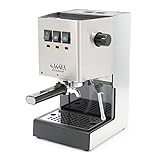
The listing name calls this the E24, which retailers describe as the newest refresh of the Classic. The pitch is mainly a brass boiler in place of aluminum, along with an all-stainless portafilter. That boiler has more thermal mass, which owners say gives slightly steadier shots and better steam recovery, although it can take a touch longer to warm up. The brushed stainless finish is the traditional look of the Classic. If you plan to keep the machine for years and want the most current internals, this is the revision to read about first, but confirm the boiler material on the listing.
Gaggia RI9380/49 Classic E24 in Thunder Black – the E24 in a darker finish

This listing is named Classic E24 and uses a black finish, so the internal specification should match the stainless E24 above. The reason to choose it is purely cosmetic: black hides fingerprints and water spots better than brushed steel, and it blends into dark counters. The listing is marked Small, which most likely refers to the size option on the retailer page, not a different machine. The Classic body is compact for a 58 mm machine, so you should still measure your cabinet clearance for the tall water tank lid.
Gaggia RI9380/48 Classic Evo Pro in Polar White – the Evo Pro with a light finish

The Evo Pro name points to the earlier revision of the same machine. Core features are the same as described in this review: the 58 mm group, 3-way solenoid, rocker switches and no PID. The key difference to check is the boiler, which has typically been aluminum on units sold under the Evo Pro name. White suits a bright kitchen and shows less dust than black. If the listing is for the Evo Pro rather than the E24, make sure the details match what you expect before you buy.
Gaggia RI9380/51 Classic Evo Pro in Industrial Grey – the Evo Pro in a neutral tone

Industrial Grey is a neutral option for kitchens with stainless appliances or concrete counters. The machine underneath is the same Evo Pro platform, with the same 2.1 liter tank, single boiler and commercial-style steam wand. Color variants often ship from different production runs, so read the specification fields for any small differences in the included baskets, tamper or accessories. For buyers deciding between finishes only, this one blends in more than the white version and stands out less than the blue.
Gaggia Classic Evo Pro in Jungle Green – the newer color option

The listing name is shorter and does not repeat the RI9380 code, which suggests a newer listing entry. Jungle Green is a distinct color that fits retro-styled kitchens. Because the name does not state the revision, confirm whether it follows the Evo Pro or E24 specification, especially the boiler material and portafilter finish, before deciding. The workflow is identical to the other variants: manual, single boiler, no PID, and dependent on your grinder.
Gaggia RI9380/50 Classic Evo Pro in Classic Blue – the boldest finish

Classic Blue is the most colorful of the group and reads as a statement piece on the counter. The internals match the Evo Pro described above, so the same advice applies: expect a learn-as-you-go machine, plan for a separate grinder, and budget some time for tuning. If you want the machine to look at home in an open kitchen, the color options are a legitimate reason to pick one listing over another, as long as the specification fields agree.
Questions
Is the Gaggia Classic Evo Pro good for beginners?
Yes, if the beginner wants to learn technique and is willing to buy a grinder. The controls are simple, but results depend on your grind, dose and tamp, so expect a few weeks of adjustment. Anyone who wants consistent drinks from day one should consider a more automatic machine.
Does it have a PID?
No. It uses a thermostat, so brew temperature rises and falls during the heating cycle. Owners manage this with timing habits, or they add an aftermarket PID kit later.
Can it make milk drinks?
Yes, through a manual steam wand. Because it is a single boiler, you must wait for it to heat to steam temperature after brewing, and cool down again before the next shot. That works for one or two drinks but is slow for a crowd.
What is the difference between the Evo Pro and the E24?
Retailers describe the E24 as the refreshed version with a brass boiler and a stainless portafilter, while earlier Evo Pro units used an aluminum boiler. The workflow is the same on both. Check the listing and manufacturer page for the exact specification of the unit you are ordering.
Do I need a separate grinder?
Yes. The machine has no grinder, and fresh, fine, consistent grounds are what make the 58 mm baskets worthwhile. A grinder with fine, stepless or closely stepped adjustment gives the best results.
How big is the water tank?
About 2.1 liters, or roughly 72 ounces, according to retailer and review specifications. That is enough for many drinks between refills, though you should confirm on the listing for your region.
Update History
- October 21, 2026 – Initial publication; specifications checked against manufacturer documentation where available.
- Check the product page for current specifications and availability before buying.
Sources
- Manufacturer product and specification information for the Gaggia Classic family
- Retailer product pages and listing specification fields
- Independent reviews and enthusiast guides covering the Evo Pro and E24 revisions


Write Your Review
No reviews yet. Be the first to share your experience!