

Key takeaways
- Using a medium or coarse grind, which produces gritty, weak coffee.
- Overfilling the pot so the foam spills the moment it rises.
- Using high heat, which collapses the foam and scorches the coffee.
- Stirring after the foam forms.
- Using an induction hob with a copper pot.
The best Turkish coffee pot for most people is a hammered, tin-lined copper cezve in the 8 to 14 ounce range, such as the Hakan 8 oz or the Volarium 14.4 oz, because copper spreads low heat evenly and builds the thick foam that defines the drink. If you cook on induction or want something that never needs polishing or re-tinning, a stainless steel cezve with a magnetic base, such as the Matiks 15 oz induction model, is the practical alternative. Whichever you choose, size the pot to your usual number of cups, because a cezve brews best when it is at least half full.
A cezve (called an ibrik in much of the English-speaking world, although in Turkish that word technically refers to a water pitcher) is a small pot with a long handle and a narrow neck that tapers upward. You combine very finely ground coffee, cold water and optional sugar, heat slowly, and lift the pot off just as the foam rises. The narrow neck holds the foam, the long handle keeps your hand away from the heat, and the flared base lets the coffee heat evenly. Below are seven real pots covering hammered and engraved copper, stainless steel and induction-ready designs, followed by sizing math, a step-by-step method, a cost-per-cup example and the ownership details that decide how long the pot lasts.
Our top picks


As an Amazon Associate we earn from qualifying purchases at no extra cost to you.
Quick Comparison of the Best Turkish Coffee Pots
| Pick | Best for | Material | Capacity | Induction | Price tier |
|---|---|---|---|---|---|
| Hakan hammered copper cezve | Best traditional single-serve pot | Hammered copper, tin-plated interior | 8 oz (smaller 5 oz also sold) | No | Budget to mid-range |
| Volarium hammered copper cezve | Best overall for 3 to 4 servings | Hammered copper, tin-lined | 14.4 fl oz (about 425 ml) | No | Budget to mid-range |
| DEMMEX engraved copper cezve | Best handmade gift | Engraved copper, made in Turkey | About 9 oz | No | Mid-range |
| LAZWARD hammered copper cezve | Best for 2 to 3 people | Hammered copper | 400 ml (13.5 oz) | No | Budget to mid-range |
| Rassme copper three-pot set | Best for learning sizes | Handmade copper | 100, 150 and 200 ml | No | Mid-range |
| Cuisinox TUR-700 stainless cezve | Best low-maintenance pot | Stainless steel | 24 oz (about 700 ml) | Check base | Budget |
| Matiks 15 oz induction cezve | Best for induction cooktops | Stainless steel | 15 oz (about 440 ml) | Yes | Budget |
Capacities come from manufacturer and retailer listings. Sellers label cezve sizes inconsistently, so always compare ounces or milliliters instead of the cup count printed on the box.
Best Traditional Single-Serve Pot: Hakan Hammered Copper Cezve
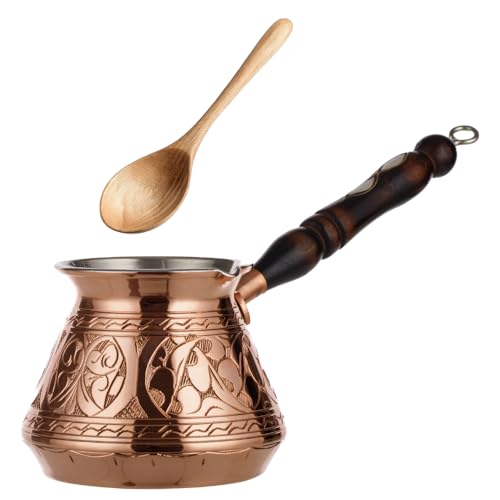
Hakan sells a hammered copper cezve in an 8 ounce size, plus a smaller 5 ounce (about 150 ml) version. According to the brand, the inside surface is tin plated, which is what makes copper safe for coffee, and it cannot be used on an induction cooker. A silver-lined version with 1.5 mm copper and a bronze handle is also offered. The small bodies are ideal for one or two traditional demitasse cups.
The advantage of a small pot is control. With only 150 to 240 ml of water, the coffee reaches the foaming point quickly and evenly, and there is little risk of the pot overflowing. The long handle and tapered neck are exactly what the form is meant to be.
Who it suits: single drinkers, anyone learning the method and buyers who want a classic look.
Main trade-off: copper needs hand washing, occasional polishing and a tin lining that eventually wears, and the 5 ounce size is too small to make more than one serving.
Best Overall for Three to Four Servings: Volarium Hammered Copper Cezve
The Volarium cezve is a hammered, tin-lined copper pot sized at 14.4 fluid ounces, about 425 ml. At that size it can serve four demitasse cups if you fill it to two-thirds, which fits the common guidance that a cezve should be at least half full for good foam and no more than two-thirds full to avoid boil-over. The hammered exterior adds strength and a traditional appearance, and the tin lining means the inside is food safe.
It is a strong all-rounder because it can brew one serving at the half-full minimum or four servings at a time, giving you flexibility for guests.
Who it suits: couples, small families and anyone who entertains occasionally.
Main trade-off: like all copper pots it needs gentle cleaning, and the tin lining needs periodic inspection. If it wears through to the bare copper, the pot should be re-tinned before further use.
Best Handmade Gift: DEMMEX Engraved Copper Cezve
DEMMEX offers an engraved, handmade copper cezve made in Turkey in a size of about 9 ounces. Roundups often single it out as the most consistent decorative option because the engraving is cut into the metal rather than printed on, so it does not wear off with cleaning. It is fundamentally the same cooking vessel as the plainer copper pots, so you are paying for craftsmanship and presentation rather than a different brewing result.
Who it suits: gift buyers and people who want a pot that doubles as a decorative piece.
Main trade-off: engraved surfaces trap polish and tarnish more than smooth ones, and the brewing quality is no better than a plainer pot at a lower tier.
Best for Two to Three People: LAZWARD Hammered Copper Cezve
The LAZWARD hammered copper cezve is listed at 400 ml, about 13.5 ounces, as a small stovetop pot. That places it between the single-serve Hakan and the larger Volarium, and it is a sensible size for sharing a pot of coffee with a partner or guest. Filled to between half and two-thirds, it yields roughly three servings of 65 to 70 ml each.
Who it suits: two or three drinkers who want a copper pot without an oversized body.
Main trade-off: sellers list several versions and sets under similar names, so confirm the capacity, lining and handle material on the specific listing.
Best for Learning Sizes: Rassme Handmade Copper Three-Pot Set
Rassme sells handmade copper cezves, including a set of three pots at roughly 100, 150 and 200 ml. A set like this is useful because it lets you match the pot to the serving: 100 ml for one small cup, 150 ml for one generous cup or two small ones, and 200 ml for two to three servings. It also makes it easy to see how pot size affects foam and brew time.
Who it suits: enthusiasts, households with varied needs and buyers who want to experiment.
Main trade-off: three pots means three pieces to polish and store, and the smallest size is quite tiny for a full mug.
Best Low-Maintenance Pot: Cuisinox TUR-700 Stainless Cezve
The Cuisinox TUR-700 is a stainless steel cezve of about 24 ounces, roughly 700 ml. Stainless needs no tin lining, no polishing and no special care beyond ordinary washing, and it will last for decades. Its larger size suits four to six servings if you fill it appropriately. Stainless does not conduct heat as evenly as copper, so you should use gentler heat and watch the pot closely, but modern clad bases narrow the gap considerably.
Check the base for magnetism if you use induction, because stainless steel is not automatically induction compatible. Cuisinox also sells induction-ready designs, so verify the specific listing.
Who it suits: larger households and anyone who wants a pot they never need to maintain.
Main trade-off: stainless produces foam less readily than copper, and a 24 ounce pot is too large to brew a single serving well.
Best for Induction Cooktops: Matiks 15 oz Induction Cezve
Matiks sells a 15 ounce stainless steel cezve marketed specifically for induction use. Induction cooktops only heat magnetic metals, so copper and brass pots do not register unless they have a magnetic base or you place a converter disk underneath. A purpose-built induction cezve avoids that problem. At about 440 ml it covers two to four servings.
Who it suits: anyone with an induction hob and rental kitchens with electric cooktops.
Main trade-off: induction heats quickly and unevenly in small pots, so you must use the lowest settings and stay at the stove to avoid boil-over.
Copper Versus Stainless Steel
| Factor | Tin-lined copper | Stainless steel |
|---|---|---|
| Heat evenness at low heat | Excellent | Good with clad base |
| Foam quality | Best | Good |
| Maintenance | Hand wash, polish, watch the lining | Dishwasher safe in many cases |
| Induction | Not compatible unless magnetic base | Compatible if base is magnetic |
| Longevity | Decades with care, lining may need re-tinning | Decades with no care |
| Look | Traditional | Modern |
Some roundups argue that a handmade copper pot brews the same coffee as a plainer one, and in practice the difference between copper and stainless is subtle if you manage the heat carefully. Copper is the traditional choice and forgives you more at low heat, while stainless forgives you in ownership.
How to Choose a Turkish Coffee Pot
Size it to your serving
A traditional Turkish coffee cup holds roughly 60 to 70 ml. As a guide, a 6 to 8 ounce pot suits one serving, a 12 ounce pot suits two to three, and 16 to 20 ounces or more suits four or more. Always fill the pot to between half and two-thirds of its capacity, because the foam climbs the neck.
Check the lining
Copper pots should be lined with tin or, less commonly, silver. An unlined copper pot is not suitable for brewing because acidic liquids can leach copper. Inspect the lining before every use and stop using the pot if the copper is exposed.
Handle and neck
A long handle keeps your hand out of the heat. Wooden or bronze handles stay cooler than metal ones, but wood should be kept dry. A tapered neck helps trap foam, while a wide mouth makes cleaning easier.
Heat source
Gas and electric coils work with any metal. Glass-ceramic hobs work with flat-bottomed pots. Induction requires magnetic stainless or a converter disk.
Decision Matrix by Situation
| Your situation | Choose | Why |
|---|---|---|
| Drinking alone, want tradition | Hakan 8 oz | Right size for one or two cups |
| Serving three to four people | Volarium 14.4 oz | Fills well for up to four servings |
| Giving a gift | DEMMEX engraved | Handmade, decorative |
| Sharing with one or two guests | LAZWARD 400 ml | Mid-size copper |
| Learning how much foam each size makes | Rassme three-pot set | 100, 150 and 200 ml |
| Zero maintenance, bigger batches | Cuisinox TUR-700 | Stainless, 24 oz |
| Cooking on induction | Matiks 15 oz | Magnetic base |
How to Brew Turkish Coffee, Step by Step
- Measure cold water. Use about 60 to 70 ml per serving, measured with the serving cup itself so the volume matches. Cold water gives the coffee time to heat and build foam gradually.
- Add the coffee. Use about 7 grams, one heaping teaspoon, per serving. The grind must be powder-fine, finer than espresso, similar to flour, with a particle size around 75 to 125 microns. A burr grinder with a dedicated Turkish setting is ideal.
- Add sugar if you want it. Sugar goes in before heating and cannot be added later without disturbing the foam. Common levels are none, a little or medium sweet.
- Stir once. Combine the ingredients until the coffee is wet, then stop. Stirring after heating begins breaks the foam.
- Heat slowly. Use low heat and keep the pot still. Slow heating gives the best foam and a smoother taste.
- Lift at the first rise. When the foam rises to the neck, remove the pot from the heat before it boils over. Many cooks repeat the rise once or twice for thicker foam.
- Pour foam first. Spoon a little foam into each cup, then pour the rest gently so the foam stays on top.
- Let the grounds settle. Wait about a minute before sipping and do not drink the sediment at the bottom.
Worked Example: Sizing and Cost Per Serving
Take the 14.4 ounce Volarium pot, which holds about 425 ml. Filling it to 60 percent gives roughly 255 ml of water, which is about four servings of 65 ml. At 7 grams per serving you need about 28 grams of coffee, which is a little over an ounce. A 250 gram bag of fine-ground Turkish coffee therefore makes around 35 servings, so a single serving uses well under three percent of a bag.
If you tried the same four servings in a 24 ounce Cuisinox pot, 255 ml of water would fill only about 36 percent of its 700 ml volume. That is below the half-full guideline, so the foam would be thin and the coffee would heat unevenly. Conversely, brewing a single 65 ml serving in a 5 ounce Hakan pot (about 150 ml) fills it to around 43 percent, still a little low, so the 150 ml size is better suited to two servings or a generous single one. The sizing rule is simple: choose the pot where your most common batch lands between half and two-thirds full.
Cooking energy is trivial. A small pot reaches the foaming point in roughly two to four minutes on a low flame, so the energy per serving is a small fraction of boiling a kettle.
Durability and Ownership Realities
The tin lining
Tin is soft. Abrasive scrubbers, metal utensils and high heat all wear it away. Wash copper cezves by hand with a soft sponge, never scrape, and avoid heating an empty pot. If the lining wears through, have it re-tinned by a craftsperson, or retire the pot.
Tarnish and polish
Copper tarnishes on the outside. A paste of lemon juice, salt and flour or a commercial copper cleaner restores the shine. Tarnish is cosmetic, but a green or blue deposit inside the pot is not and should be cleaned off immediately.
Handles
Wooden handles can loosen and char. Keep them away from the flame and dry them after washing. Riveted metal handles are more durable but get hot.
Stainless care
Stainless steel pots rarely fail. Remove coffee residue quickly to avoid staining, and avoid chlorine bleach.
Common mistakes
- Using a medium or coarse grind, which produces gritty, weak coffee.
- Overfilling the pot so the foam spills the moment it rises.
- Using high heat, which collapses the foam and scorches the coffee.
- Stirring after the foam forms.
- Using an induction hob with a copper pot.
Cezve, Ibrik and Briki: What Is the Difference?
The names describe essentially the same pot in different regions. Cezve is the Turkish term and is common across the Balkans, ibrik is widely used in English and in the Middle East, and briki is the Greek version. Small differences in handle length, neck shape and body profile exist, but any of them brews Turkish-style coffee. When shopping, search for several names, since listings are inconsistent.
Which Turkish Coffee Pot Should You Buy?
For most buyers, a tin-lined hammered copper pot sized for the usual serving count is the right answer. Choose the Hakan if you mostly drink alone, the Volarium or LAZWARD if you serve two to four, the DEMMEX if you want a gift, and the Rassme set if you want to learn how size affects the cup. Pick the Cuisinox for a lifetime of no-fuss use and bigger batches, and the Matiks if your cooktop is induction. A burr grinder with a true Turkish setting matters as much as the pot, because the grind is the largest quality factor.
Frequently Asked Questions
Is a copper cezve better than stainless steel?
Copper conducts heat very evenly at low temperatures and is the traditional choice, so it gives the easiest path to thick foam. Stainless steel is far easier to maintain, lasts indefinitely and works on induction. With good technique both make excellent coffee.
What size cezve should I buy?
Match it to your usual batch. A 6 to 8 ounce pot suits one person, around 12 ounces suits two or three, and 16 ounces or more suits four or more. Aim to fill the pot between half and two-thirds, since too little water yields poor foam and too much risks boil-over.
Can I use a cezve on an induction cooktop?
Only if it has a magnetic base. Copper and brass pots do not work on induction on their own, but you can use a converter disk, or buy a stainless cezve designed for induction. Test any stainless pot with a magnet on the base first.
Is it safe to brew in copper?
Yes, if the interior is lined with tin or another food-safe lining and that lining is intact. Unlined copper can react with acidic foods and drinks, so avoid it for coffee. Inspect the lining regularly and stop using the pot if the copper shows through.
What grind do I need for Turkish coffee?
A powder-fine grind, finer than espresso, closer to flour. Particles around 75 to 125 microns are typical. Most standard home grinders cannot reach this, so look for a burr grinder with a Turkish setting or buy coffee already ground for the method.
Why does my Turkish coffee not foam?
The usual causes are a grind that is too coarse, heat that is too high, a pot that is too large for the batch, or stirring after the foam starts forming. Use cold water, fine grounds, low heat and a pot that is at least half full.




Write Your Review
No reviews yet. Be the first to share your experience!