

Our Top Picks
 Mixpresso 4 Cup Copper Small Electric Percolator Coffee9.2 x 6 x 9.92 Inches2.2 PoundsCheck on Amazon
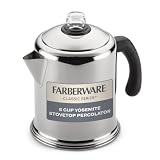
 Farberware Classic Stainless Steel Yosemite Coffee Percolator8 Cup - Clear Knob9.2 x 8.7 x 7 inches2.25 poundsCheck on Amazon

The COLETTI Bozeman 6-cup is the best small percolator coffee pot in this group for most people: it is a stovetop stainless steel pot that the maker also rates for campfires, and its listing stresses that no aluminum or plastic touches the coffee. For a countertop machine that plugs in, the Mixpresso 4-cup electric is the small option. A percolator cycles hot water up a center tube and drips it back through a basket of coarse grounds, and “small” here means roughly four to eight cups. Note that a percolator “cup” is a small 5 to 6 oz measure, not a mug.
Quick List
- COLETTI Bozeman 6-Cup – best overall for camping, stovetop, and anyone avoiding aluminum
- Mixpresso 4-Cup Electric – best for a plug-in countertop percolator with keep-warm
- Farberware Yosemite 8-Cup – best for a classic stainless stovetop pot with a glass knob
- Primula Today 9-Cup Aluminum – best for a basic stovetop pot, with aluminum as the trade-off
- VEVOR 12-Cup Electric – best for office or family use, though it is large for this category
- Mongdio Stovetop Moka Pot – best for small, strong espresso-style coffee, but it is not a true percolator
Which One Is Right for You?
| If you… | Choose |
|---|---|
| camp over a fire or a stove and want stainless steel | COLETTI Bozeman 6-Cup |
| want a plug-in pot that keeps coffee warm on a counter | Mixpresso 4-Cup Electric |
| like the traditional look and a see-through knob | Farberware Yosemite 8-Cup |
| want a plain stovetop pot and accept aluminum | Primula Today 9-Cup |
| serve a group in an office or a family kitchen | VEVOR 12-Cup Electric |
| want a small strong brew, not a percolated cup | Mongdio Moka Pot |
| live in a small apartment with one burner | COLETTI Bozeman or Mixpresso 4-Cup |
Treat the six as three groups. Five are percolators for stovetop or campfire (COLETTI, Farberware, Primula) and countertop (Mixpresso, VEVOR); the moka pot is a different kind of brewer, included because shoppers often search for it alongside percolators. If “small” is your main criterion, the COLETTI 6-cup and the Mixpresso 4-cup are closest, with the Farberware 8-cup as a mid-size step up.
All 6 Picks in Detail
1. COLETTI Bozeman 6-Cup – Best Overall Small Percolator
As an Amazon Associate we earn from qualifying purchases at no extra cost to you.

The Bozeman is a stainless steel stovetop percolator made for camping. The maker describes 18/8 food-grade stainless steel, a glass view top, a hardwood handle, and a steel basket, and says no plastic or aluminum touches the coffee. The 6-cup size makes about 30 fl oz (0.9 L), which fits a solo camper or a couple.
It suits anyone who wants a sturdy pot for a campfire, gas stove, electric stove, or glass-ceramic cooktop, and who prefers to skip aluminum. The standard model is not made for induction; the maker sells a separate induction version.
- Capacity: 6 cups, about 30 fl oz (0.9 L)
- Material: 18/8 stainless steel, with a glass view top
- Handle: hardwood, per the maker
- Heat sources: campfire, gas, electric, glass-ceramic; induction needs the separate model
- Warranty: a one-year replacement guarantee per the maker
- Brewing note: use coarse grounds and steady heat
Pros:
- No aluminum or plastic in the brew path per the listing
- Works over open fire as well as a stove
- Small enough for a camp kitchen
Cons:
- Wood handle can get hot or scorch near a flame
- Not for induction in the standard version
Compared with the Farberware, it is smaller and more camping-oriented, while the Farberware is the more traditional kitchen pot. One practical tip for any campfire percolator: set it on a grate or the edge of the coals rather than in the flames, because direct flame scorches the base and makes it hard to hold a gentle perk.
2. Primula Today 9-Cup Aluminum – Best Basic Stovetop Pot, With a Caveat
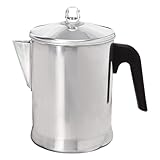
The Primula Today is a stovetop percolator made of aluminum, according to the listing title. It is a light, simple pot meant to brew on a stovetop, and at 9 cups it sits at the upper end of “small.” It does not match the “stainless steel” preference many shoppers have, so it is here as an option for those who accept aluminum.
It suits anyone who wants a lightweight pot for an occasional batch and does not need the sturdier feel of stainless steel. Aluminum heats quickly, which can be useful, but it can pit or discolor over time if cleaned harshly.
- Capacity: 9 cups per the listing
- Material: aluminum
- Heat source: stovetop; confirm induction support on the listing
- Weight: light
- Style: classic percolator
- Care: hand wash gently, avoid abrasives
Pros:
- Light and quick to heat
- Simple to use
Cons:
- Aluminum, not stainless steel
- Large for a “small” pot
Compared with the Farberware, it is lighter but less durable.
3. Mixpresso 4-Cup Electric – Best Plug-In Countertop Pick

The Mixpresso is a small electric percolator with a copper-colored body and stainless steel lids. Listing information states a 4-cup capacity of about 32 oz, a keep-warm function, a removable basket, and an easy-pour spout. Because the pot has its own heating base, you do not need a stove or a fire.
It suits a desk, a small kitchen, a dorm, or a second home with limited cookware. The pot, with its 24-inch removable cord, can sit on any outlet-equipped counter.
- Capacity: 4 cups, about 32 oz per a retailer listing
- Power: 120V with a 24-inch removable cord per the listing
- Brew time: about 7 to 10 minutes per the listing
- Features: keep-warm, indicator light, and auto shut-off per the listing
- Size: about 9.7 inches tall by 9.5 inches long by 5.7 inches wide per one listing
- Care: the basket and pump tube should be hand washed, though one retailer lists the pot as dishwasher safe, so confirm
Pros:
- No stove needed
- Keeps coffee warm after brewing
- Compact enough for a small counter
Cons:
- Limited to places with an outlet
- Maximum brew temperature is disputed between sources, so confirm
Against the VEVOR, it is far smaller and easier to store. Because it keeps coffee warm after the cycle ends, brew only what you will drink within an hour or so; coffee left on a warming element tastes flat and bitter as it sits.
4. VEVOR 12-Cup Electric – Best for Groups, Though Large

The VEVOR 12-cup electric percolator is a countertop pot with a keep-warm function and heat-resistant handle. Its listing specifies a 1.8 L capacity at 150 ml per cup, 1000 W brewing power, and a 50 W keep-warm mode, with a transparent fountain lid and a 360-degree swivel base. It is far larger than a small pot, so it is here for readers who may need more than four cups.
It suits an office, a gathering, or a family with several coffee drinkers. Materials are described inconsistently: VEVOR’s specification lists a 304 stainless steel inner liner with an outer shell of PCTG and polypropylene, while retailer pages describe a stainless steel body, so confirm which applies on the listing.
- Capacity: 12 cups (1.8 L at 150 ml per cup)
- Power: 1000 W brewing, 50 W keep-warm per the listing
- Material: 304 stainless steel inner liner; outer shell confirm on listing
- Weight and size: about 2.6 lb and 9.45 by 6.2 by 13.4 inches per the maker
- Features: removable filter basket, scale marks, one-touch switch
- Warranty: one year per the maker
Pros:
- Large capacity with a keep-warm mode
- Swivel base makes it easy to pour and move
Cons:
- Not small
- Material descriptions vary, so verify before buying
It dwarfs the Mixpresso, so choose it only if you routinely need more than a few cups. Because it is a 1000 W appliance, plug it directly into a wall outlet rather than a light-duty extension cord, and keep the base dry at all times.
5. Farberware Yosemite 8-Cup – Best Classic Stovetop Pot

The Farberware Yosemite is a long-running stainless steel stovetop percolator with a glass knob on the lid that shows when the water is perking. The 8-cup size holds about 48 oz, counting a cup as 6 oz. It is marketed for fuller, richer flavor than an automatic drip machine, and for use on stoves and over campfires.
It suits readers who want a traditional pot for the stove at home or at a cabin, and who are happy to watch the burner. One published account reported about 13 minutes for a full pot to begin perking on medium heat, followed by 5 to 7 minutes of perking, so plan for a 15 to 20 minute process.
- Capacity: 8 cups, about 48 oz
- Material: stainless steel, with a glass knob
- Style: classic stovetop percolator
- Heat: stove or campfire, confirm induction support on the listing
- Perk time: roughly 5 to 10 minutes once perking begins, per published accounts
- Care: wash by hand and dry thoroughly
Pros:
- Stainless steel build with a familiar design
- Glass knob shows the perk rate
Cons:
- Eight cups is more than a solo drinker needs
- Requires watching and heat control
Next to the COLETTI, it is larger and less camping-specific. Before relying on it for induction, check the product page, as the title says nothing about cooktop compatibility. Many owners of traditional percolators simply keep one pot for the stove and a lighter pot for trips.
6. Mongdio Stovetop Moka Pot – Best Small Strong Brew, Not a True Percolator
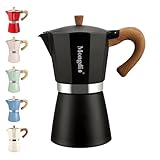
The Mongdio is a stovetop espresso maker, also called a moka pot, and its listing also uses the words Cuban coffee maker and greca. It appears here because the title mentions “percolator,” but a moka pot works differently: steam pressure pushes water up through fine grounds in a single pass, rather than cycling it repeatedly. Treat it as a runner-up that does not match the percolator facet.
It suits readers who want a small, concentrated, espresso-style cup, possibly to dilute into an americano. The capacity and material are not in the visible title, so confirm both before you decide.
- Type: moka pot, not a percolator
- Brew style: pressure-driven, single pass
- Grind: fine, not coarse
- Capacity: confirm on listing
- Material: confirm on listing, since moka pots may be aluminum or stainless steel
- Heat source: stovetop; confirm induction support on the listing
Pros:
- Strong, concentrated coffee in a small package
- Simple, with no moving parts
Cons:
- Not a percolator
- Needs a fine grind and careful heat control
Unlike every other pick here, it uses fine grounds and a single pass.
Specs Compared
| Product | Type | Capacity | Material | Heat source | Notes |
|---|---|---|---|---|---|
| COLETTI Bozeman 6-Cup | Stovetop percolator | 6 cups (about 30 fl oz) | 18/8 stainless steel, glass top | Campfire, gas, electric, glass-ceramic | Induction needs separate model |
| Mixpresso 4-Cup Electric | Electric percolator | 4 cups (about 32 oz per listing) | Copper-colored body, stainless lids | 120V outlet | Keep-warm, auto shut-off |
| Farberware Yosemite 8-Cup | Stovetop percolator | 8 cups (about 48 oz) | Stainless steel, glass knob | Stove or campfire; confirm induction | Classic design |
| Primula Today 9-Cup | Stovetop percolator | 9 cups | Aluminum | Stovetop; confirm induction | Light weight |
| VEVOR 12-Cup Electric | Electric percolator | 12 cups (1.8 L) | 304 stainless liner; outer shell confirm | 120V, 1000 W | 50 W keep-warm |
| Mongdio Moka Pot | Moka pot | Confirm on listing | Confirm on listing | Stovetop; confirm induction | Not a percolator |
How We Chose These
This guide rests on research into the six listed products. We read each listing title and specification field, compared them with manufacturer and retailer descriptions, and sorted the group by capacity, heat source, and material. Because “small” is relative, we ranked the closest-sized pots first and flagged the larger ones plainly. We also called out the one product that is not a percolator. Where sources disagreed or the listing was silent, we say to confirm the detail on the product page.
What to Look For
Size and what a “cup” means
Percolator cups are small. Most brands count a cup as 5 to 6 oz, so an 8-cup pot such as the Farberware holds about 48 oz, and a 4-cup pot holds roughly 20 to 32 oz depending on the maker’s math. The Mixpresso listing cites 32 oz, which implies a larger cup, so check the ounce figure rather than the cup count. A good rule of thumb is to divide your intended mug volume by 6 to find your cup count: two 10 oz mugs is 20 oz, or about 4 cups. Brewing less than half capacity usually gives uneven results, so match the pot to the number of drinkers you normally serve.
Stovetop, campfire, or electric
Stovetop percolators suit camping, cabins, and power outages, but they need attention: you watch the knob, adjust the heat, and time the perk. Electric percolators automate heating and add keep-warm, but they need an outlet, and their bases should never be submerged. Check heat compatibility too. Some stainless pots work on gas, electric, and ceramic hobs but not on induction without a different base, and aluminum is not induction compatible. If you cook on induction, look for a listing that explicitly states induction support.
Materials and what touches the coffee
Stainless steel resists corrosion and does not add a metallic taste, and it is the easier material to keep clean. Aluminum is lighter and heats quickly, but it can pit and discolor, and some people prefer to avoid it for hot, acidic drinks. Plastic parts in electric pots are common on outer shells, handles, and lids; look at what touches the water and coffee. Handles matter too: wood can scorch near flame, while heat-resistant plastic can melt if left too close to the burner.
Brewing technique that avoids bitter coffee
Percolators run the same water through the grounds repeatedly, which can over-extract. Use a coarse grind, about the texture of sea salt, so fine grounds do not slip through the basket. Start at medium heat until the water begins to perk, then lower to medium-low so the knob shows a gentle, steady bubble. Perk for about five to ten minutes, depending on strength; published accounts for the Farberware suggest six to seven minutes is a common target. Remove the basket and stem afterward so the grounds stop extracting, and pour the coffee without delay.
Cleaning and descaling
Percolators trap coffee oils in the stem, basket, and under the lid, and those oils turn rancid and bitter within a few brews. Wash the removable parts after each use, and give the pot a deeper clean every week or two if you brew daily. Electric models collect mineral scale on the heating surface, particularly in hard-water areas. When the pot takes longer to heat or leaves a white film, run a diluted white vinegar cycle or follow the manufacturer’s descaling advice, then run two cycles of clean water so no taste lingers. Always check the product page before using a harsh cleaner on aluminum or on a painted outer shell.
Safety basics
Handles and lids become very hot, so use a mitt and pour away from your body. Never fill above the maximum line, and never run an electric percolator dry or immerse its base in water. Unplug it when finished, and keep the cord away from the counter edge. At a campfire, set the pot on a stable grate and keep children away from the flame and the steam.
A worked example
Say you camp as a pair and each drink one 10 oz mug. That is 20 oz, or about 3.5 cups of the 6 oz kind. A 6-cup pot holds about 30 oz, which leaves room for refills without running at half capacity. If you instead brew at an office for eight people with 8 oz servings, you need around 64 oz, which is why a 12-cup electric pot is more suitable than anything small.
Questions
What grind is best for a percolator?
A coarse grind, similar to French press grounds, works best. Fine grounds can pass through the basket holes and leave sediment, and they over-extract during repeated cycles.
How long should I perk coffee?
Most published guides suggest roughly five to ten minutes after the pot begins to perk, with many people settling near six or seven minutes. Shorter gives a milder cup, longer gives a stronger and sometimes bitter one.
Can I use a stovetop percolator on induction?
Only if the listing says it is induction compatible. Aluminum is not magnetic, and the COLETTI maker sells a separate induction model. Confirm the heat sources on each product page.
Is a moka pot the same as a percolator?
No. A moka pot forces steam-heated water up through fine grounds once, producing a concentrated, espresso-style coffee. A percolator cycles water through coarser grounds repeatedly, giving a lighter, larger-volume cup.
How do I clean a percolator?
Disassemble the basket, stem, and lid, wash the parts with warm soapy water, and dry them fully. Descale an electric model with a diluted vinegar or manufacturer-approved solution when mineral buildup appears, and rinse thoroughly.
Which is the best small percolator for camping?
The COLETTI Bozeman 6-cup is built for campfire use and avoids aluminum and plastic in the brew path per its listing. The Farberware 8-cup is a classic alternative if you need more volume.
Update History
- October 21, 2026 – Initial publication; product set drawn from current catalog listings.
- Check the product page for current specifications and availability before buying.
Sources
- Manufacturer product and specification pages for COLETTI, VEVOR, and Mixpresso
- Retailer listing titles and specification fields for all six products
- Published product write-ups and user accounts describing perk times and capacity for the Farberware Yosemite


Write Your Review
No reviews yet. Be the first to share your experience!