

Key takeaways
- Best small French presses compared by capacity, glass and steel parts, and filter design, from 12 oz single mugs to compact 34 oz pots.
The Veken 21 oz (0.6 L) is the best small French press in this group for most households: it makes one large mug or two small cups, and the listing describes a borosilicate glass carafe, stainless steel parts, and silicone seals with no plastic touching the brew. “Small” in French press terms usually means 12 oz to 21 oz, which brews one to two servings; the 34 oz presses below are the standard family size and are included for readers who want a compact body but a bit more room. Choose by how many cups you pour at once, not by how it looks on the shelf.
Quick List
- Veken 21 oz (0.6 L) – best overall for one or two people who want a plastic-free brew path
- Bodum Brazil 12 oz – best for a single mug from a classic, repairable design
- Veken 34 oz (1 L) – best for small households that want a bigger batch from the same design
- QUQIYSO Borosilicate Glass – best for buyers who want a four-filter glass press with a stainless frame
- Utopia Kitchen 34 oz Glass – best for a no-nonsense press with a fine filter stack
- Basics 34 oz Borosilicate Press – best for a simple glass press with dishwasher-safe parts
Which One Is Right for You?
| If you… | Choose |
|---|---|
| brew for one or two and want a small, plastic-free brew path | Veken 21 oz |
| drink a single 8 to 10 oz mug | Bodum Brazil 12 oz |
| host a partner or a guest most mornings | Veken 34 oz |
| want a four-filter system in a glass body | QUQIYSO Borosilicate Glass |
| look for an established house-brand glass press | Utopia Kitchen 34 oz Glass |
| want parts you can put in the dishwasher | Basics 34 oz Borosilicate Press |
| need a replacement beaker option down the road | Bodum Brazil 12 oz |
Three of the six are 34 oz presses. That is the common “standard” size rather than a truly small one, and about four 8 oz mugs of coffee fit in it. If you are strictly looking for small, start with the Veken 21 oz and the Bodum 12 oz and treat the larger models as step-ups. Whichever you choose, the same coarse grind, hot-but-not-boiling water, and four-minute steep apply to all six, so the real decision is capacity, materials, and how much you value spare parts.
All 6 Picks in Detail
1. Veken 21 oz (0.6 L) – Best Overall Small Press
As an Amazon Associate we earn from qualifying purchases at no extra cost to you.

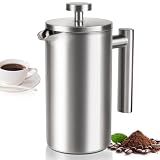
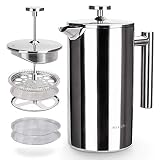
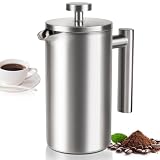
The Veken 21 oz is a small pot made from thickened, heat-resistant borosilicate glass with a stainless steel brewer assembly. The listing stresses a “no plastic touching” design: it says surfaces that contact water or coffee are glass, 304 stainless steel, or food-grade silicone. It holds 21 oz, so it makes a big mug for one or two smaller cups, which is a flexible size for a small kitchen.
It suits solo drinkers who like a refill, couples who split a pot, and anyone who wants to avoid plastic near hot coffee.
- Capacity: 21 oz, or 0.6 L
- Carafe: thickened borosilicate glass
- Filter: four-layer stainless steel, per the listing
- Seals: food-grade silicone
- Size: listings give about 6.1 inches deep, 3.6 inches wide, and 7.2 inches tall
- Extras: ounce markings and a scoop per the listing; thermal shock figures differ between listings, so confirm on the page
Pros:
- Plastic-free contact surfaces described in the listing
- Right size for one to two servings
- Four-layer filter reduces fine grounds
Cons:
- Glass still breaks if dropped
- Dishwasher guidance varies, so check the page
Compared with the Bodum 12 oz, it holds nearly twice as much and puts more emphasis on materials. For a practical sense of scale, 600 ml of water yields roughly two 8 oz mugs after the grounds absorb their share, so it works well for a weekend brunch for two. Because the carafe is thick, preheat it with a splash of hot water on cold mornings, and wash the filter stack by hand if your listing’s care notes call for it.
2. Bodum Brazil 12 oz – Best for a Single Mug

The Bodum Brazil is the reference design for a small press. It uses borosilicate glass with a polypropylene handle, lid, and base, and a stainless steel plunger and filter. At 0.35 L, it matches Bodum’s “3 cup” label, which counts a cup as about 4 oz. In real terms it is one mug.
It suits readers who value a long-lived design with spare parts available. The glass beaker can be replaced separately, so a crack is not the end of the press.
- Capacity: 12 oz (0.35 L)
- Carafe: heat-resistant borosilicate glass
- Plunger and filter: stainless steel
- Frame, lid, handle: polypropylene
- Cleaning: described as dishwasher safe in published sources
- Origin: made in Portugal per the listing title
Pros:
- Compact, with a trusted track record
- Replacement glass sold separately
Cons:
- Plastic frame and lid
- Only one mug per brew
Next to the Veken 21 oz, it is smaller and more traditional, with a plastic frame instead of a plastic-free brew path. It also takes up the least cupboard space of any press here, which suits a dorm, a desk drawer, or a small apartment kitchen. The tradeoff is yield: after the grounds absorb some water you will pour closer to 9 or 10 oz, which is a mug, not a pot.
3. Veken 34 oz (1 L) – Best Step-Up for a Small Household

This is the larger sibling of the 21 oz: a 34 oz (1 L) press with thickened glass and a stainless steel brewer, described by the listing as having no plastic touching the coffee. It also doubles as a cold brew pot per the listing. It is not small by French press standards, but it is a manageable size if two people drink coffee at once.
It suits couples, small offices, and anyone who wants a single design they can scale up or down. If you only ever pour one cup, choose a smaller size.
- Capacity: 34 oz, or 1 L
- Carafe: thickened glass
- Body: stainless steel brewer assembly
- Plastic: listing says no plastic touches the coffee
- Extra use: cold brew, per the listing
- Filter and dimensions: confirm on listing
Pros:
- Enough volume for two people
- Same material philosophy as the smaller Veken
Cons:
- Too large to be called small
- Half-filled batches brew unevenly
It beats the 21 oz on capacity, while the 21 oz is easier to store. If you buy this size, aim to brew at least two-thirds full, since the filter and plunger are designed for a full-height column of water, and a nearly empty carafe cools quickly and steeps unevenly.
4. QUQIYSO Borosilicate Glass – Best for Four-Filter Glass Design
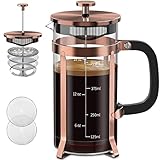
The QUQIYSO is a borosilicate glass press with a stainless steel frame, thickened glass, and an “easy to clean” design with four filters per the listing. The size is not in the visible title, so confirm whether you are looking at a small, medium, or large capacity before you buy.
It suits shoppers who want a conventional glass-and-steel press and are willing to check the details on the product page.
- Carafe: borosilicate glass, thickened
- Frame: stainless steel per the listing
- Filters: four per the listing
- Cleaning: described as easy to clean
- Capacity: confirm on listing
- Seal materials: confirm on listing
Pros:
- Stainless frame resists dents
- Multiple filters help with sediment
Cons:
- Capacity not stated in the title
- Limited brand detail
Compared with the Utopia glass press, it markets stainless steel construction more than plastic-framed styling. Because the capacity is not stated in the title, check the product page for the ounce figure and the dimensions before relying on it as a small press, and look at whether spare filters are included in the box.
5. Utopia Kitchen 34 oz Glass – Best Straightforward Glass Press

The Utopia Kitchen 34 oz is a black, heat-resistant borosilicate glass press, sold as a cafetiere and tea maker. Retailer descriptions mention a stainless steel plunger and a four-filter sieve system with an 80 mesh filter, though listings also mention a triple filter, so counts differ. Listing text describes an insulated plastic frame, so it is not a plastic-free design.
It suits readers who want the standard 34 oz size and a no-frills build.
- Capacity: 34 oz, or 1 L
- Carafe: borosilicate glass, heat resistant
- Frame: plastic per listing text
- Filter: stainless steel mesh; layer count varies by listing
- Use: coffee and tea
- Servings: about four 8 oz cups per listing wording
Pros:
- Familiar size and shape
- Works for tea and coffee
Cons:
- Plastic frame
- Filter description is inconsistent between listings
It resembles the Basics press below, with a slightly different filter story. Since listings for this press disagree on filter count, it is worth reading the product page and the included instructions to see exactly which screens ship in the box. The same coarse grind and four-minute steep apply as with every press here.
6. Basics 34 oz Borosilicate Press – Best for Dishwasher-Friendly Parts

The Basics 34 oz French coffee press is a borosilicate glass model with a BPA-free frame, a triple filtration system, and parts described as dishwasher-safe. It aims to be the plain, no-surprise option: a standard size from a house brand with simple controls.
It suits shoppers who want an easy-to-clean press and do not need a small body. Because the listing does not give dimensions in the title, confirm the footprint if your shelf space is tight.
- Capacity: 34 oz
- Carafe: borosilicate glass
- Frame: BPA-free plastic per the listing
- Filter: triple filtration
- Cleaning: dishwasher-safe parts per the listing
- Dimensions: confirm on listing
Pros:
- Dishwasher-safe parts
- Plain design that is easy to use
Cons:
- Not truly small
- Plastic frame
It is the simplest of the three 34 oz presses, while the Veken 34 oz focuses on material choices. Its dishwasher-safe parts make cleanup easier for households that brew every day, though hand washing the mesh screens is still the best way to keep them straight and prevent them from warping over time.
Specs Compared
| Product | Capacity | Carafe | Frame | Filter | Size note |
|---|---|---|---|---|---|
| Veken 21 oz | 21 oz (0.6 L) | Thickened borosilicate glass | Stainless steel; silicone seals | Four-layer stainless steel | Small |
| Bodum Brazil 12 oz | 12 oz (0.35 L) | Borosilicate glass | Polypropylene | Stainless steel | Smallest |
| Veken 34 oz | 34 oz (1 L) | Thickened glass | Stainless steel | Confirm on listing | Standard |
| QUQIYSO Borosilicate | Confirm on listing | Thickened borosilicate glass | Stainless steel | Four filters | Confirm on listing |
| Utopia Kitchen 34 oz | 34 oz (1 L) | Borosilicate glass | Plastic | Stainless mesh; layers vary | Standard |
| Basics 34 oz | 34 oz | Borosilicate glass | BPA-free plastic | Triple filtration | Standard |
How We Chose These
This guide is based on research of the six listed products. We read each listing title and specification field, checked the Bodum and Veken details against published manufacturer and retailer descriptions, and sorted the group by capacity, carafe material, frame material, and filter design. Because only two products are truly small, we say plainly where a 34 oz press is a standard-size alternative. Where a value was not stated or sources disagreed, we flag it so you can confirm on the product page.
What to Look For
Decide what “small” means for you
French press sizes are measured in ounces, liters, or “cups,” and the cups are not American coffee cups. A 12 oz press (0.35 L) makes about one mug. A 21 oz press (0.6 L) makes one large mug or two small cups. A 34 oz press (1 L) is the common standard and makes about four 8 oz servings. Expect actual brewed coffee to be about 10 to 15 percent below the labeled capacity, because the grounds absorb water and you need headroom for the plunger. If you drink one 12 oz mug each morning, the 21 oz is the sweet spot; if you drink two, the 34 oz is more flexible.
Glass, frame, and what touches the coffee
Borosilicate glass handles thermal shock better than ordinary glass, which is why nearly every press here uses it. The frame, lid, and plunger vary. Some presses use polypropylene frames; others use stainless steel with silicone seals and claim that no plastic touches the brew. If you care about plastic, read the listing carefully, because a “BPA-free” label means a certain chemical is absent, not that plastic is. A stainless frame is also easier to keep looking new, but it adds weight and can dent. Spare parts matter too: Bodum sells replacement glass, which can make a press last for years.
Filter layers
A French press filter is a metal mesh disc held by a spring and a cross plate. More layers do not always mean less sediment, but a tight mesh and a properly seated disc make a real difference. Look for a filter that disassembles for cleaning and for spare screens in the box. Expect some silt at the bottom of the cup: that is part of the style. If you want a cleaner cup, use a slightly coarser grind and pour slowly, leaving the last sip behind.
Brewing basics for a small press
A common ratio is about 1 part coffee to 15 parts water by weight, which works out to roughly 40 grams of coffee for a 21 oz press when filled to about 600 ml of water. Use a coarse grind, water at about 195 to 205 degrees Fahrenheit, and a four-minute steep. Stir gently after pouring, wait, and press slowly. Pour out the coffee right away. If it tastes bitter, grind coarser or shorten the steep; if it tastes thin, add coffee or steep a bit longer.
Storage and daily care
Small presses are easy to store but easy to neglect. Rinse the carafe and plunger right after pouring, because coffee oils dry into a film that tastes stale in the next brew. Once a week, take the filter stack apart and scrub each screen with a soft brush under warm water. Store the press with the plunger lifted so the seals are not compressed, and keep the lid off or loose until everything is dry. A press that is cleaned this way can last for years, and replacing a worn screen is far less work than replacing the whole unit.
Shelf space, travel, and breakage
A smaller press is easier to store, but small presses are tall and narrow, so they tip more easily. Measure the height of the cabinet shelf before you buy; the Veken 21 oz is listed at about 7.2 inches tall, and the 34 oz presses are taller. For travel, wrap the carafe in a towel and remove the plunger. Glass presses are the first thing to break in a shared kitchen, so if the press will live in a busy office or a rental, consider a model whose beaker is sold separately, such as the Bodum, or one with a thick wall that is better able to absorb bumps.
A worked example
You want two 8 oz mugs for a weekend brunch. A 21 oz press fits that perfectly, with a little headroom. A 12 oz press would need two brews, and a 34 oz press would work but you would be filling it only halfway, which makes the grounds-to-water ratio harder to hit. That is why many small households end up with a 21 oz as their main press and a 12 oz as a desk model.
Questions
What is the smallest French press size?
Most single-serve presses hold about 12 oz, or 0.35 L, and some travel presses are smaller. A 12 oz press brews one mug, which is why Bodum labels it a “3 cup” size. Smaller sizes exist, but they fit a short espresso-sized cup rather than a mug.
Is a 34 oz press too big for one person?
It can be. You can brew a half batch, but coffee-to-water ratios and steep times are harder to control at low fills. A 21 oz or a 12 oz press is a better fit for one drinker.
How long should I steep coffee in a small press?
Four minutes is the common starting point. Go a bit shorter for a milder cup or longer for a stronger one, adjusting grind size too. Always pour out the coffee as soon as you press.
Can I put a glass French press in the dishwasher?
Some can, but it depends on the model. The Basics press lists dishwasher-safe parts, while the Bodum is described as dishwasher safe in published sources. Veken guidance differs between listings, so check each product page.
Do I need to preheat the carafe?
It helps, especially in a cold kitchen. Swirl a little hot water in the carafe, pour it out, then add grounds and the rest of the water. This keeps the brew temperature from dropping too quickly.
Does a smaller press make stronger coffee?
Not by itself. Strength depends on the ratio of coffee to water, the grind, and the steep time. A small press is simply easier to measure precisely, so it is easier to repeat the same cup every morning.
Update History
- October 21, 2026 – Initial publication; product set drawn from current catalog listings.
- Check the product page for current specifications and availability before buying.
Sources
- Manufacturer product and specification pages for Bodum and Veken
- Retailer listing titles and specification fields for all six products
- General brewing guidance on grind, ratio, water temperature, and steep time from coffee industry educational material

Write Your Review
No reviews yet. Be the first to share your experience!