

Key takeaways
- Best budget espresso machines with milk frothers: four pump models and two steam-driven options compared on tanks, gauges and wands.
The CASABREWS CM5418 is the best overall pick among these budget espresso machines with milk frothers: a compact pump machine with a manual steam wand, a built-in pressure gauge and a removable 34-ounce tank. If you want the largest tank in the group, look at the CASABREWS 3700 Essential or the XIXUBX. Two of the six listings, the SHARDOR and the HBN, are 3.5 bar steam-driven machines that make strong moka-style coffee rather than true espresso, so they are best treated as entry-level options for casual milk drinks.
Quick List
- CASABREWS CM5418 – best overall for a pump machine with a gauge and a steam wand
- CASABREWS 3700 Essential – best for a bigger water tank and a simple, beginner-friendly layout
- XIXUBX 20-Bar with Milk Frother – best for a large tank and a pressure gauge in a compact body
- Spacekey 20-Bar Espresso Machine – best for a removable frothing nozzle and a cup-warming tray
- SHARDOR 3.5 Bar Compact – best for a very small machine and one-knob control (steam-driven, moka-style)
- HBN 3.5 Bar, 2-4 Cup – best for a no-fuss steamer-style maker for occasional lattes (steam-driven)
Which One Is Right for You?
| If you… | Choose |
|---|---|
| want a real pump machine with a visible pressure gauge | CASABREWS CM5418 |
| make several milk drinks in a row and hate refilling the tank | CASABREWS 3700 Essential |
| want a gauge and a pitcher in the same compact package | XIXUBX 20-Bar |
| want to rinse the frothing nozzle easily and warm cups on top | Spacekey 20-Bar |
| have limited space and want the simplest operation | SHARDOR 3.5 Bar |
| mostly want a strong coffee base for a latte or cappuccino at home | HBN 3.5 Bar |
Whichever you choose, budget for a grinder. Every machine here takes ground coffee only, and the quality of the shot depends as much on the grind as on the machine. A pre-ground bag labeled “espresso” works for a start, but a burr grinder lets you adjust as the beans age.
All 6 Picks in Detail
1. CASABREWS CM5418 – Best Overall for Gauge and Steam Wand
As an Amazon Associate we earn from qualifying purchases at no extra cost to you.

The CM5418 is a compact stainless steel espresso machine with a 20-bar pump, a built-in pressure gauge and a manual steam wand for milk. The manufacturer lists 1350 watts and a removable 34-ounce water tank. The pressure gauge is the main teaching tool: it shows how hard the machine is pushing, so you can see whether your grind and tamp are right. If the needle barely moves, the grind is probably too coarse or the dose too small; if it pins high and the coffee trickles, go coarser. Learning that feedback loop is what separates a machine you outgrow in a month from one you keep improving with. A 20-bar pump is a marketing rating of the pump itself; the pressure that matters at the coffee is closer to 9 bar, and the gauge helps you aim for that range.
The portafilter is 51 millimeters and ships with pressurized baskets, which forgive imperfect grind and tamp and add a little crema-like foam. The steam wand is manual, so there is a learning curve for silky microfoam, but it is the feature that lets you make real cappuccinos and lattes. Newer versions of this machine mention PID temperature control and low-pressure pre-infusion; confirm which version you are buying. For a first espresso machine, the combination of gauge, steam wand and compact body is why it leads the list: it teaches the fundamentals without hiding them behind automation.
- Pump: 20 bar (pump rating); target extraction about 9 bar
- Power: 1350 W per the manufacturer
- Tank: 34 oz, removable
- Portafilter: 51 mm with pressurized baskets
- Size: about 5.5 by 12.3 by 12 inches per retail pages; confirm on listing
Pros:
- Gauge helps you learn dialing in
- Real steam wand for milk drinks
Cons:
- Pressurized baskets limit how far you can go with fine tuning
- Tank is smaller than on some rivals
Compared with the 3700 Essential, it has a smaller tank but is better documented and includes the gauge on every version.
2. CASABREWS 3700 Essential – Best for a Bigger Tank

The 3700 Essential is the larger sibling in the CASABREWS range, with a 20-bar Italian pump, a steam wand and a removable 43.9-ounce (1.3-liter) tank. The manual lists 120 volts, 1350 watts and a size of roughly 13 by 6.5 by 12 inches. A bigger tank means fewer refills when you make multiple drinks for guests, and it also means the machine is less likely to be run dry, which can damage the pump.
Product pages describe a 51 millimeter portafilter with preset single and double shot volumes, a thermoblock heater and PID temperature control, though retailers differ on whether a pressure gauge is included, so check the exact version. As with every machine at this tier, let it warm up fully, run a blank shot to heat the group and cup, and wait between steaming and brewing because the thermoblock needs time to change temperature. Fill the tank with fresh water each time and avoid running it near empty. If you have hard water, a filtered or softened supply will extend the life of any small thermoblock machine.
- Pump: 20 bar (pump rating)
- Power: 1350 W per the manual
- Tank: 43.9 oz (1.3 L), removable
- Portafilter: 51 mm, with preset shot volumes per CASABREWS
- Gauge: varies by version; confirm on listing
Pros:
- Large tank reduces refills
- Simple layout suits beginners
Cons:
- Gauge availability varies by version
- Manual steam wand takes practice
Next to the CM5418, it trades the confirmed gauge for tank capacity.
3. XIXUBX 20-Bar with Milk Frother – Best for Tank Size and a Gauge

The XIXUBX listing describes a 20-bar compact stainless steel machine with a pressure gauge, a powerful steam wand and a milk frothing pitcher. Product pages for the gauge models list a 1350 watt motor, a 51 millimeter portafilter, a 360-degree rotating and detachable steam wand and a 42-ounce removable tank on the main model, with dimensions around 11.4 by 5 by 11.8 inches.
The company sells several related models, including touchscreen and cold-brew versions, and a few variants in the selector use 3.5 bar steam pressure, so make sure the listing you open is the 20-bar gauge machine: it should show a 20-bar pump, a gauge and a steam wand. If it is, the combination of a large tank, a gauge and a pitcher in the box is useful for a first-time buyer who does not own milk tools yet.
- Pump: 20 bar (pump rating)
- Power: 1350 W per retail pages; confirm on listing
- Tank: about 42 oz, removable
- Portafilter: 51 mm
- Extras: gauge, frothing pitcher per the listing; confirm contents
Pros:
- Large tank for the footprint
- Pitcher helps beginners start frothing right away
Cons:
- Multiple similar variants make it easy to order the wrong one
- Limited documentation compared with larger brands
Against the Spacekey, it has the gauge and a larger tank, while the Spacekey has a cup-warming tray.
4. Spacekey 20-Bar Espresso Machine – Best for Easy Cleaning and Cup Warming

The Spacekey is a 20-bar stainless steel machine with a milk frother, a 39-ounce removable tank and an Americano mode. Product pages for the related CM5080 model describe a 1350 watt heater, PID temperature control, a pre-soak step, a cup-warming tray on top, a removable water filter and a steam wand with a removable 360-degree nozzle that is easier to clean. The kit includes one-cup and two-cup filters, a portafilter and a tamper, so you can begin right away.
A removable frothing nozzle is a small feature with a big payoff: dried milk in the wand is the most common source of off flavors and clogs. A cup-warming tray helps keep a small espresso hot, because a cold ceramic cup can drop the temperature of a shot quickly. Keep your expectations realistic; a machine in this class cannot match the temperature stability of more expensive models. If your cups are cold, run hot water through the empty portafilter and cup before pulling a shot, a trick that works on any machine in this guide.
- Pump: 20 bar (pump rating)
- Power: 1350 W per the related CM5080 pages; confirm on listing
- Tank: about 39 oz, removable
- Milk system: steam wand with removable nozzle
- Extras: cup-warming tray, tamper, one- and two-cup filters per retail pages
Pros:
- Removable nozzle simplifies cleaning
- Includes a tamper and filters
Cons:
- No gauge named on the listing
- Specs differ among Spacekey’s several models
Compared with the CASABREWS 3700, it has a slightly smaller tank but adds the cup-warming tray.
5. SHARDOR 3.5 Bar Compact – Best for Simplicity (Steam-Driven)
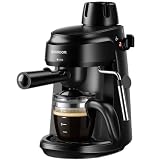
The SHARDOR is a small 3.5 bar machine with an 800 watt aluminum boiler and a marked glass carafe that collects four small cups of coffee. A single knob controls brewing, frothing and power-off, which makes it easy for beginners. Retail pages describe a steam wand that rotates through 270 degrees, coarse ground coffee input and overheat and overpressure protection.
It is important to be clear about what this machine is. A 3.5 bar machine uses boiling water pressure, much like a moka pot, so it produces strong concentrated coffee without the 9 bar pressure of true espresso, and it does not produce the crema of a pump machine. Independent write-ups describe it as an entry-level option that is good for students and casual drinkers who want a latte base. If you want true espresso, move to a pump machine like the CASABREWS. Treat the carafe marks as your dosing guide, and let the machine cool before refilling it so you do not release hot steam from the boiler cap.
- Pressure: 3.5 bar, steam-driven
- Power: 800 W
- Output: marked glass carafe, up to 4 cups
- Control: one knob for brew, steam and off
- Size: about 8.3 by 6 by 11.8 inches per retail pages
Pros:
- Very simple to use
- Small footprint for tight counters
Cons:
- Not true espresso and no real crema
- You have to watch the brew volume manually
Versus the HBN, it has a similar approach but an easier-to-read one-knob design.
6. HBN 3.5 Bar, 2-4 Cup – Best for Occasional Latte Bases (Steam-Driven)

The HBN is another 3.5 bar, 800 watt machine, listed as a 2-4 cup stainless steel cappuccino and latte maker with a milk frother. Retail descriptions mention a 240 milliliter capacity, a carafe with a water-level gauge, a removable drip tray and one-knob control for power, brewing and steaming. The company also sells a separate 20 bar pump model with a 34-ounce tank, so make sure the listing you open is the 3.5 bar machine.
Like the SHARDOR, it makes a strong coffee concentrate rather than true espresso. For milk drinks, that can be fine: a latte hides some of the difference, and a good steam wand will add the texture. For straight shots, you will find it lacks body and crema. Use it as a low-cost way to learn steaming, and upgrade to a pump machine when you want the espresso itself. Safety matters with any steam-driven boiler: never open the cap while the machine is hot or pressurized, keep your hands clear of the wand when you first open the steam valve and let the boiler cool before you refill it.
- Pressure: 3.5 bar, steam-driven
- Power: 800 W
- Capacity: 2-4 cups; about 240 mL per retail pages
- Milk: steam wand with frother
- Size: about 12.9 by 7.3 by 13.6 inches per one retailer; confirm on listing
Pros:
- Small and straightforward
- Includes a milk frothing wand
Cons:
- Not a pump machine and does not make true espresso
- Small batch size
Next to the SHARDOR, it is similar in concept; pick based on the carafe and layout you prefer.
Specs Compared
| Product | Pressure | Power | Tank / capacity | Portafilter | Gauge | Milk system |
|---|---|---|---|---|---|---|
| CASABREWS CM5418 | 20 bar pump | 1350 W | 34 oz tank | 51 mm | Yes | Manual steam wand |
| CASABREWS 3700 Essential | 20 bar pump | 1350 W | 43.9 oz tank | 51 mm | Varies; confirm on listing | Manual steam wand |
| XIXUBX 20-Bar | 20 bar pump | Confirm on listing | About 42 oz tank | 51 mm | Yes per listing | Steam wand and pitcher |
| Spacekey 20-Bar | 20 bar pump | Confirm on listing | About 39 oz tank | Confirm on listing | Confirm on listing | Steam wand, removable nozzle |
| SHARDOR 3.5 Bar | 3.5 bar steam-driven | 800 W | Up to 4 cups (carafe) | Confirm on listing | No | Steam wand |
| HBN 3.5 Bar | 3.5 bar steam-driven | 800 W | 2-4 cups (about 240 mL) | Confirm on listing | No | Steam wand |
How We Chose These
These picks are based on published specifications, not on our own brewing sessions. We read each listing, compared it with manufacturer pages and independent write-ups, and sorted the machines by pump type, tank size, portafilter size, gauge availability, milk system and how consistently the documentation describes each model. We rank true pump machines above steam-driven ones for espresso, and we flag every spec we could not confirm so you can check it on the product page.
What to Look For
Pump versus steam-driven pressure
Traditional espresso is brewed at about 9 bar of pressure at the coffee, which a pump produces. The “20 bar” on the box is the pump’s peak rating, not the pressure at the puck. Steam-driven machines labeled 3.5 bar use boiling water pressure, like a moka pot, and make a strong coffee that is not espresso in the strict sense. If you want crema and a milky drink with a real espresso base, choose a pump machine. If you only want a strong base for a latte and the simplest possible machine, a steam-driven unit can work.
Steam wand and milk frothing
A manual steam wand needs practice, but it gives you control. Purge the wand briefly before and after steaming, wipe it right away and avoid heating the milk above about 150 degrees Fahrenheit, a range many baristas aim for so the milk stays sweet. Cold whole milk in a cold pitcher is the easiest to learn on. A removable nozzle makes cleanup easier, and a pitcher in the box saves you a purchase. When you steam, keep the tip just under the surface until the milk gently stretches, then lower the pitcher so the tip sits deeper and spins the milk into a whirlpool. Stop when the pitcher is warm enough that you can hold your hand on it for only a second or two.
Tank size, power and footprint
A shot uses only an ounce or two of water, but steaming, rinsing the group and warming the machine all draw from the tank, so a 34-ounce tank means more frequent refills than a 42 to 44-ounce one. Most machines here list 1350 watts for the pump models, so use a dedicated outlet, not a loaded extension cord. Measure under your cabinets: many compact machines are about 12 inches tall, and the top of the machine needs clearance for lifting the lid and tank.
Pressurized baskets and grinders
Budget machines typically include pressurized baskets, which make the coffee forgiving to grind and tamp. That is good for beginners, but it limits how much improvement you can get from a better grinder. To dial in, start with a ratio near one part ground coffee to two parts liquid espresso by weight, pulled in roughly 25 to 30 seconds, and adjust the grind finer if it runs too fast or coarser if it chokes. Change one variable at a time and write down the dose, time and result. With pressurized baskets, expect a more forgiving but less detailed cup, which is a reasonable trade-off at this tier.
Worked example
For illustration, say you make two lattes each morning. A typical double uses about 18 grams of coffee for roughly 36 grams of liquid out, and each latte steams about 6 to 8 ounces of milk. With a 34-ounce tank, the machine will handle two drinks with plenty of margin, but you will need to refill every few days. If you host guests, a 43.9-ounce tank on the 3700 Essential reduces interruptions. Whichever machine you choose, keep the area around it dry, wipe the drip tray daily and empty the tray before it floods, since a full tray is the most common cause of puddles on the counter.
Questions
Can a budget machine make real espresso?
Pump machines like the CASABREWS models can make espresso-style shots, especially with fresh coffee and a decent grinder. The 3.5 bar machines make strong coffee that is closer to moka pot output.
Do these machines have a built-in grinder?
No. Every listing here takes ground coffee, so you need to buy a grinder or use pre-ground espresso coffee. A burr grinder with fine adjustment gives the best results.
Why does my steam wand sputter?
Water in the line or a partly blocked tip is the usual cause. Purge the wand into a cup before steaming and clean the tip after every use with a damp cloth and a pin if the manufacturer allows it.
How often should I descale?
Follow the manual, but a common schedule is every one to three months depending on water hardness. Use a descaler made for espresso machines and rinse thoroughly.
What is the difference between the 20 bar and 3.5 bar machines?
The 20 bar models use an electric pump and can reach the pressure used for espresso, while the 3.5 bar models rely on steam and make a more concentrated drip-like coffee. Choose the pump models for espresso, and the steam models for a simple, small latte base.
Can I use pods?
The CASABREWS CM5418 is a ground coffee machine and does not accept pods. Confirm on the other listings, since none of the machines here advertise pod support.
Update History
- October 21, 2026 – Initial publication; product set drawn from current catalog listings.
- Check the product page for current specifications and availability before buying.
Sources
- Manufacturer product pages and instruction manuals for CASABREWS and Spacekey
- Retailer listing titles, bullet points and specification fields for each product
- Published independent write-ups on steam-driven and pump espresso machines
Write Your Review
No reviews yet. Be the first to share your experience!