

Key takeaways
- Best 2 pot coffee makers: dual brewers and two-warmer commercial machines compared on brew heads, decanters, fill method and power draw.
For a household or small office that wants regular and decaf ready at the same moment, the dual drip “brewer station” listed here, which brews two 12-cup pots, is the closest match to a true 2-pot coffee maker in this group. Restaurants and church kitchens that value ruggedness will prefer the TQS or SYBO commercial units. The phrase “2 pot” can mean two brewing heads or one brewer with two warmers, so the sections below say which is which. Read the warmers, the electrical load and the pour-over versus plumbed setup before you choose.
Quick List
- VEVOR Commercial Drip Coffee Maker 12 Cups – best for restaurants and offices that want a stainless commercial look
- Double Coffee Brewer Station (Two 12-Cup Pots) – best overall for regular and decaf at the same time
- TQS CAFE Double 12-Cup Commercial Brewer – best for stainless dual-brew service in a busy kitchen
- SYBO 12-Cup Pour Over SF-CB-2GA – best for a pour-over commercial brewer with two warmers and two decanters
- crosson 12 Cup Commercial Brewer – best for upper and lower warmers with easy-clean surfaces
- Hamilton Beach 2-Way Programmable (49980A) – best for home users who want a full pot and a single cup, not two pots
Which One Is Right for You?
| If you… | Choose |
|---|---|
| need regular and decaf brewing at the same time | Double Coffee Brewer Station |
| run a restaurant, bakery or break room with steady demand | TQS CAFE Double 12-Cup |
| prefer a pour-over fill with two glass decanters | SYBO SF-CB-2GA |
| want one brewer that holds two pots warm | crosson 12 Cup |
| want a stainless commercial look with a standard 12-cup basket | VEVOR 12 Cups |
| mostly drink one cup but sometimes need a full pot | Hamilton Beach 2-Way (49980A) |
If you only remember one thing, remember that “two pots” and “two brewers” are not the same. A true dual brewer makes two batches at once, while a single-head machine with two warmers makes one pot at a time and keeps a second one hot. Match the design to how your coffee service actually runs.
All 6 Picks in Detail
1. VEVOR Commercial Drip Coffee Maker 12 Cups – Best for a Commercial Look in Offices
As an Amazon Associate we earn from qualifying purchases at no extra cost to you.

The VEVOR listing names a commercial drip coffee maker with a 12-cup capacity for restaurants, offices and homes, finished in stainless steel. The visible title does not state how many decanters or warmers come with it, which is the key detail for anyone shopping for “2 pot” capability. Treat it as a strong candidate when you want a durable single-batch machine, and confirm on the product page whether a second decanter and warmer are included.
A 12-cup commercial brewer counts a cup as about 5 ounces, so one batch is roughly 60 ounces, or around seven and a half 8-ounce mugs. That is enough for a small team’s first round, but a busy morning will need a second batch.
If you plan to use it at home, think about counter depth and cabinet clearance, because commercial-style bodies are often taller than a typical household drip machine. Steam rises from the brew basket, so keep it out from under low cabinets. Also check whether the machine expects a standard household outlet, since some commercial units are designed for dedicated circuits.
- Capacity: 12 cups per batch
- Stainless steel exterior, per the listing
- Marketed for restaurant, office and home use
- Number of decanters and warmers: confirm on listing
- Wattage and plumbing method: confirm on listing
Pros
- Commercial-style stainless build
- Flexible for home or office
Cons
- Visible listing does not confirm two-pot capability
- Power draw unknown from the name alone
Compared with the crosson, it is simpler and leaves the question of a second warmer to the buyer to verify.
2. Double Coffee Brewer Station (Two 12-Cup Pots) – Best Overall for Regular and Decaf Together

This listing describes a dual drip coffee maker that brews two 12-cup pots, lets you make regular or decaf at once or different flavors, and includes individual controls. That is exactly what most people mean by a “2 pot coffee maker.” Two brew heads mean two separate batches without waiting for the first to finish, which is valuable for a family with split caffeine preferences or a lobby that serves two roasts.
The visible listing is cut off, so confirm the wattage, whether it is built for home or commercial use, and whether the decanters are glass or thermal before you buy. A machine with two heating elements often needs a robust circuit.
Two heads also give you a fallback: if one side fails or needs descaling, the other keeps working. Label each decanter clearly, for example with a strip of tape marked decaf, so the wrong pot never reaches a guest who needs it. Counter space is the main cost, so measure the width of the station before ordering and leave clearance behind it for steam.
- Two brewing sides, each making a 12-cup pot
- Regular and decaf (or different flavors) at the same time
- Individual controls or features, per the truncated listing
- Decanter type and warmers: confirm on listing
- Power draw: confirm on listing
Pros
- True dual brewing
- Ideal for mixed preferences
Cons
- Larger counter footprint
- Likely higher combined power draw
Next to the TQS, it is the choice for a home or small office, while the TQS targets heavier commercial use.
3. TQS CAFE Double 12-Cup Commercial Brewer – Best for Busy Kitchens

TQS CAFE sells a commercial coffee maker with double 12-cup capacity and a stainless steel housing, aimed at offices and similar settings. The “dual 12-cup” language suggests two brew stations, which doubles throughput compared with a single basket. In a restaurant or a break room that goes through coffee all morning, that is the difference between a line and no line.
Because many commercial units differ in how they are filled, check whether this one is plumbed to a water line or filled by hand, and whether it expects a dedicated circuit.
Throughput is the reason to buy a dual commercial brewer. Two baskets let a cafe, daycare or church kitchen brew a second batch while the first is being served, which keeps lines moving. Look into how the machine handles descaling and basket cleaning, because a unit that runs all day builds mineral deposits faster than a home machine. Stainless housings wipe clean quickly, which helps in a shared space.
- Double 12-cup capacity
- Stainless steel housing, per the listing
- Commercial positioning for offices and food service
- Fill method (pour-over or plumbed): confirm on listing
- Wattage and voltage: confirm on listing
Pros
- High throughput
- Rugged exterior
Cons
- Overkill for a household
- Electrical requirements need checking
Compared with the generic Double Coffee Brewer Station, it leans more toward commercial duty.
4. SYBO 12-Cup Pour Over SF-CB-2GA – Best Pour-Over Brewer With Two Warmers
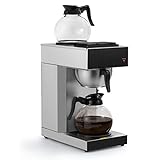
SYBO’s SF-CB-2GA is an ETL-certified 12-cup commercial pour-over brewer in stainless steel with a reusable brew basket, a spray head and two glass decanters. Pour-over means you fill the reservoir by hand rather than connect a water line, which makes it practical for pop-up service, church kitchens and offices without plumbing. Manufacturer and manual information describes two warmers with separate switches, a stainless body and a multi-stream spray head, and says it brews 12 cups in under ten minutes.
Wattage figures vary across listings, from 1610W on the manufacturer’s page to higher numbers elsewhere, so read the rating label on the machine. The manual also says it is intended for commercial use.
One more practical point: pour-over commercial brewers often have a limited reservoir, so a full 12-cup batch uses nearly all of it. The manual for this model reportedly limits the cold water poured in to about two liters, so use the markings and do not overfill. Rinse the basket and spray head between batches to keep the flow even and the coffee tasting clean.
- Capacity: 12 cups per batch, with two glass decanters
- Two warmers with independent switches, per manufacturer information
- Pour-over fill, with a reusable stainless basket
- ETL certified, per the listing
- Wattage: about 1610W per the manufacturer; confirm on the label
Pros
- Documented safety certification
- Two decanters and two warmers in the box
Cons
- One brew head, so batches are sequential
- Draws a lot of current
Compared with the crosson, it has more documented specifications and a defined set of two warmers.
5. crosson 12 Cup Commercial Brewer – Best for Upper and Lower Warmers

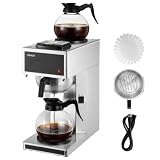
The crosson listing describes a 12-cup commercial drip brewer with an upper and a lower warmer, two glass decanters, pour-over operation and an easy-clean fingerprint-resistant finish. The upper and lower arrangement is a compact way to hold two pots: the brewed pot goes on the lower plate and the second sits above, ready for service. That layout fits a tight counter better than two side-by-side heads.
It is a single brew basket, so the second pot is a spare or a swap, not a simultaneous batch.
The stacked layout can be an advantage in small spaces such as a food truck, a bakery counter or a church side room, where every inch of counter matters. Remember that heat rises: coffee on the upper plate may stay warmer longer or scorch sooner than the lower one, so rotate pots and watch the clock. Wipe the fingerprint-resistant surface with a damp cloth and avoid abrasive pads that dull the finish.
- Capacity: 12 cups per batch
- Upper and lower warmers with two glass decanters
- Pour-over fill, per the listing
- Easy-clean fingerprint-resistant surface
- Wattage and certification: confirm on listing
Pros
- Compact two-pot holding layout
- Easy-clean finish
Cons
- Sequential brewing only
- Fewer documented specifications
Next to the SYBO, it uses a vertical warmer layout, whereas SYBO places two warmers on a lower base.
6. Hamilton Beach 2-Way Programmable (49980A) – Best for Home Users Who Want a Pot and a Cup

The Hamilton Beach 49980A pairs a 12-cup glass carafe side with a single-serve side, which is why it is called “2-way.” It is not a two-pot machine, and we include it as a home-friendly runner-up for readers whose real need is flexibility. Product information states that the carafe side makes up to 12 cups (counted as 5 ounces each), the single-serve side makes up to 14 ounces, and the machine runs on 120 volts at about 950 watts.
It has a 24-hour programmable timer, a two-hour auto shutoff, an Auto Pause and Serve function and a regular or bold selector. The single-serve side takes ground coffee or soft pods but is not designed for K-Cup pods.
For many households this is the more realistic purchase. Most mornings a single mug is enough, and the full carafe covers weekends or guests. The timer lets you wake up to a hot pot, and the glass carafe is easy to see into. If you later decide that you really do need two pots at once, one of the dual brewers above is the logical upgrade.
- 12-cup glass carafe plus single-serve up to 14 oz
- About 950W at 120V, per product information
- Programmable up to 24 hours ahead
- Two-hour auto shutoff and Auto Pause and Serve
- Not compatible with K-Cup pods on the single-serve side
Pros
- Suits both a single mug and a full pot
- Normal household power draw
Cons
- Not a two-pot brewer
- Glass carafe sits on a hot plate rather than an insulated body
Compared with the Double Coffee Brewer Station, it is the smaller, home-oriented option that does not brew two pots at once.
Specs Compared
| Model | Capacity | Brew heads | Pots / warmers | Fill method | Power |
|---|---|---|---|---|---|
| VEVOR 12 Cups | 12 cups | Confirm on listing | Confirm on listing | Confirm on listing | Confirm on listing |
| Double Coffee Brewer Station | Two 12-cup pots | Two | Individual controls per listing; confirm warmers | Confirm on listing | Confirm on listing |
| TQS CAFE Double 12-Cup | Double 12-cup | Dual, per listing | Confirm on listing | Confirm on listing | Confirm on listing |
| SYBO SF-CB-2GA | 12 cups | One | Two decanters, two warmers | Pour-over | About 1610W; confirm on label |
| crosson 12 Cup | 12 cups | One | Two decanters, upper and lower warmers | Pour-over | Confirm on listing |
| Hamilton Beach 49980A | 12 cups plus single serve to 14 oz | Two sides (pot and single cup) | One glass carafe | Reservoirs | About 950W, 120V |
How We Chose These
This guide comes from research on the six listings, not from direct use. We compared how many brew heads and warmers each product appears to have, the stated capacity, the construction, the fill method and any documented power or safety certification. Manufacturer information and manuals were used where available, notably for SYBO and Hamilton Beach. Where a title was truncated or silent, we marked the detail as “confirm on listing.” We also separated true dual brewers from single-head machines with two warmers, because the phrase “2 pot” is used loosely.
What to Look For
Two brew heads versus two warmers
A dual brewer has two independent brewing systems, so you can make two batches at the same time. A single-head machine with two warmers brews one pot at a time and holds the second. If your goal is to serve regular and decaf together, you need the first design. If you just want to keep a backup pot hot, the second is fine and usually takes less counter space.
Electrical load and circuits
Commercial brewers can draw well over a thousand watts per heating element. At 120 volts, a 1610-watt unit pulls about 13.4 amps, which is above the roughly 12 amps typically planned for a continuous load on a 15-amp circuit. A dual unit may draw more. Put these machines on a dedicated circuit, avoid power strips and extension cords, and do not run a microwave or space heater on the same line. If the listing does not state wattage, read the label or manual before you plug in.
Pour-over versus plumbed
Pour-over machines are filled by hand from a pitcher, so they work anywhere there is an outlet. Plumbed models connect to a water line and refill automatically, which saves effort in a high-volume operation but requires installation. Check the listing for the fill method and for reservoir limits, since manuals for pour-over models give a maximum amount of water per cycle.
Decanters, warmers and holding time
Glass decanters on warmers are inexpensive and easy to inspect, but a warmer plate can over-cook coffee left on it for hours. Thermal decanters hold temperature without a plate. Warmers with independent switches let you shut off a plate you are not using. As a rule of thumb, coffee held on a hot plate tastes noticeably worse after about an hour, so brew in smaller waves when you can. Keep spare decanters on hand and check that replacements are sold for your model, because glass is the part most likely to break.
Capacity math and brew size
Because a cup is only about 5 ounces, two 12-cup pots equal roughly 120 ounces, or fifteen 8-ounce mugs. Most drip brewers also perform best when filled close to their stated capacity, since very small batches can come out weak or uneven. If you often brew only three or four mugs, a smaller machine or the single-serve side of a 2-way brewer may give you better coffee than a commercial dual unit running half-empty.
Cleaning, descaling and upkeep. Machines that brew all day collect mineral scale on their heating elements. Descale on a schedule based on water hardness, typically every month or two for heavy use, using a descaler approved in the manual. Wash decanters, baskets and spray heads after each service, wipe the warmers when they are cool, and never immerse the base. Keep spare glass decanters on hand, because breakage is the most common reason a brewer is sidelined.
Worked example for a small office. Say twenty people each drink one 8-ounce mug between 8 and 10 a.m. That is about 160 ounces. Counting a 12-cup pot as 60 ounces, you need roughly three pots. A dual brewer makes two at once and the third a few minutes later, while a single-head machine needs three sequential brews of several minutes each. Match the equipment to your peak demand, not your average.
Questions
What does “2 pot” mean on a coffee maker?
It can mean two independent brewing heads, or one brewer that holds two pots on warmers. Check the listing for the number of brew baskets.
Do I need a commercial coffee maker for home?
Not usually. Commercial units are faster and sturdier but draw more power and are often labeled for commercial use only. For home, the Hamilton Beach style is the easier fit.
How many cups is a 12-cup pot really?
Coffee makers count a cup as about 5 ounces, so a 12-cup pot holds around 60 ounces, or about seven and a half 8-ounce mugs.
Can two pots brew at once on the same circuit?
It depends on the wattage. Many commercial brewers need their own circuit, so confirm the rating on the label and the circuit capacity.
Is a pour-over commercial brewer hard to use?
No. You pour measured cold water into the reservoir, and the machine does the rest. Do not exceed the water amount in the manual.
Which design keeps coffee freshest?
Thermal decanters avoid the hot plate, but they are not offered with every model. With glass decanters, brew smaller batches and serve within about an hour.
Update History
- October 21, 2026 – Initial publication; product set drawn from current catalog listings.
- Check the product page for current specifications and availability before buying.
Sources
- Manufacturer product pages and manuals for SYBO and Hamilton Beach
- Retailer listing titles and specification fields for the other brands
- General guidance on coffee maker cup sizes and household circuit capacity
Write Your Review
No reviews yet. Be the first to share your experience!