

Key takeaways
- Compare the best commercial coffee makers: VEVOR drip brewers and 45- to 100-cup urns, with capacity, power draw and circuit tips.
For most busy counters, church halls and catered events, the Hamilton Beach 45-cup fast-brew urn is the strongest all-around pick in this group. Its manual-backed capacity of 15 to 45 cups, single-spout dispensing and straightforward paper-filter workflow suit anyone serving a crowd from one machine. If you run a restaurant line or an office kitchen and want glass pots on warming plates, the VEVOR drip brewers are the better fit. “Commercial” here means built for repeated, high-volume service rather than a single mug at a time, and every pick below is judged on that basis.
Quick List
- VEVOR 12-Cup Drip Brewer (first listing) – best for a compact counter that needs a pot or two of coffee at a time
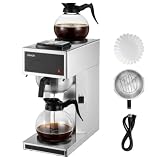
- VEVOR 24-Cup Dual-Head Brewer – best for a rush-hour counter that needs two brew heads working in parallel
- VEVOR 12-Cup Drip Brewer (second listing) – best for shops comparing a slightly different carafe and warmer configuration
- Zulay 100-Cup Urn – best for large events, buffets and fellowship halls
- Hamilton Beach 45-Cup Urn (two-way lever listing) – best for mid-size gatherings where a lever-style spout matters
- Hamilton Beach 45-Cup Fast-Brew Urn – best overall for general group service with a documented 15-to-45-cup range
Which One Is Right for You?
| If you… | Choose |
|---|---|
| serve 30 to 45 people at a time and want the simplest setup | Hamilton Beach 45-Cup Fast-Brew Urn |
| host 60 to 100 guests and need one big vessel | Zulay 100-Cup Urn |
| want glass carafes you can swap out during a breakfast rush | VEVOR 12-Cup Drip Brewer (either listing) |
| need two pots brewing at once at a counter | VEVOR 24-Cup Dual-Head Brewer |
| prefer a lever spout on a mid-size urn | Hamilton Beach 45-Cup Urn (two-way lever listing) |
| have a limited electrical circuit and need to avoid stacking loads | A single urn rather than a dual-head brewer |
Urns and drip brewers solve different problems. An urn brews a big batch into one insulated or heated vessel and holds it, while a drip brewer fills glass pots that sit on warming plates. If your service pattern is steady all day, the drip brewers give you flexibility. If it comes in waves, such as a church hall before and after a service, an urn is the calmer choice.
All 6 Picks in Detail
1. VEVOR 12-Cup Drip Brewer (first listing) – Best for a Compact Counter
As an Amazon Associate we earn from qualifying purchases at no extra cost to you.

This is the entry point for a small cafe, deli or office kitchen that wants a stainless-steel drip brewer in a familiar 12-cup format. In commercial usage a “cup” is typically five ounces, so a 12-cup batch is about 60 ounces, or roughly 1.8 liters. VEVOR sells several versions of this brewer with different numbers of glass carafes and warming plates, and the listing title here does not spell out the exact configuration, so confirm that count before ordering.
- Capacity: 12 cups per batch
- Style: drip brewer with glass carafe service
- Body: stainless steel, per the listing title
- Intended settings: restaurant, office and home, per the listing
- Carafe and warmer count: confirm on listing
- Power and plug: confirm on listing
Pros
- Familiar glass-pot workflow that staff already understand
- Compact enough for a crowded back counter
Cons
- A 12-cup batch runs out quickly in a rush
- Glass pots break, so keep a spare on hand
Who should skip it: anyone serving more than about 40 people in an hour, because a single 12-cup batch will empty before the next one finishes. Compared with the second 12-cup VEVOR listing, the differences are likely to be configuration details, so read both product pages side by side.
2. VEVOR 24-Cup Dual-Head Brewer – Best for Parallel Brewing at a Rush-Hour Counter

The dual-head design is the point of this model: two brew heads let a team start a second pot without waiting for the first to finish. Related VEVOR product pages for the same 24-cup dual-head design describe four glass carafes of about 1.8 liters each and a combined 1,610 watts per side, but those figures come from a sibling variant, so treat them as a guide and confirm the exact numbers on this listing. If the machine really draws that much power on both sides at once, it will not run reliably on one ordinary 15-amp, 120-volt kitchen circuit, which supplies about 1,800 watts at most.
- Capacity: 24 cups per cycle across two heads
- Style: dual-head drip brewer
- Body: stainless steel, per the listing title
- Reported brew time: about six minutes for 24 cups on a related VEVOR page; confirm on listing
- Electrical requirements: confirm voltage, amperage and plug before installing
Pros
- Two brew heads cut the wait during peak service
- More glass pots means longer holding without rebrewing
Cons
- Higher electrical demand than a single-head brewer
- Needs more counter and vertical clearance
Who should skip it: small offices and kitchens with one shared outlet, where the electrical demand and the tall footprint are more trouble than the extra capacity is worth. Next to the single-head 12-cup VEVOR models, this one trades simplicity for throughput, so pick it only if a single 12-cup batch already falls short.
3. VEVOR 12-Cup Drip Brewer (second listing) – Best for Comparing Carafe and Warmer Layouts

This listing is a second take on the 12-cup VEVOR format, with a title that matches the first closely but carries a different product code. VEVOR publishes 12-cup versions with two, three and four warming plates, with wattage that appears to vary between roughly 1,610 and 1,690 watts depending on configuration. Because the listing title is truncated, the safest approach is to open the product page, read the carafe count and the warmer count, and then decide whether this variant or the first one suits your volume.
- Capacity: 12 cups per batch
- Style: drip brewer with glass carafe service
- Body: stainless steel, per the listing title
- Typical VEVOR water tank on related 12-cup models: about 2.8 liters; confirm on listing
- Warmer plates: confirm on listing
Pros
- Same compact footprint class as the first 12-cup option
- Multiple configurations let you match the number of pots to your service
Cons
- Listing detail is thin, so verification takes extra reading
- Still a 12-cup batch size, not a high-volume machine
It suits a buyer who already knows how many pots they want on the counter and is willing to read the listing closely. It sits closest to the first 12-cup VEVOR, and choosing between them mostly comes down to carafe and warmer count.
4. Zulay 100-Cup Urn – Best for Events and Fellowship Halls
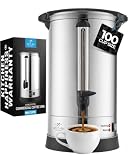
When the guest list reaches 60 or more, a 100-cup urn removes the need for repeated brewing. The manufacturer describes the unit as a 1,500-watt, 120-volt stainless-steel percolator that serves 100 five-ounce cups, with double-wall construction, a two-way faucet, a level window and a reusable filter. Zulay says it brews at roughly one cup per minute, which means a full 100-cup batch is a long cycle, so start early rather than at doors-open.
- Capacity: 100 five-ounce cups
- Style: percolator-style urn
- Construction: double-wall stainless steel
- Dispensing: two-way faucet with level window
- Power: 1,500 watts at 120 volts, per the maker
- Dimensions and weight: sources disagree, so confirm on listing
Pros
- Largest capacity in this guide
- Insulated body and cool-touch handles help with safe serving
Cons
- Percolated coffee has a different flavor profile than drip
- Heavy and tall when full, so it needs a stable table
Percolator-style brewing recirculates hot water through the grounds, so use a coarser grind than you would for drip and watch the cycle so the batch does not over-extract. Against the Hamilton Beach urns it offers more than double the capacity, but it takes longer to fill and brew.
5. Hamilton Beach 45-Cup Urn (two-way lever listing) – Best for Mid-Size Gatherings

This listing carries the same 45-cup, 15-to-45-cup, one-minute-per-cup branding as the other Hamilton Beach urn here, with a two-way lever noted in the title. The wording “two-way lever” suggests a spout that supports both single-cup pours and continuous fill, which helps when someone is topping up a thermos or large carafe. Because the product code differs from the other Hamilton Beach listing, double-check the model number on the page, the included filter basket and the warranty terms before choosing between them.
- Capacity: 15 to 45 cups, per the listing title
- Style: coffee urn and hot beverage dispenser
- Finish: silver, per the listing title
- Spout: two-way lever, per the listing title
- Model number and wattage: confirm on listing
Pros
- Flexible batch size, from 15 up to 45 cups
- Lever spout is easier to use for repeated pours
Cons
- Overlaps heavily with the other Hamilton Beach urn
- Not the right size for crowds above 45 people
It suits churches, classrooms and community groups that serve in small, repeated pours rather than one big rush. It is nearly interchangeable with the fast-brew model below, so the final choice comes down to spout style and how the page describes the model.
6. Hamilton Beach 45-Cup Fast-Brew Urn – Best Overall for Group Service

The Hamilton Beach 40521 family is the best-documented machine here. The instruction manual lists an electrical draw of 1,500 watts at 120 volts and a 45-cup fill of about 6.7 liters, which lines up with the commercial five-ounce-cup convention. The listing advertises fast brewing at about a minute per cup, and retail pages quote roughly 28 minutes for a full 45-cup batch, which works out to a little under a minute per cup. It has dual heaters to hold coffee warm and a ready light.
- Capacity: 15 to 45 cups
- Power: 1,500 watts at 120 volts, per the manual
- Heaters: dual heaters with a ready light
- Filter: removable basket that uses paper filters
- Reported size: about 12 by 12 by 15 inches; confirm on listing
Pros
- Clear documentation and a recognizable model number
- Fast enough for groups of 30 to 45 without constant babysitting
Cons
- Aluminum construction rather than stainless steel
- Single batch size cap of 45 cups
Use cold, fresh water, measure the grounds to the line shown in the manual and keep the lid closed while it brews. Compared with the Zulay urn it is smaller, but it is simpler to clean and brews a full load quicker overall.
Specs Compared
| Product | Type | Capacity | Power | Vessel / body | Brew time |
|---|---|---|---|---|---|
| VEVOR 12-Cup (first) | Drip brewer | 12 cups | Confirm on listing | Stainless body, glass carafes | Confirm on listing |
| VEVOR 24-Cup Dual-Head | Dual-head drip | 24 cups | Confirm on listing | Stainless body, glass carafes | About six minutes on a related page; confirm |
| VEVOR 12-Cup (second) | Drip brewer | 12 cups | Confirm on listing | Stainless body, glass carafes | Confirm on listing |
| Zulay 100-Cup | Percolator urn | 100 five-ounce cups | 1,500 W, 120 V (maker) | Double-wall stainless steel | About one cup per minute (maker) |
| Hamilton Beach 45-Cup (lever) | Urn | 15 to 45 cups | Confirm on listing | Silver finish | Listed as about one minute per cup |
| Hamilton Beach 45-Cup Fast Brew | Urn | 15 to 45 cups | 1,500 W, 120 V (manual) | Aluminum, removable filter basket | About 28 minutes for 45 cups (retail pages) |
How We Chose These
This guide is built from desk research rather than product use. We started with the six listings in the catalog, then compared their titles, specification fields and the manufacturers’ own documentation where it was available. Capacity, power draw, construction and dispensing style carried the most weight, because those are the details that decide whether a machine fits a counter, a circuit and a crowd. Where a listing did not state a value, the table says to confirm it on the product page rather than guessing. Where two listings look almost identical, we say so rather than inventing a difference, and we note which numbers come from a manufacturer page and which come from a sibling model.
What to Look For
Match the machine type to your service pattern
Drip brewers with glass carafes suit steady, all-day service. You brew a pot, set it on a warming plate and start the next one, which gives you a rolling supply. Urns suit events and wave-style demand: you brew one large batch ahead of time and dispense from a single spout. A dual-head brewer sits in between and is the right choice when two pots need to brew at once. If your coffee sells quickly, sizing for the peak hour matters more than sizing for the average hour.
Do the cup math honestly
Commercial “cups” are usually five ounces, not the eight- or twelve-ounce mug most people actually pour. A 12-cup batch is about 60 ounces, which is only five or six real mugs. A 45-cup urn holds about 225 ounces and a 100-cup urn about 500 ounces. As a rule of thumb, divide the number of guests by the number of cups you expect each person to drink, then multiply by the actual mug size and compare it to the total ounces. If you expect 60 guests to drink one 10-ounce mug each, you need about 600 ounces, which is more than a 100-cup urn holds in a single batch.
Check electrical load before you buy
A standard 120-volt, 15-amp circuit supplies about 1,800 watts at most, and continuous loads are normally kept below 80 percent of that. A 1,500-watt urn is near the limit on its own, so do not share its outlet with a microwave, toaster or second brewer. A dual-head brewer that lists more than one heating element can exceed what a single outlet delivers, so read the voltage and amperage on the listing, and ask an electrician if a dedicated circuit is needed. Never use a thin extension cord with a high-wattage coffee machine.
Materials, cleaning and safety
Stainless-steel interiors resist staining and are easier to keep clean than aluminum, though aluminum urns often weigh less and heat quickly. Look for removable filter baskets, a drain or spigot that comes apart, and a level window so staff can see how much is left. Hot urns are tipping and scald hazards: place them on a stable surface away from the edge, use the cool-touch handles and never move one full. Descale and clean them regularly according to the manufacturer’s directions.
Warming, holding time and quality
Coffee loses quality as it sits. Glass pots on warming plates are fine for short holds, while insulated urns hold temperature longer but can taste stale if the coffee sits for hours. As a practical rule, plan batches to be consumed within the first hour or two and rebrew instead of stretching one batch all afternoon.
Placement and workflow
Put the machine near a water source and a drain if you can, with enough clear space above it to lift lids and baskets. Keep cups, stirrers and filters within arm’s reach so one person can serve without crossing a busy aisle. Let the unit cool before you clean it, and keep cords away from wet areas and walkways.
A short buying checklist
Before you order, write down four numbers: peak guests per hour, ounces per serving, the outlet’s amperage and the counter space you can spare. Then compare them with the capacity, listed wattage and dimensions on the product page. If any of those fields is blank, ask the seller or read the manual, since a mismatch is far more expensive to fix after delivery than before. Add a few spares as well: a backup glass pot, a box of filters and a cleaning product, because a brewer without them is only half a setup.
Questions
How many cups does a “12-cup” commercial coffee maker actually make?
In the commercial convention, 12 cups is about 60 ounces, or roughly 1.8 liters. That is closer to five or six standard mugs. Always convert the listed cup count to ounces before comparing machines.
Is an urn or a drip brewer better for a small cafe?
A drip brewer with glass pots is usually better for steady daily sales because you can brew small batches and swap pots. An urn is better for events. Many cafes use a brewer for service and an urn only for catering.
Do I need a dedicated circuit?
Not always, but high-wattage machines should not share a circuit with other heavy appliances. A 1,500-watt urn takes most of a 15-amp circuit. Confirm the listed power on each machine and consult an electrician if you plan to run more than one.
Can I use these machines at home?
Yes, and some listings mention home use. The tradeoff is size and electrical draw. For a household that entertains occasionally, a 45-cup urn is plenty.
What filters do the Hamilton Beach urns use?
The Hamilton Beach manual describes a removable filter basket that takes paper filters. Check the manual for the exact filter size and whether a reusable filter is acceptable before buying supplies in bulk.
How often should I clean a commercial coffee maker?
Rinse removable parts after each use and run a descale and cleaning cycle on the schedule in the manufacturer’s manual. Harder water usually calls for more frequent descaling. A dedicated coffee equipment cleaner is the usual choice for oily residue.
What is the difference between percolating and dripping?
A percolator cycles hot water repeatedly over the grounds, while a drip brewer passes water through them once. Percolated coffee is usually bolder and can turn bitter if left running too long, while drip is cleaner and more predictable. Most large urns use the percolator approach because it works well at scale.
Update History
- October 21, 2026 – Initial publication; product set drawn from current catalog listings.
- Check the product page for current specifications and availability before buying.
Sources
- Manufacturer product and specification pages for VEVOR, Zulay and Hamilton Beach
- Hamilton Beach instruction manual for the 45-cup urn
- Retailer listing titles and specification fields
Write Your Review
No reviews yet. Be the first to share your experience!