

Key takeaways
- Descaling. Hard water leaves scale in the tank and spray head, which lengthens brew times and cools the water. Descale every one to three months depending on water hardness, and consider a water filter sized for coffee brewers.
- Spray heads. A clogged spray head leaves dry spots in the basket and under-extracts the coffee. Remove and soak the head weekly.
- Warmers. Warmer plates burn coffee oils on to glass and steel. Wipe daily, and never leave a pot on for longer than an hour.
- Decanters. Glass breaks. Stock spares, or switch to thermal servers for places with frequent traffic.
- Electrical. Higher-output units need dedicated circuits. A 120 V brewer at 1600 W uses a large share of a 15 amp circuit, so avoid plugging a toaster or microwave into the same line.
- Warranty and service. Ask local suppliers about parts and service for the brand you choose before buying.
The best commercial coffee brewer for most small businesses is the Bunn VP17 pourover series, because it needs no plumbing, brews about 3.8 gallons an hour, and is widely serviced. Operations with a water line and heavy morning rushes are better served by a plumbed automatic such as the Wilbur Curtis G3 ThermoPro or the Fetco CBS-2131 XTS, while offices and cafes that only need a few pots a day can get by with a Technivorm Moccamaster or a Bonavita Connoisseur. The right choice depends on your peak-hour volume, whether you have a water line behind the counter, and who will be cleaning the machine.
Commercial brewers are sized in gallons per hour, not cups, and they are built for repeated brewing through the day with stainless water paths and replaceable parts. This guide compares seven real models and series by output, plumbing, footprint and ownership realities. Specifications come from manufacturer and dealer listings and a few vary by configuration, so confirm the exact part number before ordering, particularly voltage, since many commercial brewers come in 120 V and 240 V versions with very different output.
Quick comparison of the seven picks
| Pick | Best for | Output | Water supply | Notes |
|---|---|---|---|---|
| Bunn VP17-1 | Best overall pourover | About 3.8 gal/hr | Pour-in, no plumbing | 1600 W, one lower warmer, about 17.8 in tall |
| Bunn VP17-3 | Best for service counters | About 3.8 gal/hr | Pour-in, no plumbing | Three lower warmers, fits under standard cabinets |
| Bunn VPR-2GD | Best value office kit | Pourover class | Pour-in, no plumbing | Reported to include two decanters and dual warmers |
| Wilbur Curtis G3 ThermoPro | Best plumbed high volume | Up to about 12 gal/hr on 220 V single | Plumbed | 1.5 gal batch, stainless water path, thermal servers sold separately |
| Fetco CBS-2131 XTS | Best programmable | 3.9 to 9.7 gal/hr by configuration | Plumbed, 1/4 in flare per manual | 1 gal batch, touchscreen, batch copying |
| Moccamaster KBGV Select | Best small-office | 40 oz (1.25 L) per batch | Pour-in | 1475 W, 5-year warranty, glass carafe |
| Bonavita Connoisseur BV1901TS | Best budget thermal | 8 cups in about six minutes | Pour-in | SCA-certified thermal brewer |
What “commercial” actually means
A commercial brewer is one built for repeated, high-volume use, usually with a stainless steel tank that holds hot water ready to brew, a spray head that wets the grounds evenly, and a design that meets food-service sanitation standards such as NSF listing. The key difference from a home drip machine is recovery: after a batch, a commercial tank reheats fast enough that you can brew again within minutes. Home brewers cannot keep up with that. For an office with ten people, a good home-grade brewer may be enough, but for a restaurant, church, caterer or breakroom serving dozens of cups an hour, commercial equipment pays back in reliability and speed.
Best overall: Bunn VP17-1
The VP17-1 is a stainless pourover brewer that brews up to 3.8 gallons per hour into standard decanters. You pour water in by hand, so it needs no plumbing, and it runs on a standard 120 V circuit at about 1600 W (13.3 amps). Typical dimensions are about 8 inches wide, 17.7 inches deep and 17.8 inches tall, with one lower warmer.
Who it suits: cafes without a dedicated water line, food trucks, offices, churches, and any business that moves the machine between locations. Bunn’s pourover line is among the most common brewers in food service, which makes parts and service easy to find.
Pros: no plumbing required, fast, standard 120 V power, easy to replace parts. Cons: you fill it by hand, so someone must pour water for every batch, and the water tank takes space and time to heat when first turned on. A single warmer also limits how many pots you can hold at once.
Best for service counters: Bunn VP17-3
The VP17-3 is the three-warmer version of the same pourover brewer. Its height of about 17.3 inches lets it slide under standard kitchen cabinets, and it includes a splash-guard funnel. Decanters are typically sold separately, so confirm what is in the box. Guides disagree on brew time, with figures between about 90 seconds and about 3 minutes per pot, which likely reflects different decanter sizes and configurations.
Who it suits: operations that need to hold several pots of different coffees, such as regular, decaf and a dark roast, on the same counter.
Pros: three warmers, low profile, same plumbing-free design. Cons: more warmers draw more power in aggregate, and coffee left on a warmer for over an hour begins to taste stale. Plan to brew in small batches and discard pots after about an hour.
Best value office kit: Bunn VPR-2GD
The VPR series is a related pourover line, and the VPR-2GD is described by one 2026 guide as a good-value office choice because it ships with two glass decanters and dual warmers. As with the VP17 line, there is no plumbing requirement and output is in the same pourover class.
Who it suits: small offices, break rooms and waiting areas where staff pour water themselves and the main goal is hot coffee without a service call.
Pros: ready to use out of the box with decanters, familiar Bunn design. Cons: glass decanters break, so keep spares, and the machine’s standard brew basket is sized for pots, not for the large batches that plumbed brewers do.
Best plumbed high-volume brewer: Wilbur Curtis G3 ThermoPro
The Wilbur Curtis G3 ThermoPro line covers single and twin versions in 1.0 and 1.5 gallon batch sizes. Its stainless steel water path resists corrosion, and the G3 control board lets you select one, two or three batches. Output depends on voltage and configuration, with one 1.5 gallon single listed at 4.5 gallons per hour on 120 V and 12 gallons per hour on 220 V, and a twin listed at 15 to 21 gallons per hour. The single stands about 35 inches tall, so check the clearance on your counter.
Who it suits: restaurants, hotels, convenience stores and cafeterias that serve large numbers of customers at peak times and have water and electrical service behind the counter.
Pros: high output, strong build, serviceable parts, dispenser options for thermal servers. Cons: it needs plumbing and, for the highest output, 220 V power. The size is considerable, and thermal servers are an extra purchase.
Best programmable: Fetco CBS-2131 XTS
The Fetco CBS-2131 XTS is a 1 gallon (3 liter) single brewer with a touchscreen. Output depends on the configuration code, with listings showing 3.9 gallons per hour on one 120 V version, 5.8 on another 120 V version and 9.7 on a 240 V version. The unit measures about 11.75 inches wide, 20.4 inches deep and 26.25 inches tall, and weighs 29 lb empty. Features include a cascading spray dome, brew basket sensors, a manual hot water faucet and the ability to copy a batch recipe from one unit to another. The manual specifies a 1/4 inch flare water connection with a minimum flow, while one dealer lists a 3/8 inch inlet, so verify against the model number before the plumber arrives.
Who it suits: specialty cafes that run several coffees and want to dial in brew volume, time and temperature for each.
Pros: programmable, consistent, compact. Cons: more complex than a pourover, so training and descaling matter, and the control board is a point of failure.
Best small-office brewer: Technivorm Moccamaster KBGV Select
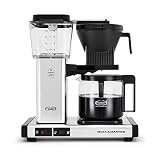
The Moccamaster is not a true commercial brewer, but it is the benchmark for small offices and workgroups. The KBGV Select brews 40 ounces (1.25 liters, ten cups) in four to six minutes with a hand-built copper boiler, a selector for half or full carafe, and a drip-stop basket. It draws 1475 W, measures about 14 inches tall, and carries a five-year warranty. Its brewing temperature falls within the range recommended by the Specialty Coffee Association.
Who it suits: offices of up to about ten people, small shops that brew a pot at a time, and anyone who values taste over speed.
Pros: excellent cup quality, long warranty, simple. Cons: one carafe at a time, and the glass carafe breaks. It cannot keep up with a rush.
Best budget thermal: Bonavita Connoisseur BV1901TS
The Bonavita Connoisseur is an eight-cup brewer with a thermal carafe, and it is often called the least expensive SCA-certified brewer of its kind. It brews a full batch in about six minutes.
Who it suits: tiny offices and waiting rooms that value reliable temperature and a carafe that keeps coffee hot without a warmer plate.
Pros: low cost, SCA certification, thermal carafe prevents scorching. Cons: eight cups does not scale to a crowd, and it is a home-grade machine, so heavy use will shorten its life compared with a Bunn or Curtis.
How to size a commercial brewer with numbers
A standard cup in food service is about 6 to 8 oz, and a gallon holds 128 oz. That means one gallon gives roughly 16 to 20 cups, and a 3.8 gallon per hour brewer can produce 60 to 80 cups an hour in the right conditions.
- Estimate peak demand. Count the cups needed in your busiest hour. A 40-seat cafe might pour 50 to 70 cups in the morning peak.
- Add a margin. Size for about 25 percent over peak to cover refills and to avoid holding coffee past its best.
- Match output to need. 70 cups an hour is about 3.5 to 4.4 gallons, so a VP17 is just enough, while two VP17s or a plumbed 1.5 gallon unit gives headroom.
- Check holding capacity. If you want multiple varieties on hand, count warmers or thermal servers.
A worked example: a church fellowship hall serving 100 people after service needs about 100 cups in 20 to 30 minutes. That is 12 to 15 gallons. A single VP17-1 would need three to four hours, so the church would be better with a plumbed unit that does batches of 1.5 gallons, or several urns filled in advance.
Decision matrix by situation
| Your situation | Best match | Reason |
|---|---|---|
| No water line, moderate demand | Bunn VP17-1 | Pour-in, 120 V, 3.8 gal/hr |
| Need several coffees on warmers | Bunn VP17-3 | Three lower warmers |
| Small office, basic needs | Bunn VPR-2GD | Decanters and warmers bundled |
| Busy restaurant with water line | Wilbur Curtis G3 ThermoPro | High output, serviceable |
| Specialty cafe, programmable recipes | Fetco CBS-2131 XTS | Touchscreen, batch copy |
| Under ten people, quality first | Moccamaster KBGV Select | Cup quality, warranty |
| Tiny office, tight budget | Bonavita Connoisseur | Thermal carafe, low cost |
Ownership realities: cleaning, descaling and wear
- Descaling. Hard water leaves scale in the tank and spray head, which lengthens brew times and cools the water. Descale every one to three months depending on water hardness, and consider a water filter sized for coffee brewers.
- Spray heads. A clogged spray head leaves dry spots in the basket and under-extracts the coffee. Remove and soak the head weekly.
- Warmers. Warmer plates burn coffee oils on to glass and steel. Wipe daily, and never leave a pot on for longer than an hour.
- Decanters. Glass breaks. Stock spares, or switch to thermal servers for places with frequent traffic.
- Electrical. Higher-output units need dedicated circuits. A 120 V brewer at 1600 W uses a large share of a 15 amp circuit, so avoid plugging a toaster or microwave into the same line.
- Warranty and service. Ask local suppliers about parts and service for the brand you choose before buying.
Common mistakes
Buying on capacity alone is the biggest one. A brewer with a large tank but a slow recovery time still makes you wait between batches. Another is ignoring the filter size and basket, which should match the filters you can buy easily. Finally, many businesses overlook the quality of the water, even though coffee is about 98 percent water, so a basic filter can improve taste and protect the equipment.
Coffee quality in a commercial brewer
Volume is only half the story, because a brewer that makes plenty of weak or scorched coffee loses customers. Three variables control extraction in any batch brewer: the ratio of coffee to water, the water temperature at the grounds, and the contact time. The Specialty Coffee Association’s brewing guidance points to a ratio of roughly 55 grams of coffee per liter of water and a brewing temperature of about 92 to 96 degrees Celsius, with a total brew time of around four to eight minutes for automatic drip. Pourover commercial machines such as the Bunn VP17 line spray heated water over the grounds in a pattern designed to wet the whole bed, and the plumbed Fetco and Curtis brewers let you program pulse or bypass settings to fine-tune the result.
Grind size must match the basket. Commercial baskets are deep and flat, so a medium grind works for most, while finer grinds can overflow the filter and coarser grinds under-extract. Pre-ground packs sold for food service are cut to suit this, but a commercial grinder next to the brewer gives noticeably fresher results. Because large batches sit longer, consider brewing into thermal servers or an airpot and discard anything held past an hour or two. Finally, keep a simple log of dose and brew time each day. If a pot starts tasting thin, the first checks are the dose, the spray head and the water temperature, in that order, and those checks cost nothing.
Staffing also shapes the choice. A plumbed, programmable unit lets a new employee press one button and get a consistent pot, which matters when turnover is high. A pourover machine is more forgiving to repair but depends on the person filling it measuring water correctly, so mark the fill line on the pitcher. In many small businesses, the cheapest way to improve coffee is training one person to own the descaling and cleaning schedule, because neglected equipment is the most common cause of bitter or flat coffee, regardless of brand or price.
Frequently Asked Questions
Do I need plumbing for a commercial coffee brewer?
Not necessarily. Pourover brewers like the Bunn VP17 series take water poured in by hand and run on a normal outlet. Automatic plumbed brewers like the Fetco and Wilbur Curtis units connect to a water line and save labor at busy times.
How many cups per hour does a commercial brewer make?
A VP17-class pourover brews about 3.8 gallons an hour, which is roughly 60 to 80 cups. Plumbed units range widely by voltage and configuration, from about 4 to over 20 gallons an hour.
Can I use a commercial brewer at home?
Yes, if you have the counter space and a suitable circuit. A VP17 is compact enough for a large kitchen, though most households will be happier with a Moccamaster or similar home-grade machine.
How long can coffee sit on a warmer?
Quality drops noticeably after about 30 to 60 minutes on a hot plate. Use thermal servers if you need to hold coffee longer, and brew smaller batches more often.
What is the difference between 120 V and 240 V brewers?
Higher voltage lets the heating element deliver more power, which means faster recovery and higher hourly output. The same model may list quite different gallons per hour at each voltage, as with the Fetco XTS configurations.
How often should I descale a commercial brewer?
Every one to three months in most cases, and more often with hard water. Slower brewing, lower water temperature or a sputtering spray head are signs it is overdue.
Write Your Review
No reviews yet. Be the first to share your experience!