

Key takeaways
- Compare five cup rinsers for home bars, from deck-mount glass rinsers to a two-in-one sprayer model, and match the mount, jets, and finish to your sink.
A cup rinser is a small plumbed station that sits beside the kitchen sink and rinses the inside of a cup, glass, or milk pitcher with a fan of pressurized water the moment it is pressed down over the spray head. The best choice for most home coffee bars is the Delta Glass Rinser, because it fits a standard countertop hole, connects to the cold water line with the parts in the box, and rinses everything from an espresso cup to a tall travel tumbler with the same press-down motion. The five rinsers in this guide all do the same core job, which is to flush out milk film, coffee residue, and rinse water in a few seconds, without a sink full of soapy water and without a brush that never quite reaches the bottom of a narrow cup. Each one mounts differently, sprays differently, and suits a different sink, so the deciding factor is always the hole in the counter and the cups on the shelf.
These rinsers solve a small problem that repeats every day, and the repetition is the point. A milk pitcher that sits unrinsed between drinks grows a film that bakes on the next time the pitcher is steamed, an espresso cup that is only swirled under the tap keeps a ring of dried coffee at its base, and a baby bottle or a narrow travel cup cannot be reached by any brush at all. A cup rinser answers all three with the same motion: turn the cup upside down, press it onto the spray head, and the jets reach where a hand cannot. None of the five here is a pitcher-only station of the kind that needs a drain tray and a plumbed drain, and none of them is a detergent dispenser. They are water-only rinse stations, and the differences that matter are the mount, the spray pattern, the material, and what comes in the box.
As an Amazon Associate, we earn from qualifying purchases.
Table of Contents
- Why a Cup Rinser Earns Its Place
- How to Choose a Cup Rinser
- Quick Comparison
- Delta Glass Rinser, SpotShield Stainless
- Kraus CleanMate Glass Rinser, Spot-Free Stainless
- Delta Metal Glass Rinser, Matte Black
- AquatiQ Two-in-One Glass Rinser and Sprayer, Nickel
- Focket Rotating Glass Washer, Silver
- How to Install a Cup Rinser
- Who Should Skip a Cup Rinser
- Safety and Recall Checks
- Frequently Asked Questions
- Conclusion
- Product and ASIN Reference
Why a Cup Rinser Earns Its Place
The first reason a cup rinser earns its place is that it rinses the inside of a vessel a hand cannot reach. An espresso cup is short and wide, so a rinse under the tap does the job, but a milk pitcher is tall and narrow, a travel tumbler is taller still, and a baby bottle is narrower than any brush head. A rinser does not care about the shape: the cup goes upside down over the spray head, the rim presses the actuator, and the jets spray upward into the vessel from below, reaching the base and the corners that a sponge never touches. The water then runs straight down into the sink, so there is no puddle on the counter and no second rinse to chase the first.
Milk film is the second reason, and it is the one that matters most beside an espresso machine. Steamed milk leaves a thin protein film on stainless steel within minutes, and that film hardens every time the pitcher is steamed again without a rinse in between. A pitcher that is rinsed under the tap between drinks still keeps a faint film at the base, because tap water runs down the walls rather than spraying up into them. A rinser blasts the film off with pressurized jets while it is still soft, which keeps the pitcher clean enough that a weekly deep wash is enough, and it keeps the next round of milk tasting clean rather than carrying the sour note of old milk residue. The same logic holds for espresso cups: a cup rinsed on a rinser between shots has no dried coffee ring waiting for the next pour.
Speed is the third reason, and it shows up in the morning rush. A rinse on a rinser takes a few seconds, and it takes one hand, so the other hand is free to wipe the steam wand, knock out the puck, or set the next cup on the drip tray. A rinse under the tap takes longer, uses both hands, and leaves the cup dripping over the counter on its way back to the tray. A household that pulls two or three drinks in a row will feel the difference by the second drink, and a household that hosts a weekend brunch will feel it by the fifth cup. The rinser does not make the coffee, but it removes the slowest step between one drink and the next.
Water use is the fourth reason, and it runs against the first impression. A rinser looks wasteful, since it sprays water at full pressure, but each rinse lasts only a few seconds and the spray stops the moment the cup lifts off the actuator. A tap left running while a pitcher is scrubbed and rinsed uses far more water over the same job, and a sink half filled for soaking uses more still. The rinsers in this guide run at about 1.2 gallons per minute at standard household pressure, and a three-second rinse therefore uses a small fraction of a gallon. A household that rinses every cup on a rinser will use less water than a household that rinses every cup under a running tap, and the cups will be cleaner for it.
The last reason is the counter itself. A cup rinser mounts in a hole that most kitchens already have and never use: the hole left by a soap dispenser, a sink sprayer, or a hole cover. That hole is usually the most useless square inch on the counter, and a rinser turns it into the most used one. The rinser sits low and flat beside the sink, it does not take counter space the way a drying rack does, and it drains into the sink, so nothing extra needs plumbing. The five rinsers here all mount in a standard hole, and the guide below matches each one to its sink, so the part that arrives is the part that fits the hole that is already there.
How to Choose a Cup Rinser
Start with the hole, not the rinser, because the hole decides everything else. Most kitchen sinks have a spare hole of about one and one-eighth inches in diameter, left by a soap dispenser or a sink sprayer, and most rinsers in this guide are made to fit exactly that hole. Measure the hole before ordering, and measure the distance from the centre of the hole to the edge of the sink basin: the rinse water has to fall into the basin, so a hole more than about three inches from the basin edge will spray onto the counter instead. Also measure the distance from the hole to the backsplash or to any raised lip on the sink, since a rinser needs about two and one-quarter inches of clearance behind it for the cup to tilt onto the spray head without hitting the wall. When the hole is the wrong size or in the wrong place, the fix is a different hole, not a different rinser.
Next, decide between a plastic-body rinser and a metal-body rinser, because the five rinsers here split on that line. A plastic-body rinser with a stainless finish is lighter, easier to install, and gentler on a thin countertop, and it is the sensible pick for a rented kitchen or a first rinser. A metal-body rinser with a brass base is heavier, stiffer, and harder to scratch, and it is the pick for a household that will press a heavy pitcher onto it several times a day for years. Both kinds spray the same way, and both kinds connect to the same water line, so the choice is about feel and longevity rather than function. A household that wants the lowest maintenance should look at the finish as well: a finish that resists fingerprints and water spots will look clean with a wipe, while a polished finish will show every drop.
The spray head comes third, and the difference is between a single central jet and a ring of jets. A single central jet is simple and strong, and it suits wide cups and pitchers that sit squarely over the centre. A ring of jets reaches the walls of the vessel as well as the base, and it suits narrow bottles and tall tumblers that need the spray to spread. The number of jets is the simplest way to compare: the rinsers in this guide range from a single central spray to nine separate jets arranged around the head. More jets mean more coverage, but they also mean more water per second, so a household on a well or a low-pressure supply should check the flow rate in the listing before choosing the busiest head.
Then check the flow rate, because it decides how fast the rinse is and how much water it uses. The rinsers in this guide that publish a flow rate list about 1.2 gallons per minute at 60 pounds per square inch, which is a strong rinse that still stops the moment the cup lifts off. A rinser with a higher flow rate will rinse faster, but it will also spray harder, which can splash a shallow cup, and it will use more water per rinse. A household with low water pressure should pick a rinser with fewer jets, since fewer jets keep the pressure up at each opening, and a household with high pressure should pick a rinser with a cover, since a cover stops an accidental press from spraying the ceiling.
The fittings in the box come after the flow rate, and they decide whether the install is a half-hour job or a trip to the hardware store. A complete kit includes the rinser, a tee adapter that splits the cold water line, a supply hose, washers, a mounting nut, and a cover for the spray head. Some rinsers in this guide ship with all of that, and some ship with the rinser and the hose only, expecting the tee to come from the plumbing aisle. Check the pack contents line in the listing before ordering, and check the thread size on the supply connection, since a connection that does not match the shut-off valve under the sink will need an adapter that is not in the box.
Finally, think about the cup sizes on the shelf, because a rinser has a minimum and a maximum opening. The smallest cup that will rinse on most of these rinsers has an opening of about one inch across, and the largest has an opening of about three and six-tenths inches across. A narrow espresso cup, a standard mug, a milk pitcher, a wine glass, and a baby bottle all fall inside that range, but a wide soup bowl does not, and a very narrow spice jar does not either. Measure the smallest and the largest vessels the household actually rinses, and compare them with the range in the listing before ordering, since a rinser that cannot take the pitcher is a rinser that does not earn its place beside the machine.
Finally, match the finish to the tap and check what spares exist, because a rinser is a fixture the household will see every day. A stainless finish matches a stainless faucet, a matte black finish matches dark fixtures, and a nickel finish sits between the two, so the rinser looks like part of the sink rather than an afterthought. Check whether the maker sells a replacement actuator, washers, and a cover, since those are the parts that wear first, and a rinser with spares available will last years longer than one without. A cover matters more than it looks: it stops an accidental press, it keeps dust and grounds out of the spray head, and it keeps the rinser looking tidy between uses, so a household that wants the neatest deck should treat a cover as a requirement rather than an extra.
Quick Comparison
| Product | Body | Spray | Flow Rate | Mount |
|---|---|---|---|---|
| Delta Glass Rinser, SpotShield Stainless | Plastic with stainless finish | Central jets with Touch-Clean holes | 1.2 GPM | Single-hole deck mount |
| Kraus CleanMate Glass Rinser, Spot-Free Stainless | Stainless steel and plastic | Nine jets | 1.2 GPM | Deck mount |
| Delta Metal Glass Rinser, Matte Black | Brass with matte black finish | Central jets | 1.2 GPM | Single-hole deck mount |
| AquatiQ Two-in-One Glass Rinser and Sprayer, Nickel | Stainless steel | Rinser jets plus pull-out sprayer | Check listing | Standard counter hole |
| Focket Rotating Glass Washer, Silver | ABS and stainless steel | Rotating spray with basin | Check listing | Hose and tee connection |
Delta Glass Rinser, SpotShield Stainless

The Delta Glass Rinser is the best overall pick in this guide, and its balance is the reason. It is the rinser that fits the most kitchens with the least fuss: it drops into a standard single countertop hole, it connects to the cold water line with the tee adapter in the box, and it rinses everything from a small espresso cup to a tall travel tumbler with the same press-down motion. The body is plastic with a SpotShield stainless finish, which is the finish that resists fingerprints and water spots, so the rinser looks clean with a wipe rather than a scrub. The footprint is compact, about 4.5 inches wide by 4.0 inches long and 1.5 inches high, which leaves room for the faucet and the soap dispenser on a crowded deck.
The spray is the detail that sets this rinser apart from a plain tap rinse. High-pressure water jets reach into the cup where a hand cannot, and the Touch-Clean spray holes let lime and calcium buildup be wiped away with a fingertip rather than picked out with a pin. The rinser is rated at a maximum flow of 1.2 gallons per minute at 60 pounds per square inch, which is a strong rinse that still stops the moment the cup lifts off the actuator, so a three-second rinse uses only a small amount of water. The minimum drinkware opening is about one inch across, and the maximum is about three and six-tenths inches, which covers an espresso cup, a standard mug, a milk pitcher, a wine glass, a baby bottle, and a travel cup in one range.
The fit is the other strength, because one part covers so many sinks. The rinser installs in an empty standard countertop hole, such as the hole used for a soap dispenser or a sink sprayer, and it can also be installed in a sink deck hole where one is free. The kit includes the tee adapter for an easy connection to the water line, and it includes a cover accessory that sits over the spray head when the rinser is not in use, which stops an accidental press from spraying the counter. The sleek, low-profile design coordinates with most faucets, so the rinser looks like it belongs beside the tap rather than like an add-on that arrived later.
The limits are the ones that come with a plastic body. The rinser is not a heavy brass fixture, and a household that presses a heavy pitcher onto it hard, several times a day, will feel the difference against a metal-body rinser over years of use. The plastic body is also the reason the rinser is easy to install and gentle on a thin countertop, so the trade is real in both directions. Buy the Delta Glass Rinser when the sink has a standard spare hole and the household wants the simplest, most forgiving rinser in this guide, and skip it when the household wants a solid metal body or a second sprayer built into the same hole.
Specs
- Form Deck-mount glass and cup rinser
- Material Plastic body with SpotShield stainless finish
- Size About 4.5 inches wide by 4.0 inches long by 1.5 inches high
- Flow rate 1.2 gallons per minute at 60 pounds per square inch
- Spray High-pressure jets with Touch-Clean spray holes
- Drinkware opening About 1 inch minimum to about 3.6 inches maximum
- Mounting Single-hole deck mount; fits a standard soap dispenser or sprayer hole
- Includes Rinser, tee adapter, and cover accessory
- Tier Mid-range
Kraus CleanMate Glass Rinser, Spot-Free Stainless

The Kraus CleanMate Glass Rinser is the strongest sprayer in this guide, and its nine jets are the reason. Nine separate jets arranged around the spray head reach the walls of the vessel as well as the base, so a narrow baby bottle, a tall travel tumbler, and a milk pitcher with a film at its base all get rinsed in the same few seconds. The body is stainless steel and plastic in a spot-free stainless finish, which resists fingerprints and water spots, and the deck-mount form sits low beside the sink, so it does not crowd the faucet. The rinser is rated at a maximum flow of 1.2 gallons per minute at 60 pounds per square inch, which keeps the pressure up at each of the nine openings.
The safety lock is the detail that makes this rinser practical in a busy kitchen. A light press starts the spray, and a small spin of the glass after pressing locks the spray off, so a cup cannot keep spraying if it is knocked against the head by accident. That lock matters most in a household with children or in a kitchen where the rinser sits beside the cutting board, since an accidental spray at full pressure will soak the counter and anything on it. The lock is mechanical, with no electronics and nothing to charge, so there is nothing to fail and nothing to maintain.
The finish is the other strength, because a rinser lives in the wettest spot in the kitchen. The spot-free stainless finish keeps the rinser looking clean between wipes, and the stainless steel and plastic body resists rust and discoloration from daily contact with water. The rinser weighs about 0.88 pounds, which is light enough to install without help and heavy enough to sit firmly in its hole without rocking when a pitcher is pressed onto it. The deck-mount install uses a standard countertop hole, and the kit connects to the water line with the fittings in the box.
The limits are the ones that come with a busy spray head. Nine jets use more water per second than a single central jet, so a household on a low-pressure supply should check the flow before choosing this rinser, since low pressure will leave the outer jets weak. The rinser also has no cover in the box, so a household that wants the spray head covered between uses should order one separately or rely on the safety lock alone. Buy the Kraus CleanMate Glass Rinser when the household rinses narrow bottles and tall tumblers as well as cups and pitchers, and skip it when the water pressure is low or when the household wants a metal-body rinser with a cover included.
Specs
- Form Deck-mount glass and cup rinser
- Material Stainless steel and plastic
- Finish Spot-free stainless steel
- Weight About 0.88 pounds
- Flow rate 1.2 gallons per minute at 60 pounds per square inch
- Spray Nine jets with safety lock
- Mounting Deck mount in a standard countertop hole
- Tier Mid-range
Delta Metal Glass Rinser, Matte Black

The Delta Metal Glass Rinser in matte black is the solid metal pick in this guide, and its brass body is the reason. Where the plastic-body rinsers are light and forgiving, this rinser is built from brass with a matte black finish, which gives it a weight and a stiffness that a household feels every time a pitcher is pressed onto it. The rinser measures about 4.5 inches wide by 4 inches long by 1.5 inches high, and it weighs about 1.9 pounds, which is more than twice the weight of the plastic-body rinsers here. That weight holds the rinser steady in its hole, and the metal base spreads the force of each press across the deck rather than concentrating it on a plastic rim.
The finish is the other strength, because a rinser in matte black does two jobs at once. It matches a matte black faucet and a dark sink, so the rinser looks like part of the fixture set rather than an add-on, and the matte surface hides water spots and fingerprints far better than a polished finish. The rinser is rated at a maximum flow of 1.2 gallons per minute at 60 pounds per square inch, which is the same strong rinse as the other Delta rinser here, and it connects to either the hot or the cold supply line, so a household that wants a hot rinse for greasy milk film can have one. The supply line in the box is 42 inches long, which reaches the shut-off valve under most sinks without an extension.
The mounting is the same single-hole deck mount as the rest of this guide, and it fits a standard countertop hole, such as the hole used for a soap dispenser or a sink sprayer. The kit includes a matching finish cover that sits over the spray head when the rinser is not in use, and an optional spacer for sinks with raised ledges, which is the detail that saves an install on a farmhouse sink or a sink with a thick deck. The metallic base sits flat on the deck, and the mounting nut below holds it firmly, so the rinser does not rock when a heavy pitcher is pressed onto it.
The limits are the ones that come with a metal body and a dark finish. The rinser is heavier to install, and a household that is not comfortable under the sink should expect a longer install than the plastic-body rinsers need. The matte black finish also shows limescale more readily than a stainless finish in a hard-water home, so a household with hard water should wipe the head after use. Buy the Delta Metal Glass Rinser when the household wants the heaviest, stiffest rinser in this guide and a finish that matches dark fixtures, and skip it when the household wants the lightest install or a stainless finish that hides limescale.
Specs
- Form Deck-mount metal glass and cup rinser
- Material Brass with matte black finish
- Size About 4.5 inches wide by 4 inches long by 1.5 inches high
- Weight About 1.9 pounds
- Flow rate 1.2 gallons per minute at 60 pounds per square inch
- Supply Connects to hot or cold line; 42 inch supply hose included
- Mounting Single-hole deck mount with matching finish cover and optional spacer
- Tier Premium
AquatiQ Two-in-One Glass Rinser and Sprayer, Nickel
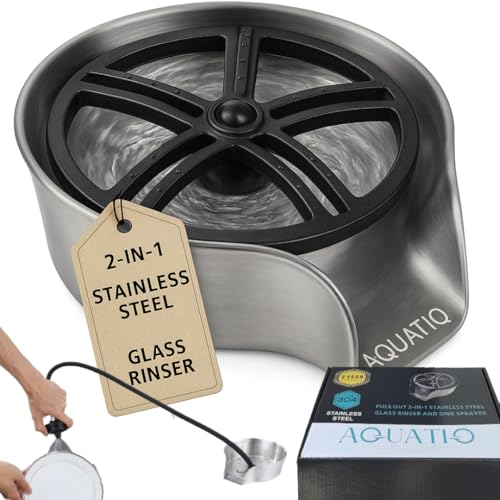
The AquatiQ Two-in-One Glass Rinser and Sprayer is the most versatile pick in this guide, and its second tool is the reason. One hole in the counter gives the household two fixtures: a press-down glass rinser for cups, pitchers, and bottles, and a pull-out sink sprayer for rinsing the basin, the cutting board, and the sink itself. A kitchen that has to choose between a rinser and a sprayer, because it has only one spare hole, does not have to choose at all with this model. The body is stainless steel in a nickel finish, which matches a stainless faucet and a stainless sink, and the two-in-one form means the sprayer is always where the rinse happens rather than across the sink.
The sprayer is the detail that changes the daily routine. A pull-out sprayer reaches around the basin, so a household can rinse a soapy sponge, wash down the sink after a messy prep, or fill a pot that does not fit under the faucet, all from the same hole that rinses the cups. The rinser head itself is a high-pressure cup washer that presses down over the spray disc, so the two functions do not interfere: the rinser works when a cup is pressed onto it, and the sprayer works when it is pulled out of its dock. The model fits standard counter holes, so it drops into the same soap dispenser or sprayer hole as the other rinsers here, and the stainless steel build resists rust and daily contact with water.
The fit is the other strength, because a two-in-one fixture has to fit two jobs into one hole. The rinser and the sprayer share one mounting, so the install is a single hole rather than two, and the fittings in the box connect both functions to the water line. A household that is remodelling a kitchen and counting holes will appreciate that arithmetic, and a household in a small kitchen will appreciate that the sprayer does not take a second hole that the soap dispenser needs. The nickel finish is a middle ground between chrome and matte black, so it matches most stainless fixtures without standing out.
The limits are the ones that come with a combined fixture. A two-in-one rinser and sprayer has more moving parts than a rinser alone, and more parts mean more seals and more places for a leak to start over years of use. The sprayer hose also needs room under the sink to pull out and retract, so a household with a crowded cabinet under the sink should check the clearance before ordering. Buy the AquatiQ Two-in-One Glass Rinser and Sprayer when the household has one spare hole and wants both a cup rinser and a sink sprayer, and skip it when the household already has a sprayer it likes or wants the simplest possible rinser with the fewest parts.
Specs
- Form Two-in-one glass rinser and sink sprayer
- Material Stainless steel
- Finish Nickel
- Mounting Fits standard counter holes
- Spray High-pressure cup washer jets plus pull-out sprayer
- Use Rinses cups, pitchers, and bottles; sprayer rinses the basin
- Tier Premium
Focket Rotating Glass Washer, Silver

The Focket Rotating Glass Washer is the budget pick in this guide, and its basin is the reason. Instead of mounting in a countertop hole, this rinser is a two-piece rotating washer with its own ABS basin, a hose, and a tee joint, so it can be set up where the household needs it rather than where the spare hole happens to be. The cup goes upside down over the spray head, the rim presses the actuator, and the spray rotates inside the cup, reaching the base and the walls while the basin catches the rinse water. The kit weighs about 639 grams, which is light enough to move between the sink and the bar, and the ABS and stainless steel build keeps it rustproof in daily use.
The rotating spray is the detail that sets this washer apart from a fixed-jet rinser. A fixed jet sprays straight up, which rinses the base well and the walls less well, while a rotating spray sweeps around the inside of the vessel, so a tall tumbler and a narrow bottle get rinsed on all sides in the same few seconds. The washer connects with a G1/2 thread, which is the standard thread for a faucet or a supply hose, and the tee joint in the box splits the water line so the washer can share a connection with the tap. The basin is the part that makes the washer work without a deck hole: the rinse water collects in the basin and drains away, so the washer can sit in the sink itself.
The portability is the other strength, because a rinser that does not need a hole does not need a permanent decision. A household that rents, a household that is not ready to drill a hole, and a household that wants a rinser at a second sink can all use this washer without changing the counter. The two-piece kit packs away when it is not needed, and it sets up again in minutes, which suits a household that hosts a brunch once a month and wants a rinser for the day rather than a fixture for the decade. The silver finish matches most sinks and taps, so the washer does not look out of place beside the basin.
The limits are the ones that come with a portable basin washer. The washer is not a deck-mount fixture, so it does not have the low, flat profile of the rinsers above, and it takes up space in the sink while it is in use. The ABS basin is also lighter than a metal deck mount, so a heavy pitcher pressed hard onto the spray head can shift the washer if it is not held steady. Buy the Focket Rotating Glass Washer when the household wants a rinser without drilling a hole, or wants a second rinser for a bar sink, and skip it when the household wants a permanent, low-profile fixture in a standard countertop hole.
Specs
- Form Rotating glass washer with basin
- Material ABS and stainless steel
- Weight About 639 grams
- Connection G1/2 thread with hose and tee joint included
- Spray Rotating spray head
- Includes Washer kit in two pieces, ABS basin, hose, tee joint, and manual
- Tier Budget
How to Install a Cup Rinser
Installing starts with the water off, because the rinser connects to the supply line under the sink and a live line will spray the cabinet. Shut off the cold water at the valve under the sink, open the tap to release the pressure, and lay a towel in the cabinet to catch the water that is left in the line. Remove the soap dispenser, the sink sprayer, or the hole cover from the spare hole, and clean the deck around the hole, since old sealant and grime will keep a new rinser from sitting flat.
Next, set the rinser into the hole from above, with the spray head facing up and the overhang pointing toward the basin, so the rinse water falls into the sink rather than onto the counter. From below, fit the rubber washer, the metal washer, and the mounting nut onto the threaded body, and tighten the nut by hand first, then with a wrench for a final quarter turn, so the rinser sits firmly without cracking a thin deck. A rinser that rocks in its hole will leak around the base and will spray unevenly, so check the fit by pressing the actuator with a cup before connecting the water.
Then connect the water line. Fit the tee adapter onto the cold water shut-off valve, connect the supply hose from the tee to the rinser, and tighten both connections with a wrench, taking care not to cross the threads. Turn the water back on slowly and watch every joint for a drip, since a slow drip under the sink will go unnoticed for weeks and will stain the cabinet. Press a cup onto the spray head and check that the spray is strong and even, that the water falls into the basin, and that the spray stops the moment the cup lifts off. If the spray is weak, check that the shut-off valve is fully open and that the supply hose is not kinked behind the cabinet.
Finally, fit the cover over the spray head when the rinser is not in use, and set a routine for cleaning it. Wipe the spray holes with a fingertip or a soft cloth to clear lime and calcium buildup, and rinse the basin or the deck around the rinser after each use, since milk residue left on the head will harden and block the jets. A rinser that is wiped after use stays clean with no effort, and a rinser that is never wiped will need its jets cleared with a pin, which is a job that is easy to avoid and annoying to do.
Who Should Skip a Cup Rinser
A cup rinser is a fixture for a household that rinses cups, pitchers, and bottles every day, and several buyers should skip it. Anyone whose sink has no spare hole and no room for a new one has nothing to gain from a deck-mount rinser: drilling a hole in a stone counter needs a professional, and drilling a hole in a thin stainless deck can weaken it. A portable basin washer is the better fix for that kitchen, since it needs no hole at all, and a household that is happy rinsing under the tap should not drill a hole for a fixture it will not use.
Owners of very low-pressure supplies should also think twice. A rinser needs household water pressure to spray, and a supply that barely runs the tap will barely run a nine-jet head, so the rinse will be a dribble rather than a blast. A household on a well or with a pressure problem should fix the pressure first, or pick a rinser with a single central jet, which keeps the pressure up at one opening rather than spreading it across nine.
A household that rinses only a few cups a day, and washes everything else in the dishwasher, is the third reason to skip. A rinser earns its place by repetition, and a household that rinses one mug in the morning and one glass at night will not feel the benefit. The fixture still works, but it is a hole in the counter for a job the tap already does, and the money is better spent on a better pitcher or a better scale.
Finally, a buyer who needs to rinse milk pitchers at a cafe pace should think twice about a deck-mount cup rinser. A cafe that rinses dozens of pitchers an hour needs a plumbed pitcher rinser with its own drain tray and a drain hose, which is a different class of station built for volume. A home cup rinser will rinse a pitcher well, but it will not keep up with a commercial pace, and a household that is really running a small cafe should look at the commercial station rather than the home fixture.
Safety and Recall Checks
Cup rinsers are simple water fixtures with no heating element, no pressure vessel, and no electrical parts, and no CPSC recall for a cup rinser, a glass rinser, or a sink rinser of the kind in this guide was found in a search of the CPSC recall database. A rinser cannot burst, overheat, or expel hot water on its own, since it only passes through the water the household supply already delivers, so the safety questions are the ordinary ones for any fixture connected to drinking water: check for leaks, keep the spray head clean, and connect it to a supply that is safe to drink.
Two nearby records are worth scoping so the classes are not confused. The CPSC has warned consumers to stop using certain cheap kitchen and bathroom faucets sold through online marketplaces, because they can leach dangerously high levels of lead into drinking water, and the warning names brands such as VFAUOSIT, KICIMPRO, BASDEHEN, and HGN among the faucets to check. Those products are faucets, not glass rinsers, and none of the five rinsers in this guide is a faucet or a product from any of those brands. The warning still teaches the right lesson for any fixture that touches drinking water: buy from an established fixture maker, check that the product complies with the drinking-water standards for lead, and never install an unbranded fixture that will carry water into a cup. The rinsers here come from established fixture makers, and their listings state compliance with the relevant drinking-water standards.
The practical safety checks for a rinser are short. Inspect the supply hose and the tee adapter when the rinser arrives and again when the cabinet is cleaned, and replace any hose with a crack, a bulge, or a stiff section, since a failed supply hose will flood the cabinet. Shut off the water before any install or repair, and never work on a live supply line. Keep the spray head covered when it is not in use, since an accidental press will spray water across the counter and onto anything nearby. Rinse the head after use, and never use the rinser to spray anything other than drinkware, since the jets are sized for cups and will not clean a greasy pan.
Frequently Asked Questions
Will a cup rinser fit any kitchen sink?
It fits most sinks that have a spare countertop hole of about one and one-eighth inches, such as the hole left by a soap dispenser or a sink sprayer. Measure the hole and the distance from the hole to the basin edge before ordering, since the rinse water has to fall into the basin.
Is a cup rinser the same as a pitcher rinser?
No. A cup rinser is a deck-mount fixture beside the sink that rinses cups, glasses, bottles, and pitchers with a press-down spray. A pitcher rinser is a larger plumbed station with its own drain tray, built to rinse milk pitchers at a cafe pace. A home bar needs the first, and a cafe needs the second.
Does a cup rinser use a lot of water?
No. A rinser rated at about 1.2 gallons per minute that runs for three seconds uses only a small fraction of a gallon per rinse, and the spray stops the moment the cup lifts off. A tap left running while a pitcher is scrubbed uses far more water over the same job.
Do I need a plumber to install a cup rinser?
Most households do not. A deck-mount rinser installs in a standard hole with a wrench and the fittings in the box, and the job takes about half an hour. A household that needs a new hole drilled in stone, or that is not comfortable under the sink, should hire a professional for that part of the job.
Conclusion
The right cup rinser is the one that matches the sink beside the espresso machine: the hole that is already there, the cups that actually get rinsed, and the finish that matches the tap. The Delta Glass Rinser gives most households a simple deck-mount rinser with a spot-resistant finish and the fittings in the box, the Kraus CleanMate Glass Rinser gives a household that rinses narrow bottles and tall tumblers nine jets and a safety lock, the Delta Metal Glass Rinser gives a household that wants a solid brass body a matte black fixture that matches dark taps, the AquatiQ Two-in-One gives a kitchen with one spare hole both a rinser and a sprayer, and the Focket Rotating Glass Washer gives a household that cannot drill a hole a portable rinser that works without one. All five rinse with water only, all five stop the moment the cup lifts off, and all five keep milk film and coffee rings from hardening between drinks.
Start with the hole, measure it, and measure the distance to the basin edge before anything else. Check the fittings in the box, check the flow rate against the household pressure, and confirm that the smallest and the largest vessels on the shelf fall inside the rinser’s opening range. Fit the cover when the rinser is not in use, wipe the spray head after use, and check the supply hose when the cabinet is cleaned. A rinser will not make better coffee, but a rinser that is fitted, fed, and kept clean takes the slowest step out of every drink, and that is exactly what a good cup rinser should do.
Product and ASIN Reference
| Product | ASIN |
|---|---|
| Delta Glass Rinser, SpotShield Stainless | B07ZDPBSTY |
| Kraus CleanMate Glass Rinser, Spot-Free Stainless | B0D7KN2DR8 |
| Delta Metal Glass Rinser, Matte Black | B089JBJH7C |
| AquatiQ Two-in-One Glass Rinser and Sprayer, Nickel | B0FC6V66XC |
| Focket Rotating Glass Washer, Silver | B0DQY3X332 |
More from Amazon
Programs that pair well with the guide above. Offers and eligibility are set by Amazon and may change.
Set up recurring deliveries of everyday items on eligible products. Terms and savings are set by Amazon.
Explore Subscribe & SaveCollect the home and kitchen items you want in one registry that guests can shop from.
Create a wedding registryFree shipping on eligible items, Prime Video and more. Eligible new members can start with a free trial.
Start a Prime free trialAudiobooks and podcasts to listen to on the go. Eligible new members can start with a free trial.
Try Audible freeAs an Amazon Associate we earn from qualifying purchases.



Write Your Review
No reviews yet. Be the first to share your experience!