

Key takeaways
- Pros: mature design, PID, gauge, big community, parts available.
- Cons: large, grinder steps are coarse for light roasts, plastic parts.
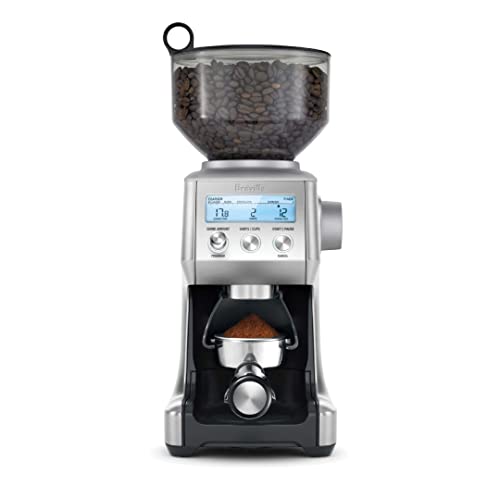
The best espresso machine with a built-in grinder for most people in 2026 is the Breville Barista Express: it combines a conical burr grinder, PID temperature control, a pressure gauge and a manual steam wand in one body. Step up to the Barista Pro for faster heat-up and a stronger wand, or the Barista Express Impress if you want assisted tamping. The De’Longhi La Specialista line suits buyers who prefer a different workflow, and the Gaggia Brera is the choice if you want push-button bean-to-cup instead of a semi-automatic.
An all-in-one machine saves counter space and a purchase, but it also ties two parts together: when the grinder fails or falls behind your skill, you cannot swap just that part. This guide explains how to judge the grinder inside the machine, compares seven current models with real numbers, and shows how to calculate whether an integrated grinder or a separate pair is the better buy for you. Specifications come from manufacturer sheets and may vary by region.
Our top picks



As an Amazon Associate we earn from qualifying purchases at no extra cost to you.
Quick comparison of the seven built-in grinder picks
| Pick | Best for | Grinder | Hopper | Portafilter | Style | Price tier |
|---|---|---|---|---|---|---|
| Breville Barista Express (BES870) | Best overall | Conical burr, 18 settings | About 250 g | 54 mm | Semi-automatic, manual wand | Mid to upper-mid |
| Breville Barista Express Impress (BES876) | Best guided workflow | Conical burr, 25 settings | About 250 g | 54 mm | Semi-automatic with assisted tamping | Upper-mid |
| Breville Barista Pro (BES878) | Best speed and wand | Steel conical burr, 30 settings | About 250 g | 54 mm | Semi-automatic, ThermoJet | Upper-mid |
| De’Longhi La Specialista Arte Evo (EC9155) | Best for a simpler grinder dial | Conical burr, 8 settings | About 250 g | 51 mm | Semi-automatic | Mid |
| De’Longhi La Specialista Opera (EC9555) | Best for finer grind control | 15 settings, sensor grinding | Large hopper | 51 mm | Semi-automatic with Smart Tamping | Upper-mid |
| Ninja Luxe Cafe Premier (ES601) | Best multi-drink machine | Conical burr, 25 settings | Built-in hopper | Integrated basket | Espresso, drip and cold brew | Mid |
| Gaggia Brera | Best push-button bean-to-cup | Flat ceramic burr, 5 settings | About 8 oz | None (brew group) | Super-automatic | Mid |
How to judge a built-in grinder before you buy
A built-in grinder is not just a convenience. It sets the ceiling on your espresso, because grind consistency affects extraction more than any other variable apart from the coffee itself. Five features tell you how good the grinder is likely to be.
1. Number of settings and where they sit
More steps do not always mean finer control, because many machines put only a few steps in the range that works for espresso. The Barista Express has 18 steps, the Impress 25, the Barista Pro 30, and the Arte Evo 8. The Opera has 15. A coarser step size means that going from sour to bitter can be a single click, which makes dialing in harder. Look for models that also allow an internal burr adjustment, which moves the whole range finer or coarser. Breville machines provide this inside the hopper, and De’Longhi machines provide a similar adjustment.
2. Burr type and size
Conical steel burrs are the common choice on Breville and De’Longhi semi-automatics. Ceramic flat burrs appear on entry-level super-automatics like the Gaggia Brera. Steel burrs tend to be sharper and cut more evenly at fine settings; ceramic burrs stay sharp longer but can chip on stones. Burr diameter also matters, though it is rarely published for these machines.
3. Dosing control
Some machines grind by time, some by weight estimation, and some use sensors to correct. Time-based dosing is simple, but changes in bean density mean the dose will drift, so weigh your coffee on a scale at first. The Impress and Opera include guidance or sensing to reduce drift. Measure by weighing a few doses in your first week.
4. Retention
Grinders that sit above the portafilter hold some grounds inside the chute. Retention affects freshness and makes a switch between beans (for example decaf to regular) less clean. Wipe the chute out weekly and purge a gram or two before each dose.
5. Noise and workflow
Integrated grinders are loud. Most are between 65 and 85 decibels at the machine. The Arte Evo is reported to be among the quieter ones at 62 decibels, but you should check how loud it is in your kitchen if you have someone sleeping nearby.
Best overall: Breville Barista Express
The Barista Express has been the default recommendation for integrated machines for years. It has a conical burr grinder with 18 grind settings, a hopper of about 250 grams, a 54 mm portafilter, PID temperature control and a pressure gauge. The tank holds around 2 liters, and the manual steam wand makes it possible to learn milk texturing. Dose-control grinding delivers coffee straight into the portafilter.
Who it suits: beginners and intermediates who want a single, proven machine with abundant accessories, spare parts and tutorials.
Main trade-off: the grinder is good but not exceptional, and its step size makes fine adjustment harder when you use light roasts. It is wide at around 13 inches and heats in around 30 seconds rather than the instant heat-up of ThermoJet machines.
- Pros: mature design, PID, gauge, big community, parts available.
- Cons: large, grinder steps are coarse for light roasts, plastic parts.
Best guided workflow: Breville Barista Express Impress
The Impress adds an integrated conical burr grinder with 25 settings, an assisted tamping lever that applies roughly 10 kilograms of force with a small twist, and an intelligent dosing system that suggests grind adjustments after each shot. It keeps a 54 mm portafilter, an 18-gram recommended dose, a 250-gram hopper, a 2-liter tank and PID temperature control.
Who it suits: people who want a guided path to consistent shots, particularly if tamping and dosing have been frustrating.
Main trade-off: it costs more than the standard Express, and the automated tamp removes a skill that some enthusiasts want to learn. The machine is as large as the Express.
- Pros: assisted tamp, 25 settings, dosing feedback, PID.
- Cons: higher cost, large footprint, simplifies rather than teaches puck prep.
Best speed and wand: Breville Barista Pro
The Barista Pro replaces the thermocoil of the Express with a ThermoJet heater that reaches extraction temperature in about three seconds. It has steel conical burrs, 30 grind settings, a 250-gram hopper, PID control, an LCD display and a manual wand with a 360-degree swivel and four-hole tip. The US manual lists about 1680 watts and a 2-liter tank. It does not have a pressure gauge.
Who it suits: milk-drink fans who want to start brewing quickly each morning and value finer grind steps.
Main trade-off: a higher cost than the Express, no gauge, and the same shared-appliance limitation: a grinder fault affects the whole machine.
- Pros: fastest heat-up here, 30 settings, strong wand, digital display.
- Cons: no gauge, plastic parts, costs more.
Best for a simple grinder dial: De’Longhi La Specialista Arte Evo
The Arte Evo (EC9155) uses a stainless steel conical burr grinder with 8 grind levels and a hopper of about 8.8 ounces, or 250 grams. It offers three brew temperatures of 92, 94 and 96 degrees Celsius, a 51 mm portafilter, and a manual steam wand. Grind size is set with a marked dial at the base of the hopper. A selectable extra-fine option lengthens the grind time rather than changing the physical burr gap, so treat it as a dose tool.
Who it suits: buyers who want a simpler grinder interface and a slimmer machine than a Breville Express, and who do not plan to chase light-roast espresso.
Main trade-off: only eight steps and a 51 mm portafilter limit upgrades and fine adjustment. Reviewers often start at a mid-low setting and adjust the dose time instead.
- Pros: simple controls, quiet grinder, temperature options, compact.
- Cons: few grind steps, 51 mm accessories limited.
Best for finer grind control: De’Longhi La Specialista Opera
The Opera (EC9555) has 15 grind settings with Sensor Grinding Technology, a 19-bar pump, a Smart Tamping station that applies about 20 kilograms of pressure, a thermoblock with three temperature settings, a 51 mm portafilter and a 2-liter tank. It lists 1550 watts, a weight near 13 kilograms and dimensions of about 38 by 37 by 44.5 centimeters. It also offers cold brew and espresso-cool recipes.
Who it suits: users who want a guided but still manual process and who like cold espresso drinks.
Main trade-off: it is bigger and heavier than many alternatives, the 51 mm basket size limits accessory choice, and the extra features add complexity that may not be needed.
- Pros: 15 settings, sensor-based dosing, smart tamp, cold options.
- Cons: bulky, 51 mm size, more to clean.
Best multi-drink machine: Ninja Luxe Cafe Premier (ES601)
The Ninja Luxe Cafe Premier is a 3-in-1 machine that makes espresso, drip coffee and cold brew from one body. Its conical burr grinder has 25 settings and weight-based dosing, and the Pro model (ES701) adds an ergonomic tamper, a hot water outlet and a ristretto option. Because the portafilter system is integrated, it targets people who value convenience and variety over traditional workflow.
Who it suits: households where some people want espresso and others want a mug of drip coffee, and where counter space is limited to one appliance.
Main trade-off: the design is not compatible with most standard accessories, and it is more of a convenience appliance than an enthusiast machine. Check the steam wand type and the maintenance cycle before buying.
- Pros: three drink types, 25 settings, weight-based dosing, one footprint.
- Cons: limited accessories, large body, less control over extraction.
Best push-button bean-to-cup: Gaggia Brera
The Gaggia Brera is a compact super-automatic with a flat ceramic burr grinder, five grind settings, a bean hopper of about 8 ounces, a 1.2-liter tank, a 15-bar pump and a removable brew group. It makes espresso and lungo by button and uses a manual Pannarello wand for milk. The unit measures about 10 inches wide and weighs about 18 pounds.
Who it suits: people who want espresso-style drinks with minimal skill and no tamping or dosing, and who accept less control.
Main trade-off: five grind steps give limited control, the Pannarello wand is made for easy foaming and not for latte art, and some reviewers report reliability concerns with the grinder, so check warranty terms before buying.
- Pros: easy, compact, removable brew group, quick workflow.
- Cons: limited control, five grind steps, mixed reliability reports.
Decision matrix by situation
| Your situation | Best match | Reason |
|---|---|---|
| First espresso machine, wants proven design | Breville Barista Express | Mature, PID, gauge, strong support |
| Struggles with tamping and dose | Barista Express Impress | Assisted tamp and dosing feedback |
| Wants espresso ready in seconds | Breville Barista Pro | ThermoJet heater, 30 grind steps |
| Prefers a simple dial and slim body | La Specialista Arte Evo | 8 settings, 250 g hopper |
| Wants cold espresso drinks | La Specialista Opera | Cold brew and espresso-cool recipes |
| Household wants drip and espresso | Ninja Luxe Cafe Premier | Espresso, drip and cold brew in one |
| No skill, no tamping, quick button | Gaggia Brera | Super-automatic with removable brew group |
Worked calculation: integrated grinder or separate pair?
Suppose a combined machine costs 700 units, and a comparable separate setup costs a 350-unit machine plus a 350-unit grinder. At first glance the totals match. The difference is in the ceiling and the repair path. If the integrated grinder fails after three years, repair or replacement may cost 150 to 250 units and require shipping the whole appliance. With a separate grinder, a failure leaves you with a working machine, and you can replace just the grinder.
Now include space. A combined machine such as the Barista Express takes up about 13 inches of width. A compact machine of 7.7 inches plus a grinder of about 5 inches wide takes 12.7 inches, so the saving in width is small. Where the integrated machine wins is workflow: one plug, one cleaning routine, and fewer purchases while you learn. Where the separate pair wins is the long run, because a quality grinder retains its value as you improve. If you expect to use espresso for more than three years and care about light roasts, plan to buy separately. If you are not sure you will keep making espresso, an integrated machine reduces the risk.
Setting up the built-in grinder: step by step with reasons
- Season the burrs with a few hundred grams of cheap beans. New burrs have a rougher edge, and the first batches may grind unevenly.
- Start at the manufacturer’s suggested setting. This avoids jamming the grinder at a very fine setting with dry beans.
- Weigh the first dose. Aim for 18 grams in a standard double basket, then check whether the grinder is delivering that amount.
- Adjust the grind setting while the grinder is running. Most conical burr grinders require movement while the burrs are turning to avoid damage.
- Change only one variable at a time. Grind size, dose and time each shift the flavor; changing two together hides the cause.
- Taste after each change. Sour means finer or longer; bitter or dry means coarser or shorter.
- Tamp level and consistently. If you use assisted tamping, check that the puck surface is flat.
- Keep the hopper at a small fill level. Beans stored in a sunlit hopper go stale quickly, so load only a few days of beans.
Ownership realities: what wears first
Burrs and the grind chute
Burrs dull gradually. Many owners notice that the same setting produces slower shots after a year or two, which means a finer setting is needed. Clean the burrs and chute with a brush every few weeks and use grinder-cleaning tablets sparingly. Replacement burrs are available for many Breville models.
Oily beans
Very dark, oily roasts can clog the chute and coat the hopper. Choose medium or medium-dark roasts and wipe the hopper as part of your routine.
Water and scale
Thermocoil and thermoblock heaters need regular descaling. Use filtered water and follow the intervals in the manual.
Common mistakes
- Filling the hopper with a month of beans.
- Using the pressurized baskets forever and never moving to single-wall baskets.
- Adjusting the grind only when the grinder is idle.
- Ignoring the weight of the dose and relying on the built-in setting alone.
- Leaving milk residue in the wand.
Frequently Asked Questions
Are espresso machines with built-in grinders any good?
Yes, the better ones produce good espresso for a wide range of home users. The limit is the grinder: integrated grinders usually have fewer steps and less precision than separate grinders that cost the same as the whole machine. For medium and medium-dark roasts they are often more than adequate.
Can I replace the built-in grinder later?
Not easily. Most machines allow you to bypass the grinder by using pre-ground coffee in the portafilter, but you cannot swap the burr set for a larger one. If you outgrow the grinder, you can pair the machine with an outboard grinder and ignore the built-in one.
How often should I clean the grinder?
Brush out the chute and burr area every few weeks, depending on how oily your beans are. Run a cleaning tablet designed for grinders every couple of months, then purge with a small handful of beans before using it for espresso again.
What is the difference between semi-automatic and super-automatic?
A semi-automatic machine requires you to dose, tamp and start the shot, and gives you control over each variable. A super-automatic grinds, tamps and brews at the touch of a button, with less control and usually less intensity in the cup. Choose the style that matches the time and effort you want to invest.
Which grind setting should I start with?
Start at the manufacturer’s recommended setting, then adjust according to the time and taste of the first shot. If the shot is fast and sour, go finer. If it is slow and bitter, go coarser. Expect to adjust each time you change beans.
Do I still need a scale?
Yes. A scale accurate to 0.1 gram helps you measure your dose and your output, which are the best ways to repeat a good shot. Even machines with weight-based dosing benefit from an occasional check.


Write Your Review
No reviews yet. Be the first to share your experience!