

The best espresso machine for latte art is one with a steam wand that delivers dry, powerful steam within seconds of finishing the shot, a wand tip that lets you spin milk into a whirlpool, and brew temperature that stays steady from cup to cup. In 2026 the Breville Barista Pro is the best all-round choice for most home baristas, the Rancilio Silvia is the classic learning wand, and the Breville Dual Boiler is the pick when you want to brew and steam at the same time without waiting.
Latte art is mostly a milk skill, so this guide focuses on what matters for pouring: steam power, wand design, recovery time, and how much the machine forgives a beginner. You will find seven current machines, a table of real specifications, a method for choosing by situation, a worked pitcher-and-volume calculation, and a practice plan that explains why each step works. Specifications are taken from the manufacturers’ published sheets and may vary by region.
Our top picks


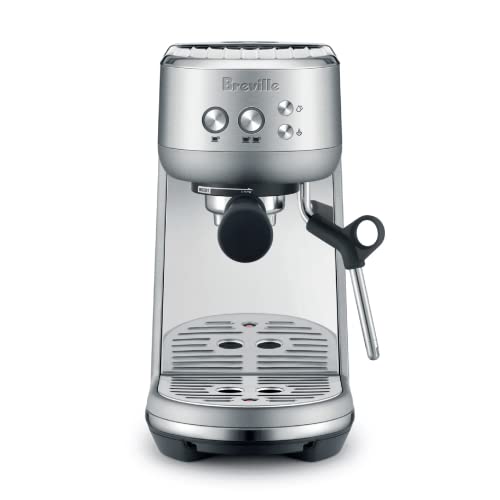 Breville BES450BSS Bambino Espresso Machine
- Cappuccino maker and latte machine has an automatic…
- Espresso maker includes innovative ThermoJet heating system that…
- Manual espresso machine features low pressure pre infusion…

As an Amazon Associate we earn from qualifying purchases at no extra cost to you.
Quick comparison of the seven latte art machines
| Pick | Best for | Boiler setup | Portafilter | Steam wand | Brew and steam together | Price tier |
|---|---|---|---|---|---|---|
| Breville Barista Pro (BES878) | Best overall with grinder | ThermoJet, 3-second heat-up | 54 mm | Manual, 360-degree swivel, 4-hole tip | Yes, quick switch | Upper-mid |
| Breville Bambino Plus | Best compact option | ThermoJet | 54 mm | Automatic or manual | Fast switch | Mid |
| Rancilio Silvia | Best classic learning wand | Single brass boiler, 0.3 L | 58 mm | Commercial-style articulating wand | No | Mid to upper-mid |
| Gaggia Classic Evo Pro | Best budget traditional wand | Single boiler, 2.1 L tank | 58 mm | Manual | No | Mid |
| Profitec GO | Best PID single boiler | Single brass boiler, PID | 58 mm | Manual | No | Upper-mid |
| Lelit Anna (PID version) | Best slim single boiler | Single boiler, 0.25 L | 57 mm | Manual | No | Mid to upper-mid |
| Breville Dual Boiler (BES920) | Best for volume and speed | Dual stainless boilers, triple PID | 58 mm | Manual | Yes | Premium |
What actually makes a machine good for latte art
Pouring a rosetta or a tulip needs microfoam: milk with tiny, uniform bubbles that behave like wet paint. To make it, the machine must put enough heat and air into cold milk before it passes the point where the milk becomes too hot to handle, which is commonly given as about 60 to 65 degrees Celsius. That window is short, so steam power and wand design matter more than anything else.
Steam power and recovery
Steam power comes from the boiler or heater and the pump feeding it. A larger steam boiler or a heat-exchange design produces dry, steady steam, which means less water in the milk and a longer window to stretch and then spin the milk. Small single-boiler machines have a shorter window, and you must flip the machine into steam mode and wait for the boiler to heat from brew temperature to steam temperature, which takes between 20 seconds and a minute on many models. Thermoblock and ThermoJet systems skip this wait but give less volume per second.
Wand tip and movement
A wand that swivels 360 degrees and a tip with several small holes let you create a whirlpool in a small pitcher without much strain. A single-hole commercial wand is more demanding but gives an experienced user more control over how much air enters. If you are learning, a wand with multiple holes reduces the number of pitchers you will spoil.
Brew temperature stability
Latte art begins with a good espresso base. Crema that breaks up or a shot that pulls unevenly will wreck a pour. PID temperature control, found on the Barista Pro, Profitec GO, Lelit Anna PID and Breville Dual Boiler, keeps brewing temperature consistent so the shot you pour into is predictable.
Cup clearance and drip tray height
Pouring art needs room to position a pitcher near the cup. Check that your preferred latte cup, usually 180 to 240 milliliters, fits under the portafilter without tilting. Some compact machines have low clearance and need a removed drip tray.
Best overall: Breville Barista Pro
The Barista Pro combines a ThermoJet heater, which reaches extraction temperature in about three seconds, with an integrated conical burr grinder that has 30 settings and a 250-gram hopper. The portafilter is 54 mm, the machine uses PID temperature control, and the manual steam wand has a 360-degree swivel with a four-hole tip. According to the manufacturer’s manual, it runs on roughly 1680 watts, has a 2-liter tank, and includes low-pressure pre-infusion.
Why it suits latte art: the wand recovers almost immediately after a shot, so you can pull espresso and steam within the same minute without waiting for a boiler to change temperature. The four-hole tip gives beginners a forgiving whirlpool in a 350-milliliter pitcher.
Main trade-off: the build leans on plastic, the integrated grinder limits future upgrades, and the steam power, though good, cannot match a dual-boiler machine for back-to-back milk drinks.
- Pros: instant heat-up, strong wand for the category, built-in grinder, PID, digital interface.
- Cons: no pressure gauge, less repairable than traditional machines, plastic housing.
Best compact: Breville Bambino Plus
The Bambino Plus is a small machine that can make rosettas, although its steam output is lower than the Barista Pro. It offers an automatic mode with adjustable milk temperature and texture, plus a manual mode that lets you control the wand yourself. For learners with a small kitchen, that dual mode is a useful bridge: start with automatic milk for a week, then switch to manual once you can read the steam sounds.
Why it suits latte art: ThermoJet means no waiting between shot and steam, and it takes up under 8 inches of counter width. It works well with a 350-milliliter pitcher or smaller.
Main trade-off: the steam tip has fewer holes, steam volume is limited when you make two drinks back to back, and there is no grinder. You will also need a good outboard espresso grinder.
- Pros: automatic and manual milk modes, fast, tiny footprint.
- Cons: smaller steam capacity, needs a grinder, mostly plastic.
Best classic learning wand: Rancilio Silvia
The Rancilio Silvia is a long-standing favorite for people who want to learn milk steaming on a commercial-style machine. It has a 58 mm portafilter, an insulated 0.3-liter brass boiler, a 2-liter reservoir and a vibration pump. Since the V3 design, the stainless steel wand has an articulating ball joint with a single-hole tip, and reviewers frequently describe its steam as strong for a home single-boiler machine. The machine weighs around 14 kilograms and measures about 23.5 centimeters wide.
Why it suits latte art: the wand is the same style you will find in cafés, so the skill transfers directly. Its steam pressure is powerful enough to texture a 300-milliliter pitcher of milk in roughly 30 to 40 seconds once the boiler is up to steam temperature.
Main trade-off: there is no PID in the standard model, so brew temperature can drift unless you temperature-surf, and you must wait after brewing for the boiler to climb to steam temperature. It is also a machine that does not brew and steam at the same time.
- Pros: commercial-style wand, 58 mm group, repairable, long service life.
- Cons: no PID, wait between brew and steam, no grinder, no preinfusion.
Best budget traditional wand: Gaggia Classic Evo Pro
The Classic Evo Pro keeps the 58 mm portafilter and three-way solenoid of the Gaggia Classic line, with updated components and a 9-bar over-pressure valve setup. Published specifications list a vibratory pump, a 2.1-liter water tank, and about 1425 watts of power. The boiler is small, so steam sessions are short, but the commercial-style wand is accessible to anyone who wants to learn on a manual tool without spending as much as on a prosumer machine.
Why it suits latte art: you get a real manual wand and a standard group size at a moderate cost, and aftermarket steam tips with more or fewer holes are widely available if you want to adjust the character of the steam.
Main trade-off: there is no PID, the boiler is small, and the waiting time between brewing and steaming is long enough to affect workflow. Expect to make drinks one at a time.
- Pros: low cost for a 58 mm machine, huge community, straightforward upgrades.
- Cons: no PID, small boiler, slow steam recovery, no grinder.
Best PID single boiler: Profitec GO
The Profitec GO is a compact single-boiler machine with PID temperature control and a 58 mm portafilter. Listings describe a brass boiler of 0.3 to 0.4 liters, a brew pressure gauge, an adjustable over-pressure valve and a footprint around 8.3 inches wide. The GO 2.0 update adds selectable preinfusion, a hot water function and guided descaling. A single boiler means you brew first and then steam, which takes some patience.
Why it suits latte art: PID stability makes the espresso predictable, which lets you focus on your milk. The slim body takes up little space, and the manual wand gives you full control.
Main trade-off: the price is high for a single-boiler machine, and you must wait between brew and steam. Choosing it makes sense if you value build quality and a small footprint over speed.
- Pros: PID, pressure gauge, 58 mm group, narrow, quality construction.
- Cons: single boiler workflow, costs more than similar-size machines, no grinder.
Best slim single boiler: Lelit Anna (PID version)
The Lelit Anna is an Italian single-boiler machine with a 0.25-liter boiler, a 57 mm portafilter, a vibration pump and a 2.7-liter reservoir. It weighs roughly 7 kilograms, so it is lighter than the Silvia or the Profitec, and the PID model gives you control over brew temperature. It brews and steams one after the other.
Why it suits latte art: the wand is manual and responds well to a light hand, and the small boiler heats to steam temperature quickly. It suits one or two milk drinks at a time.
Main trade-off: 57 mm accessories are less common than 58 mm ones, and the small boiler limits sustained steaming. It does not have a built-in grinder, so factor in the cost of a separate one.
- Pros: PID option, light, compact, quick to heat.
- Cons: 57 mm size, small boiler, single-boiler workflow.
Best for volume and speed: Breville Dual Boiler (BES920)
The Dual Boiler offers a stainless 10-ounce brew boiler and a 32-ounce steam boiler, triple PID control with temperature accuracy around plus or minus 2 degrees Fahrenheit, a 58 mm portafilter, and a 2.5-liter water tank. It has two pumps: a 15-bar Italian pump limited to 9 bar at extraction, and a separate low-pressure pump to feed the steam boiler. Brew temperature adjusts in 1-degree increments, and preinfusion is programmable. Warm-up takes about 10 to 15 minutes.
Why it suits latte art: you can pull a shot while the steam boiler is ready, so milk is steamed right as the espresso finishes and stays fresh. That makes it the best option if you are making several milk drinks for family or guests, or practicing multiple pours in a row.
Main trade-off: it is large, at about 16 inches wide, weighs around 30 pounds, and is the most expensive machine on this list. It is also a machine that some retailers list as discontinued, so check availability and parts support in your region before deciding.
- Pros: brew and steam together, triple PID, large steam boiler, programmable preinfusion.
- Cons: large and heavy, premium cost, long warm-up, no grinder.
Decision matrix by situation
| Your situation | Best match | Reason |
|---|---|---|
| Want grinder and wand in one machine | Breville Barista Pro | 30-setting grinder, ThermoJet, four-hole wand |
| Tiny counter, learning to steam | Breville Bambino Plus | Under 8 inches wide with automatic fallback |
| Want a café-style wand to master | Rancilio Silvia | Articulating single-hole commercial wand |
| Low budget, willing to tinker | Gaggia Classic Evo Pro | 58 mm group and manual wand at a moderate cost |
| Want steady shots and a gauge | Profitec GO | PID, gauge and 58 mm group in a slim body |
| Light machine for small kitchen | Lelit Anna PID | About 7 kg, PID option, quick steam heat |
| Make four or more milk drinks per session | Breville Dual Boiler | Separate 32-ounce steam boiler |
Worked calculation: pitcher size, milk volume and steam time
Most beginners use a pitcher that is too large. Milk expands by about 30 to 50 percent when steamed for lattes, so you should fill a pitcher no more than about one third to one half full. For a 240-milliliter latte cup, 150 milliliters of cold milk produces about 200 to 220 milliliters of textured milk, which leaves room for a pour and a little remainder. A 350-milliliter pitcher is the common choice for one drink.
Now compare the steam time. If your steam output heats 150 milliliters of milk from 4 to 62 degrees Celsius, you need to add about 58 degrees of heat. At about 4.18 joules per gram per degree, that is roughly 36,000 joules. A machine delivering a few hundred watts of useful steam heat needs 60 to 120 seconds for that load. Strong steam wands can do it in 25 to 40 seconds, which gives you time to introduce air for the first 5 to 8 seconds and then spin the milk to refine it. If steam takes much longer than 50 seconds, the milk is likely to be overheated before it is silky, and the foam may separate. The calculation is why steam power matters more than any other single spec in latte art.
A practice plan with reasons
- Start with cold milk and a cold pitcher. Cold metal gives you more time before the milk reaches temperature.
- Purge the wand for two seconds. This clears condensate so you are not adding water to the milk.
- Place the tip just below the surface, slightly off center. This makes a whirlpool and introduces air in a controlled way.
- Stretch for 3 to 6 seconds. Listen for a soft paper-tearing sound; loud screeching means too much air or tip too high.
- Submerge the tip deeper and spin. Let the whirlpool break up the larger bubbles until the milk looks glossy.
- Stop around 60 to 65 degrees Celsius. The pitcher should be hot but not painful for a few seconds on the hand.
- Tap, swirl and pour immediately. Tapping removes large bubbles, and swirling keeps foam and liquid combined until you pour.
- Practice with water and a drop of dish soap on a day you are not drinking. This lets you work on the pour motion without wasting milk.
Ownership realities for latte art machines
Wand maintenance
Wipe the wand with a damp cloth right after steaming and purge it. Milk proteins bake onto a hot wand and block the tip holes, which reduces steam force and creates uneven foam. If a hole is blocked, soak the tip in hot water and use the manufacturer’s cleaning pin.
Scale and water quality
Steaming heavily uses more water and creates more scale in boilers. Filtered water with moderate mineral content protects the heating element, and a regular descaling schedule follows your manual. Avoid distilled water in machines with level sensors that rely on mineral conductivity.
Consumables to expect
- Group gaskets and shower screens, usually replaced every year or two with daily use.
- Steam tips, which are inexpensive and sometimes swappable between brands.
- Water filters or cartridges, if your machine uses them.
- A pitcher in the 300 to 350 milliliter range with a sharp spout.
Common mistakes
- Using milk that is not cold or fresh, which reduces stretching time and flavor.
- Overfilling the pitcher, so the whirlpool has no room.
- Steaming too long, which scalds the milk and dries the foam.
- Skipping the purge and adding water to the pitcher.
- Pouring from too high, which breaks the foam into the espresso instead of floating it on top.
Frequently Asked Questions
Can I make latte art on an entry-level machine?
Yes, with practice. Many entry-level machines can produce enough microfoam for a simple heart or rosetta, particularly those with a manual wand and quick recovery. They are less forgiving when you make several drinks in a row, and you will usually need to steam smaller volumes.
Is an automatic steam wand good enough for latte art?
An automatic wand creates milk with consistent texture and temperature, which is good for learning how the milk should look. Many baristas then switch to manual mode to control the amount of air and the position of the whirlpool. The Bambino Plus lets you try both on the same machine.
Do I need a dual boiler for latte art?
No. Single-boiler and ThermoJet machines are fine for one or two drinks at a time. A dual boiler matters when you want to brew and steam simultaneously or serve many milk drinks in a row.
What milk works best for latte art?
Fresh whole milk is the easiest to texture because its protein and fat give stable foam and a creamy taste. Many barista-formulated plant milks are designed to stretch, with oat and soy being the most common. Experiment with small batches and check each brand’s label.
How hot should the milk be?
Aim for around 60 to 65 degrees Celsius. Above about 70 degrees, milk proteins break down, the foam loses stability, and the taste becomes flat and sulfurous.
How long does it take to learn latte art?
Most people can pour a basic heart after a few weeks of regular practice, and a rosetta or tulip may take a few months. Short daily sessions with a small pitcher improve technique faster than occasional long ones.


Write Your Review
No reviews yet. Be the first to share your experience!