

Key takeaways
- Best German made French presses: what six Bodum listings say about origin, how to read Made in labels, and which size and frame to choose.
The Bodum 34 oz Chambord in polished stainless steel is the best all-around choice from this set, but a plain-spoken caveat comes first: none of the six listings says “Made in Germany.” Each title states Portugal. Bodum itself is a Danish-founded, Swiss-based housewares company, and the only German reference we found is in the description of one large Brazil listing, which refers to German heat-resistant borosilicate glass. So this guide treats “German made” as a question to verify, not a claim to repeat, and helps you read the labels before you buy.
Quick List
- Bodum Chambord 34 oz, Polished Steel – best overall for a durable, metal-framed eight-cup press
- Bodum Brazil 34 oz, Black (first listing) – best for a lighter-weight everyday pot
- Bodum Chambord 34 oz, Copper – best for matching warm-toned kitchen hardware
- Bodum Brazil 51 oz – best for large batches and the one description that mentions German glass
- Bodum Brazil 34 oz, Black (second listing) – best as a backup if the first Brazil listing is unavailable
- Bodum Chambord 12 oz – best for solo drinkers who still want a steel frame
Picking the Right Size and Frame
| If you… | Choose |
|---|---|
| want one dependable press for a household of two to four | Bodum Chambord 34 oz, Polished Steel |
| host brunch or brew for six or more | Bodum Brazil 51 oz |
| want a non-silver frame for the kitchen | Bodum Chambord 34 oz, Copper |
| prefer a lighter pot and do not mind plastic parts | Bodum Brazil 34 oz, Black |
| find the first Brazil listing out of stock | Second Bodum Brazil 34 oz listing |
| brew one mug at a time | Bodum Chambord 12 oz |
Because the six products share one brand and one country of manufacture on paper, the useful questions are about volume and frame rather than provenance. If a German origin is the whole point, skip to the section on reading origin labels, since that decides more than any feature below.
All 6 Picks in Detail
1. Bodum Chambord 34 oz, Polished Steel – Best Overall Everyday Press
As an Amazon Associate we earn from qualifying purchases at no extra cost to you.

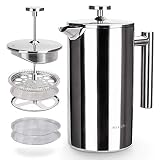
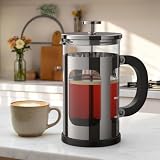
The Chambord is the model many people mean when they say “a French press.” This version has a polished stainless steel frame around a high-heat borosilicate glass carafe, and the listing says Made in Portugal. The 34 oz size is Bodum’s eight-cup press, with a cup defined as 4 oz. The plunger is stainless steel and the handle is plastic, so treat it as a table-top pot, not a stovetop one. For most households it is the safest default. The design is deliberately simple: a carafe, a frame with a spout, and a plunger with a mesh-and-plate filter. There is little to break besides the glass, and the parts that do wear, such as the filter screen, are replaceable. If you can only buy one press from this list, buy this one and look up the spare filter for it at the same time.
- Volume: 34 oz (about 1 liter), eight cups by Bodum’s measure
- Glass: high-heat borosilicate per the listing
- Frame: polished stainless steel
- Origin per listing title: Portugal
- Replacement carafes are sold separately for many Bodum models
Pros:
- Rigid metal frame protects the glass
- Widely sold, so parts are easy to find
Cons:
- Glass carafe can chip or crack from impact
- No German origin stated on the listing
It is heavier than the Brazil but feels sturdier.
2. Bodum Brazil 34 oz, Black (First Listing) – Best Lighter Everyday Pot
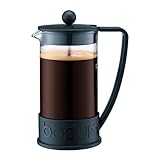
The 34 oz Brazil keeps the proven plunger and glass carafe, with a plastic frame in black. Bodum describes the plastic as BPA-free and the plunger as stainless. It is easier to lift and move than the steel-framed Chambord, and it is a common first press. The listing states Portugal. Pick it if weight and simple styling matter more than a metal finish. Households that move the pot between the counter and a dining table every morning tend to value the lighter body, and so do people who lift it one-handed to pour. Hand-wash the plastic parts unless the listing clearly allows the dishwasher.
- Volume: 34 oz (about 1 liter), eight cups
- Glass: high-heat borosilicate
- Frame and handle: plastic per maker descriptions
- Plunger and filter: stainless steel
- Origin per listing title: Portugal
Pros:
- Light and easy to pour
- Same capacity as the Chambord
Cons:
- Plastic frame may feel less durable over years
- Origin is not Germany
It matches the Chambord’s volume and gives up some of its heft.
3. Bodum Chambord 34 oz, Copper – Best for Warm-Toned Kitchens

Mechanically this is the polished Chambord with a copper-colored frame. The listing carries the same glass and steel description and the same Portugal origin. Its pull is purely visual, a press that looks at home next to copper pots or warm wood. If the metal finish is coated, treat it more gently than bare steel, and confirm care guidance on the listing page. Think about how the finish will sit beside other items on your counter: copper tones pair well with wood and warm lighting, and clash a little with cool stainless appliances. It is a style choice more than a performance choice.
- Volume: 34 oz (about 1 liter)
- Glass: borosilicate per the title
- Frame: copper-toned stainless steel per the title
- Origin per listing title: Portugal
- Care: confirm finish-specific instructions on the listing
Pros:
- Stands out from the usual silver and black
- Same internals as the standard Chambord
Cons:
- Finish may scuff more visibly
- No German origin claim
Choose it over the polished version if the look is the reason you are shopping.
4. Bodum Brazil 51 oz – Best for Large Batches
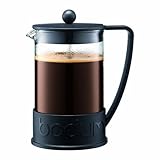
Moving up to 51 oz gives you a twelve-cup press by Bodum’s count, roughly 1.5 liters. The listing title states Portugal, but the product description refers to German heat-resistant borosilicate glass for the carafe, which is the only German mention in the set and one to confirm on the live page. The base and handle are described as BPA-free polypropylene, which keeps the weight down for such a big pot. It suits brunches, offices, and anyone who would otherwise brew twice. The caution is that a pot this size is awkward in a small sink and heavy when full, so plan where you will rinse it. Because the mesh filter and the plunger are scaled up too, a coarse grind matters even more here, or the plunger will fight you on the way down.
- Volume: 51 oz (about 1.5 liters), twelve cups by Bodum’s measure
- Glass: high-heat borosilicate; description references German glass, confirm on listing
- Frame and handle: plastic per descriptions
- Origin per listing title: Portugal
- Typical dose: about 80 grams of coffee for 1.3 liters of water on a 1:16 ratio
Pros:
- Serves a crowd in one pass
- Lighter than a steel-framed pot of the same size would be
Cons:
- Large carafes need more care to handle safely
- Coffee left in a big pot cools and stews on the grounds
Versus the 34 oz Chambord, it trades a premium frame for sheer volume.
5. Bodum Brazil 34 oz, Black (Second Listing) – Best as a Backup Option
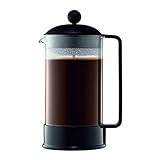
This second listing duplicates the first Brazil 34 oz listing above in name, size, color, and stated origin. The product record is the only likely difference, so compare model numbers, bundled items, and availability. It earns a place because duplicate listings are often the difference between buying today and waiting. If both are active and look identical, either is a sensible choice, and nothing in the title ranks one above the other. When the listings are this close, look at delivery windows, included parts, and the return terms rather than at the feature list, because the feature list is the same. Do not buy both unless you want a spare for guests.
- Volume: 34 oz (about 1 liter), eight cups
- Glass: high-heat borosilicate per the title
- Frame: plastic per maker descriptions
- Origin per listing title: Portugal
- Model and seller details: confirm on the page
Pros:
- Gives a second source for the same press
- Straightforward, familiar design
Cons:
- No visible difference from the first Brazil listing
- No German claim to evaluate
Treat the two Brazil 34 oz listings as one product with two entries.
6. Bodum Chambord 12 oz – Best for Solo Drinkers with a Steel Frame

The 12 oz Chambord is a three-cup press, enough for about one big mug. It keeps the stainless frame and glass carafe of the larger Chambord and states Portugal in the title. A small pot cools quickly, so preheating the carafe helps. It is the lowest-commitment way to get the steel-framed design if you drink alone. It also works as a tea pot for a single serving, since the same mesh holds back loose leaves. Because the carafe is narrow, a long-handled spoon or stir stick helps you wet all the grounds evenly at the start of the steep.
- Volume: 12 oz (about 350 ml), three cups
- Glass: high-heat borosilicate
- Frame: polished stainless steel
- Origin per listing title: Portugal
- Typical dose: about 22 grams of coffee for 12 oz of water on a 1:16 ratio
Pros:
- Compact, with the same frame quality as the big Chambord
- Easy to wash and store
Cons:
- Too small for two people
- Same Portugal origin on the listing
It is the small-batch partner of the first pick.
Specs Compared
| Product | Volume | Bodum cup count | Frame | Glass note | Origin per listing |
|---|---|---|---|---|---|
| Chambord 34 oz, Polished Steel | 34 oz | 8 | Polished stainless steel | Borosilicate | Portugal |
| Brazil 34 oz, Black (first) | 34 oz | 8 | Plastic (confirm on listing) | Borosilicate | Portugal |
| Chambord 34 oz, Copper | 34 oz | 8 | Copper-toned stainless steel | Borosilicate | Portugal |
| Brazil 51 oz | 51 oz | 12 | Plastic (confirm on listing) | Description mentions German borosilicate; confirm on listing | Portugal |
| Brazil 34 oz, Black (second) | 34 oz | 8 | Plastic (confirm on listing) | Borosilicate | Portugal |
| Chambord 12 oz | 12 oz | 3 | Polished stainless steel | Borosilicate | Portugal |
How We Chose These
This shortlist comes from desk research on the catalog listings assigned to this topic. We read each title for capacity, frame, glass, and stated country of origin, then compared them with the manufacturer’s published descriptions. Because every title says Portugal, no product qualifies as German made on the evidence in the listing, and we say so in each entry. We ordered the picks by usefulness for typical households: overall suitability first, then volume, finish, weight, and duplicates. Claims about German glass come from a listing description and are marked as something to confirm. Duplicate listings are called out instead of padded into separate recommendations, and no claim about durability, hold time, or taste is made beyond what the maker or the listing states. If a better-documented German-made press appears in the catalog later, this page will be revised.
What to Look For
What “Made In” Does and Does Not Tell You
A country-of-origin statement describes where a product was manufactured or last substantially transformed, which can differ from where the brand is based, where the design was created, and where the raw glass was formed. A press may be designed in Denmark, owned by a Swiss company, and assembled in Portugal, using glass that comes from yet another country. When shoppers search for “German made,” they usually want the quality associated with German manufacturing, but the label alone does not establish it. Look for the exact words “Made in Germany” on the packaging or product page, and treat phrases like “German engineering” or “German style” as marketing.
Why Glass Origin Gets Mentioned
Germany has a long history of borosilicate glass, dating back to work in Jena in the late nineteenth century, so sellers sometimes mention German glass as a quality signal. In a French press the glass is only one of several parts. The frame, plunger, and filter are made and finished separately and may come from different factories. If the glass source matters to you, look for a statement on the product page rather than an assumption from the brand name, and confirm it before buying.
Steel Frame or Plastic Frame
The metal frame on the Chambord line is more rigid and shields the glass from knocks. The plastic frame on the Brazil line is lighter and often easier to pour from. Neither changes the taste of coffee, which depends on grind, water temperature, and time. If you are choosing between a Chambord and a Brazil of the same size, think about how often the pot gets moved and how much it will be handled.
Volume, Cup Counts, and a Worked Dose
Bodum calls 4 oz a cup, so 12 oz is three cups, 34 oz is eight, and 51 oz is twelve. These are generous pot sizes, not mug sizes. A practical full-pot rule is to leave a little headspace and use around one gram of coffee for every sixteen grams of water. In a 51 oz pot, filling to about 44 oz means roughly 1.3 liters of water, so a dose of about 80 grams of coffee. For a 12 oz pot filled to 10 oz, about 295 grams of water takes about 18 grams. Use a coarse grind and steep about four minutes.
Reading Product Pages for Origin Clues
Product pages carry origin information in several places, and they do not always agree. The title may include a phrase such as “Made in Portugal,” a specification table may list a country of origin, and the description may add details about individual parts. When two of these conflict, trust the most specific one, and ask the seller to settle it if the answer affects your purchase. A manufacturer’s own product page is the best tiebreaker. Keep the packaging when the press arrives, since the box usually carries the legal origin statement.
Why Duplicate Listings Exist
Marketplaces often hold several records for one physical product, created by different sellers, packaging versions, or color variants. The two 34 oz Brazil entries here are an example. They can differ in model number, bundled items, or fulfillment, even when the title is word-for-word the same. For a buyer the useful move is to compare the details, not to assume there is a hidden difference in quality.
A Simple Weekly Care Routine
- After each brew, knock the grounds into a bin or compost caddy instead of rinsing them down the drain.
- Rinse the carafe and the plunger with warm water straight away, before the oils dry.
- Unscrew the filter stack once a week and wash each plate and mesh disc separately.
- Check the glass for chips along the rim and base, and check the frame for loose screws.
- Let every part dry fully before reassembly to avoid musty smells.
A press that is cleaned this way keeps tasting fresh, and the filter lasts noticeably longer. Replace a bent or stretched mesh disc as soon as grounds begin to slip past it.
Grind and Water Basics
Coarse grounds, around the size of coarse sea salt, are the standard recommendation for any plunger pot. Water between 195 and 205 degrees Fahrenheit is the common range, which is about thirty seconds off the boil. If the brew tastes sour or thin, grind a touch finer or steep a little longer. If it tastes harsh and bitter, go coarser or shorten the steep.
Safe Handling
Do not put a glass press with a plastic or metal frame on a burner or in a microwave; heat the water separately and pour it in. Glass presses should be warmed gradually: rinse with hot tap water before adding boiling water, and never move a hot carafe to a cold surface. Do not use a chipped carafe. Wash plungers in warm soapy water and take the filter stack apart so grounds do not collect between plates. Follow the dishwasher guidance on the specific listing.
Questions
Are any of these French presses made in Germany?
Not according to their listings, which each say Portugal. One large Brazil listing mentions German borosilicate glass in its description, and that should be confirmed on the live page.
Is Bodum a German company?
No. Bodum was founded in Denmark and is based in Switzerland. Its glass presses in this set are marked as made in Portugal.
What is the difference between a Chambord and a Brazil?
The Chambord uses a stainless steel frame, while the Brazil uses a plastic frame. Both pair a glass carafe with a stainless plunger and filter.
How many people does each size serve?
As a rough guide, 12 oz suits one person, 34 oz suits two to four, and 51 oz suits six or more. Actual servings depend on mug size and how strong you brew.
Can the glass carafe be replaced?
Replacement carafes exist for many Bodum sizes, sold separately. Check that the replacement matches the model line and cup count, and confirm the listing states compatibility with your pot before you order. A mismatched carafe can sit loose in the frame and crack under normal use.
Does the country of manufacture change the taste of the coffee?
No. The taste is determined by the beans, grind, water temperature, ratio, and steep time. Origin matters more for build quality expectations and personal preference than for flavor. If flavor is your goal, spend your attention on fresh beans, a good grinder, and a consistent coarse grind.
Update History
- October 21, 2026 – Initial publication; product set drawn from current catalog listings.
- Check the product page for current specifications and availability before buying.
Sources
- Manufacturer product and specification pages for Bodum
- Retailer listing titles, descriptions, and specification fields
- Reference histories of borosilicate glass and the French press
Write Your Review
No reviews yet. Be the first to share your experience!