

Key takeaways
- The best semi automatic espresso machines for beginners, compared by grinder, steam wand, tank size, and ease of use, with a first-shot guide.
The CASABREWS CM5418 is the best starting point for most beginners in this group: a compact stainless steel machine with a 20-bar pump, a steam wand for milk, and a built-in pressure gauge that shows you what the pump is doing while you learn. If you would rather not buy a separate grinder, the AMZCHEF and 30-setting models with built-in grinders save a step. A semi-automatic espresso machine means you grind, dose, and tamp the coffee yourself and start and stop the shot, while the machine handles pump pressure and water temperature.
Quick List
- CASABREWS CM5418 – best overall for learning with a pressure gauge
- AMZCHEF Espresso Machine with Grinder (44 settings) – best for an all-in-one with wide grind control
- Espresso Machine with Grinder and Frother (30 settings) – best for a mid-range grinder-equipped setup with a steam wand
- CASABREWS 3700 Essential – best for a straightforward, no-grinder machine with a large tank
- De’Longhi Classic Espresso Machine – best for a familiar brand with rapid heat-up and an easy milk frother
- AMZCHEF Espresso Machine with Self-Cleaning (Platinum) – best for a fast-heating machine with an LCD and self-cleaning function
Which One Is Right for You?
| If you… | Choose |
|---|---|
| want a gauge that shows how your tamping and grind are performing | CASABREWS CM5418 |
| want a more familiar brand name and quick warm-up | De’Longhi Classic Espresso Machine |
| do not own a grinder and want the most grind settings | AMZCHEF Espresso Machine with Grinder (44 settings) |
| want a built-in grinder with a steam wand at a step below the 44-setting model | Espresso Machine with Grinder and Frother (30 settings) |
| already own a grinder and want a large 43.9 oz tank | CASABREWS 3700 Essential |
| like an LCD interface and a self-cleaning function | AMZCHEF Espresso Machine with Self-Cleaning (Platinum) |
The biggest decision is whether you want a built-in grinder. Machines with grinders cost you counter space but remove the need to buy and learn a second device. Machines without one are simpler and usually more compact, but you must supply freshly ground coffee. Pick that first, then choose by steam wand, tank size, and brand comfort. If you are unsure, a machine without a grinder paired with a separate burr grinder gives you the best long-term upgrade path, while an all-in-one gets you drinking sooner.
All 6 Picks in Detail
1. CASABREWS CM5418 – Best overall for learning with a pressure gauge
As an Amazon Associate we earn from qualifying purchases at no extra cost to you.

The CM5418 is a compact stainless steel machine with a 20-bar pump, a steam wand for milk frothing, and a built-in pressure gauge. The gauge is the standout for beginners: it gives you real feedback on whether your grind and tamp are producing resistance, which is the core skill of espresso. The compact size suits apartments and small kitchens, and the steam wand lets you practice microfoam for lattes and cappuccinos.
Who it suits: first-time buyers who want to understand what makes a good shot, not just press a button. You will need a separate grinder, and you should plan to buy one with fine adjustment, since pre-ground coffee limits results.
- Compact stainless steel body
- 20-bar pump per the listing
- Built-in pressure gauge
- Steam wand for milk frothing
- Removable tank of about 34 oz and about 1350 W per manufacturer information
- Roughly 51 mm portafilter with dual-wall baskets per manufacturer information; confirm on listing
- PID-style temperature control and low-pressure pre-infusion per manufacturer information
Pros:
- Gauge makes troubleshooting easier
- Small footprint for tight counters
Cons:
- No built-in grinder
- Steam wand takes practice
It is the same family as the 3700 Essential, with the gauge as the key difference.
2. AMZCHEF Espresso Machine with Grinder, 44 Grind Settings – Best for an all-in-one with wide grind control

This AMZCHEF unit combines an espresso maker with a built-in grinder offering 44 grind settings, temperature control, a milk frother, and hot and cold brew options as named in the listing. For a beginner, 44 settings can be a double-edged sword: more steps give finer control, but more choices to get wrong. Start in the middle of the range, adjust one step at a time, and record what works.
Who it suits: people who want to go from beans to espresso without buying a grinder, and who enjoy tweaking. If counter space is tight, check the footprint on the product page, because grinder-equipped machines are taller and wider.
- Built-in grinder with 44 grind settings
- Temperature control per the listing
- Milk frother for cappuccinos and lattes
- Hot and cold brew options per the listing
- Pump pressure and tank size: confirm on listing
Pros:
- No separate grinder to buy
- Wide range of grind settings
Cons:
- Bigger footprint than non-grinder machines
- Built-in grinders are harder to upgrade
Compared with the 30-setting model, it offers finer adjustment steps but possibly more complexity.
3. Espresso Machine with Grinder and Frother, 30 Grind Settings – Best for a mid-range built-in grinder setup

This unbranded-title listing describes a 20-bar machine with a built-in grinder offering 30 settings, a steam wand, temperature control, and hot and cold brew options. Thirty steps is plenty for a beginner, and the steam wand lets you learn milk texturing. Because the title does not name a maker, look for the brand, warranty terms, and customer support information on the product page before buying.
Who it suits: shoppers who want the convenience of a built-in grinder and a steam wand and are happy to research the seller. It is a sensible alternative if you find the 44-setting machine’s range more than you need.
- Built-in grinder with 30 settings
- 20-bar pump per the listing
- Steam wand and frother
- Temperature control and hot and cold brew per the listing
- Brand, tank size, and wattage: confirm on listing
Pros:
- Beans-to-cup workflow in one body
- Manageable number of grind steps
Cons:
- Brand and support are not clear from the title
- Hard to repair or swap the grinder later
Its closest rival is the 44-setting AMZCHEF; choose this one if you prefer fewer settings and a plain model name.
4. CASABREWS 3700 Essential – Best for a straightforward machine with a large tank

The 3700 Essential is a stainless steel espresso machine with a 20-bar Italian pump, a steam wand, and a removable 43.9 oz water tank. The large tank means fewer refills, which matters if you make several drinks for guests. It lacks the pressure gauge found on the CM5418, so you rely on taste and flow rate for feedback.
Who it suits: beginners who already own or plan to buy a grinder and want a dependable machine with a generous reservoir. It is simple to use and suited to learning the basics of dose, grind, tamp, and extraction time.
- Stainless steel body
- 20-bar Italian pump per the listing
- Steam wand for milk
- 43.9 oz removable water tank
- Gauge and wattage: confirm on listing
Pros:
- Large removable tank
- Simple layout for beginners
Cons:
- Needs a separate grinder
- No gauge named in the listing
Choose it over the CM5418 for tank size, and the CM5418 for the gauge.
5. De’Longhi Classic Espresso Machine – Best for a familiar brand with rapid heat-up

De’Longhi is a long-established espresso machine maker, and this Classic model in matte black is described as easy to use with a milk frother, rapid heat-up, and preset options for single shots. The listing leans on ease of use, which suits beginners who want a smooth first week. Manufacturer and retailer pages describe a 15-bar pump aimed at a 9-bar extraction, a thermoblock heater, one-touch single and double presets with programmable volume, a manual steam wand, and a removable tank of roughly 57 oz. The title itself states fewer details, so confirm these on the product page.
Who it suits: people who value a recognized brand, a clean look, and support options, and who want to start pulling shots quickly without a deep learning curve. A separate grinder is needed, since it does not include one.
- Matte black finish
- Rapid heat-up per the listing; thermoblock heater per manufacturer pages
- Manual steam wand for lattes and cappuccinos
- Single and double shot presets per manufacturer pages
- 15-bar pump and roughly 57 oz tank per manufacturer and retailer pages; confirm on listing
Pros:
- Recognized brand with broad service networks
- Designed with ease of use in mind
Cons:
- Fewer specifics in the title
- Still needs a grinder for best results
Next to the CASABREWS models, it trades the visible gauge for brand familiarity and presets.
6. AMZCHEF Espresso Machine with Self-Cleaning (Platinum) – Best for fast heat-up and an LCD interface
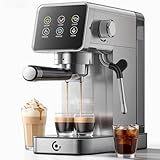
This AMZCHEF model in platinum advertises a 20-bar pump, a self-cleaning function, 1350 W fast heating, a 44 oz tank, a manual steam wand for latte art, and an LCD. A 1350 W element is typical for compact espresso machines and supports quick warm-up. The self-cleaning feature runs a rinse cycle to flush the system, which can reduce routine maintenance. A manual steam wand is the right tool for learning microfoam and latte art.
Who it suits: beginners who want a modern interface and a machine that helps with upkeep. Confirm whether it includes a grinder; the title does not say so, so assume you will need your own.
- 20-bar pump per the listing
- 1350 W heating per the listing
- 44 oz water tank per the listing
- Manual steam wand for latte art
- LCD display and self-cleaning function
Pros:
- Fast heat-up
- Self-cleaning cycle simplifies maintenance
Cons:
- Grinder not stated in the title
- Digital interfaces can add complexity
It sits close to the CASABREWS 3700 on features, with the LCD and self-clean cycle as the differences.
Specs Compared
| Model | Pump | Grinder | Steam wand | Tank | Other features |
|---|---|---|---|---|---|
| CASABREWS CM5418 | 20 bar | No | Yes | About 34 oz per manufacturer | Pressure gauge, stainless steel |
| AMZCHEF 44 settings | Confirm on listing | Built-in, 44 settings | Frother per listing | Confirm on listing | Temperature control, hot and cold brew |
| Grinder and Frother, 30 settings | 20 bar | Built-in, 30 settings | Steam wand | Confirm on listing | Temperature control, hot and cold brew |
| CASABREWS 3700 Essential | 20 bar Italian pump | No (confirm on listing) | Yes | 43.9 oz | Stainless steel |
| De’Longhi Classic | 15 bar per manufacturer pages | No | Manual steam wand | About 57 oz per retailer pages | Rapid heat-up, single and double presets |
| AMZCHEF Self-Cleaning | 20 bar | Confirm on listing | Manual steam wand | 44 oz | 1350 W, LCD, self-cleaning |
How We Chose These
We worked from the six listings provided and reviewed their titles, plus manufacturer and retailer specification pages for the CASABREWS CM5418 and the De’Longhi Classic. For a beginner audience we focused on how easy each machine is to learn: whether it has a grinder, a gauge, a steam wand, or presets, how large the tank is, and how the maker describes heat-up and cleaning. Where a listing did not state a spec, we said so and recommended confirming it. We did not rank by pump pressure alone, since the bar figure on the box is a peak figure. This is a desk-research comparison rather than a lab evaluation.
What to Look For
What Semi-Automatic Really Means
On a semi-automatic machine, you control the inputs and the machine controls the pressure and temperature. You grind and dose the coffee, tamp it into the portafilter, lock it in, and press a switch to start the pump. You stop the shot when the volume looks right, typically about 25 to 30 seconds for a standard double. Fully automatic machines do all of that for you, and manual lever machines give you control over pressure as well. Semi-automatic is the sweet spot for learning because it teaches the fundamentals without demanding expertise.
Built-In Grinder or Separate Grinder?
The grinder matters more than the machine when it comes to taste. A built-in grinder saves money and space and makes sure you use fresh beans. A separate grinder usually offers finer adjustment and can be upgraded later. If you choose a machine without a grinder, budget for a quality burr grinder and avoid pre-ground coffee, which goes stale quickly and cannot be adjusted to dial in a shot.
Pressurized Baskets and the 20-Bar Claim
Many entry-level machines ship with pressurized baskets, which have a small exit hole that builds pressure regardless of how fine or coarse your grind is. They are forgiving and ideal for beginners using pre-ground coffee, but they cap the quality you can reach. The 20-bar figure on the box is a pump figure, not the pressure at the coffee. Espresso is traditionally extracted at about 9 bar, and most machines use a valve to limit it. Treat bar numbers as a rough guide only.
Steam Wand and Milk
If you plan to drink lattes and cappuccinos, the steam wand matters. A manual wand teaches you to stretch and texture milk but requires practice, usually a few weeks to get silky microfoam. Aim to heat milk to roughly 140 to 150 degrees Fahrenheit, which is hot but still comfortable to drink, and avoid overheating, which scorches the milk. Wipe the wand and purge it after each use. A practical routine is to purge a short burst of steam before and after texturing, wipe the wand with a damp cloth right away, and keep a dedicated pitcher so you can judge volume by eye. Start with cold milk in a cold pitcher filled to just below the spout base, because the milk expands as it takes in air. Introduce air for the first few seconds, then lower the tip and roll the milk until the pitcher feels warm to the hand. If you drink plant milks, barista versions of oat and soy tend to foam more predictably than thin almond milk.
A Worked Example: Dialing In Your First Shot
A common starting recipe is 18 grams of ground coffee yielding about 36 grams of liquid espresso in 25 to 30 seconds, a 1:2 ratio. If the shot runs in under 20 seconds and tastes sour, grind finer. If it takes over 35 seconds and tastes bitter, grind coarser. Change one variable at a time, write down your numbers, and use a small scale if you can. Machines with smaller baskets may need a smaller dose, so check the basket size on the product page. For example, a machine with a 51 mm portafilter usually suits a dose of about 14 to 16 grams in a double basket, so you would aim for roughly 28 to 32 grams in the cup. Scaling the recipe to the basket keeps the extraction in the same range and avoids a crowded puck that drains unevenly.
Warm-Up, Preheating, and Temperature
Espresso is brewed with water at roughly 195 to 205 degrees Fahrenheit, and small machines can lose heat quickly if the portafilter and cups are cold. Run a blank shot of water through the empty portafilter before your first drink, and warm your cup on top of the machine or with hot water. Machines that advertise fast heat-up, such as the 1350 W units, reach brewing temperature in about a minute or less according to manufacturers, but giving the metal parts a few extra minutes to soak up heat improves consistency. Some models describe temperature control or pre-infusion, which wets the puck at low pressure before the full pump pressure arrives and helps even extraction.
Accessories Worth Having
A few inexpensive tools make a bigger difference than a fancier machine. A tamper that fits your portafilter basket, a small kitchen scale that reads to 0.1 gram, a stainless milk pitcher around 12 oz for single drinks, a knock box or a bin for used pucks, and a soft brush for the group head. Check the portafilter diameter on your chosen machine before buying a tamper, because common sizes are 51 mm, 54 mm, and 58 mm, and one that is too small leaves coffee along the edges, which causes channeling.
Reading Listings Carefully
Marketing titles stack features, so separate what is a spec from what is a slogan. A tank size in ounces, a wattage, a grind-setting count, and a named steam wand are specs you can compare. Phrases like barista quality or professional are not. When two listings look similar, such as the grinder-equipped models here, compare their photos for portafilter size, drip tray design, and where the controls sit, then read the manual if one is offered. A manual download is a good sign of a maker that supports its product.
Size, Tank, and Maintenance
Measure the space under your cabinets, including the height needed to remove the tank and portafilter. A tank of around 40 oz or more means fewer refills for a household. Descale every one to three months depending on your water hardness, and rinse the group head and drip tray regularly. Machines with self-cleaning cycles can help, but they do not replace descaling.
Questions
Do I need a separate grinder?
If your machine does not have a built-in grinder, yes. Fresh grinding is the single biggest quality upgrade, and pre-ground coffee often makes it hard to dial in a good shot. If you are not ready to buy a grinder, choose a machine with one included.
Is 20 bar better than 15 bar?
Not necessarily. Both are peak pump figures, and espresso extraction is meant to happen around 9 bar. What matters is build quality, temperature stability, and the quality of your grind.
How long does it take to learn espresso?
Most people produce drinkable shots within a week and consistently good ones in a month or two. Steaming milk to a silky texture usually takes longer. Keep notes and change one variable at a time to learn faster.
How often should I descale?
Every one to three months is a common guideline, depending on how hard your water is and how often you brew. Follow the manufacturer’s instructions and use a descaler designed for coffee machines. Using filtered water slows scale buildup.
Can I make iced drinks with these machines?
Yes, any of them can brew a shot over ice or into a glass with cold milk. Some listings mention cold brew modes, which brew at lower temperatures over a longer time. Check the product page for how each mode works.
Is a pressure gauge useful?
It is a helpful learning tool because it shows whether your grind and tamp are creating enough resistance. A pressure that stays low suggests your grind is too coarse, while very high readings suggest it is too fine. It does not replace taste, but it speeds up troubleshooting.
Update History
- October 20, 2026 – Initial publication; product set drawn from current catalog listings.
- Check the product page for current specifications and availability before buying.
Sources
- Retailer listing titles and specification fields for each product named above
- Manufacturer product and specification pages for CASABREWS (CM5418) and De’Longhi (Classic), used for tank size, wattage, presets, and pump details
- Independent product write-ups for the CM5418 that confirm the portafilter size and extraction pressure context



Write Your Review
No reviews yet. Be the first to share your experience!