

Key takeaways
- Skipping the full warm-up. An E61 group is a large block of brass; the boiler gauge can say “ready” while the group is still cold. Give the machine at least 20 to 30 minutes unless it advertises an actively heated group.
- Using hard tap water. Scale builds fastest inside the small heat exchanger tube. Use filtered or softened water and descale on the schedule in the manual.
- Chasing one temperature forever. A one-degree difference matters less than grind size and dose. Fix those first, then adjust temperature.
- Forgetting the steam boiler pressure. Pressure that creeps above the recommended range wastes energy and shortens seal life; check the gauge after warm-up.
- Not backflushing. E61 groups with a three-way valve need a routine backflush with espresso machine cleaner to avoid clogging.
The best heat exchanger espresso machine for most home baristas in 2026 is the Lelit Mara X, thanks to its compact E61 body and dual-probe temperature control; the Profitec Pro 500 PID is the pick for buyers who want a bigger boiler and a heavier, more serious build. A heat exchanger (HX) machine brews and steams at the same time from one boiler, which makes it the sweet spot between a single-boiler machine and a full dual boiler. This guide explains how the design works, compares seven current models by the numbers, and shows which one fits your kitchen, your drink habits and your patience for temperature surfing.
Our top picks


As an Amazon Associate we earn from qualifying purchases at no extra cost to you.
Quick Comparison of the Seven Picks
| Pick | Best for | Boiler | Water tank | Pump | Temperature control |
|---|---|---|---|---|---|
| Lelit Mara X (PL62X) | Best overall | 1.8 L stainless HX | 2.5 L | Vibration | Dual probe, PID-style display |
| Profitec Pro 500 PID | Best build quality | 2 L stainless | About 2.8-3 L | Vibration (Ulka EX5) | PID with shot timer |
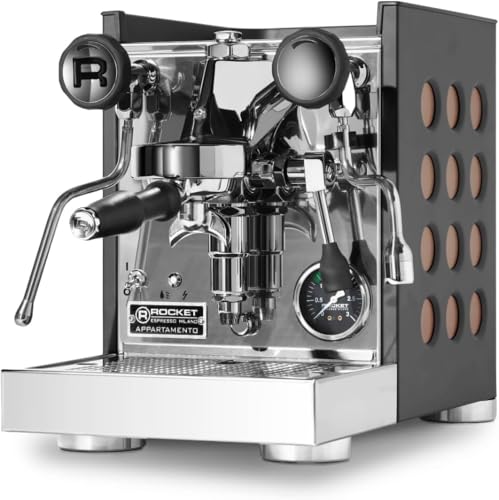
| Rocket Appartamento TCA | Best compact design | 1.8 L copper | 2.5 L | Vibration | Four temperature presets |
| ECM Mechanika VI Slim | Best for small counters | About 1.9-2.2 L stainless | About 2.8 L | Vibration | Three selectable boiler settings |
| Turin Gallatin V | Best value | 2 L stainless | Check listing | Vibration | PID, shot timer, pressure gauge |
| Izzo Vivi PID | Best for milk drinks | 1.8 L copper | 3 L | Vibration | PID with shot timer |
| Rocket Mozzafiato FAST V | Best fast warm-up | 1.8 L copper | Check listing | Vibration | Actively heated E61 group, OLED display |
Specifications above follow manufacturer pages and retailer spec sheets, and a few figures (boiler volume, weight) differ slightly between regional versions, so confirm the numbers for the exact version you plan to buy.
How a Heat Exchanger Espresso Machine Works
An HX machine has a single boiler that is kept hot enough to make steam, typically around 120 to 125 degrees Celsius inside the boiler. Fresh water from the tank does not sit in that boiler. Instead it travels through a small stainless tube that runs through the hot boiler, picks up heat on the way, and reaches the E61 brew group a few seconds later at brewing temperature. Because the steam boiler stays at steam temperature all day, you can pull a shot and froth milk at the same moment, with no waiting between the two jobs.
The trade-off is temperature stability. The water in the tube is not heated to a fixed target the way it is in a dual boiler, so the brew temperature depends on how long the water sat in the tube since the last shot. This is why traditional HX owners learn to run a short “cooling flush”, releasing a small amount of water through the group before locking in the portafilter. Modern designs reduce the guesswork in different ways. The Lelit Mara X adds a second temperature probe on the group so the display reflects what is happening where the coffee meets the water, and the PID-equipped Profitec, Turin and Izzo machines let you hold the steam boiler at a precise temperature.
Heat Exchanger vs Dual Boiler vs Single Boiler
| Feature | Single boiler | Heat exchanger | Dual boiler |
|---|---|---|---|
| Brew and steam at the same time | No, switch and wait | Yes | Yes |
| Brew temperature precision | Good with PID | Good with flush routine or probe | Best |
| Warm-up time | 5-15 minutes | 15-30 minutes with an E61 group | 15-30 minutes |
| Typical footprint | Small | Medium | Large |
| Upfront cost | Lowest | Middle | Highest |
| Parts to maintain | One boiler | One boiler plus tube | Two boilers, extra valves |
For a household that makes two to six milk drinks in a row, HX is often the more sensible choice than a single boiler, because the wait between brewing and steaming disappears. If you chase different roasts every week and want exact temperature control per coffee, a dual boiler becomes more attractive.
Best Overall: Lelit Mara X (PL62X)
The Mara X is the machine most retailers and reviewers recommend first, and the reasons are practical. It has a 1.8 L stainless steel boiler with a stainless heat exchanger, a 2.5 L tank, and an E61-style L58E group with mechanical pre-infusion. Lelit lists the footprint at roughly 22.5 cm wide, 52 cm deep and 35.5 cm high with a weight near 18.5 kg, which makes it one of the smallest E61 heat exchangers on the market. A second temperature probe near the group feeds the display, so you see a more useful number than a boiler reading alone, and the machine is built to reduce the need for long cooling flushes.
Who it suits: first-time HX buyers, apartment kitchens and anyone who wants an E61 machine without giving up half the counter. Main trade-off: some critics have questioned its thermal management compared with a true dual boiler, and a few owners still prefer a short flush before a shot. Build quality is good rather than exceptional, and at around 18 kg it is lighter than most competitors.
Best Build Quality: Profitec Pro 500 PID
The Pro 500 PID trades compactness for substance. Retailers list a 2 L stainless steel boiler (some quote 2.1 L), a 2.8 to 3 L water tank with a low-water sensor, a 1400 W element and a Ulka EX5 vibration pump. It measures about 30.2 by 44.7 by 39.3 cm without the portafilter and weighs close to 23 kg. The PID controller sits in the front panel with an integrated shot timer, and steam pressure can reach about 1.8 bar, enough for confident milk work.
Who it suits: people who plan to keep one machine for a decade, want a large stable boiler and like a visible PID. Main trade-off: a vibration pump is louder than a rotary pump, and the cabinet is wider than the Mara X or the Appartamento. If you have a narrow counter under cabinets, measure the height before you buy.
Best Compact Design: Rocket Appartamento TCA
The Appartamento is the machine many people picture when they think of a small, good-looking HX. It carries a 1.8 L copper boiler, a 2.5 L tank and is just under 8 inches wide, which lets it fit where wider E61 machines cannot. The TCA version adds four selectable temperature presets, giving you a simple way to adjust for lighter or darker roasts without a full PID menu. It is also a classic example of a machine that rewards a consistent routine: wait for warm-up, flush briefly, brew.
Who it suits: buyers who care about the look of the machine and have limited counter width. Main trade-off: there is no full PID readout, so temperature surfing skills still matter, and the price premium is partly for the design and Italian build rather than extra features.
Best for Small Counters: ECM Mechanika VI Slim
ECM’s Mechanika VI Slim measures about 25 by 44.5 by 39.5 cm and weighs around 20 kg according to ECM. It is a single-boiler heat exchanger with an E61 group, a vibration pump and a tank near 2.8 L. Boiler volume is quoted as about 1.9 L by ECM and 2.2 L by some retailers. The control panel offers three selectable boiler temperature settings (120, 124 and 128 degrees Celsius), a pre-infusion option and an eco mode that cuts power use when idle.
Who it suits: owners who want a slim, well-made German machine with a few helpful options. Main trade-off: retailers disagree on whether a PID display is part of the package, so read the specific listing carefully before you order.
Best Value: Turin Gallatin V
Espresso Outlet names the Gallatin V as its best overall value among 2026 heat exchangers, with pricing starting at the low end of the full-size HX range. It has a 2 L stainless boiler, a PID, a shot timer, programmable pre-infusion and a pressure gauge on a vibration-pump platform. The Gallatin R, which shares the boiler, swaps in a rotary pump and plumbing-in capability for people who want a quieter machine hooked to a water line.
Who it suits: buyers who want PID and pre-infusion programming without paying the premium of the European heavyweights. Main trade-off: the brand is newer and sold mainly through one retailer, so long-term parts availability is worth asking about.
Best for Milk Drinks: Izzo Vivi PID
The Vivi PID pairs a 1.8 L copper boiler with a generous 3 L tank and a PID with integrated shot timer. Its articulating no-burn steam and hot water wands are the practical highlight: they reach where you need them and stay cool to the touch, which is helpful when steaming several pitchers back to back.
Who it suits: households that make lattes and flat whites every morning. Main trade-off: it is built around ease of use rather than a flashy appearance, and the copper boiler needs normal descaling discipline.
Best Fast Warm-Up: Rocket Mozzafiato FAST V
Rocket’s Mozzafiato FAST V keeps the 1.8 L copper boiler of its siblings but adds an actively heated E61 group and an OLED interface. Retailers quote warm-up in roughly 15 minutes, noticeably shorter than the half hour many E61 machines need to heat the group head properly. A PID and vibration pump complete the package.
Who it suits: people who want to switch on and pull a shot without waiting for a cold cast-iron group to catch up. Main trade-off: it sits at the upper end of the HX price range.
Worked Example: How Much Does a Cooling Flush Cost You?
Suppose you pull a double shot after the machine has idled for ten minutes. A typical HX routine releases about 100 to 150 ml of water through the group before the shot to purge overheated water from the tube. If you make four drinks a day, that is roughly 400 to 600 ml of flush water daily, or about 12 to 18 litres a month. The water itself costs almost nothing, but the flush also costs about 8 to 15 seconds per drink and removes some of the heat from the group.
A machine with a dual-probe system or a PID-managed boiler shortens or removes that routine, which is the real value of features like the Mara X probe: not luxury, but saved time on every shot. If you make one drink a day and enjoy the ritual, the flush is a non-issue; if you make six drinks every morning for guests, favour the PID-equipped models.
Decision Matrix: Matching the Machine to Your Situation
| Your situation | Best match | Why |
|---|---|---|
| Narrow counter, first E61 | Lelit Mara X or ECM Mechanika VI Slim | Widths of roughly 22-25 cm |
| Wants a machine for 10+ years | Profitec Pro 500 PID | 2 L boiler, heavy 23 kg build |
| Design matters as much as shots | Rocket Appartamento TCA | Just under 8 inches wide, polished finish |
| Four or more milk drinks daily | Izzo Vivi PID | Large tank, no-burn wands, PID |
| Wants PID without top-tier price | Turin Gallatin V | PID, timer and pre-infusion built in |
| Hates waiting for warm-up | Rocket Mozzafiato FAST V | Actively heated group, about 15 minutes |
How to Choose a Heat Exchanger Machine
1. Measure before you browse
E61 machines are deeper than most people expect. The Mara X is about 52 cm deep with a portafilter, and the Pro 500 PID lists roughly 55.5 cm with the portafilter in place. Check the clearance under upper cabinets too, since heights run from about 35 to 40 cm and you still need room to lift the tank lid.
2. Decide how much temperature help you want
If you want a visible number and shot timer, look at the Pro 500 PID, Gallatin V, Vivi PID or Mozzafiato FAST V. If you are comfortable learning a flush routine, the Appartamento TCA is simpler and cheaper to run.
3. Think about pump noise and plumbing
All seven picks here use vibration pumps in their standard form. If you want a quieter machine or a direct water line, ask about rotary-pump versions such as the Gallatin R.
4. Check tank size against your habits
A 2.5 L tank holds enough water for roughly 15 to 20 double shots plus steaming, but a household making many milk drinks will refill more often than the 3 L tanks on the Vivi PID or Pro 500 PID.
5. Plan for ownership costs
Boilers need regular descaling, E61 groups need periodic gasket replacement, and the vibration pump is a wear item. Budget for a new group gasket and shower screen roughly once a year with daily use, and choose a machine from a brand whose spare parts you can actually source in your region.
Ownership Realities and Common Mistakes
- Skipping the full warm-up. An E61 group is a large block of brass; the boiler gauge can say “ready” while the group is still cold. Give the machine at least 20 to 30 minutes unless it advertises an actively heated group.
- Using hard tap water. Scale builds fastest inside the small heat exchanger tube. Use filtered or softened water and descale on the schedule in the manual.
- Chasing one temperature forever. A one-degree difference matters less than grind size and dose. Fix those first, then adjust temperature.
- Forgetting the steam boiler pressure. Pressure that creeps above the recommended range wastes energy and shortens seal life; check the gauge after warm-up.
- Not backflushing. E61 groups with a three-way valve need a routine backflush with espresso machine cleaner to avoid clogging.
Daily Routine for Consistent Shots on an HX Machine
- Turn the machine on and wait the full warm-up time so the group, portafilter and cups are hot.
- Lock in an empty portafilter and run a short flush until the water runs steady, then wait for the machine to recover before dosing.
- Grind, dose and tamp immediately, then lock in and start the shot within a few seconds.
- Time the shot from the pump starting, aiming for about 25 to 32 seconds for a typical 1:2 ratio, and adjust grind rather than temperature first.
- Steam milk after the shot; the steam boiler is always ready, so the transition takes seconds.
- Purge the steam wand, wipe it clean and rinse the group with a quick flush.
Frequently Asked Questions
Is a heat exchanger espresso machine better than a dual boiler?
Neither is simply better. A dual boiler offers tighter temperature control, while an HX machine is typically smaller and less expensive for similar steam power. For most home users making milk drinks, an HX with a PID or probe system produces shots that are very close to a dual boiler’s.
Do I always have to do a cooling flush?
On a traditional HX design, yes, if the machine has sat idle for more than a few minutes. Machines with a group probe or PID-managed boiler reduce how much you need to flush, though many owners still run a short purge out of habit.
How long should an E61 machine warm up?
Plan for about 20 to 30 minutes so the heavy brass group stabilises. Machines with an actively heated group, such as the Rocket Mozzafiato FAST V, advertise a warm-up of roughly 15 minutes.
Can I plumb an HX machine directly to a water line?
Some models support it, usually with a rotary pump; the Turin Gallatin R lists plumbing capability. Many vibration-pump models are tank-only, so check the manual for an inlet kit before assuming.
What grinder should I pair with an HX machine?
Pick a grinder with fine, repeatable adjustment, because the machine can only be as consistent as the grind. A quality burr grinder is a bigger upgrade to shot quality than moving between mid-range HX machines.
How often do I need to descale?
It depends on your water hardness. With filtered water, descaling every six to twelve months is common, while hard water may need it quarterly. Follow the manufacturer’s instructions and never use vinegar unless the manual allows it.


Write Your Review
No reviews yet. Be the first to share your experience!