

Key takeaways
- Under-filtering the cold brew. Fine sediment clogs faucet discs and spoils the cascade; double filter with paper.
- Over-charging. Adding extra cartridges does not improve the pour and can produce too much foam; follow the maker’s guidance.
- Skipping a rinse. Leftover coffee ferments and leaves bitter, sour notes in the next batch.
- Replacing seals too late. Rubber gaskets harden over months; replace them when you notice slow leaks or lost pressure.
- Chilling too little. Gas dissolves better in cold liquid, so chill the coffee thoroughly before charging.
- Putting milk or sweetened coffee inside the keg. Dairy spoils quickly and sugar gums up the tap.
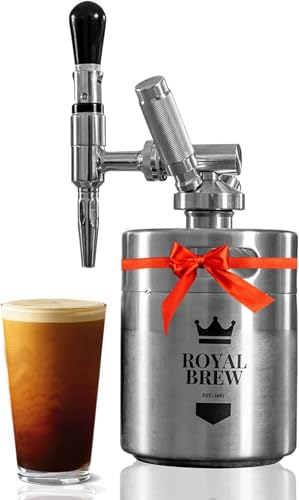
The best home nitro coffee dispenser system for most households in 2026 is a stainless mini keg in the 64 oz class, such as the Royal Brew Nitro System, because it holds about a week of cold brew for two people and pours through a real stout-style faucet. If you drink one or two glasses at a time, a handheld dispenser like the Hatfields London NitroPress or the iSi Nitro Whip is cheaper and easier to store. Insulated growler-style kegs such as the GrowlerWerks uKeg Nitro suit people who want to brew, infuse and carry the coffee in one vessel. Below is how each type works, how seven options compare, and what ownership really involves.
Our top picks


As an Amazon Associate we earn from qualifying purchases at no extra cost to you.
Quick Comparison of the Picks
| Pick | Best for | Capacity | Build | Gas format | Price tier |
|---|---|---|---|---|---|
| Royal Brew Nitro System | Best overall mini keg | 64 oz (128 oz version exists) | Stainless steel, chrome finish | Takes 8 g N2O and 2 g N2 cartridges per maker | Mid |
| GrowlerWerks uKeg Nitro | Best insulated keg | 50 oz | Double-wall vacuum insulated stainless | Cartridges with built-in regulator | Upper mid |
| KEG STORM Nitro Cold Brew Maker | Best value large keg | 64 oz | Stainless mini keg | Cartridge based | Mid |
| Hatfields London NitroPress | Best handheld dispenser | About 32 oz | Beer-tap-style nozzle | N2 and N2O compatible | Low to mid |
| iSi Nitro Whip | Best for sturdy single batches | 1 quart (32 oz) | Stainless steel with silicone grip | iSi-brand nitrogen chargers | Mid |
| Nitroknox kit | Best starter kit | Dispenser size varies | Aluminium body | Includes nitrogen cartridges | Low |
| Nitro kegerator with dual taps | Best for heavy use | Full-size kegs | Refrigerated cabinet | Nitrogen tank and regulator | High |
Specifications come from manufacturer descriptions and retailer listings and are summarised, so check the exact listing for gas type and capacity before buying; compatibility claims differ between sources.
What a Nitro Coffee System Actually Does
Nitro coffee is cold brew infused with gas and dispensed through a restricted faucet. When the pressurised liquid squeezes through tiny holes in the faucet disc, the dissolved gas comes out as a dense cascade of micro bubbles that settles into a creamy head and a velvety texture. No dairy is involved: the body comes from the gas and the brewing method. Because cold brew is low in acidity, the result tastes smooth and slightly sweet without added sugar.
Home systems fall into three groups. Handheld dispensers are bottles with a nozzle that you fill, charge with a cartridge, shake and pour. Mini kegs are stainless vessels with a dedicated tap, which you fill with finished cold brew, charge and store in the fridge. Kegerators use a full gas tank and a regulator connected to a tap, similar to a draft beer setup. Each step up increases capacity, consistency and cost.
Nitrogen vs Nitrous Oxide: Which Gas Do You Need?
| Property | Nitrogen (N2) | Nitrous oxide (N2O) |
|---|---|---|
| Texture | Velvety, fine bubbles | Foamier, larger bubbles |
| Flavour impression | Neutral, true coffee taste | Slightly sweet impression |
| Typical cost per charge | Higher | Lower |
| Cartridge size seen on home kits | About 2 g | About 8 g or 16 g |
| Best when | You want a pub-style pour | You want the cheapest charge |
Nitrogen dissolves slowly, which is why professional systems run it at high pressure. Nitrous oxide dissolves much more easily, so a small cartridge goes further in a home device. Do not assume a keg takes both: the Royal Brew kit is described as taking both cartridge types, while some insulated kegs are specified for one gas only. Always follow the manufacturer’s cartridge instructions, and never use a gas the manual does not list.
Best Overall: Royal Brew Nitro System
The Royal Brew kit is a 64 oz stainless steel mini keg with a chrome finish, a dual-action stout creamer faucet, a tap plug and cleaning brushes in the box. A 128 oz version is also offered for larger households. Reviewers who compare mini kegs highlight the cascading pour and the ease of cleaning compared with narrow handheld bottles.
Who it suits: two to four coffee drinkers who prefer to brew a large batch of cold brew on Sunday and pour fresh nitro through the week. Main trade-off: cartridges are sold separately, and the keg takes noticeable fridge space; a 64 oz vessel needs a spot about the size of a large water pitcher.
Best Insulated Keg: GrowlerWerks uKeg Nitro
The uKeg Nitro is a 50 oz double-wall vacuum insulated stainless steel keg with a pressure gauge and a regulator cap. One event user reports it staying cold for a full six-hour gathering without ice, and the stainless build handles being carried. Some versions include filter bags so you can brew the cold brew inside the vessel.
Who it suits: people who take coffee to picnics, workplaces or camping trips, and anyone who wants a single container for steeping, infusing and serving. Main trade-off: it is one of the pricier options in this guide, some owners find the pressure adjustment fiddly, and its gas format is narrower than that of the more flexible kits.
Best Value Large Keg: KEG STORM Nitro Cold Brew Maker
The KEG STORM is a 64 oz stainless mini keg that roundups position as the value option among large-capacity systems, undercutting the best-known names while keeping the same basic keg-and-tap format. For households that want the capacity of the Royal Brew without paying the top of the range, it is the kind of keg to compare against.
Who it suits: budget-aware buyers who still want a countertop tap. Main trade-off: published detail on materials and gas specifications is thinner than for the better-known kits, so read the product page for cartridge type and seal materials before purchase.
Best Handheld Dispenser: Hatfields London NitroPress
The NitroPress is a portable, hand-held dispenser, listed at about 32 oz in one roundup, with a beer-tap-style nozzle that aerates the foam as you pour. It works with both nitrogen and nitrous oxide cartridges, so you can choose texture or cost. It is small enough to travel in a bag, and it fills and cleans quickly between batches.
Who it suits: single drinkers, small apartments and people who want to try nitro without committing to a keg. Main trade-off: capacity limits servings per charge, and the cascade is less dramatic than from a full keg faucet.
Best for Sturdy Single Batches: iSi Nitro Whip
The iSi Nitro Whip is a 1 quart stainless steel dispenser with silicone grips on the diffuser and cartridge holder. It is built for the repetitive shaking that charging requires, and it looks professional on a counter. It is limited to iSi-branded nitrogen chargers.
Who it suits: cooks and baristas who already use iSi whipping equipment and want one more tool that does coffee and cream. Main trade-off: brand-locked chargers raise the cost per serving and reduce flexibility.
Best Starter Kit: Nitroknox Nitro Cold Brew Kit
The Nitroknox kit is a matte black aluminium dispenser that ships with ten nitrogen cartridges, so you can start pouring on the day it arrives. It is designed around pure nitrogen but is described as working with other gases too.
Who it suits: first-time buyers who want everything in one box. Main trade-off: the aluminium body feels less premium than stainless alternatives, and it will not match a keg for capacity or cold retention.
Best for Heavy Use: A Nitro Kegerator
If you pour four or more nitro coffees a day, a dedicated kegerator with a nitrogen tank, regulator and stout faucet gives the most consistent draft quality. Some compact models fit under a counter, and dual-tap cabinets such as 24-inch nitro cold brew kegerators exist for households that want a second tap for tea or sparkling water. Kegs are usually bought separately.
Who it suits: offices, holiday homes and coffee-obsessed households. Main trade-off: the setup costs far more than a mini keg, needs a place to store a gas cylinder, and demands regular line cleaning.
Worked Example: Cost Per Glass
Take a 64 oz keg that holds about 8 cups of 8 oz. If you buy a cold brew concentrate and dilute it one to one, the ingredient cost is the concentrate share plus the gas. A pack of ten cartridges might cover ten kegs in a nitrous oxide setup, or less for nitrogen. That means gas adds roughly one cartridge per 8 glasses, or around one-eighth of a cartridge per glass.
Now compare with a daily café nitro. If you buy one café drink per workday, that is about 20 to 22 drinks a month. A mini keg that serves 8 glasses per fill will need about three fills a month, so you make three batches of cold brew instead of 21 purchases. Even allowing for coffee beans, filters and gas, the break-even point for a mid-range keg tends to arrive within a few months for a daily drinker, but not for someone who drinks nitro twice a month.
Decision Matrix
| Your situation | Best choice | Why |
|---|---|---|
| Live alone, drink one glass a day | Hatfields London NitroPress or Nitroknox kit | Small capacity, low outlay, easy storage |
| Household of two to four | Royal Brew 64 oz or KEG STORM | Week-long batches with a real faucet |
| Travel, camping, events | GrowlerWerks uKeg Nitro | Vacuum insulation and carry handle |
| Already own iSi tools | iSi Nitro Whip | Familiar chargers and construction |
| Cafe-style daily service | Nitro kegerator | Tank-fed pressure and multiple taps |
How to Choose a Nitro Dispenser
1. Start with the coffee, not the gadget
Nitro only improves good cold brew. Brew a coarse grind for 12 to 18 hours in the fridge and filter well; any grit will clog a stout faucet. Many users dilute a 1:4 coffee-to-water concentrate to taste before charging.
2. Match capacity to your drinking pattern
Cold brew keeps for roughly a week to ten days refrigerated, so do not pick a keg you cannot finish. A 64 oz keg is about 8 cups; a 32 oz dispenser is four.
3. Confirm the gas format
Check whether the device takes nitrogen, nitrous oxide or both, and in which cartridge size. Then work out the cost per charge, since cartridges are a recurring expense.
4. Look at the faucet
The cascade comes from a restrictor disc in a stout-style faucet. Models with a dedicated tap pour more reliably than ones that rely on a simple spout.
5. Check cleaning access
Coffee oils collect in the tap and seals. A wide opening, removable faucet and included brushes make weekly cleaning realistic.
Ownership Realities and Common Mistakes
- Under-filtering the cold brew. Fine sediment clogs faucet discs and spoils the cascade; double filter with paper.
- Over-charging. Adding extra cartridges does not improve the pour and can produce too much foam; follow the maker’s guidance.
- Skipping a rinse. Leftover coffee ferments and leaves bitter, sour notes in the next batch.
- Replacing seals too late. Rubber gaskets harden over months; replace them when you notice slow leaks or lost pressure.
- Chilling too little. Gas dissolves better in cold liquid, so chill the coffee thoroughly before charging.
- Putting milk or sweetened coffee inside the keg. Dairy spoils quickly and sugar gums up the tap.
Step-by-Step: Making Your First Nitro Batch
- Brew cold brew at a ratio of roughly 1:8 for ready-to-drink or 1:4 for concentrate, steeping for 12 to 18 hours in the fridge.
- Filter twice through paper to remove fine particles that can block the faucet.
- Chill the filtered coffee for at least a few hours; cold liquid holds gas better.
- Pour into the keg or dispenser, staying below the fill line to leave headspace.
- Seal, then charge with the cartridge type the manufacturer specifies and shake gently for the time recommended in the manual.
- Rest the vessel in the fridge for at least a few minutes to let the gas dissolve, then pour at a slight angle through the tap.
- Vent pressure and rinse the vessel after each batch.
Which Beans and Brew Ratios Work Best for Nitro
Because nitro is served cold and without ice, flavour gaps show up quickly. Medium and medium-dark roasts with chocolate, caramel or nutty notes generally suit the creamy texture, while very light roasts can taste thin or sharply acidic once chilled. A coarse, even grind keeps the extraction smooth and the filtering easy. Many home brewers steep at a ratio near 1:8 coffee to water for a drink-ready brew, or 1:4 for a concentrate that they dilute with cold water at the keg. Concentrate saves fridge space, which matters when you are storing a 64 oz keg alongside groceries.
Single-origin coffees from Brazil, Colombia and Guatemala are common choices because they carry cocoa and toasted-nut flavours that stand up to the dense mouthfeel. Fruity African coffees can work, but their acidity becomes more obvious as the drink warms, so serve them in small glasses and drink them quickly.
Serving Ideas and Simple Variations
- Straight pour. Serve in a tall pint glass without ice so the cascade is visible and the head stays intact.
- Vanilla nitro. Add a small splash of vanilla syrup to the glass before pouring; do not add syrup to the keg itself.
- Nitro tonic. Pour over a short measure of plain tonic water for a bright, bitter-sweet summer drink.
- Salted caramel cold foam. Top the poured coffee with a spoonful of sweet cream whipped separately.
- Dessert float. Pour over a scoop of vanilla ice cream for an affogato-style treat.
Storage, Safety and Cartridge Handling
Gas cartridges are pressurised and should be stored in a cool, dry place away from heat and direct sun. Keep spares in their original packaging, and never puncture or reuse a cartridge. Charging devices have pressure relief designs, but you should still vent a keg before opening it and keep it out of reach of children. If a seal is cracked, a gauge reads unusually high or a vessel is dented, stop using it and contact the manufacturer. For wall-mounted kegerators with gas cylinders, secure the cylinder upright with a strap and check the regulator connection for leaks with soapy water rather than a flame.
Finally, remember that nitrous oxide cartridges are sold for culinary use. Using them for any other purpose is unsafe and unsupported by the makers of these dispensers.
Frequently Asked Questions
Do I need a nitro keg, or will a regular cold brew pitcher do?
A pitcher makes cold brew but cannot create the creamy cascade. The effect needs gas under pressure and a restricted faucet, which is what the dispensers and kegs here provide.
Is nitro cold brew stronger than regular cold brew?
The caffeine depends on the cold brew you put in, not on the gas. Nitro is usually served undiluted and without ice, so a glass can contain more coffee than an iced one of the same size.
Can I use nitro cartridges meant for whipped cream?
Whipped cream chargers contain nitrous oxide, which some home devices accept. Use only the cartridge type and size the device manual lists, and follow all safety guidance printed on the cartridge packaging.
How long does nitro coffee stay good in the keg?
Plain cold brew generally keeps for about a week to ten days refrigerated in a clean vessel. The nitro effect fades as pressure drops, so recharge as needed, and discard coffee that smells sour.
Is a nitro system hard to clean?
It takes a few minutes. Rinse the vessel, remove and wash the faucet, soak seals in warm water with mild detergent and let everything dry before storage.
Are nitro systems worth it for occasional drinkers?
For fewer than two glasses a week, a small handheld dispenser or simply visiting a café makes more sense. A mini keg pays off for regular drinkers who can finish a batch within a week.




Write Your Review
No reviews yet. Be the first to share your experience!