

Key takeaways
- Best Overall: KRUPS Precision Electric Coffee Grinder, 3 oz, 200 W, stainless steel blades.
- Best Value: Cuisinart One Touch Coffee Grinder DCG-20BKN, 2.5 oz with safety interlock.
- Best Quiet Option: KRUPS Silent Vortex, 3 oz, 175 W, listed as 5x quieter, with a removable dishwasher-safe bowl.
- Best for Coarse-to-Fine Control: SHARDOR Super Silent Blade Grinder with timed grind rotary knob and removable stainless bowl.
- Best for Hands-Free Grinding: Hamilton Beach Custom Grind, hands-free operation and auto shutoff, up to 14 cups.
- Best Budget: BLACK+DECKER One Touch Coffee Grinder, 150 W, 2/3 cup capacity.
The best grinder for flax seeds is a small electric blade mill with a removable stainless steel bowl, and the KRUPS Precision (3 oz capacity, 200 W motor, stainless steel blades) is the model we would start with. The runner-up is the Cuisinart One Touch DCG-20BKN, a compact 2.5 oz grinder with a safety interlock that costs less and does the same job. Both are built for dry beans, herbs and spices, so whole flax seed, which is small, hard and slightly oily, is well within their remit.
If you run an espresso setup, there is a second reason to read this guide: your espresso burr grinder is the wrong place to put seeds. Seeds leave an oily film, can leave fragments in the burr chamber, and may change the taste of the next shot. A dedicated seed and spice mill costs a fraction of an espresso grinder and keeps the burrs clean. Below you will find six blade mills compared, a worked example of how much you can grind in one batch, cleaning steps that actually work, and answers to the most common questions, including the best grinder for flax seeds on a budget. We did not personally use these products; this guide is research-based, built on manufacturer specification pages and listing details, and anything not stated by a maker is marked “not listed”.
Our top picks


As an Amazon Associate we earn from qualifying purchases at no extra cost to you.
Top Picks at a Glance
- Best Overall: KRUPS Precision Electric Coffee Grinder, 3 oz, 200 W, stainless steel blades.
- Best Value: Cuisinart One Touch Coffee Grinder DCG-20BKN, 2.5 oz with safety interlock.
- Best Quiet Option: KRUPS Silent Vortex, 3 oz, 175 W, listed as 5x quieter, with a removable dishwasher-safe bowl.
- Best for Coarse-to-Fine Control: SHARDOR Super Silent Blade Grinder with timed grind rotary knob and removable stainless bowl.
- Best for Hands-Free Grinding: Hamilton Beach Custom Grind, hands-free operation and auto shutoff, up to 14 cups.
- Best Budget: BLACK+DECKER One Touch Coffee Grinder, 150 W, 2/3 cup capacity.
Comparison Table
| Product | Best for | Key specs (as listed) | Watch for | Price tier |
|---|---|---|---|---|
| KRUPS Precision | All-round seeds, spices, beans | 3 oz capacity, 200 W, stainless steel blades | Bowl removability not listed in the title | Budget |
| Cuisinart DCG-20BKN | Small weekly batches | 2.5 oz, safety interlock, on/off switch | Smallest capacity of the group | Budget |
| KRUPS Silent Vortex | Quiet kitchens, shared homes | 3 oz, 175 W, removable dishwasher-safe bowl, 5x quieter | Lower wattage than the standard KRUPS | Mid-range |
| SHARDOR Silent Blade | Choosing coarse or fine by time | Timed rotary knob, removable stainless bowl | Newer brand, wattage not listed | Budget |
| Hamilton Beach Custom Grind | Hands-free grinding | Up to 14 cups, hands-free, auto shutoff, removable chamber | Chamber material not listed | Budget |
| BLACK+DECKER One Touch | Occasional grinding on a tight budget | 150 W, 2/3 cup, stainless blades, push-button | Smaller bowl, hold-to-grind operation | Budget |
Why a Blade Mill Suits Flax Seeds
Flax seed is tiny and flat with a hard, glossy shell. To get a usable meal from it, the shell has to be cracked and the seed broken into small pieces. A spinning blade does that quickly: seeds are thrown against the blade, which chops them in a few seconds. Burr grinders are designed for larger, drier items like coffee beans and work by crushing between two fixed surfaces. Small seeds can slip through burr gaps without being broken, and the natural oil in flax can build up and gum the burrs. That is why a blade mill is the standard tool.
A blade grinder is also the most affordable way to handle other small ingredients such as whole spices, chia seed or sesame, so a single mill can double as your spice grinder. The practical rule is to keep one mill for seeds and spices and your burr grinder for coffee.
1. KRUPS Precision Electric Grinder: Best Overall
- 3 oz capacity.
- 200 W motor.
- Stainless steel blades.
- Listed for coffee beans, herbs, nuts and spices.
- Black finish.
Best for: a household that wants one mill for flax, spices and the occasional coffee dose. Skip if: you want a quiet motor; this one is conventionally loud for a few seconds.
The 200 W motor is among the stronger ones in this group, which matters for dense items. More power helps the blade keep speed when it hits seeds and whole spices, and it shortens the time needed to reach a fine meal. The 3 oz capacity is a practical size: roughly 85 grams of dry material by weight. For flax, which is denser per volume than beans, fill only about half the bowl so the blade has room to move the seeds around. A packed bowl grinds unevenly because the blade cannot circulate the contents.
The listing names herbs and nuts alongside coffee and spices, which is useful if you also want to chop walnuts for baking or pulverize dried herbs. Use short pulses of one to three seconds and shake the grinder between pulses for a more even result.
What it lacks is any grind-size selector. Grind fineness is controlled by how long you hold the button, which takes some practice. Flax meal needs only a few seconds; beyond that you risk warming the seeds, and the oil will begin to clump.
Pros:
- 200 W motor handles dense seeds and spices.
- 3 oz bowl is a convenient batch size.
- Listed for beans, herbs, nuts and spices.
Cons:
- No grind selector, control is by time.
- Loud during use.
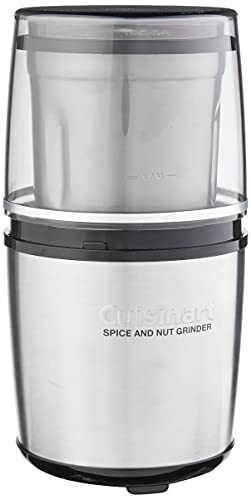
2. Cuisinart One Touch DCG-20BKN: Best Value for Small Batches
- 2.5 oz capacity.
- Stainless steel.
- On/off switch with safety interlock.
- Listed as grinding enough for 12 cups of coffee.
- Compact design.
Best for: someone who grinds a small amount of flax weekly and wants a simple, compact tool. Skip if: you want to grind a month’s supply in one session.
A safety interlock means the motor will not run unless the lid is closed, which is an important feature in any appliance with an exposed blade. The on/off switch is a plain press-and-hold design: hold to grind, release to stop. That makes it easy to control short pulses for seeds.
At 2.5 oz, the bowl holds slightly less than the KRUPS. For flax, half full is about 35 to 40 grams, which is a few days of ground flax for one person at a tablespoon-a-day habit. That is not a disadvantage: ground flax is best made in small batches, since the broken seed has more surface exposed to air. Making a week’s supply at a time and storing it in a sealed container in the refrigerator is a common practice.
The compact body is easy to store in a drawer, which suits small kitchens. Because it is a classic design, replacement lids and accessories are widely available.
Pros:
- Safety interlock.
- Compact and easy to store.
- Lower price tier.
Cons:
- Smaller bowl than the 3 oz models.
- No grind selector.
3. KRUPS Silent Vortex: Best Quiet Mill With a Washable Bowl
- 3 oz capacity.
- 175 W motor.
- Listed as 5x quieter than the maker’s standard grinders.
- Removable, dishwasher-safe bowl.
- Listed for coffee beans, spices and herbs; 12-cup yield.
Best for: shared homes, apartments and early-morning grinding. Skip if: you want the highest motor power for the price.
Cleaning is the biggest practical challenge with flax. The oil sticks to the bowl and the blades, and it can smell stale if left. A removable, dishwasher-safe bowl solves most of it: lift it out, wash it and let it dry fully. That is a more thorough clean than a wipe-down. Because the motor and blade assembly stays in the lid, never submerge that part; wipe it with a damp cloth.
The maker lists a noise reduction of five times quieter than its regular models. We cannot verify that figure without measuring it ourselves, so treat it as the maker’s claim. Even so, a quieter mill is a useful feature if you grind in a shared kitchen.
With 175 W, the motor is a bit lower in power than the standard KRUPS. For flax that makes little difference, since seeds are small and soft compared with whole spices like cinnamon sticks.
Pros:
- Removable dishwasher-safe bowl.
- Quieter design, per the maker.
- 3 oz capacity.
Cons:
- Higher price than basic mills.
- Lower wattage.
4. SHARDOR Super Silent Blade Grinder: Best for Controlling Fineness by Timer
- Timed grind control using a rotary knob.
- Adjustable from coarse to fine.
- One removable stainless steel bowl.
- Listed for coffee beans, spices and herbs.
- Wattage and capacity: not listed in the title.
Best for: people who want repeatable results without holding a button. Skip if: you need confirmed capacity and power figures before buying.
A timed knob solves the biggest problem with blade mills, which is inconsistency. Instead of holding a button for a guessed number of seconds, you turn the knob to a set time and the mill stops by itself. For flax, a short time gives a coarse crack and a longer one gives a fine meal. Note your preferred setting once, and the result repeats.
The removable stainless steel bowl helps with cleaning and prevents flavor transfer better than a plastic bowl, since stainless steel does not absorb oil or smell. If you move between spices and flax, wash the bowl between uses.
The weak side is documentation. The title gives no capacity or wattage, so check the product page before ordering. As with any newer brand, keep the packaging for the return window.
Pros:
- Timer knob for repeatable grinding.
- Stainless steel removable bowl.
- Quiet operation claimed in the product name.
Cons:
- Capacity and power not listed.
- Less established brand.
5. Hamilton Beach Custom Grind: Best for Hands-Free Operation
- Listed for up to 14 cups of coffee.
- Grinds beans, spices and more.
- Hands-free operation with auto shutoff.
- Easy-clean removable chamber.
- Stainless steel body.
Best for: someone who wants to press a button and walk away. Skip if: you prefer to pulse manually and watch the texture.
Hands-free operation is helpful when you grind larger batches. You select a time, the grinder runs, then it stops. For flax this means you can walk away, but be careful: running too long can warm the seeds and turn the meal pasty. Start with a short run, check the result, and add seconds if needed.
The removable chamber is the key feature for flax. Oily residue builds up on the chamber walls, and a removable part can be washed under running water and dried completely. The listing does not state whether the chamber is dishwasher-safe or what it is made of, so follow the maker’s guidance.
Capacity for 14 cups of coffee suggests a larger chamber than the Cuisinart, though the listing does not state it in ounces. If you intend to batch-grind, check the product page for the actual volume.
Pros:
- Hands-free with auto shutoff.
- Large capacity for the category.
- Removable chamber.
Cons:
- Chamber material and capacity in ounces not listed.
- Auto operation can over-grind if timed too long.
6. BLACK+DECKER One Touch Coffee Grinder: Best Budget Option
- 150 W motor.
- 2/3 cup coffee bean capacity.
- Stainless steel blades.
- One-touch push-button control.
- Listed as a spice grinder.
Best for: occasional use and a tight budget. Skip if: you plan to grind daily and want a removable bowl.
With 150 W it is the least powerful here, but flax seeds are small enough that power is rarely an issue. The 2/3 cup capacity is the equivalent of roughly 2 oz of beans. For flax, a half-full bowl yields enough meal for a few days.
The push-button control grinds while you hold it down. It is simple, but you have to stay at the counter. The listing does not mention a removable bowl, so cleaning means wiping the interior, which can leave a thin film of oil. If that bothers you, step up to a model with a removable bowl.
Pros:
- Lowest cost.
- Simple push-button operation.
- Stainless steel blades.
Cons:
- Lowest wattage.
- No removable bowl listed.
Also Consider
- Hamilton Beach Fresh Grind: stainless steel blades, listed for up to 12 cups, with an easy-clean removable chamber. A straightforward budget alternative.
- Wancle Electric Coffee Grinder: one-touch mill for beans and spices that includes a cleaning brush.
- A dedicated spice mill or small food processor: if you grind large quantities, a small food processor may be quicker, though it is harder to clean.
How We Chose
This guide is research-based. We did not personally use these products. Because most manufacturers market these mills as coffee and spice grinders, we looked for models whose listings name spices, herbs or nuts, since seeds fall into that category, and none of the makers specifically promises flax results. We read manufacturer specification pages and listing details for capacity, wattage, blade material, bowl design and safety features. We excluded burr grinders, which are not designed for oily seeds, and avoided claims we could not verify, such as exact grind sizes. Price tiers are used instead of prices. We also applied general food-handling advice on cleaning and storing oily seeds.
Buying Guide
Capacity and how much to grind at once
Think in batches. If you use a tablespoon of flax a day (about 10 grams), a week needs about 70 grams, which is a little under a 3 oz bowl at full fill and comfortable at half fill in two batches. Ground flax goes stale faster than whole seed because breaking the shell exposes the oil to air. Grind small batches, store them in an airtight container in the refrigerator, and use them within a week or two. For anything longer, store whole seeds and grind as you go.
Motor power
For seeds, 150 to 200 W is adequate. More power helps with hard whole spices, and a stronger motor holds speed under load. Do not run any mill for more than the maker’s stated maximum time at a stretch, because motors can overheat. Short pulses are safer and give you better control.
Bowl design and cleaning
Flax oil is sticky and can hold odors. A removable stainless steel bowl is easier to clean than a fixed chamber. If the bowl is fixed, a dry brush and a few spoonfuls of uncooked rice ground for several seconds can lift residue, followed by a wipe. Never immerse the motor base in water, and unplug the unit before cleaning.
Safety features
Choose a grinder with a lid interlock so the blade cannot spin when the lid is off. Keep fingers out of the bowl, let the blades stop fully before opening, and keep the grinder dry.
Noise and counter space
Blade mills are noisy but short-lived in use; most seed batches take under 20 seconds. If you share walls or have a sleeping household, a quieter model such as the KRUPS Silent Vortex may be worth it. All six picks are small enough to store in a drawer.
Step by Step: Grinding and Cleaning Flax in a Blade Mill
- Measure first. Spoon whole seeds into the cool, dry bowl until it is about half full. For a 3 oz bowl that is roughly 40 grams, enough for about four days at a tablespoon a day.
- Close the lid fully. If the model has a safety interlock, the motor will not start until the lid is seated. That is a feature, not a fault.
- Pulse in short bursts. Run for two seconds, stop, shake the mill gently so seeds near the edge move to the blade, then run again. Three to five pulses are usually enough for a coarse meal. A timer-knob model can do the same with one setting.
- Stop at the texture you want. Fully broken seed looks like coarse flour with flecks. If it starts to look damp or paste-like, you have run it too long; let it cool before the next batch.
- Empty and store. Tip the meal into a clean, dry, airtight jar and put it in the refrigerator. Label it with the date.
- Clean right away. Unplug the mill. Wash a removable bowl with warm soapy water or follow the maker’s dishwasher guidance, and dry it fully before it goes back on the base. For a fixed chamber, brush out the loose meal, grind a spoonful of dry rice for ten seconds, discard it and wipe with a dry cloth. Do not leave damp meal in the bowl, because oil and moisture together are what create stale smells.
Cleaning promptly matters most if the same mill also grinds coffee or strong spices. Flax is mild, but oil traces can carry the aroma of whatever you ground last. A tidy routine means the next batch of coffee or cumin tastes like itself.
Common Mistakes to Avoid
- Using your espresso burr grinder for seeds. Oily residue and fragments can linger and affect the taste of coffee.
- Overfilling the bowl. Seeds need room to move; half full gives the most even result.
- Grinding too long. Heat makes the meal clump. Pulse and stop.
- Storing ground flax at room temperature for weeks. Refrigerate in an airtight container.
- Washing the motor base. Only the bowl is meant to be washed.
Frequently Asked Questions
What is the best grinder for flax seeds?
A small electric blade mill such as the KRUPS Precision, with a 200 W motor and a 3 oz bowl, is a strong choice. The Cuisinart DCG-20BKN is a lower-cost alternative with a safety interlock.
Can I grind flax seeds in a coffee grinder?
Yes, if it is a blade-style coffee and spice grinder. Avoid doing it in a burr grinder, and avoid using the same mill for flax and coffee unless you clean it well, because the oils can flavor your coffee.
Can I use my espresso grinder for flax seeds?
We do not recommend it. Seeds are oily and small, and they can leave residue between the burrs or pass through unbroken. Use a separate blade mill.
How long should I grind flax seeds?
Usually a few seconds in short pulses, until the seeds look like a coarse meal. Longer grinding warms the seeds and can make them clump.
How do I clean a grinder after flax seeds?
Unplug it, wash the removable bowl if there is one, and dry thoroughly. For a fixed chamber, grind a spoonful of dry rice, discard it and wipe the chamber with a cloth.
How should I store ground flax?
In an airtight container in the refrigerator, in small amounts. Ground seed has more surface exposed to air, so it is best used within a short time. Check the packaging of your seeds for the maker’s storage guidance.
Is a manual grinder an option for flax seeds?
Some people use hand mills, but many coffee hand grinders are designed for beans and have narrow burr gaps. Check the maker’s list of suitable ingredients before using one for seeds.
Which One Should You Buy?
Choose the KRUPS Precision if you want one reliable mill for seeds, spices and coffee. Pick the Cuisinart DCG-20BKN for the most compact option, the KRUPS Silent Vortex if noise and washing matter, the SHARDOR if you like a timer knob, the Hamilton Beach Custom Grind for hands-free grinding, and the BLACK+DECKER if you grind only now and then. Whichever mill you pick, keep it separate from your espresso grinder, grind small batches, and store the meal cold and sealed.
Sources
- KRUPS manufacturer product pages for the Precision and Silent Vortex grinders
- Cuisinart manufacturer page for the DCG-20BKN
- Hamilton Beach manufacturer pages for the Custom Grind and Fresh Grind models
- BLACK+DECKER and SHARDOR manufacturer product pages
- General food-storage guidance from public food-safety agencies
Last updated: October 2026





Write Your Review
No reviews yet. Be the first to share your experience!