

Key takeaways
- Best 2 cup French presses compared: six stainless 12 and 17 ounce models, plus a 34 ounce runner-up, with sizes, filters and brewing ratios.
For two mugs of coffee without a big carafe, the Secura 17-ounce insulated stainless steel French press is the best all-rounder here: it is large enough to pour two modest cups, its double-wall body helps hold heat, and it ships with extra filter screens. If you brew for yourself, the 12-ounce class (Secura 12 oz, the mini 12 oz stainless press or the RAINBEAN) is the better size. A French press steeps coarse grounds directly in hot water and then separates them with a plunger and mesh filter, so “2 cup” is really a matter of how many ounces you want in the mug.
Quick List
- 12 OZ Full Stainless Mini French Press – best for camping and solo mornings where durability matters
- Secura 17 oz Insulated French Press – best overall for two small mugs
- RAINBEAN 12 oz Mini Press – best for a single-serve press with a three-stage filter
- LRYYBTI 17 oz Stainless Press – best for measuring with scale lines inside the carafe
- Secura 12 oz Insulated French Press – best for a compact insulated press for one
- 34 oz Double-Wall French Press – best for sharing, but larger than a true 2-cup size
Which One Is Right for You?
| If you… | Choose |
|---|---|
| brew for two and want a double-wall body | Secura 17 oz |
| take a press camping or want one that will not shatter | 12 OZ Full Stainless Mini |
| want a press with a three-stage filter for one cup | RAINBEAN 12 oz |
| like a built-in scale to measure water | LRYYBTI 17 oz |
| want the smallest insulated model | Secura 12 oz |
| might brew for three or four people some days | 34 oz Double-Wall |
As a rule of thumb, buy by ounces rather than by the word “cup.” A 12-ounce press makes one generous mug or two small cups, a 17-ounce press makes two mugs of moderate size, and a 34-ounce press is built for a small group.
All 6 Picks in Detail
1. 12 OZ Full Stainless Mini French Press – Best for Camping and Solo Mornings
As an Amazon Associate we earn from qualifying purchases at no extra cost to you.

This listing describes a sturdy, full stainless steel 12-ounce French press sold as a mini or small camping model, with a teapot-style use hinted at in the title. All-metal construction is the headline: there is no glass to chip in a backpack, which makes it more forgiving than a glass beaker. The trade-off is that you cannot see the grounds or the color of the coffee while it steeps, so rely on a timer instead of your eyes.
A 12-ounce press leaves room for the grounds and some headspace, so the finished volume is smaller than the label suggests. Plan on roughly one tall mug or two small espresso-style cups of strong coffee.
Metal presses also forgive rough handling at a campsite, where a glass beaker can crack on a cold morning when boiling water hits it. If you use it outdoors, pre-warm the body with a splash of hot water, pour from a safe height, and keep the plunger straight so the mesh seats evenly against the wall. The listing leaves out some details, such as filter construction, so read the full product page before you buy.
- Capacity: 12 ounces
- Full stainless steel body, per the listing
- Marketed as a mini, camping and kitchen press
- Filter layers and wall construction: confirm on listing
- Dishwasher safety: confirm on listing
Pros
- No glass to break
- Compact for travel
Cons
- Cannot watch the brew
- Insulation is not stated in the visible name
Compared with the Secura 12 oz, it focuses on rugged simplicity, while the Secura emphasizes insulation and extra screens.
2. Secura 17 oz Insulated French Press – Best Overall for Two Small Mugs
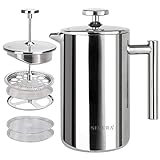
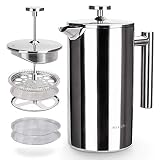
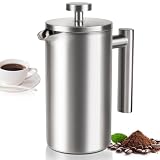
Secura sells this press as a 304-grade stainless steel insulated model with two extra screens, in a 17-ounce (0.5-liter) size and a silver finish. The extra screens are worth noting because mesh filters wear out or clog with fine grounds over time, and having spares makes the press last longer. A 0.5-liter capacity is the sweet spot for two people sharing a morning pot, or one person who likes a large mug and a half.
Insulated walls also mean the coffee stays warm while you finish your first cup, which is a practical advantage over a single-wall glass press.
Because it is insulated, you can leave the finished coffee in the press for a few minutes while you find mugs, though the plunger should be pushed down first so the grounds stop extracting. Secura publishes sizes across its range, so the same design is available smaller or larger if your needs change, and replacement screens are easy to understand because the extras come in the box.
- Capacity: 17 ounces (0.5 liter)
- Double-wall insulated stainless steel, “304 grade” in the listing name
- Includes two extra screens
- Silver finish
- Exact usable brew volume: confirm on listing
Pros
- Good size for two small mugs
- Spare screens included
Cons
- Opaque body hides the steep
- Larger than a single-serve press if you brew alone
Next to the LRYYBTI at the same nominal size, the Secura leans on the brand’s insulation and spare screens, while the LRYYBTI adds scale lines.
3. RAINBEAN 12 oz Mini Press – Best for a Three-Stage Filter

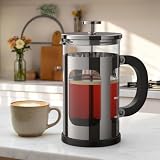
The RAINBEAN is a 12-ounce mini press sold as a one-cup, single-serve French press with a three-layer filtration system and a heat-resistant, thick body. The title does not make clear whether the body is glass or another material, so check the product page before assuming. The three filtration stages are intended to reduce sediment in the cup, which is the most common complaint about French press coffee.
With a one-cup design, it is the best match for someone who brews a single mug and does not want leftovers going cold. Two people will find it small.
A multi-stage filter generally means a metal mesh plus one or more finer layers, though the exact structure should be checked on the product page. Even the best filter will not remove all fine particles, so a coarse, even grind remains the most effective way to keep the cup clean. If you like a lighter body, a paper filter inside the carafe is a common workaround, but only if the design allows it.
- Capacity: 12 ounces, marketed as one cup
- Three filtration layers, per the listing
- Heat-resistant, thick construction
- Body material and lid design: confirm on listing
- Single-serve format
Pros
- Multi-stage filter for a cleaner cup
- Small footprint on a desk or counter
Cons
- Too small for two full mugs
- Fewer details visible in the name
Compared with the Secura 12 oz, it focuses on filtering, whereas the Secura offers an insulated metal body.
4. LRYYBTI 17 oz Stainless Press – Best for Measuring With Scale Lines

LRYYBTI sells a 17-ounce stainless steel French press with scale lines and two extra filters. Scale lines on the inside make portioning easy: fill to the mark, add grounds, and you have a repeatable recipe. That consistency helps beginners dial in a ratio of coffee to water without a kitchen scale. Two spare filters are also a handy inclusion.
The listing does not state whether the walls are single or double layer, so confirm that if heat retention matters to you.
Scale lines are only a guide, because the marks show the volume of water rather than the weight of coffee. Still, they remove one variable. Fill to the first line for a smaller cup, pour to the higher line when you have a guest, and keep the grounds amount consistent each time. Over a few mornings you can adjust the steep time up or down until the cup matches your taste.
- Capacity: 17 ounces
- Stainless steel, silver, per the listing
- Scale lines for measuring
- Includes two extra filters
- Wall construction: confirm on listing
Pros
- Built-in measurement aids repeatable brewing
- Spare filters
Cons
- Insulation not confirmed
- Same opaque-body drawback as other steel presses
Compared with the Secura 17 oz, it adds measurement marks but offers less documented insulation.
5. Secura 12 oz Insulated French Press – Best Compact Insulated Press
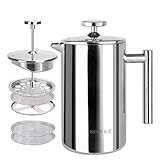
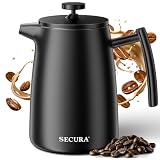
Secura’s 12-ounce model is the smaller sibling of the 17-ounce press: 304-grade stainless steel, double-wall insulation, two extra screens and a silver finish. Retailer pages describe it as holding 12 ounces (0.35 liter) and brewing up to about 9 ounces of coffee, which is a useful reality check on how much liquid you actually get. Product data also lists a three-layer filter screen and cool-touch handle and knob, and describes the parts as dishwasher safe, though you should confirm on the product page.
The honest brew-volume figure is a point in its favor, because buyers often expect a 12-ounce press to deliver a full 12-ounce mug. In practice the plunger, grounds and headspace take up part of the volume. For a morning cup this is plenty, and the compact size fits easily in a cupboard or a carry-on bag. If the listing is out of stock, the 17-ounce version is the next logical step.
- Capacity: 12 ounces (0.35 liter)
- Brews up to about 9 ounces of coffee, per retailer data
- Double-wall insulated stainless steel
- Includes two extra screens
- Roughly 3.5 inches deep and 6 inches tall per one listing; confirm on listing
Pros
- Insulated and compact
- Honest, documented brew volume
Cons
- Only about 9 ounces of coffee per batch
- Not ideal for two people
Compared with the Secura 17 oz, it is the better choice for one person, and the 17-ounce is the better pick for two.
6. 34 oz Double-Wall French Press – Best for Sharing, but Larger Than 2 Cups
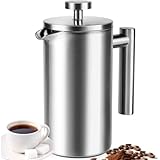
This listing is for a 34-ounce, full stainless steel French press labeled as four cups, with an upgraded double-walled insulated design. It is not a true 2-cup press: at 34 ounces it holds about four 8-ounce servings. We include it as a runner-up for anyone who sometimes brews for two and sometimes for four, and who would rather own one press than two. Use it only when you can fill it reasonably full, because a mostly empty tall press loses heat faster.
The double-wall design helps offset the larger air space inside when you brew a smaller batch, but the best results come when the press is at least half full. Treat it as a two-in-one choice: a good press for a couple on weekends and a good press for a small family on holidays. If your goal is strictly one or two small cups, one of the 12 or 17 ounce models is easier to store and clean.
- Capacity: 34 ounces, sold as four cups
- Full stainless steel with double-wall insulation
- Food-grade materials, per the listing
- Filter details: confirm on listing
- Larger footprint than any other press here
Pros
- Flexible: serves two generously or four modestly
- Insulated body
Cons
- Too large for a strict 2-cup need
- Takes more space to store
Compared with the 17-ounce presses, it doubles the capacity but gives up compactness.
Specs Compared
| Model | Capacity | Material | Insulation | Filters / extras | Best for |
|---|---|---|---|---|---|
| 12 OZ Full Stainless Mini | 12 oz | Stainless steel | Confirm on listing | Confirm on listing | Camping, solo |
| Secura 17 oz | 17 oz (0.5 L) | 304-grade stainless | Double wall | 2 extra screens | Two small mugs |
| RAINBEAN 12 oz | 12 oz | Confirm on listing | Confirm on listing | 3 filtration layers | Single serve |
| LRYYBTI 17 oz | 17 oz | Stainless steel | Confirm on listing | Scale lines, 2 extra filters | Measured brewing |
| Secura 12 oz | 12 oz (0.35 L) | 304-grade stainless | Double wall | 2 extra screens | One person |
| 34 oz Double-Wall | 34 oz | Stainless steel | Double wall | Confirm on listing | Sharing |
How We Chose These
We assembled this guide through research rather than direct use. For each of the six listings, we compared the stated capacity, body material, insulation, filter details and extras, using the listing names and manufacturer and retailer specification pages where they were available. Because sellers label sizes differently, we treated ounces as the true measure of “2 cup” suitability, and we marked anything the listing did not state as “confirm on listing.” The largest press is included as a clearly labeled runner-up rather than being passed off as a 2-cup model.
What to Look For
Decode the “cup” label
Brewers use different cup sizes. Coffee makers commonly count a cup as 5 ounces, while French press makers often count 4 ounces per cup and some sellers use 8 ounces. That is why a 34-ounce press can be sold as “four cups” and a 12-ounce press as “one cup” or “three cups,” depending on the maker. Look at the ounce or milliliter figure, and remember that you cannot fill a press to the brim because grounds and plunger take up room. For example, one retailer states that the Secura 12 oz brews up to about 9 ounces of coffee.
Material: steel versus glass
Stainless steel is durable and often double-walled, which holds heat longer. Glass lets you watch the steep and has no metallic feel, but it can break. Check the grade of steel in the listing; 304, sometimes described as 18/8 or 18/10, is the common food-grade choice. Because steel is opaque, a timer is essential.
Filters and sediment
The mesh filter determines how much sediment ends up in your cup. Multi-layer screens and extra spare screens help. A coarse grind is the best defense, since fine grounds slip through any mesh. Pressing slowly, and stopping before the plunger hits the bottom, also reduces sludge.
A simple brewing recipe
A common starting ratio is about 1 part coffee to 15 parts water by weight, adjusted to taste. For a 12-ounce press filled with about 9 ounces of water (roughly 265 grams), that works out to around 17 to 18 grams of coffee, or three level tablespoons. Use water just off the boil, around 195 to 205 degrees Fahrenheit, add a coarse grind, stir gently, and steep for about four minutes before pressing. Pour all of the coffee out immediately, because it keeps extracting if left on the grounds.
Heat retention and preheating
Preheating is a quick way to improve any press. Swirl a little hot water in the carafe, discard it, and then add your grounds and fresh water. On a steel body this step matters because cold metal pulls heat out of the brew in the first minute. Double-wall models lose heat more slowly than single-wall ones, so they benefit less from preheating but still gain a small improvement. Water that is too hot can scorch the coffee, so let a just-boiled kettle sit for 30 seconds before pouring.
Plunger, lid and handle design. A good plunger fits snugly, so the mesh scrapes the wall as it moves and does not let grounds escape around the edges. Look for a lid that locks or pours through a spout, a handle that stays cool, and a knob that does not heat up with the body. These details matter more on small presses, where there is little margin between the handle and the hot walls. Replacement screens extend the life of a press, which is why models with spare screens in the box are attractive.
Cleaning and care. Dispose of grounds in the trash or compost, not the drain. Rinse the filter assembly and take it apart periodically so old oils do not turn rancid. Check the listing for dishwasher guidance, and replace the filter screen if it bends or no longer seals against the wall.
Worked example: choosing between 12 and 17 ounces. Say you drink one 10-ounce mug each morning and your partner drinks one 8-ounce mug. Together that is about 18 ounces of coffee, which exceeds the usable volume of a 17-ounce press once the grounds take their share. In that case, either brew twice in a 12-ounce press or accept slightly smaller mugs from a 17-ounce model. If you both drink 6-ounce cups, the 17-ounce press covers you in one batch. Do the math with your own mug sizes before choosing.
Questions
What size is a 2 cup French press?
There is no single standard. Most sellers use a 12-ounce press for one to two small cups and a 17-ounce press for two mugs, so shop by ounces.
Is a 12 oz or 17 oz press better for two people?
The 17-ounce size is a better fit. A 12-ounce press may produce only about 9 ounces of coffee, which is enough for one person.
Do stainless steel presses keep coffee hot?
Double-wall models hold heat longer than single-wall designs. Check each listing for insulation, since not every steel press has it.
How long should I steep coffee in a French press?
About four minutes is a common starting point. Steep longer for a stronger cup and shorter for a lighter one, and adjust grind size as needed.
What grind size should I use?
Use a coarse grind, about the texture of coarse sea salt. Fine grounds pass through the mesh and make the cup muddy.
Can I use a larger press for a small batch?
You can, but a mostly empty press loses heat faster and the steep may be uneven. Choose a size close to what you brew most often.
Update History
- October 21, 2026 – Initial publication; product set drawn from current catalog listings.
- Check the product page for current specifications and availability before buying.
Sources
- Manufacturer and retailer product and specification pages for Secura
- Retailer listing titles and specification fields for the other brands
- General French press brewing guidance on ratio, grind and steep time
Write Your Review
No reviews yet. Be the first to share your experience!