

Key takeaways
- Silicone gaskets harden and flatten over a year or two of daily use. Replacement gaskets are inexpensive for most brands, so check availability before you buy.
- Coffee oils build on the inner walls and turn rancid, transferring a stale taste to fresh beans. Wash the canister with warm soapy water every month or after each empty cycle, and dry it completely before refilling.
- Clear and glass bodies look attractive but need a dark cupboard. Light degrades roasted coffee quickly, so a clear jar on a bright counter undermines the point of airtight storage.
- Scented cleaners leave residue that coffee absorbs. Use unscented soap and rinse thoroughly.
The best coffee bean vault for most households is the Planetary Design Airscape, a steel canister with a plunger-style inner lid that pushes air out of the container without any pump or battery. If you want the strongest air removal and a seal indicator, the Fellow Atmos vacuum canister is the step up, and the Coffee Gator is the sensible budget pick. Which one suits you depends on how many beans you buy at a time, how fast you drink them, and whether you care more about simplicity or maximum oxygen removal.
Roasted coffee loses aroma through three routes: oxygen, light, and moisture, with heat speeding up all three. A vault controls the first two while keeping the third out of the picture. Freshly roasted beans also release carbon dioxide for days after roasting, which is why some vaults include a one-way valve and others expect you to leave the lid slightly loose in the first week. The sections below compare seven real, currently sold canisters by capacity, sealing method, and ownership realities such as cleaning and lid wear. Capacity figures come from the manufacturers’ own pages where available and from retailer listings otherwise, and the sources do not always agree, so treat any number as approximate and check the maker’s page before you order.
Our top picks


As an Amazon Associate we earn from qualifying purchases at no extra cost to you.
Quick comparison of the seven picks
| Pick | Best for | Sealing method | Typical bean capacity | Price tier |
|---|---|---|---|---|
| Planetary Design Airscape (classic) | Best overall | Plunger lid pushes air out | About 1/2 lb (250 g size) or 1 lb (500 g size) | Mid-range |
| Planetary Design Airscape Kilo | Bulk buyers | Plunger lid, larger body | Roughly 1 to 2.5 lb, listings vary | Mid-range |
| Airscape Steel One Touch Lid | Easiest lid to use daily | Plunger lid with one-hand closure | Similar to classic sizes | Mid-range |
| Fellow Atmos | Best vacuum option | Twist-pump vacuum | 0.4 L: about 6 oz; 0.7 L: about 10-11 oz; 1.2 L: about 16 oz | Upper mid-range |
| Coffee Gator | Best budget | Gasket lid, CO2 valve, date dial | 11, 16 and 22 oz sizes | Budget |
| Friis Coffee Vault | Best for fresh roasts | Gasket lid with one-way valve | 12 oz and 16 oz sizes | Mid-range |
| Veken | Best with a bean window | Gasket lid, CO2 valve, clear window | 16 oz and 22 oz sizes | Budget |
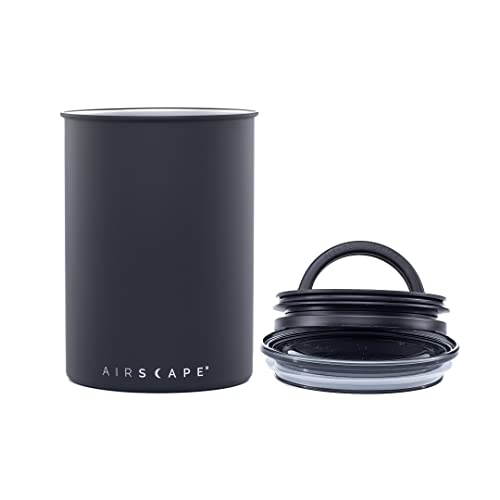
Best overall: Planetary Design Airscape
The Airscape has been a staple recommendation for years because its mechanism is simple. After you fill the steel body, you press the inner lid down onto the surface of the beans and then twist the outer lid to lock it. The inner lid displaces the headspace air, so less oxygen sits above the beans than in an ordinary jar. Planetary Design lists two sizes on its own product page, a 250 g version that holds about half a pound of beans and a 500 g version that holds about one pound.
Who it suits: anyone who buys one standard 12 oz bag every one to two weeks and wants something that lives on the counter and works without batteries or pumps. The opaque steel blocks light completely, and there is nothing electronic to fail.
Pros: no moving electronics, full light blocking, easy to wash by hand, widely stocked in several sizes. Cons: the plunger lid only removes the air that sits above the beans, not the air between them. As you use up the beans, the inner lid has to travel farther down, so you must remember to press it each time. The opaque walls also hide how many beans are left, and you will learn to judge by weight or by the feel of the lid.
Ownership realities: the inner lid has a silicone seal that is the part most likely to wear. It lifts out for washing. Wash it by hand with mild soap, dry it fully, and do not let oils build up, since rancid residue is the most common reason a canister makes fresh beans taste flat.
Best for bulk buyers: Airscape Kilo
The Kilo is the same design in a larger body. Planetary Design’s collection page describes it as a way to store a larger quantity, while one retail listing says it can take around two and a half pounds of beans; those two descriptions do not match each other, so confirm the stated capacity for the exact listing you are buying. Roundups generally treat the Kilo as the answer for people who buy two-pound or kilo bags.
Who it suits: households that go through a big bag in two to three weeks, or small offices that share one grinder.
Pros: holds a whole large bag, same simple mechanism, opaque steel. Cons: a bigger canister means more headspace to purge as the level drops. If you drink slowly, a large vault with a few beans left in it is worse than a small one that stays nearly full. A good rule is to pick the size that you will empty in about two weeks, not the size of the biggest bag you can find on sale.
Best everyday lid: Airscape Steel One Touch Lid
This variant keeps the same steel body but changes how the lid works, so that one hand can close it. For people who open the canister twice a day, a small convenience like that decides whether you actually keep sealing it properly. A canister that is annoying to close ends up left open, and an open vault is only a decorative jar.
Who it suits: daily espresso or drip drinkers who fill a hopper from the canister each morning.
Pros: quick one-handed closing, same light-proof steel. Cons: the more moving parts in a lid, the more places for grounds and oils to collect. Brush the rim after each refill, and wipe the underside of the lid every week or two.
Best vacuum option: Fellow Atmos
The Atmos takes a different approach. Instead of pushing air out with a plunger, you twist the lid to run a small pump that lowers the internal pressure. According to review summaries, the pressure drops to roughly half an atmosphere, which cuts the oxygen on the beans by about half compared with sealing at normal pressure. It comes in three sizes, 0.4 L, 0.7 L and 1.2 L, which hold about six, ten to eleven, and sixteen ounces of beans respectively, and in steel or glass versions with manual or electric lids.
Who it suits: people with a special lot of beans, a slower drinking pace, or an interest in squeezing every extra week out of a pricey bag. The seal indicator tells you the vacuum is intact, which removes the guesswork that comes with a plunger lid.
Pros: strongest air removal of the group, seal indicator, three sizes. Cons: it costs noticeably more than the budget canisters, and vacuum storage also pulls some volatile aromatics out of freshly roasted coffee that is still degassing. Beans in their first few days after roasting are better left in a valve bag or a valve canister before you move them in.
Ownership realities: the vacuum seal depends on the gasket staying clean. If the lid stops pulling down firmly, check the gasket for a trapped bean fragment before deciding it has failed.
Best budget: Coffee Gator
The Coffee Gator is a stainless steel canister with a rubber-sealed lid, a one-way carbon dioxide valve, and a date dial on top so you can set the roast or opening date. It comes in 11 oz, 16 oz and 22 oz sizes, and the 16 oz version is commonly described as holding a full 16 oz of beans or around 13 oz of grounds.
Who it suits: first-time buyers, students, and anyone who wants steel and a seal for a modest outlay. The date dial is a more useful feature than it looks, because it prevents you from losing track of how old the beans are.
Pros: lowest cost of the group, steel body, date dial, valve. Cons: it does not remove air. The valve lets carbon dioxide escape but the oxygen already in the container stays. For beans you will finish within ten to fourteen days that is acceptable, but it is not the right tool for long-term storage.
Best for fresh roasts: Friis Coffee Vault
The Friis Coffee Vault is a steel canister with a gasket lid and a one-way valve, sold in roughly 12 oz and 16 oz sizes. It is built around the idea that beans straight from the roaster are still giving off gas, so the container should let that gas leave rather than building pressure inside.
Who it suits: buyers who order from local roasters and receive beans within a day or two of roasting, or home roasters who need somewhere to rest the beans for a few days without exposing them to light.
Pros: valve suited to degassing beans, opaque body, compact sizes. Cons: like the Coffee Gator, the valve handles outgoing gas but does not actively remove oxygen. It makes the most sense as a rest-and-store canister, and for longer storage some owners pair it with smaller airtight portions in the freezer, which is covered below.
Best with a bean window: Veken
The Veken canister comes in 16 oz and 22 oz sizes with a gasket lid, a valve, and a clear window that shows how many beans remain. Sources disagree on the exact bean capacity of the larger size, so read the listing before assuming it takes a full two-pound bag.
Who it suits: people who like to see at a glance when they need to reorder, and anyone who keeps the canister inside a closed cupboard where light is not a concern.
Pros: bean-level window, valve, budget cost. Cons: any window lets in some light. In a cupboard this is not a problem, but on a sunny counter the window works against the whole reason for owning an opaque vault. Place it away from windows and bright kitchen lights.
How to choose a vault with numbers
Three numbers decide the right canister: how many ounces you drink per week, how many weeks the beans stay good, and how much of the canister you fill.
- Weekly use. A person drinking two cups a day at about 18 g of beans per cup uses roughly 250 g, or just over 8 oz, per week. A pair of drinkers uses double that.
- Target storage window. Most roasters suggest finishing beans within two to four weeks of the roast date for the best flavor. That means a solo drinker needs space for 8 to 16 oz, and a couple needs 16 to 32 oz.
- Fill level. Aim to keep the canister at least two-thirds full. More headspace means more oxygen sitting above the beans.
A worked example: a couple using 36 g of beans a day goes through 252 g per week, or about 9 oz. A 16 oz canister gives them under two weeks per fill, which is ideal for fresh flavor, and a 22 oz or kilo-class canister would stay half-empty for most of its cycle. The same couple buying two-pound bags at a discount is better off splitting the bag between two 16 oz vaults and keeping one sealed until the first is empty.
Decision matrix by situation
| Your situation | Best match | Why |
|---|---|---|
| One drinker, one 12 oz bag per two weeks | Airscape 500 g or Atmos 0.7 L | Fills to the right level and stays nearly full |
| Couple, two cups each a day | Airscape classic or Coffee Gator 22 oz | Roughly two weeks per fill without large headspace |
| Buy kilo bags to save money | Airscape Kilo, or two smaller vaults | Keeps portions sealed until needed |
| Beans bought within days of roast | Friis Coffee Vault or Veken | One-way valve lets gas leave |
| Rare or expensive lots, slow pace | Fellow Atmos | Vacuum removes the most oxygen |
| Tight budget | Coffee Gator | Steel, seal and date dial at the lowest cost |
What wears out and what to avoid
Every vault has one wear item, and knowing which saves frustration.
- Silicone gaskets harden and flatten over a year or two of daily use. Replacement gaskets are inexpensive for most brands, so check availability before you buy.
- Coffee oils build on the inner walls and turn rancid, transferring a stale taste to fresh beans. Wash the canister with warm soapy water every month or after each empty cycle, and dry it completely before refilling.
- Clear and glass bodies look attractive but need a dark cupboard. Light degrades roasted coffee quickly, so a clear jar on a bright counter undermines the point of airtight storage.
- Scented cleaners leave residue that coffee absorbs. Use unscented soap and rinse thoroughly.
Common mistakes include keeping the canister next to the stove or the espresso machine, where heat cycles accelerate staling; storing ground coffee for weeks, since grounds lose aroma far faster than whole beans; and leaving the original bag inside the vault, which defeats the seal.
Should you freeze beans instead?
Freezing is a legitimate way to extend life if done right, and it complements a vault rather than replacing it. Split a large bag into portions you will use within one to two weeks, seal each in an airtight bag or small canister, and freeze them. Take a portion out only when you need it, let it come to room temperature before opening so condensation does not form on the beans, and do not refreeze. A vault then holds only the current week’s supply. This approach is most useful for people who buy specialty lots in bulk or who are away for long stretches.
Frequently Asked Questions
Is a vacuum canister really better than a plunger-style canister?
A vacuum canister such as the Fellow Atmos removes more of the air inside, so there is less oxygen left to stale the beans. A plunger design like the Airscape removes the air above the beans and is easier to use. For beans you finish within two to three weeks, the difference in flavor is small, and the simpler one is the one you will actually seal every time.
How long do beans stay fresh in an airtight canister?
Whole beans taste best within about two to four weeks of the roast date, even when stored well. A good vault slows the decline but does not stop it. Dark roasts show staling differently because their oils sit on the surface and oxidize sooner.
Should I keep the beans in the fridge?
No. A refrigerator is humid and full of strong odors, and coffee readily absorbs both. If you need long storage, portion the beans and freeze them in sealed containers instead, and thaw each portion unopened.
Can I store ground coffee in a bean vault?
Yes, but ground coffee goes stale much faster because far more surface area is exposed to air. Grind only what you need for the next day or two if you can. If you buy pre-ground coffee, choose a smaller canister and finish it quickly.
Do I need a canister with a CO2 valve?
It helps for beans that are only days from roasting, because they release a lot of gas and a sealed container with no outlet can trap it. For beans that are already a week or two past roasting, a valve matters far less than keeping out light and air.
How often should I clean the canister?
Wash it with unscented soap once a month, or whenever you finish a batch before refilling. Dry it completely, since trapped moisture is worse for beans than oxygen.





Write Your Review
No reviews yet. Be the first to share your experience!