

Key takeaways
- Burrs. Steel burrs typically last for hundreds of kilograms of coffee. Signs that burrs need replacing include longer grind times for the same dose and a bitter, uneven taste.
- Oils and fines. Coffee oils build up in the chute and burr chamber. Brush out the grinder weekly and run a grinder cleaning tablet every month or two.
- Plastic parts. Hoppers and catch bins crack over time. Check whether replacements are sold separately; Baratza and Fellow list parts.
- Motor and gears. DC motors are durable; gear or capacitor failures are rare but harder to fix on sealed units.
- Static. Dry weather causes static cling; a few drops of water on the beans (the Ross droplet technique) helps.
The best electric burr grinder for most people in 2026 is the Baratza Encore ESP, because its 40 mm steel conical burrs cover both espresso and filter coffee, it has 40 grind settings split into fine and coarse ranges, and Baratza designs its grinders to be repaired rather than replaced. If you only brew filter coffee, the Fellow Ode Gen 2 is the sharper tool, and if you want a quiet stepless grinder dedicated to espresso, the Eureka Mignon Silenzio is the one to compare.
A burr grinder crushes beans between two rotating abrasive surfaces instead of chopping them with a spinning blade, so particles come out far closer in size. That matters because extraction is a function of particle size: fines over-extract and taste bitter while boulders under-extract and taste sour. In practice, the grinder is the single piece of equipment that most changes how good home coffee tastes, and in espresso it matters even more than the machine. This guide covers seven real, current electric burr grinders, compares their burrs, settings, hoppers and noise, and explains which one suits which brewing method.
Our top picks


As an Amazon Associate we earn from qualifying purchases at no extra cost to you.
Quick comparison of the seven picks
| Grinder | Best for | Burr type and size | Adjustment | Hopper | Espresso capable? |
|---|---|---|---|---|---|
| Baratza Encore ESP | Best overall, entry espresso plus filter | 40 mm steel conical | 40 settings (20 fine micro-steps, 20 coarse macro-steps) | About 227-300 g (listings vary) | Yes, entry level |
| Eureka Mignon Silenzio | Quiet, dedicated espresso | 50 mm flat steel | Stepless | 300 g | Yes, strong |
| Breville Smart Grinder Pro | Convenience and value, wide range | Steel conical | 60 settings | About 16-18 oz | Yes |
| Fellow Opus | All-purpose, budget-friendly | 40 mm steel conical | 41 steps plus micro adjust | 110 g | Limited, coarse side stronger |
| Fellow Ode Gen 2 | Filter and pour-over | 64 mm flat steel | 31 steps (11 numbered) | 100 g | No |
| Baratza Virtuoso+ | Filter brewing, upgrade from entry grinders | 40 mm conical | 40 settings | 225 g | No |
| OXO Brew Conical Burr | Budget everyday filter | 40 mm stainless conical | 15 main settings (micro steps vary by listing) | About 1 lb | No |
Specifications come from manufacturer pages and major retailer spec tables. Where sources conflict (the Encore ESP hopper size and the OXO micro-adjustments, for example), the table shows a range or hedges rather than picking a number. Prices are given as tiers instead of figures: the OXO and Opus sit at the budget end, the Encore ESP, Virtuoso+ and Breville in the mid range, and the Ode Gen 2 and Eureka Mignon Silenzio at the upper-middle end.
Best overall: Baratza Encore ESP
The Encore ESP is a variation of Baratza’s long-running Encore, a grinder with a reputation for being easy to repair. It uses 40 mm hardened M2 steel conical burrs, a DC motor and a burr speed of about 550 rpm. Settings 1 to 20 are micro-steps intended for espresso, and settings 21 to 40 are macro-steps intended for filter brewing, so a single grinder can switch between a fine espresso grind and a pour-over without feeling like a compromise on either side. Retailers list power at about 70 W, a weight near 7 pounds and a grounds bin of roughly 120 to 140 g.
The Encore ESP is not a perfect espresso grinder. Reviewers note that dedicated espresso users may eventually want finer adjustment control, since the spacing between steps is larger than on a stepless grinder, and the hopper size appears differently on different listings (between 8 and about 10.6 oz).
Who it suits: beginners who want one grinder for both espresso and drip or pour-over, and anyone who values being able to buy replacement burrs and parts. Trade-offs: no stepless adjustment, plastic body, and noticeable noise compared with the Silenzio.
Best for espresso: Eureka Mignon Silenzio
The Mignon Silenzio is a compact Italian grinder with 50 mm flat steel burrs, stepless adjustment and a 300 g hopper. The motor runs at about 1350 rpm, and the grinder takes roughly 12 seconds to grind an 18 g dose. Eureka’s Silent Technology adds insulation and damping to cut noise, and the ACE system is designed to reduce clumping and static. The lower burr is adjusted, so the grind setting stays put when you open the grinder to clean it. An analog timer from 1 to 14 seconds controls dose, and a manual mode lets you hold the button.
Some retailers now sell a newer Silenzio 55 with 55 mm burrs, so check which version is on offer. The step up to the Mignon Specialita gives 55 mm flat burrs, a touchscreen with two programmable doses and a slightly faster grind time of about 9 to 12 seconds for an 18 to 20 g dose.
Who it suits: espresso drinkers who want quiet, precise, repeatable doses and are comfortable with a dedicated espresso grinder. Trade-offs: it is not designed for coarse filter brewing as its main job, there is no fine-tuned display, and there is no single-dose hopper design, so beans sit in the hopper.
Best value all-rounder: Breville Smart Grinder Pro (BCG820)
The Smart Grinder Pro offers 60 grind settings, an LCD that shows your dose, and Dosing IQ, which adjusts grind time in 0.2-second increments. The hopper holds about 16 to 18 oz depending on the listing, power is listed at 165 W, and the grinder includes portafilter cradles for 50 and 54 mm baskets as well as a container for filter coffee. The adjustable top burr allows a finer or coarser range than the stock numbered settings.
It is one of the best sellers because it covers so much ground, from espresso to French press, in a single machine. The trade-off is that the plastic construction and a number of moving parts increase wear compared with an all-metal grinder. The detents on the dial are fine, but the grind retention in the chute can be noticeable.
Who it suits: a household that brews with multiple methods and wants a grinder that can be set and forgotten. Trade-offs: some retention, plastic construction, and noise on the louder side.
Best budget all-purpose: Fellow Opus
The Opus is a conical burr grinder meant to span espresso to cold brew at a lower price. It has 40 mm stainless steel conical burrs with six blades, 41 stepped adjustments plus an internal micro-adjustment ring, a 110 g hopper and a 100 g catch cup. A 6 Nm motor turns the burrs at about 350 rpm, and the timer gives 30, 60 or 90 seconds with one, two or three presses. The grinder weighs about 1.8 kg and measures about 210 by 129 by 268 mm. Setting 1.0 sits at about 230 microns according to one reviewer, so the finest espresso settings leave little margin for light roasts.
Who it suits: cost-conscious buyers who brew filter coffee most days and make espresso occasionally on forgiving beans. Trade-offs: the plastic body, a hopper that holds only one or two doses of beans, and a lower ceiling for dialing in light-roast espresso.
Best for pour-over: Fellow Ode Gen 2
The Ode Gen 2 is a filter-only grinder with 64 mm stainless steel flat burrs, 31 settings across 11 numbered positions, a 100 g hopper and a Smart Speed PID motor that holds burrs at about 1400 rpm. Its two-stage geometry bottoms out around 250 to 300 microns, which is too coarse for espresso, so it is intentionally a brew grinder. The aluminum body weighs about 4.6 kg, and the US version is rated at 140 W. An anti-static ionizer and a redesigned catch-cup area reduce mess, and a single-dose workflow keeps retention low.
Flat burrs produce a more bimodal particle distribution than conical burrs, which tends to highlight clarity and brightness in light roasts. If you mostly drink pour-over or batch brew from single-origin beans, it is among the best choices.
Who it suits: pour-over and filter enthusiasts who want clarity. Trade-offs: no espresso capability, a smaller hopper, and a price that is higher than similarly capable conical grinders.
Best step-up filter grinder: Baratza Virtuoso+
The Virtuoso+ uses 40 mm conical burrs with 40 settings spanning roughly 200 to 1200 microns, a 225 g hopper, a 140 g grounds bin and a digital timer that can be programmed to a tenth of a second, with a pulse button. Its burrs turn at around 550 rpm. Because its finest setting is not designed for espresso, it is a filter grinder and is described by reviewers as a “filter grinder, not an espresso one.”
It is a solid grinder for drip, pour-over and French press, and Baratza sells replacement burrs, so it can be maintained for many years.
Who it suits: people who brew filter coffee and want a repairable grinder with a timer. Trade-offs: no espresso capability and plastic body.
Best budget everyday grinder: OXO Brew Conical Burr
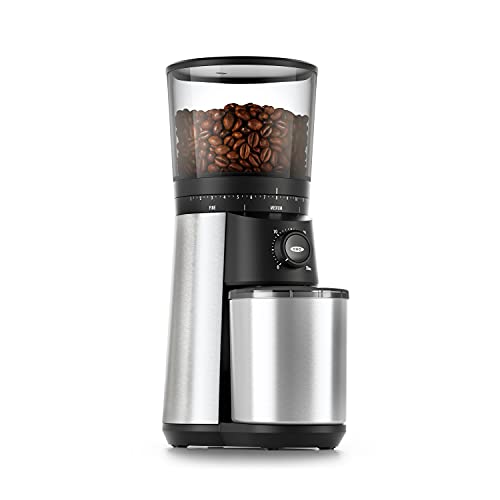
The OXO Brew Conical Burr Grinder uses 40 mm stainless steel conical burrs, 15 main settings (some listings mention micro-adjustments; others do not), and a hopper of about one pound. It has a one-touch start timer and a static-fighting container. It is the least expensive grinder on this list, and for daily drip, French press and pour-over it is often adequate.
Its limitation is range: it is not designed to make a true espresso grind, and the step size between settings is coarse compared with Baratza or Eureka grinders.
Who it suits: beginners who want a real burr grinder at an entry-level price. Trade-offs: modest build quality, coarser step increments and no espresso support.
How to choose: a decision matrix
| Your situation | Best match | Why |
|---|---|---|
| You brew both espresso and filter coffee | Baratza Encore ESP or Breville Smart Grinder Pro | Fine and coarse ranges in one unit |
| You only make espresso | Eureka Mignon Silenzio | Stepless adjustment and quiet operation |
| You only make pour-over or batch brew | Fellow Ode Gen 2 or Baratza Virtuoso+ | Filter-tuned burr geometry |
| You want the cheapest real burr grinder | OXO Brew Conical or Fellow Opus | Entry-level price, conical burrs |
| You switch beans often | Ode Gen 2 (single dose) | Low retention workflow |
| You care about repairability | Baratza Encore ESP or Virtuoso+ | Replacement parts widely available |
The numbers that actually matter
Burr size and grind speed
Bigger burrs cut faster at lower rpm. A 40 mm conical at 550 rpm needs about 20 to 30 seconds for an 18 g espresso dose, while a 50 mm flat at 1350 rpm does it in about 12 seconds. Faster grinding generates less heat in the beans, but the difference in a home setting is small.
Step size and why stepless matters for espresso
Espresso is sensitive: a change of a few microns can shift shot time by five seconds or more. A stepped grinder with 40 settings across 200 to 1200 microns has steps of about 25 microns on average, but espresso steps are smaller on grinders like the Encore ESP, where settings 1 to 20 are micro-steps. A stepless grinder like the Silenzio removes the constraint entirely, which is why many espresso drinkers prefer it.
Worked example: retention and waste
If a grinder retains 1 g of coffee each time and you grind 18 g doses, you are changing about 5.5 percent of the dose each time you switch beans. Over a 250 g bag that is about 14 doses, so 14 g of beans (roughly one extra dose) ends up mixed across settings. Single-dose workflows and the Ode’s low-retention design reduce that loss.
Ownership realities: what wears first
- Burrs. Steel burrs typically last for hundreds of kilograms of coffee. Signs that burrs need replacing include longer grind times for the same dose and a bitter, uneven taste.
- Oils and fines. Coffee oils build up in the chute and burr chamber. Brush out the grinder weekly and run a grinder cleaning tablet every month or two.
- Plastic parts. Hoppers and catch bins crack over time. Check whether replacements are sold separately; Baratza and Fellow list parts.
- Motor and gears. DC motors are durable; gear or capacitor failures are rare but harder to fix on sealed units.
- Static. Dry weather causes static cling; a few drops of water on the beans (the Ross droplet technique) helps.
Common mistakes with electric burr grinders
- Buying a filter grinder for espresso. Grinders such as the Ode Gen 2 and Virtuoso+ cannot go fine enough.
- Changing grind size while the grinder is off. On many conical grinders, adjust only while the motor is running to avoid jamming.
- Overfilling the hopper. Leaving a week of beans in the hopper lets them go stale.
- Never cleaning. Rancid oils flavor every dose.
- Judging by price alone. A grinder that fits your brewing method will outperform a pricier one that doesn’t.
Matching grind size to brew method
Every brew method has a typical particle range, and knowing it tells you whether a grinder can do your job. The figures below are common starting points from the specialty coffee community, not rules, and they shift with roast level and water temperature.
| Brew method | Typical particle size | Texture | Grinders on this list that reach it |
|---|---|---|---|
| Espresso | About 200-350 microns | Fine, like powdered sugar with some grit | Encore ESP, Smart Grinder Pro, Mignon Silenzio, Opus (coarse end of range) |
| Moka pot | About 350-500 microns | Fine to medium-fine | Encore ESP, Smart Grinder Pro, Silenzio, Opus |
| Pour-over and drip | About 600-900 microns | Medium, like sand | All seven |
| French press | About 900-1200 microns | Coarse, like sea salt | All except where the hopper limits batch size |
| Cold brew | About 1000-1400 microns | Extra coarse | Virtuoso+, Opus, Smart Grinder Pro, Encore ESP |
The key lesson is that the espresso row is the narrow, demanding one. A grinder that reaches 250 microns on paper may still jump from 230 to 280 between two adjacent steps, which is the difference between a choking shot and a gushing one. If espresso is your main interest, step size matters more than the top-end coarse range.
Noise, retention and counter fit
Three practical traits decide whether you enjoy a grinder day after day. Noise first: grinders with fast motors and thin plastic housings can be loud enough to wake a household, which is why the Silenzio markets its insulation. Retention second: some of the coffee you grind stays in the chute or burr chamber, so the first dose of a new bean is partly the previous bean. Counter fit third: the Breville and OXO have large hoppers and stand taller than the Opus or Encore ESP, so check the clearance under your cabinets before buying.
A simple habit helps with retention on any of these machines. Before a dose you care about, grind and discard one or two grams, which flushes the old coffee out of the chute. Tapping the side of the catch cup or using a small puffer bulb removes stuck grounds and keeps flavors from carrying over between beans.
Frequently Asked Questions
Are conical or flat burrs better?
Neither is universally better. Conical burrs tend to give a rounder, heavier body and are easier to build at lower prices. Flat burrs tend to produce more clarity and brightness. Choose based on the coffee you like and the brewing method.
Can one grinder do both espresso and drip well?
Yes, but with compromises. The Baratza Encore ESP and Breville Smart Grinder Pro are designed for this. Specialist grinders perform better in their niche.
How often should I clean my grinder?
Brush it out weekly and deep clean monthly or every two months, depending on how oily your beans are. Dark roasts leave more residue.
How long do grinder burrs last?
Steel burrs commonly last several years of home use; manufacturers often quote hundreds of kilograms. Replace them if your grind gets inconsistent or you need to keep moving to finer settings to compensate.
Is a single-dose grinder worth it?
If you switch beans often or want to minimize stale coffee, yes. If you drink one coffee for weeks, a hopper grinder is fine.
Do I need a more expensive grinder than my espresso machine?
Often, yes. Many coffee professionals recommend spending at least as much on the grinder as on an entry-level machine, because a better grinder improves every cup.


Write Your Review
No reviews yet. Be the first to share your experience!