

Key takeaways
- Kingrinder K6 review: 48 mm burr, 240 clicks, starting grind settings, strengths and limits, and how it compares with the K7 and Timemore.
The KINGrinder K6 is a 48 mm-burr hand grinder with an external adjustment ring, built for people who want true espresso-capable steps in the mid-range of hand grinders. It suits home brewers who switch between espresso, moka pot, pour-over and French press and would rather turn a crank than buy an electric grinder. It does not suit anyone who wants a loading hopper, a very fast grind for a big batch, or the largest burr among hand grinders. Here is what the K6 does well, where it makes you work, and which listed alternatives (the K7 and the Timemore Chestnut family) deserve a look.
Quick Verdict
- Best for: a single home brewer who wants an espresso-capable hand grinder that also covers filter and press grinds
- Strength: 48 mm seven-edge stainless burr with 60 clicks per rotation, about 16 microns per click, adjusted from the outside
- Limitation: roughly 30-35 g capacity and a workout for the wrist, with about 40 seconds reported for an 18 g espresso dose
- Watch for: no rubber pad on the catch cup, a calibration dial that is awkward to re-zero after disassembly, and user reports about bearing corrosion
- Step-up option: the K7 offers a larger 53 mm burr and a magnetic catch cup
Key Specs
| Spec | KINGrinder K6 |
|---|---|
| Burr | 48 mm, seven-edge conical, SUS420 stainless steel |
| Adjustment | External ring; 60 clicks per rotation, up to 4 rotations (240 clicks total) |
| Step size | About 16 microns per click |
| Capacity | 30 g per the listing; 30-35 g per reviewers (confirm on listing) |
| Weight | About 630 g per the listing (other retailers cite about 650 g) |
| Body | Anodized aluminum with a rubber grip band |
| Handle | Wooden knob; the listing in this group is the straight-handle version |
| Drive shaft | 6.35 mm (1/4 inch) hex, drill compatible |
| Catch cup | Large, deep, screw-on |
| Reported retention | About 0.1 g in one review |
Who It Is For (and Who Should Skip It)
The K6 is a good fit for a person who brews one or two cups at a time and likes to switch methods: a morning espresso, an afternoon pour-over and a weekend French press. The external adjustment ring makes changes quick, and the large number of steps allows fine dialing in for espresso. It also helps that the grinder is relatively light for a metal hand grinder, which suits travel and small kitchens.
It is a poor match for several buyers. Anyone grinding for four or more people at a time will find a 30-35 g capacity limiting and the grinding time tiring. People who want an electric grinder should look elsewhere. Buyers who value the most even filter grind possible should look at the K7, which uses a larger burr, and those who want a lighter pack-and-go option may prefer a smaller Timemore model. Finally, if you dislike maintenance steps, note that the K6 is more demanding to re-zero after disassembly than some rivals.
Choosing a starting grind
The click numbers reviewers quote count from the zero point, where the burrs just touch. Because that point depends on how the grinder was assembled, the same click number can produce different results on two units. The practical routine is to find your zero, then work from a starting range and adjust by a few clicks at a time.
| Brew method | Reviewer starting range (clicks) |
|---|---|
| Espresso | 30-60 |
| Moka pot | 60-70 |
| Pour-over | 80-100 |
| French press | 100-120 |
For espresso, change one or two clicks per shot and note the shot time. For filter coffee, taste the cup and move in larger steps. Keep notes on each bean, because a fresh roast and an older one will not share the same setting.
What It Does Well
External adjustment with fine steps. Moving the ring changes the grind setting without opening the grinder, and with about 16 microns between clicks you can tune an espresso shot in small increments. A sample of reviewer starting points puts espresso at roughly 30-60 clicks, moka pot at 60-70, pour-over at 80-100 and French press at 100-120. Treat those as starting points, because your beans, roast and zero point will shift the numbers.
Reasonable speed. One reviewer reports around 40 seconds for an 18 g espresso dose and about 30 seconds for 15 g of pour-over coffee. That is workable for one or two cups, though it is still a hand grinder.
Low retention. A reported retention of about 0.1 g means very little of the previous dose lingers to mix with the next, which matters for single-dosing and for changing beans.
Solid build for the weight. The anodized aluminum body with a rubber grip band feels sturdy, and at about 630 g the K6 is lighter than several comparable models, according to one reviewer.
Drill compatibility. The 6.35 mm hex drive shaft lets you attach a drill to take the effort out of grinding, though a reviewer cautions that it needs a drill with enough torque.
Comfort for a hand grinder. The rubber grip band and the wooden knob give you something secure to hold while you turn, and the weight sits low in the body. The grinder is not effortless, since an 18 g espresso dose takes about 40 seconds, but it is workable for a daily routine and the drill option exists for anyone who finds it tiring.
A range of brew methods from one tool. Having 240 clicks to work with means a single grinder can cover espresso at the fine end and French press at the coarse end. That makes it a sensible single-grinder purchase for someone who has not settled on one method.
Where It Falls Short
Re-zeroing is awkward. After you disassemble the grinder, the calibration dial does not return to zero easily, and reassembling the U-clip takes patience. If you plan to clean the burrs often, expect to re-find your setting.
The catch cup is basic. It is large and deep, but it screws on and has no rubber pad on the bottom, so a reviewer notes it may scratch easily on a hard surface.
Possible bearing corrosion. A user-reported concern says the bearings may rust more easily than on some rivals. It is not a verified defect, but it is a reason to keep the grinder dry and avoid washing the internals with water.
Capacity is modest. The listing gives 30 g and most reviewers cite 30-35 g. That is fine for single cups but limits batch brewing.
Coarse-end behavior. A comparison of the K7 notes that the K6’s coarser settings can feel less predictable, and that the K6 offers more total settings than the K7 mostly at the extremes. If you brew mostly filter coffee, the K7 is the better design.
How It Compares
| Grinder | Burr | Adjustment | Capacity | Best for |
|---|---|---|---|---|
| KINGrinder K6 | 48 mm, seven-edge | 60 clicks per rotation, about 16 microns per click | 30-35 g | Espresso plus filter from one grinder |
| KINGrinder K7 | 53 mm, seven-edge | 100 settings, about 15 microns per click | 30-35 g | Filter-focused brewers, easier disassembly |
| Timemore Chestnut C3 ESP | 38 mm, S2C stainless | 30 clicks per revolution, about 0.0233 mm per click | About 25 g | Compact travel and espresso |
| Timemore C5 ESP Pro | 42 mm S2C-042-III | About 50 clicks per rotation, 15 microns per click | About 25-30 g | Smaller, finer-stepped espresso grinder |
The K6’s 48 mm burr is larger than either Timemore burr but smaller than the K7’s 53 mm burr. The Timemore grinders are smaller and lighter, while the K7 offers the best filter-grind consistency of the group according to the reviewer who compared it with the K6.
How to read the table: step size is the part that matters most for espresso, because shot time changes quickly with small adjustments. The K6, the K7 and the C5 ESP Pro all sit around 15-16 microns per click, which is fine enough to dial in a shot. The standard C3S and C5 Pro steps are coarser, which is perfectly adequate for filter coffee but less forgiving for espresso. Capacity limits matter more for batch brewing: a 25-35 g hopper covers one or two cups, so anyone brewing larger volumes will refill the grinder or grind in two passes.
Handle and body choices also matter. The K6 is a straight-handle grinder with a wooden knob in the listing used here, the K7 in this group has a bent handle, and the Timemore grinders are smaller in the hand. If wrist comfort is a concern, think about how long you will spend grinding each day and whether a drill adapter is worth buying.
Alternatives Worth Considering
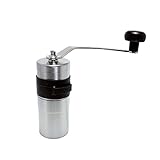
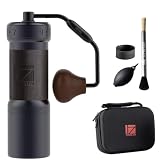
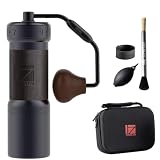
KINGrinder K6 (silver, straight handle) – the grinder reviewed above
As an Amazon Associate we earn from qualifying purchases at no extra cost to you.

This listing is the K6 in silver with a straight handle and a stainless burr. The listing text says it supports grind settings for various brewing methods. It is the reference model for this review, so the specifications above apply. Confirm the capacity and handle type on the product page.
KINGrinder K7 (iron gray, bent handle) – when filter grind quality is the priority

The K7 steps up to a 53 mm seven-edge burr, 100 settings at about 15 microns per click and a magnetic catch cup. A reviewer reports better grind consistency than the K6, though the catch cup connection is less stable than the K6’s threaded design. It suits pour-over fans first and espresso second.
Timemore Chestnut C3 ESP – for a compact espresso-capable grinder

A 38 mm S2C stainless burr with fine steps of about 0.0233 mm per click and 30 clicks per revolution. It is smaller than the K6, so it is easier to carry and store, and the capacity is around 25 g. Confirm the weight and capacity on the listing, since sources vary.
Timemore C5 Pro – when you want a 42 mm burr
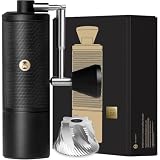
The listing describes a 30 g capacity, a CNC stainless conical burr and an internal adjustment. A reference source lists a 42 mm burr with 48 clicks per revolution for the C5 Pro. It suits buyers who want a bit more burr than the C3 without the K6’s size.
Timemore C5 ESP Pro – for finer steps on a 42 mm burr
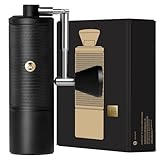
This C5 variant pairs the S2C-042-III conical burr with a listed 0.015 mm adjustment precision, which is the same fineness of step as the K6’s roughly 16 microns. It is the Timemore for espresso-focused brewers who want precise steps. Confirm weight and handle details on the page.
Timemore Chestnut C3S – a coarser-stepped, simpler grinder

The C3S uses a 38 mm S2C stainless burr. A reference source lists the C3S Pro at 12 clicks per revolution and 0.0833 mm per click, which is coarser stepping than the ESP versions and suits filter coffee more than espresso. Confirm the exact variant on the listing.
Questions
Can the KINGrinder K6 grind for espresso?
Yes. The external ring has about 16 microns between clicks, and reviewers suggest starting around 30-60 clicks for espresso. You will still need to dial in for your beans.
How many clicks should I use for pour-over?
Reviewers cite roughly 80-100 clicks as a starting point, with French press at about 100-120. Move one or two clicks at a time and taste.
How much coffee does the K6 hold?
The listing says 30 g, while reviewers and retailers cite 30-35 g. That covers one or two cups of coffee.
Can I use a drill with the K6?
The drive shaft is a 6.35 mm hex, which suits a drill, but a reviewer notes the drill needs enough torque. Start slowly.
Should I choose the K6 or the K7?
Choose the K7 for pour-over and easier disassembly with its larger 53 mm burr. Choose the K6 for its larger number of total settings, especially if you also brew espresso.
How do I keep the K6 in good condition?
Brush out the burrs, avoid water on the internals and re-check your zero point after cleaning. A reviewer reports concerns about bearing corrosion, so keep the grinder dry.
Update History
- October 21, 2026 – Initial publication; specifications checked against manufacturer documentation where available.
- Check the product page for current specifications and availability before buying.
Sources
- Manufacturer and retailer product pages for the KINGrinder K6 and K7 and the Timemore Chestnut grinders
- Retailer listing titles and specification fields for the listed models
- Independent grinder reviews and comparison tables covering the K6, K7 and Timemore Chestnut range


Write Your Review
No reviews yet. Be the first to share your experience!